
First deposit bonus casinos in Australia: why a definitive shortlist does not exist
A reader typing “best first deposit bonus casino Australia” expects a ranked list. We can’t honestly hand one over, and the reason is the one the topic sits on top of: no online casino game offered to anyone in Australia carries a licence, anywhere in the country. The Interactive Gambling Act 2001 prohibits it. The page below is what we have instead — the law that closes the door, the regulator’s record of who has been knocking on it, the payment channels that decide whether a transfer even gets there, the safer routes that do exist inside the rules, and the ACMA’s own list of the brands that have already had a formal warning for trying. First deposit bonus casinos in Australia — More on this topic at casino table games .

Current as of 29 October 2026 · verified against the Australian Communications and Media Authority register of formal warnings and blocking requests.
- The legal shelf: what the Interactive Gambling Act 2001 actually says
- How the ACMA enforces: blocking, warnings, the running total
- The payments shelf: how the transfer gets there, or doesn’t
- The responsible-gaming shelf: BetStop, the helpline, what offshore cannot offer
- The brands the ACMA has named, side by side
- The overview shelf: what a reader is actually choosing between
- What an Australian reader can lawfully use
- Frequently asked questions
The legal shelf: what the Interactive Gambling Act 2001 actually says
The Interactive Gambling Act 2001, the federal statute that governs online gambling in Australia, is built on a single rule. A person or a company must not provide a prohibited interactive gambling service to a customer who is physically present in Australia. The prohibited category is not a vague one. Online casino games, online pokies and in-play betting sit inside it. Wagering on a sporting event or a race placed before the event, lotteries and keno sit outside it. The distinction matters because the second group is the part the Northern Territory Racing and Wagering Commission (NTRWC) licenses in practice — Sportsbet, Bet365 and Ladbrokes among 52 online bookmakers. Online casino is the part no state or territory will license. A licence a site displays from Curaçao or from Anjouan changes nothing about an Australian customer’s position. The IGA targets the provider, not the player, so the punters themselves are not prosecuted, but the site itself is breaking Australian law from inside Australia.
The IGA was strengthened in 2017 and amended again in 2023. The credit-card ban for licensed wagering came in on 11 June 2024, with penalties of up to A$247,500 for operators that accept one. The Interactive Gambling Amendment (Gambling Reform) Bill 2026 passed Parliament on 19 August 2026; its advertising and inducement measures commence 1 January 2027, so they are law with a start date, not yet in force on a 2026 page. The 2017 amendment is what gave the ACMA its present teeth: it can investigate, issue formal warnings, and direct Australian internet service providers to block illegal sites at the network level.

What this means in plain words. Any “best first deposit bonus casino” list aimed at an Australian reader would, by construction, recommend a brand that the ACMA has either already warned or could warn tomorrow. The page below does not assemble that list, because assembling it is the opposite of the editorial job. The shelf that does the work here is the ACMA’s own. The brands named in the table further down are the ACMA’s, in the ACMA’s order, with the ACMA’s dates — not a ranking and not a recommendation.
How the ACMA enforces: blocking, warnings, the running total
The ACMA’s enforcement record is the cleanest window into the shape of the illegal market. By the ACMA’s own count as reported in June 2026, a total of 1,751 illegal gambling and affiliate marketing websites had been blocked since the first blocking request in November 2019. The round reported on 26 June 2026 alone added another 12 to the list: 7Signs, ChromaBet, Donbet, Duospin, Freshbet, Slots Gem, Jacks Club, Lucky Start, Pointsbetz, Spinrise, Vinyl Casino and Wildsino. More than 230 unlicensed gambling services had left the Australian market since enforcement was strengthened in 2017 — that is the cumulative effect of blocking, of formal warnings, and of operators deciding the cost of staying reachable from Australia is no longer worth it.
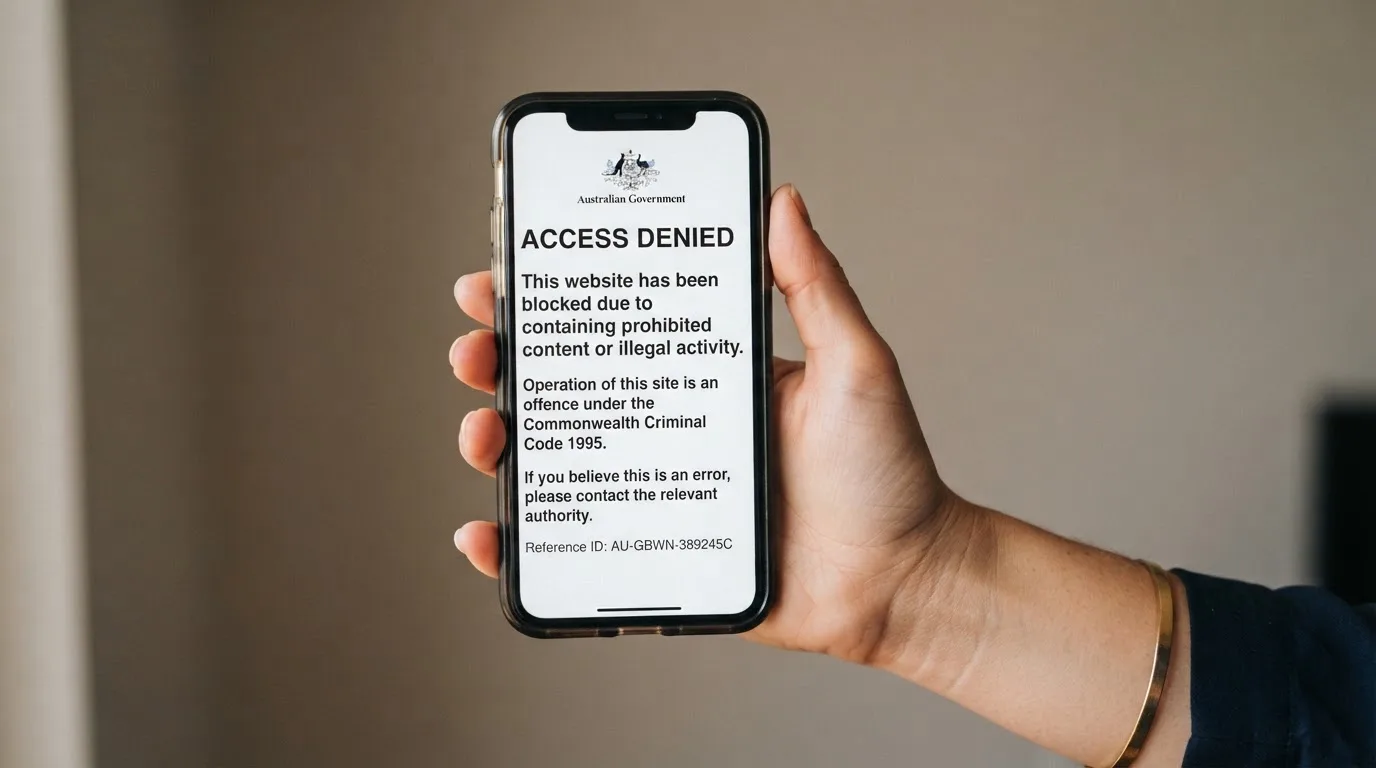
The arithmetic that matters to a reader is the running total against the running time. 1,751 sites blocked across the roughly six-and-a-half-year window from the first blocking request in November 2019 to June 2026 works out at an average somewhere in the range of 270 blocked sites per year, with the early years lower and the most recent years running well above that. That is a band, not a single figure — the rate has been uneven, and the ACMA publishes it as a cumulative total rather than as an annual rate. The point of stating it is to put a number on the trend this subject sits on: every year the rate of blocking has held or accelerated, the legal market has not been quietly expanding around it. Australians who want to gamble online are still being routed, by design, toward the licensed wagering side and away from casino games.
The ACMA’s other lever is the formal warning. A formal warning is a public notice that names the operator behind a brand and the law it has breached. The warnings are dated, they are searchable on the ACMA’s own site, and they accumulate in a way that lets a reader trace who owns what. Dama N.V. received a warning in May 2022 covering six casino brands: Bambet, Dazard, Level Up, Rocketplay, Wild Tornado and Cobra Casinos. Dama received further warnings over Woo Casino in March 2025 and Spirit Casino in May 2025. In July 2025 the ACMA warned Bamboo Media over Ignition Casino and Consolutetish S.R.L. over National Casino and Bizzo Casino — Bizzo had already been warned back in 2022, when it sat under TechSolutions. EOD Code SRL received a warning in February 2025 over Instant Casino. Ryker B.V. was warned in April 2026 over Jackbit and CasinOK. Sterplay Holding Ltd was warned in April 2025 over Casino Intense. Hollycorn N.V. was warned over Sky Crown and Blue Leo in September 2022. Pulsup Ltd was warned in March 2026 over Rocketplay. These are not all the warnings the ACMA has issued; they are the ones that sit on the brands this page is about.
H2 Gambling Capital’s 2025 report estimates Australians lose about A$3.9 billion a year to illegal gambling sites, and that the share of gambling going through legal channels fell from 74% in 2021 to 64%. The two numbers belong together. The licensed wagering market is not shrinking because players have stopped gambling; the share is being lost to offshore casino brands the IGA was written to suppress. The drop from 74% to 64% is the size of the gap the ACMA’s blocking programme is trying to close.
The payments shelf: how the transfer gets there, or doesn’t
A first deposit bonus, in any market, lives or dies on whether the deposit actually lands. In Australia, that question is settled before the bonus code is even typed. The credit-card ban in force for licensed wagering since 11 June 2024 applies to credit cards, to credit-related products and, by extension, to digital wallets linked to a credit account. The Reserve Bank of Australia’s July 2025 review proposes removing surcharges only on eftpos, Mastercard and Visa card transactions, explicitly leaving American Express outside the scope of the proposed surcharge ban — which matters because Amex’s three-party scheme means the surcharge an Australian merchant charges an Amex card is the merchant’s own margin, not a network pass-through.
For Australian bank-issued cards, the major banks have layered their own blocks on top. Westpac’s gambling block refuses authorisation of transactions registered under the merchant category code “Betting/Casino Gambling” on eligible personal credit and debit cards. ANZ’s gambling transaction block, activated in the ANZ app, also blocks gambling transactions made through a digital wallet such as Apple Pay on an eligible card. Once the ANZ block is on, removing it again requires a 48-hour waiting period, and the bank warns that not all gambling transactions will be blocked and some non-gambling transactions might be blocked in error. Commonwealth Bank’s gambling lock, applied in the CommBank app, blocks most gambling transactions on eligible cards — the bank makes the same “cannot guarantee” caveat. Apple itself does not charge fees for Apple Pay; any surcharge on a deposit is the merchant’s. Apple sets no transaction limits and no PIN requirements — those are set by the card issuer or the merchant, not by Apple.
The lawful deposit routes for licensed wagering are debit card, bank transfer, PayID/Osko and BPAY. PayID sits on Australia’s New Payments Platform, which became accessible to the public on 13 February 2018 and is owned by New Payments Platform Australia Ltd — thirteen shareholders including the Reserve Bank and the major banks. More than 25 million PayID identifiers had been registered as of April 2025, and the platform is available at over 100 Australian financial institutions. With Osko, a bank transfer between participating Australian banks arrives in under a minute, 24/7, addressed to either a BSB and account number or a PayID. Participants in the platform must keep monthly outages to no more than two minutes. In 2021 the ACCC authorised merging NPP Australia with BPAY and eftpos into a single company, Australian Payments Plus (AP+).
PayID’s practical edge for a player is that paying to a PayID shows the name of the account holder before the transfer is sent — AP+ warns that being asked to transfer to a PayID on an illegal gambling site almost certainly means a scam site. BPAY, the bill-payment service available at over 140 banks and used by over 95,000 businesses, is a different shape of payment: the payer enters a Biller Code and a Customer Reference Number. BPAY has operated since 18 November 1997 and is owned equally, via Cardlink Services Limited, by ANZ, Commonwealth Bank, National Australia Bank and Westpac.
AUSTRAC’s threshold-transaction-report rule, which requires reporting of transfers of A$10,000 or more, applies only to physical cash. Ordinary electronic bank transfers are not subject to that per-transaction reporting requirement, regardless of the amount sent. By the end of 2025, Apple Pay, Google Pay and Samsung Pay together accounted for around 45% of all card payments in Australia by number — so the question of whether a digital wallet deposit reaches an offshore casino is now as common as the question of whether a debit card does.
For a reader weighing the deposit question, the picture has three points. The first is that the bank-side blocks are voluntary — a player can usually turn them off, but turning them off is the moment the bank can no longer catch a problem transaction. The second is that the credit-card ban is statutory, so a credit card or a credit-linked wallet will simply be declined at the licensed operator. The third is that on an offshore casino, none of these protections run: the merchant category code may not even classify the transaction as gambling, the bank block may not be triggered, and the deposit lands in a jurisdiction that has no obligation to send it back.
The responsible-gaming shelf: BetStop, the helpline, what offshore cannot offer
The Australian answer to problem gambling on the legal side is layered. BetStop, the National Self-Exclusion Register, has been live since August 2023. Registering on BetStop binds every Australian-licensed online and phone wagering service to exclude the named person — the exclusion is enforceable across the licensed market, not per operator. The National Gambling Helpline, 1800 858 858, runs free, 24/7, with chat at Gambling Help Online. Both are part of the licensed market’s scaffolding.
An offshore casino is not connected to BetStop. A self-exclusion registered with a Curaçao-licensed brand has no force against an Anjouan-licensed brand, and no force against the next brand the same operator launches. A complaint about a refused withdrawal goes to the offshore regulator, if there is one with a complaint mechanism, and in practice there usually is not. The protection the reader is comparing to — the licensed bookmaker that has to honour an exclusion, the bank block that has to be activated, the dispute resolution that has to be available — does not travel with the deposit.
The legal minimum age for any gambling activity in Australia is 18. The age rule is the same whether the brand is licensed or not, but the licensed operator enforces it at sign-up; the offshore one may or may not.
The brands the ACMA has named, side by side
The comparison below is the ACMA’s, not ours. Each brand sits where it sits because the ACMA itself published a formal warning naming the operator behind it.
| Brand | ACMA action and date | Operator named by the ACMA | Subject support |
|---|---|---|---|
| RocketPlay | Formal warning, March 2026; earlier warning to Dama N.V., May 2022 | Pulsup Ltd | Listings note presence on affiliate tracking pages |
| Level Up Casino | Formal warning, May 2022 | Dama N.V. | Listings note presence on affiliate tracking pages |
| Woo Casino | Formal warning, March 2025 | Dama N.V. | — |
| Spirit Casino | Formal warning, May 2025 | Dama N.V. | — |
| National Casino | Formal warning, July 2025 | Consolutetish S.R.L. | Listed on ACMA register, AUSTRAC and BetStop monitoring surfaces |
| Bizzo Casino | Formal warning, July 2025; earlier warning, 2022 | Consolutetish S.R.L.; earlier TechSolutions | Listings note presence on affiliate tracking pages |
| Ignition Casino | Formal warning, July 2025 | Bamboo Media | — |
| Instant Casino | Formal warning, February 2025 | EOD Code SRL | Listed on e-wallet and PayID scam-alert surfaces |
| Jackbit | Formal warning, April 2026 | Ryker B.V. | — |
| Casino Intense | Formal warning, April 2025 | Sterplay Holding Ltd | Listed on AUSTRAC, BetStop and affiliate tracking surfaces |
| Sky Crown | Formal warning, September 2022 | Hollycorn N.V. | — |
Reading the table the way the ACMA’s record invites. Dama N.V. is the operator that appears most often — four entries, spread across 2022 and 2025, naming six brands in 2022 alone and two more in 2025. Consolutetish S.R.L. appears twice, both in July 2025, and one of those brands — Bizzo — had already been warned under a different owner four years earlier. Pulsup, EOD Code, Bamboo Media, Sterplay, Ryker and Hollycorn each appear once. The pattern matters because the ACMA’s warnings name the operating company, not just the brand, and the same operating company turning up under fresh brand names is the pattern the blocking programme is built to interrupt.
The “subject support” column reflects what the underlying sources say about each brand — and the column is empty where the sources have nothing to say. A dash in that column is not a denial; it is the source-side gap. Where the column is populated, the entry names what the listings show, not what the brand claims. Several brands sit on affiliate marketing pages that rank them by bonus size or by free spins count, and a few are flagged on payment-fraud alerts from the operators of PayID and from AUSTRAC. None of these listings tells a reader the brand is safe to use from Australia; what they tell a reader is what the surrounding commercial plumbing looks like.
RocketPlay
RocketPlay was named in the March 2026 warning to Pulsup Ltd. The May 2022 warning to Dama N.V. also named Rocketplay. The brand appears on affiliate tracking pages, which is the only support the listings record for it. The fact that the operator has changed since 2022 is itself the warning — a brand whose ownership has shifted once can shift again, and the Australian reader has no channel to be notified when it does.
Level Up Casino
Level Up was named in the May 2022 warning to Dama N.V. as one of the six brands bundled into a single notice. The ACMA’s action predates the more recent Dama warnings by three years, and the brand is still being indexed by affiliate listing pages. The 2022 warning is the one that says what the ACMA’s position is; the listing presence does not change that position.
Woo Casino
Woo Casino received a formal warning in March 2025 under Dama N.V., three years after the 2022 warning that covered the wider Dama group. The ACMA does not publish a separate warning for every brand each year; the recurrence is itself the message. Dama’s name on a brand in 2026 is the same regulatory shape it was in 2022.
Spirit Casino
Spirit Casino received a formal warning in May 2025 under Dama N.V. — the second of the two Dama warnings issued in 2025. The two-month gap with Woo Casino is not a coincidence: the ACMA had to issue a fresh notice because Spirit was not on the 2022 list. A new brand under an already-warned operator is the working pattern of this market.
National Casino
National Casino received a formal warning in July 2025 under Consolutetish S.R.L. Consolutetish was not previously named in the ACMA’s register; the warning is the regulator’s first published notice about this operator. The brand also appears on the ACMA’s own register, on AUSTRAC surfaces and on BetStop monitoring pages — a presence that reflects what those bodies log, not any endorsement.
Bizzo Casino
Bizzo Casino received a formal warning in July 2025 under Consolutetish S.R.L. — and a previous formal warning in 2022, when the brand sat under TechSolutions (CY) Group Limited and TechSolutions Group N.V. The 2025 warning names the new operator; the 2022 warning names the old one. Two warnings, three years apart, for the same brand, under two different companies, is the most direct illustration of the pattern the ACMA’s enforcement is built around.
Ignition Casino
Ignition Casino received a formal warning in July 2025 under Bamboo Media. Bamboo Media is not a name that appears elsewhere on the ACMA’s published warnings. The warning is the regulator’s first public statement about this operator.
Instant Casino
Instant Casino received a formal warning in February 2025 under EOD Code SRL. The brand sits on e-wallet and PayID scam-alert surfaces — listings that flag the brand for the payment-side concerns an Australian reader will hit at deposit time. The combination of an ACMA warning and a payment-fraud listing is the version of “subject support” the market actually has to offer.
Jackbit
Jackbit received a formal warning in April 2026 under Ryker B.V., the same notice that covered CasinOK. The ACMA’s register does not list Ryker B.V. as having been warned before; the notice is the first.
Casino Intense
Casino Intense received a formal warning in April 2025 under Sterplay Holding Ltd. The brand appears on AUSTRAC surfaces, on BetStop monitoring pages and on affiliate tracking pages. The 2025 warning is the regulator’s first public statement about Sterplay.
Sky Crown
Sky Crown received a formal warning in September 2022 under Hollycorn N.V. Hollycorn’s same notice covered Blue Leo. The brand has sat on the ACMA’s register for the longest period of any operator in this table — long enough that the listings-side coverage of the brand is the thinnest in the set. The warning is unchanged.
The overview shelf: what a reader is actually choosing between
A first deposit bonus, in a market where it is lawful, is the marketing offer a casino extends on the first deposit a player makes — usually a percentage match up to a stated maximum, sometimes layered with free spins on a named slot. A no-deposit bonus is the marketing offer a casino extends before any deposit at all, in exchange for sign-up alone. The two are different shapes of the same lever: a no-deposit bonus has to be smaller because the casino carries the risk that the player takes the money and leaves; a first deposit bonus can be larger because the player has committed funds of their own.
A wagering requirement is the rule that turns bonus money into withdrawable money. The requirement is stated as a multiple — the bonus amount multiplied by, say, 35 or 40 — that has to be turned over in qualifying bets before any winnings can be cashed out. Where the multiple is high and the deposit is small, the requirement can run into thousands of dollars of qualifying turnover before any payout is unlocked. On a typical first deposit bonus, the requirement is part of the small print and the part the marketing copy spends the least time on.
A first deposit bonus cannot be withdrawn immediately. The wagering requirement is what stands between the bonus being credited and any of it being withdrawable. Some bonuses also carry a maximum-cashout cap — a ceiling on what a player can win from bonus-derived play, regardless of how the qualifying turnover goes. The combination of the requirement and the cap is the part of the offer that decides what it is actually worth, and the part the marketing line is least likely to lead with.
The reader’s question, “what should someone read before accepting”, has a short answer. Read the wagering multiple. Read whether the wagering applies to the bonus alone or to the bonus plus the deposit. Read the maximum-cashout cap. Read the list of games that contribute to the wagering — table games and some slots often contribute zero or a reduced percentage. Read the time window during which the wagering has to be completed. Read what happens to the bonus if the player tries to withdraw before the wagering is complete. The five paragraphs of small print are the offer; the headline is the bait.
A bigger first deposit bonus does not automatically mean better value. The wagering multiple scales with the bonus size, so a 200%-match bonus with a 50x wagering requirement is harder to clear than a 100%-match bonus with a 30x requirement — and harder to clear on a smaller deposit, because the same turnover has to come out of the same bankroll. The arithmetic is unfriendly in the same direction on both sides: bigger bonus, harder requirement.
For an Australian reader the comparison is straightforward. The set of lawfully offered first deposit bonuses on online casino games is empty. What is on offer is the comparison between an offshore casino’s bonus terms and the absence of any Australian protection around them — and that comparison has been made for the reader by the ACMA already, in 11 separate formal warnings.
What an Australian reader can lawfully use
The lawful Australian offering is not “first deposit bonus casino”. It is licensed wagering on sport and racing, lotteries and keno, land-based pokies in licensed clubs and hotels, and the land-based casinos in each state and territory. The first deposit bonus shape of marketing does not survive the translation: the credit-card ban, the IGA’s prohibition on inducements for casino games, and the bonus-restriction measures in the 2026 reform bill all push against the offer existing in the licensed market for casino play.
For a reader who wants the wagering product, the practical shape is a deposit via debit card, bank transfer, PayID/Osko or BPAY into a Northern Territory-licensed bookmaker — Sportsbet, Bet365 or Ladbrokes among them — at an age of 18 or older, with BetStop available if self-exclusion is needed. For a reader who wants the casino product lawfully, the path is a land-based casino or a licensed pokies venue. The first deposit bonus attached to either of those routes is a different product from the one this subject covers, and it sits under a different regulator.
Frequently asked questions
What is a first deposit bonus, and how is it different from a no-deposit bonus?
A first deposit bonus is matched to a player’s first deposit — typically a percentage up to a ceiling, sometimes with free spins attached. A no-deposit bonus is offered on sign-up, before any deposit. The difference is who carries the risk: a no-deposit bonus is smaller because the casino is paying out before the player has committed money, and a first deposit bonus can be larger because the deposit itself is part of the wager the player has accepted.
Do first deposit bonuses usually carry wagering requirements?
Yes. A wagering requirement is the rule that converts bonus money into withdrawable money, expressed as a multiple of the bonus amount. The requirement is the part of the offer that decides how much qualifying turnover has to run before any winnings can be cashed out. It is also the part the marketing copy spends the least time on, which is why it is the part to read first.
Is it legal for an online casino to offer Australians a first deposit bonus?
No. The Interactive Gambling Act 2001 prohibits providing online casino games to a person in Australia, and the prohibition covers the bonus attached to it. No state or territory licenses online casino games. The licensed alternative is wagering on racing and sport, lotteries and keno, and land-based casino and pokies venues.
Can a first deposit bonus be withdrawn immediately after it is credited?
No. The wagering requirement sits between credit and withdrawal — the bonus has to be turned over the stated number of times before any winnings are unlocked, and some offers also cap the amount that can be cashed out. The credit and the withdrawal are separated by the qualifying turnover, and that is the rule rather than the exception. See also Best high-roller casino with bonus in Australia 2026 .
What should someone read before accepting a first deposit bonus offer?
The wagering multiple, the base it applies to (bonus alone or bonus plus deposit), the maximum-cashout cap, the list of contributing games, the time window for completion, and the rule on early withdrawal. The small print is the offer; the headline is the lead-in to it. On a 2026 Australian page the prior question is the legality of the offer itself — and the answer to that is in the section on the Interactive Gambling Act.