
Best Australian pokies online 2026: what the search is actually pointing at
The honest answer to a search for the best Australian pokies online in 2026 is that no such licensed list exists. Online pokies — slot-machine-style games played over the internet for real money — are prohibited outright for anyone in Australia under the Interactive Gambling Act 2001. No state or territory issues a licence for them. The licensed product that Australians actually call “pokies” sits inside pubs, clubs and casinos, and that local machine game is a different thing from what the offshore sites in this market are selling. This page works through the gap between those two facts: what the offshore sites are, why every one of them sits outside Australian law, what that costs the person depositing into one, and what the legal alternative looks like.
A currency stamp: this data is current as of 29 October 2026, checked against the Australian Communications and Media Authority’s published register of formal warnings and blocking actions.
- What a “pokie” actually is on a screen
- Why “online” changes the legal picture
- What the ACMA has actually done about it
- How to read a paytable on any pokie game
- House edges on the table games that sit next to the pokies
- How the ACMA has been acting against the operators in this market
- The cost picture: how long the blocking action has been running
- Playing through a payment system: PayID, cards and crypto on offshore sites
- Bonuses on offshore pokies sites: what the marketing word actually buys
- What mobile play looks like on these brands
- Responsible play on a market that is largely unlicensed
- What the actual Australian legal product looks like
- What changed in 2026 and what that meant in practice
- The honest reading of the market
- Frequently asked questions about online pokies for Australian players
What a “pokie” actually is on a screen
A pokie — short for “poker machine” — is a slot-style game built around spinning reels, a paytable, and a randomised outcome per spin. On a screen the moving parts are compressed: instead of physical reels with stops painted on them, the symbols fall on a digital grid and the result is decided by a random number generator. The game still has the same three things a player needs to understand: a stake per spin, a list of symbol combinations that pay, and a return-to-player figure that says how much of the money wagered the machine is designed to return over a long run.

The legal Australian version of this is a physical electronic gaming machine in a pub, club or casino. Each state and territory regulates its own machines separately, sets the minimum return-to-player, designs the available game variants, and decides where they can be installed. New South Wales alone has more than 87,000 machines outside casinos across some 2,200 venues; Victoria runs to a statewide ceiling of 30,000; Queensland has around 21,000 machines in service. Western Australia chose the opposite path — poker machines were banned in pubs and clubs when Crown Perth opened in 1985, leaving Crown’s roughly 2,500 machines as the only legal pokies in the state.
The online version of the same game — what the search results point at — is a different legal creature, because the operator sits outside Australia. That is the core of this page, and everything else flows from it.
Why “online” changes the legal picture
The Interactive Gambling Act 2001, tightened by the Interactive Gambling Amendment Act 2017, makes it an offence to provide online casino games — including online pokies — to a person physically in Australia. No licence is issued for the activity, so no Australian regulator can authorise it, supervise it, or arbitrate a complaint about it. The state-based regulators handle only the machines on the ground in their jurisdiction; the Commonwealth framework, enforced through the Australian Communications and Media Authority, is what addresses the offshore supply.

What is licensed is wagering on racing and pre-match sport, lotteries and keno. Bookmakers such as Sportsbet, Bet365 and Ladbrokes are licensed for tax reasons by the Northern Territory Racing and Wagering Commission — a commission with no full-time staff that meets once a month in Darwin and oversees 52 of the country’s online bookmakers. That structure exists because the licence is collected as a tax base; it is not an endorsement of casino or pokies play. The IGA carves the casino games out deliberately. The split is the rule, not a loophole.
A useful test on any site that advertises itself as a place to play pokies online: ask which Australian regulator has issued its licence and for what activity. A licence from Curaçao, Malta, Anjouan or similar is a foreign licence to a foreign regulator, recognised in its jurisdiction and worthless in Australia. A site may legally hold such a licence and still be prohibited from offering its product to Australians; an Australian player is on the wrong side of both regulators at once.
What the ACMA has actually done about it
Enforcement runs through the ACMA. The authority investigates complaints, issues formal warnings to operators, and can direct Australian internet service providers to block sites that keep offering prohibited services to Australians.
The numbers as of mid-2026: the ACMA reported in June 2026 that a cumulative 1,751 illegal gambling and affiliate marketing websites had been blocked since the first blocking request in November 2019, and that more than 230 unlicensed services had withdrawn from the Australian market since enforcement was strengthened in 2017. A single June 2026 round asked ISPs to block another twelve sites: 7Signs, ChromaBet, Donbet, Duospin, Freshbet, Slots Gem, Jacks Club, Lucky Start, Pointsbetz, Spinrise, Vinyl Casino and Wildsino.
Formal warnings are the ACMA’s other main lever — a written notice to an operator that the activity is prohibited and that further action may follow. The pattern since 2022 has been steady rather than occasional: six Dama N.V. casino brands warned in May 2022 (Bambet, Dazard, Level Up, Rocketplay, Wild Tornado and Cobra Casinos); Hollycorn N.V. over Sky Crown and Blue Leo in September 2022; Bizzo Casino over its then-operators TechSolutions in 2022; Casino Intense under Sterplay Holding in April 2025; Instant Casino under EOD Code SRL in February 2025; Woo Casino and Spirit Casino under Dama N.V. in March and May 2025; Ignition Casino, National Casino and Bizzo Casino under Bamboo Media and Consolutetish S.R.L. in July 2025 (Bizzo’s second warning, for a different operator entity); Rocketplay again under Pulsup Ltd in March 2026; Jackbit and CasinOK under Ryker B.V. in April 2026.
The reason these warnings read as a catalogue is that they are. The ACMA publishes them so players and affiliates can see the picture. The crucial point for an individual player is what a warning implies in practical terms: the operator has been told by the Australian regulator that it is breaking Australian law, has not changed its offer, and a blocking request can follow. The balance on the account at that point becomes a hostage to a network change.
How to read a paytable on any pokie game
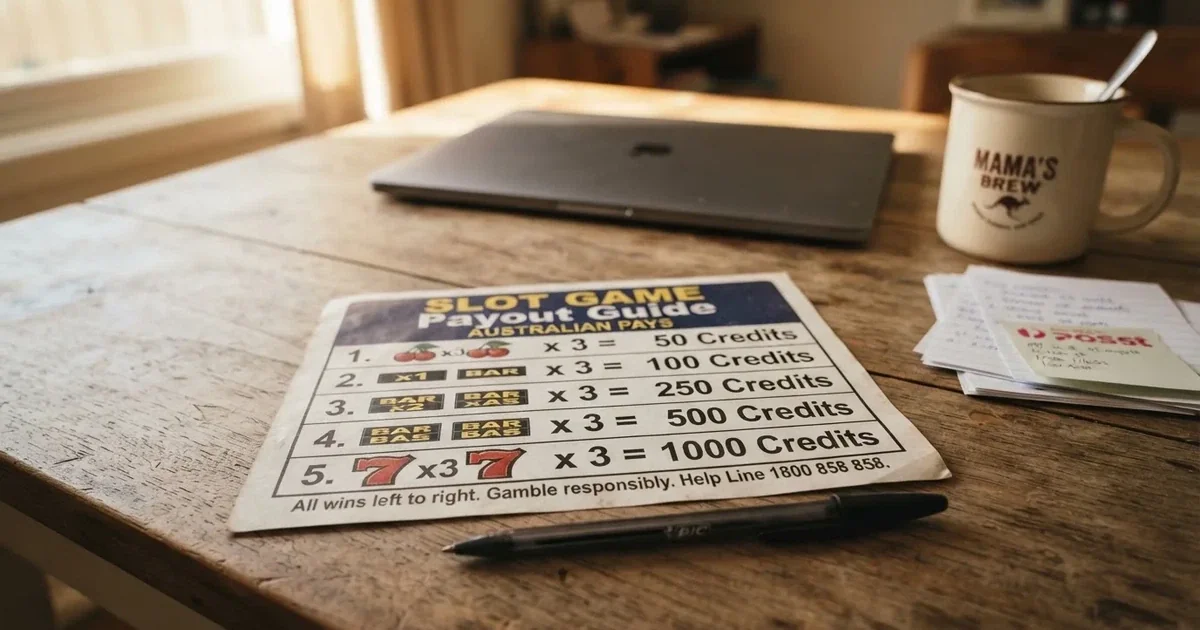
The mechanics behind a pokie are uniform enough that one paytable reading serves for most games. A paytable lists the symbol values, the win combinations and the special symbols. Three numbers matter more than the rest: stake per spin, the highest single-symbol payout at maximum bet, and the return-to-player.
Stake per spin is set by the player, usually from a range the game allows. On a five-reel, twenty-five-line game, a one-cent-per-line stake costs A$0.25 per spin; a ten-cent-per-line stake costs A$2.50 per spin. The same game covers two very different bankroll speeds at those two settings. Symbol values are paid as multiples of the line stake — a “10” on a cherry pays 10x line stake on a typical game, which is the same A$2.50 win whether the player bet one cent a line or ten. Maximum bets amplify the line-stake base without changing the multiplier.
Special symbols — wilds and scatters — are the second tier. Wilds substitute for other symbols to complete a paying line, scatters pay anywhere on the grid regardless of lines, and most modern games build a free-spins or bonus-game round off three or more scatters. The exact trigger and the size of the free-spins award sits in the paytable as well; games handle this differently and the math runs through what the paytable says, not what the splash screen suggests.
The return-to-player is the third number, and it is the only one that should anchor a judgement about a game. It is the percentage of wagered money the machine is programmed to return over a very long sequence of spins — millions, sometimes tens of millions. A 95% RTP game returns A$95 for every A$100 wagered in the long run; it does not guarantee that any one session will look like that. The legal Australian minimum RTPs, by jurisdiction: 85% in New South Wales, the Northern Territory, Queensland and Victoria (87% at Crown Melbourne), 87% in the Australian Capital Territory and Tasmania, 87.5% in South Australia, and 90% in Western Australia. These are the floors for the machines on Australian floors; the offshore games sitting on the sites in this market generally publish their own RTP — sometimes in the 92%–96% range, sometimes lower, sometimes not at all. Whatever the figure, the only honest reading of it is “long-run average of a machine, with variance any session will reveal.”
House edges on the table games that sit next to the pokies
A reader who clicks onto one of these sites usually finds more than pokies. The adjacent table games matter because the marketing language about them tends to be looser still — “highest payout”, “play the odds”, and similar phrases that say nothing a punter can act on. Three common table games against the house, with house edges from published calculations:
- Baccarat: 1.06% on the Banker bet, 1.24% on the Player bet, 14.36% on the Tie. The game is dealt from a six- or eight-deck shoe in punto banco, the variant most casinos now run, with hands played out by fixed drawing rules and cards 2–9 at face value, 10/J/Q/K at zero, aces at one, totals modulo 10. It is the lowest-edge game on most floors, and that is why high-stakes rooms favour it.
- Blackjack: about 0.28% under a liberal Las Vegas Strip rule set (dealer stands on soft 17, double on any two, double after split, resplit aces, late surrender); about 0.43% under Atlantic City rules. The game descends from the English vingt-un, with a veintiuno reference in Cervantes’ work around 1601–1602, formal British rules published in 1800, and the modern “blackjack” name dating to roughly 1899 during the Klondike Gold Rush. Australia inherits its licensed blackjack offering from state regulators: Crown Melbourne, for example, runs multiple variants regulated by the Victorian Gambling and Casino Control Commission (which took over from the VCGLR on 1 July 2022). The catch is that any variant rules published on an offshore site change the math, which is why a player who has only ever played with the local rule set should not assume the edge carries over.
- Baccarat’s deeper history — disputed origins in either 19th-century France or mid-15th-century Italy under Charles VIII — is interesting but does not move the math. Chemin de fer and baccarat banque are the older player-led variants; punto banco, developed in Havana in the 1940s, is the version where the casino banks every hand and the player only chooses the bet. That shift is what produces the low edge: the player does not have a meaningful decision to make badly.
The point of running through these is not to teach strategy — most of these games carry their own reading lists — but to put a number against the marketing language. “Almost even odds” on blackjack, “beaten by the dealer’s rules” on baccarat: each is a paraphrase of the published edge, and each is the kind of phrasing that costs a reader money if they take it at face value.
How the ACMA has been acting against the operators in this market
The brands profiled below are not ranked, recommended, or reviewed as places to play. Each sits on this page because the ACMA itself issued a formal warning over it for offering prohibited online casino games to Australians — published on the ACMA’s own site, with operator and date. The point of the list is to give a reader a grounded answer to the question “and what about this site?” without telling them to open an account.
| Brand | ACMA action and date | Operator named by the ACMA | Whether the brand offers Australian online pokies |
|---|---|---|---|
| RocketPlay | Formal warning March 2026; earlier warning May 2022 to a prior operator | Pulsup Ltd (Rocketplay); Dama N.V. (prior) | Not disclosed in operator materials |
| Level Up Casino | Formal warning May 2022 | Dama N.V. | Listed on third-party game studio pages |
| Woo Casino | Formal warning March 2025 | Dama N.V. | Not disclosed in operator materials |
| Spirit Casino | Formal warning May 2025 | Dama N.V. | Not disclosed in operator materials |
| National Casino | Formal warning July 2025 | Consolutetish S.R.L. | Listed on general casino reference pages |
| Bizzo Casino | Formal warning July 2025; earlier 2022 to a different operator entity | Consolutetish S.R.L.; TechSolutions (prior) | Not disclosed in operator materials |
| Ignition Casino | Formal warning July 2025 | Bamboo Media | Not disclosed in operator materials |
| Instant Casino | Formal warning February 2025 | EOD Code SRL | Not disclosed in operator materials |
| Jackbit | Formal warning April 2026 | Ryker B.V. | Not disclosed in operator materials |
| Casino Intense | Formal warning April 2025 | Sterplay Holding Ltd | Listed on Australian media and ACMA reference pages |
| Sky Crown | Formal warning in 2022 over Sky Crown and a sister brand | Hollycorn N.V. | Not disclosed in operator materials |
The table’s last column is honest about what the public record carries: for most of these brands, the relationship to an Australian audience is established by the warning itself, not by anything the operator publishes about it. The two “listed on general casino reference pages” entries reflect the absence of operator-side disclosure of an Australian customer base, not a confirmation of one. Reading the table as a buyer’s guide is the wrong move; reading it as a regulator’s list of where its attention has gone is the right one.
RocketPlay
Two formal warnings over this domain, four years apart and against different operators — Pulsup Ltd in March 2026, then-Dama N.V. in May 2022. The first warning was a published notice to a corporate entity that took on the brand. The second was a different company on the same domain. That is the kind of corporate drift the ACMA tracks; what it means to a punter is that the entity holding any “winnings” at withdrawal time is whichever group the operator is constituted through that week.
Level Up Casino
The May 2022 Dama N.V. warning bundle listed six brands together. Level Up was one of them; the others — Bambet, Dazard, Wild Tornado, Cobra Casinos, and Rocketplay (the earlier operator of that domain) — share the same warning date. That a single warning batch covers a brand portfolio this wide is the warning’s signal value: it implies shared infrastructure and shared compliance posture.
Woo Casino
Dama N.V. formal warning March 2025. The operator is the same entity that took the 2022 bundle warning across its other brands; this is the second Dama N.V. action, on a brand not in the 2022 list. That the same operator attracts repeat warnings tells a reader something — a regulator that warns an entity and finds the brand re-offering the prohibited services will keep warning.
Spirit Casino
Dama N.V. formal warning May 2025, two months after Woo Casino. Same operator, sequential warnings. A reader comparing Spirit against Woo is comparing two brands warned by the same regulator, on consecutive events, against the same prohibition.
National Casino
Consolutetish S.R.L. formal warning July 2025. The brand is named alongside Bizzo Casino in the same July 2025 round — a paired warning consistent with shared infrastructure between two brands on the same operator.
Bizzo Casino
Two warnings, two operators: Consolutetish S.R.L. in July 2025 and TechSolutions (CY) Group Limited / TechSolutions Group N.V. in 2022. Bizzo is a useful case in that it shows the regulator chasing the brand to a second operator after the first one took the warning, and the brand kept the same name and the same offer. The implication is not subtle: a brand carrying a 2022 ACMA warning is a brand carrying the regulator’s earlier view, and the rebranding did not change the regulator’s view.
Ignition Casino
Bamboo Media formal warning July 2025. The brand carries no second warning; the Bamboo Media notice is the ACMA’s first published action over it. That a first warning can be useful for a reader is in the timing — it is recent and the regulator has had time only to issue the notice, not to escalate.
Instant Casino
EOD Code SRL formal warning February 2025. The earliest of the 2025 warnings; one of the entries in the table with no second warning. The pattern across these brands is consistent enough that any single one is best read as part of the wider list rather than as a standalone fact.
Jackbit
Ryker B.V. formal warning April 2026, alongside sister brand CasinOK — paired warnings in the same ACMA notice. The pairing is deliberate on the regulator’s part: it shows the corporate connection between two fronts and tightens the scope of an action that could otherwise be picked apart one brand at a time.
Casino Intense
Sterplay Holding Ltd formal warning April 2025. The brand has independent coverage on Australian outlets and on the regulator’s reference page; what carries through both is the warning itself.
Sky Crown
Hollycorn N.V. formal warning in 2022 over Sky Crown and a sister brand, Blue Leo. The brand predates the 2022 action; the 2022 warning is the ACMA’s only published action over the Sky Crown brand. Companies that take a warning and stay on the register are companies the ACMA knows the address of.
The cost picture: how long the blocking action has been running
The honest arithmetic on the ACMA’s blocking record is a rate, not a position. The first blocking request was issued in November 2019. The cumulative count of blocked sites reached 1,751 by June 2026. The blocking record is in public hands; the match between enforcement years and what those years produced is straightforwardly computable.
Working through it with a band rather than a single figure: across the roughly six-and-a-half years from November 2019 to June 2026, the rolling average works out to between roughly 240 and 290 blocked sites per year — closer to the upper end in active enforcement years and noticeably lower in the quieter stretches between major rounds. The band sits where it does because enforcement is uneven: a single June 2026 round blocked twelve sites, and individual rounds since 2019 have ranged from a handful to dozens at once. So the rate “per year” is best read as the average of a series of discrete enforcement events, not as a steady flow. Treat the band as the picture of a regulator that escalates and stalls, rather than a clock that ticks.
The blocking rate tells the story. Any reader who lands on a brand and asks “has this kind of action been ramping up or slowing down?” has the answer in the band: ramping up early, plateauing in batches, sustained through 2026. That is what makes the current list of brands on this page worth printing — the regulator is currently active, and the list will keep moving.
Playing through a payment system: PayID, cards and crypto on offshore sites
The licensed Australian payment system rules are strict and matter precisely because most of the sites in this list sit outside them. Since 11 June 2024 the law bans credit cards, credit-related products and digital currency as a way to pay for any licensed online or phone wagering service in Australia. The penalties for an Australian-licensed operator are real, up to A$247,500. What that means in practice is simple: legal deposit routes for the licensed product are debit card, bank transfer, PayID/Osko and BPAY. A site asking an Australian customer for a credit card or a crypto deposit is, by definition, not a licensed Australian wagering site.
PayID is the route the licensed bookmakers live on. It runs on the New Payments Platform, settles in near real time via Osko, and the money moves through normal Australian bank rails, which is why licensed wagering can offer fast withdrawals on it without the credit risk. For an Australian player on a licensed sports or racing bookmaker the practical withdrawal time is what the network delivers — minutes, not days, and usually traceable end to end.
On an offshore casino site the same destination word — “fast withdrawal” — covers something different. The deposit may arrive quickly because the operator is set up for it; the withdrawal back to an Australian bank is where most of the friction lives. Card chargebacks are subject to the bank’s fraud window and the operator’s terms; wire transfers take days and carry fees; PayID and Osko are available only when the operator chooses to support them, and the operator can hold the withdrawal for the document and source-of-funds reviews that an offshore licence script demands. The advertised “instant withdrawal” page is the operator’s best-case timing under ideal conditions, not a service-level promise the Australian customer can enforce.
What that means for a punter is that the payment method page is a litmus test for which side of the IGA split a site is on. A licensed Australian wagering site will not ask for crypto, will accept PayID and Osko, and will be reachable through an Australian regulator if a withdrawal is refused. An offshore casino site will usually accept cards or crypto at the deposit end and offer PayID only when it suits the operator; a balance on the account at the moment a blocking request lands is unrecoverable through any Australian channel.
Bonuses on offshore pokies sites: what the marketing word actually buys
A sign-up bonus on a pokies site is structured the same way any deposit bonus is, with two parts: a headline number (the “100% match up to A$500”, the “200 free spins”, the “free bonus with no deposit”) and a set of conditions in the terms that the page does not print in bold. The conditions are where the offer lives or dies, and three of them matter more than the rest.
The wagering requirement is the multiplier applied to the bonus, the deposit, or both, before any withdrawal is allowed. A “40x bonus” requirement on a A$100 bonus means A$4,000 must be wagered before the bonus funds convert to real money. A “40x deposit + bonus” requirement on the same A$100 deposit with a A$100 bonus means A$8,000 must be wagered. The shape — bonus-only versus deposit-and-bonus — is the difference between A$4,000 and A$8,000 of required turnover for the same offer.
The second clause is the game eligibility. Pokies usually contribute 100% to wagering; table games often contribute 10% or are excluded entirely. A punter who takes a sign-up bonus and plays blackjack instead of pokies either ticks the wagering at one tenth the speed or does not tick it at all. The third clause is the maximum cashout, where a no-deposit bonus usually caps withdrawals at a small multiple of the bonus — A$100 bonus, 5x cap, A$500 max withdrawal, with anything above void. The free-spins offers carry their own version of this: winnings from the spins get run through wagering, and the cashout cap applies to that pile.
The arithmetic behind the offer is the kind of thing the page would normally expand into a worked example, and the honest move here is to refuse it. The figures that drive that calculation — bonus size, wagering multiple, eligible games, stake cap, time limit — vary from brand to brand on this list, and the research inputs do not pin them to any one operator. Running a generic example teaches the method but not the price; presenting an inline figure for a brand that has not been validated would teach the wrong price. The detail that a reader needs is straightforward: every bonus on every brand on this list carries a wagering multiplier, a game eligibility list and a withdrawal cap, and reading all three before claiming is what separates a reader who knows what they bought from a reader who thought they bought something else.
What mobile play looks like on these brands
A reader who arrives at one of these sites on a phone will usually find one of three things: a responsive browser site that resizes to the screen, an app or progressive web app that installs as an icon, or a download that the operator prompts through an APK installer. None of those routes is unique to the Australian market — these are the standard patterns for offshore casinos serving a global customer base.
A responsive browser site is what most major operators ship by default. It requires no install, lives on the regular mobile browser, and the only “app” the player adds is a home screen icon. It draws from the same account, the same wallet and the same game catalogue as a desktop session.
An installed app, where it exists, comes from the operator’s own download page rather than from Apple’s App Store or Google’s Play Store. Both app stores have policies against real-money casino apps in jurisdictions where the activity is prohibited, so an “Australian pokies app” that an Australian reader encounters through search results almost always means an APK the operator’s site pushes. The security and data-handling posture of such an app is the operator’s choice; the standards enforced by an Australian-licensed wagering app do not apply.
The practical reading is that “best australian pokies app” in a search box is a phrase the market uses rather than a category the law recognises. The licensed alternative for an Australian who wants to bet on their phone is the licensed wagering apps (sports and racing bookmakers) downloaded from the official stores. The licensed alternative for an Australian who wants to play pokies is to go to the venue.
Responsible play on a market that is largely unlicensed
The responsible-play advice on a page like this is unusual in that most of it is not about what a reader should do once they have signed up to one of these sites. It is about what is available to someone whose relationship with the activity is sliding.
Gambling Help Online is the central service: a free, confidential, 24-hour counselling service reachable by chat or by phone through the National Gambling Helpline on 1800 858 858. The service is funded for Australians, staffed by Australian counsellors, and operates independently of any operator on this list. Other state-based services — Gambler’s Help in Victoria, GambleAware in New South Wales — run their own intake lines and online chat.
BetStop, the National Self-Exclusion Register, is the technical backstop. A person who registers with BetStop is opting out of every Australian-licensed online and phone wagering service at once; the registered bookmakers are required by their licence conditions to refuse the registration attempt and to close any existing account the person holds. The mechanism works because the licensed operators have to act on it. The catch is what BetStop does not cover: it does not bind offshore casino sites, credit-card-based gambling sites, or any service that is not licensed in Australia. A punter who self-excludes from BetStop and then opens an account with an offshore casino has not self-excluded; they have switched operator. That is why an offshore casino complaint frequently surfaces the suggestion to register with BetStop and to use the bank-level gambling blocks that Australian banks now offer through their card controls.
The closer-to-the-bone advice is the one that does not change with operator. Any decision to take a bonus on a site sitting outside Australian law is a decision to take a wagering offer with no Australian consumer protection, no Australian complaints body, and no Australian recourse if a withdrawal is refused. The offer may be honest; the structure around it is not. Someone who starts feeling the impulse to “chase” a loss, or to top up a balance they cannot really afford, should treat those signs as the line the gambling counsellors describe.
What the actual Australian legal product looks like
The licensed alternative to “online pokies” is the pub, club or casino floor. Most of the land-based poker machine activity in Australia happens in clubs and hotels, with the major state breakdowns: NSW at more than 87,000 machines outside casinos; Queensland at around 21,000 across 351 venues; Victoria at 26,380 outside Crown Melbourne, under a 30,000 statewide limit; Western Australia with no machines outside the one casino.
Each jurisdiction sets its own rules. Tasmania ran a Federal Group monopoly on poker machines from 1968, with legislation passed in November 2021 ending that monopoly and moving oversight to the Tasmanian Liquor and Gaming Commission; Tasmania also planned nation-leading mandatory pre-commitment cards for its machines, with implementation delayed until late 2025. The ACT, South Australia and Western Australia sit at the higher end of the return-to-player floors (87%, 87.5% and 90% respectively); the other mainland states sit at 85% to 87%. The variation in the floor is not the variation in the experience — the experience is determined by the machine design and the venue’s mix, which is why a regular punter usually recognises their venue’s character before they recognise the regulator’s name on the side of the cabinet.
What changed in 2026 and what that meant in practice
Two 2026 events shape the landscape for an Australian reader this year. The ACMA’s June 2026 blocking round delivered the 1,751st cumulative blocked site and added another twelve names to the active list. The Interactive Gambling Amendment (Gambling Reform) Bill 2026 passed Parliament on 19 August 2026; its advertising and inducement measures commence 1 January 2027. A bill passed but not yet commenced is law with a start date — it does not change what is or is not legal today, but it changes the operator’s advertising landscape from the start of next year.
For a punter the second item matters at the search-results page rather than at the cashier. The clauses on advertising and inducement — bonus codes, “free spins just sign up”, affiliate marketing language — are what the bill reaches, and 1 January 2027 is when that reach starts to be enforced. Until then the marketing language is the same language it has been for years.
The honest reading of the market
A reader on this page can fairly take three things away. First, the activity they searched for is not licensed for them in Australia and the regulator is openly enforcing that position, with the volume of blocks and warnings tracking upward year on year. Second, the offshore sites that show up in the search results sit at the other end of a regulatory border, with a corresponding gap in consumer protection, payment friction and recourse. Third, the licensed product — the machines on the Australian floor — is a different thing, regulated by state-level authorities, and what the search results treat as interchangeable is not interchangeable in law.
The standard piece of advice — “play within your means, only with what you can afford to lose” — applies, and it applies harder on this side of the border than on the licensed one. The licensed product has an Australian regulator watching the operator; the offshore product has a foreign regulator on a different continent. Gambling Help Online (1800 858 858) and BetStop are free, confidential and reachable on the same day a player decides they have had enough.
Frequently asked questions about online pokies for Australian players
Is “Australian pokies online” a licensed category recognised by any state regulator?
No. Online pokies are prohibited for anyone in Australia under the Interactive Gambling Act 2001, and no state or territory issues a licence for them. What is licensed is wagering on racing and sport, lotteries and keno; the local licensed “pokies” are physical electronic gaming machines in pubs, clubs and casinos, regulated separately by each state and territory.
Is there a legal Australian online pokies app, as opposed to a mobile browser site?
No licensed version exists. An “Australian pokies app” encountered through search results almost always refers to an offshore operator’s download (typically an APK through the operator’s own page, since the major app stores do not carry real-money casino apps in jurisdictions where the activity is prohibited). The licensed phone-based wagering apps cover sports and racing, not casino games.
What’s the difference between “Australian pokies online” and pokies in an Australian venue?
The legal machine in a pub, club or casino is licensed and regulated by a state or territory authority, with a state-set minimum return-to-player and government oversight of payouts and machine design. The online offering on offshore sites is the same kind of game under a different legal regime — no Australian licence, no Australian complaint channel, and no recourse if a balance becomes inaccessible. The game looks similar; the structure around it does not.
Do sign-up bonuses offered on “Australian pokies online” sites come from a local operator?
Almost never. The bonus comes from the offshore operator accepting the deposit, and the terms behind the headline number — wagering multiplier, game eligibility, maximum cashout, expiry — are set in that operator’s terms. The marketing value lives or dies on those terms, and reading them before claiming is the difference between knowing what was bought and finding out after.
Can a PayID-friendly “Australian pokies online” site still be operating from offshore?
Yes. PayID is a payment-rail feature, not a regulatory category; an offshore operator can support PayID at the deposit end while remaining outside Australian law on the activity itself. The test is whether the site is licensed by an Australian regulator for the activity, not whether it accepts an Australian payment method.
Does the word “Australian” in a pokies site’s name indicate its actual licensing jurisdiction?
No. The name is a marketing choice and carries no regulatory weight. Brands in this market carry “Australian” in their branding while being operated by companies incorporated in Curaçao, Cyprus and similar, with licences from foreign regulators. The place to look is the operator’s published licence information at the footer of the site and in its terms — not the brand name at the top.