
Online Pokies in Australia: Why the Brand “Aussie Pokies” Doesn’t Mean What It Sounds Like
There is no licensed online pokies product for Australians. That isn’t editorial throat-clearing — it’s the law. Under the Interactive Gambling Act 2001, online casino games and online pokies are prohibited for anyone physically in Australia, and no state or territory issues a licence for them. The only legal version of the game sits in a pub, club or casino, on machines the local gaming regulator has approved. Everything that calls itself an “Aussie pokies site” sits offshore, runs on a licence issued somewhere else, and answers to no Australian authority when something goes wrong.
Current as of 29 October 2026. Verified against the ACMA register of formal warnings, the Interactive Gambling Act 2001 and state-level gaming regulations.
- The “Aussie Pokies” Sites Australians Will Actually Encounter
- Why No Online Pokies Site Can Be Licensed Here
- How the ACMA Actually Moves Against a Site
- The Blocking Rate — What That Volume Actually Means
- What Offshore Pokies Sites Actually Cost the Player
- The Payment Side: Why a PayID Deposit Is Not a Green Light
- Bonuses and “Free Spins”: What the Marketing Actually Means
- The Land-Based Pokies an Australian Can Actually Play
- Reading a Pokie Paytable — What the Numbers Actually Tell You
- Responsible Play — What the Local Framework Offers
- How an Australian Reader Should Read This Page
- Frequently Asked Questions
The “Aussie Pokies” Sites Australians Will Actually Encounter
The brands below are not a recommendation, not a shortlist, and not a comparison of where to play. Each one appears on this page because the Australian Communications and Media Authority itself issued a formal warning over it for offering prohibited services to Australians. Some carry an overseas gambling licence displayed at the foot of the page; none of those licences is Australian, and none of them changes what the IGA says. Treat the list as a map of names you’ll meet in search results and affiliate banners, with the regulator’s own position attached to each one.

| Brand | ACMA action and date | Operator named by the ACMA | Pokies software support (third-party listings) |
|---|---|---|---|
| RocketPlay | Formal warning, March 2026; earlier Dama N.V. action, May 2022 | Pulsup Ltd | — |
| Level Up Casino | Formal warning, May 2022 | Dama N.V. | Listed by BGaming as a partner venue |
| Woo Casino | Formal warning, March 2025 | Dama N.V. | — |
| Spirit Casino | Formal warning, May 2025 | Dama N.V. | — |
| National Casino | Formal warning, July 2025 | Consolutetish S.R.L. | Listed in third-party casino directories |
| Bizzo Casino | Formal warning, July 2025; earlier TechSolutions, 2022 | Consolutetish S.R.L. | — |
| Ignition Casino | Formal warning, July 2025 | Bamboo Media | — |
| Instant Casino | Formal warning, February 2025 | EOD Code SRL | — |
| Jackbit | Formal warning, April 2026 | Ryker B.V. | — |
| Casino Intense | Formal warning, April 2025 | Sterplay Holding Ltd | Listed by Crown Melbourne coverage and ACMA publications |
| Sky Crown | Formal warning, September 2022 | Hollycorn N.V. | — |
Two patterns stand out the moment you read the table across. The first is the repetition of operator names behind the brand fronts: Dama N.V. alone accounts for four of the eleven rows, including RocketPlay, Level Up, Woo and Spirit. The second is that none of these companies is Australian, none holds a licence from any Australian regulator, and none of them can offer a product the IGA prohibits in the first place — whatever the badge at the bottom of the homepage says. A licence from Curaçao, Cyprus or Anjouan changes which offshore regime the operator answers to. It doesn’t change the Australian legal position.
Why No Online Pokies Site Can Be Licensed Here
The framework is short on detail by design. The Interactive Gambling Act 2001 (the IGA), tightened by the Interactive Gambling Amendment Act 2017, makes it an offence to provide online casino games, online pokies or in-play betting to a person physically in Australia. State and territory regulators do not issue licences for these products — there is no Australian-licensed online pokies operator to compare against, and no application process an operator could complete to become one. What is licensable, in practice, is wagering on races and sporting events placed before the event, lotteries and keno, and most of those licences sit with the Northern Territory Racing and Wagering Commission. The same NT commission regulates fifty-two of Australia’s online bookmakers — including Sportsbet, Bet365 and Ladbrokes — for tax reasons; the commission has no full-time staff and meets once a month in Darwin. That is the Australian-licensed online gambling market, and online pokies are not in it.
The IGA targets the provider, not the player. Individual Australians are not prosecuted for opening an account with an offshore site; the operator is the one the regulator moves against. The practical consequence is sharper than it sounds: an offshore site gives no Australian consumer protection, no complaints body, and no recourse if a withdrawal is refused or a balance disappears. The site can be blocked while your money is still sitting in the account.
How the ACMA Actually Moves Against a Site
The Australian Communications and Media Authority has three tools, and it uses them in escalating order. The lightest is a formal warning — a published letter naming the operator and the company behind it, made public on the ACMA website. The next step is asking Australian internet service providers to block the site at the DNS level, so Australian customers can no longer reach it. The third is referral to the Australian Federal Police or the Department of Public Prosecutions, where the case meets the criminal code.
The numbers give a sense of the scale. As of the figures the ACMA reported in June 2026, a total of 1,751 illegal gambling and affiliate marketing websites have been blocked since the first blocking request in November 2019, and more than 230 unlicensed gambling services have left the Australian market since enforcement was strengthened in 2017. The June 2026 round alone added twelve more domains to the block list: 7Signs, ChromaBet, Donbet, Duospin, Freshbet, Slots Gem, Jacks Club, Lucky Start, Pointsbetz, Spinrise, Vinyl Casino and Wildsino. Each round costs the operator a domain and, more often than not, the customer balances attached to it.
That scale is what makes “online pokies for Australians” a phrase with no licensed answer behind it. The H2 Gambling Capital 2025 report estimates that Australians lose about A$3.9 billion a year to illegal gambling sites, and that the share of gambling going through legal channels fell from 74% in 2021 to 64%. That’s the market the offshore “Aussie pokies” brands are fishing in: one with no local regulator, no local complaints pathway and a roughly thirty-percent legal-channel bleed.
The Blocking Rate — What That Volume Actually Means
Run the arithmetic and the picture sharpens. From November 2019 to June 2026 — about 79 months — the ACMA has moved against 1,751 illegal gambling and affiliate marketing websites. That’s an average of roughly 22 blocking actions a month, or close to one every 32 hours across the period. The figure is uneven in practice: rounds tend to bunch into the dozen-at-a-time blocks published in single notices, with quieter months in between. Read as a band, the ACMA has been issuing blocking requests at somewhere between roughly fifteen and roughly thirty per month, and the rate has not slowed since 2019. The condition attached to the figure is the definition of “illegal gambling and affiliate marketing website” the ACMA itself uses, which is broader than the pokies market alone — it covers sports books, casino games and the affiliate sites that funnel traffic to them.
For a reader, the consequence is direct: a site that exists today can be unreachable from an Australian ISP next month. A balance held in an account on a blocked site is, in practical terms, a balance held by a counterparty you can no longer reach.
What Offshore Pokies Sites Actually Cost the Player
The house always has an edge. On a legal Australian pub machine, that edge is constrained — minimum return-to-player varies by state, from 85% in New South Wales, the Northern Territory and Queensland, through 87% at Crown Melbourne, 87.5% in South Australia, and 90% in Western Australia. The offshore pokie the search result promotes next to that pub machine carries no Australian minimum-RTP requirement. The game might run at 94%, or 96%, or below the state’s legal floor — there is no Australian rule that says it has to do either. RTP, volatility and the maximum payout per spin are settings on the operator’s server, and the only thing the offshore licence requires is whatever that particular jurisdiction happens to enforce.
Two further mechanics turn the cost steeper than the headline RTP suggests. The first is the bonus structure. An “Aussie pokies” welcome offer will typically carry a wagering multiple — the dollar amount the player has to wager before any winnings can be withdrawn — of 35× to 50× the bonus, sometimes higher, and will often exclude the highest-RTP games from the count. A$100 bonus at 40× means A$4,000 of wagering before a cent of winnings clears. The second is the maximum cashout cap. Most offshore pokies bonuses carry a ceiling — typically 5× to 10× the bonus amount — on what can actually be withdrawn from bonus-derived play, regardless of the headline RTP. A A$100 bonus with a 10× cap can pay out at most A$1,000, even if the math on the reels says it should pay more.
None of this is illegal under the offshore licence. All of it is something a player on a licensed Australian machine does not have to read the small print to discover.
The Payment Side: Why a PayID Deposit Is Not a Green Light
Search results for “Aussie pokies” often cluster around PayID and Osko, both because the names sound Australian and because the technology is. PayID itself is the New Payments Platform address system that lets a player send money to a phone number, email or ABN in near-real time. BPAY is the bill-payment system that runs through Australian bank accounts. Both are Australian banking rails.
Neither rail is a licence. A site can accept a PayID deposit routed through an Australian bank account and still be operated by a company in Curaçao, running on a Curaçao-issued interactive gaming licence, with the ACMA’s formal warning sitting on its record. What the rails do is let money move; they don’t speak to the legality of what sits at the other end.
For licensed Australian wagering — the legal part of the market — credit cards, credit-related products and digital currency have been banned as a payment method since 11 June 2024, with penalties up to A$247,500 for operators that accept them. Legal deposit routes for licensed wagering are debit card, bank transfer, PayID and Osko, and BPAY. A pokies site asking an Australian customer for a credit card or a crypto deposit is operating outside the Australian rules, but again — that’s a description of the operator’s position, not a verdict on whether the deposit will clear. The credit card ban applies to licensed wagering. Offshore pokies sites are not part of the licensed wagering regime, which is why they continue to advertise card deposits to Australian customers at all.
Bonuses and “Free Spins”: What the Marketing Actually Means
The marketing word is “free.” The arithmetic is not.
A “free spins” offer on an offshore pokies site hands the player a fixed number of spins at a fixed stake on a fixed game, usually at a stake well below what a paying customer would choose. The winnings land as bonus credit, not as cash. That bonus credit then carries the wagering multiple and the cashout cap described above, and the clock starts the moment the spins are played. A 50-free-spins welcome package on a A$0.20 stake, with 40× wagering on the resulting bonus, means the player is being asked to wager A$0.20 × 50 × 40 = A$400 of real-money bets before any of the spin winnings can be withdrawn.
The Australian law treats this kind of inducement as something no licensed local product may extend. There is no licensed Australian online pokies product, so there is no licensed Australian welcome bonus either. Every bonus a player sees advertised under the “Aussie pokies” label is an inducement attached to an offshore site, paid in bonus credit, and cleared against terms the offshore operator sets. The “free” in the headline is the cost of the offer’s framing; the math is the offer itself.
The Land-Based Pokies an Australian Can Actually Play
The pokies that are legal for Australians sit in licensed venues and operate under each state and territory’s own rules. The headline numbers give a sense of the scale: New South Wales had 87,298 gaming machines outside casinos across 2,195 venues as of June 2023, with player losses of A$8.18 billion in 2022-23. Queensland had 21,122 gaming machines operating in 351 venues in October 2023. Victoria had 26,380 machines outside Crown Casino in 488 venues in 2021-22, operating under a 30,000-machine statewide cap. The machine count and the venues are state-by-state; so is the regulatory regime.
Australia-wide, the 2020-21 figures were close to A$150 billion wagered through gaming machines and A$12.18 billion lost. That places the country in an unusual statistical position: roughly 3% of the world’s pub and club poker machines, with about 0.3% of the global population. The licensed game is a significant industry, regulated by jurisdiction, and operating under a different legal frame from any “Aussie pokies” online offer.
Western Australia sits at one extreme. The state banned poker machines in pubs and clubs when Crown Perth opened in 1985, and Crown Perth’s own machine count has since grown from about 200 in 1985 to roughly 2,500, all approved by the state’s Gaming and Wagering Commission. So in Western Australia, every licensed machine sits in the one casino. Tasmania sits at another: the Federal Group held a monopoly licence over all of Tasmania’s poker machines from 1968, and legislation passed in November 2021 ended that monopoly, moving oversight to the Tasmanian Liquor and Gaming Commission. The same reform package planned nation-leading mandatory pre-commitment cards, with implementation delayed until late 2025.
New South Wales’ machine count makes the legal market big enough that the offshore “Aussie pokies” brands are competing for a slice of customers who already have licensed machines in their suburb. That is the frame: a licensed local product, in the venues Australians walk into, sitting alongside an offshore product the IGA prohibits.
Reading a Pokie Paytable — What the Numbers Actually Tell You
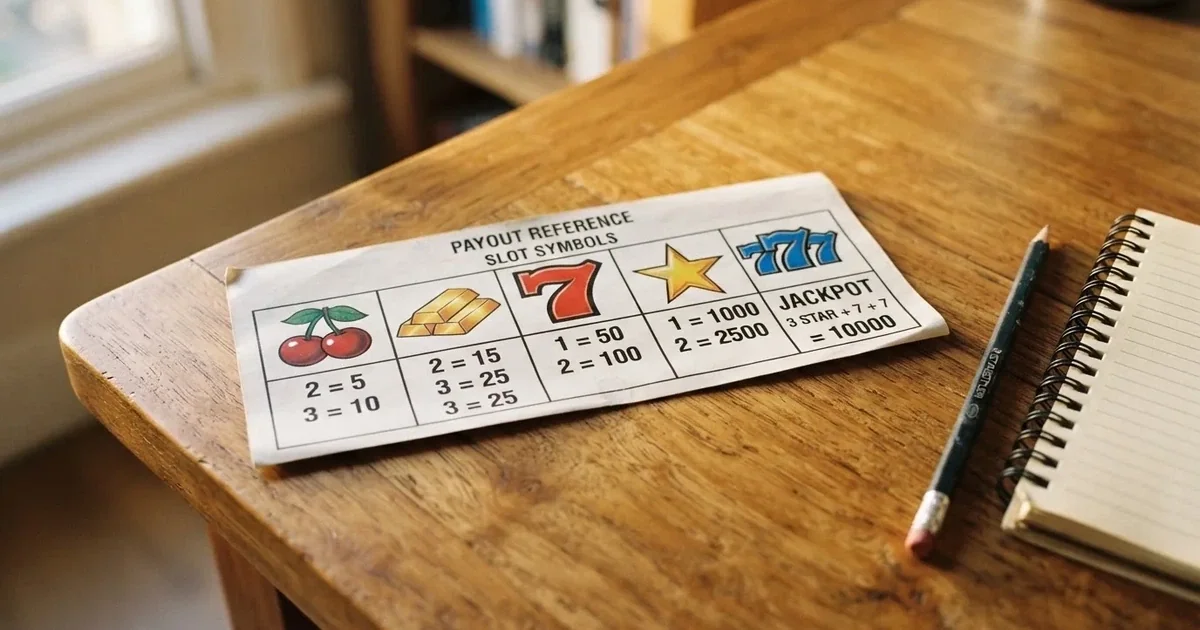
A paytable is the page inside the game that lists what each symbol combination pays. The mechanics underneath it are the same on a pub machine, a club machine and an offshore online pokie. The player picks a stake per spin, the reels resolve, and any matching combination on an active payline pays the listed amount.
Two numbers on the paytable carry most of the information. The first is the RTP — return to player — expressed as a percentage. A 96% RTP means the game returns A$96 of every A$100 wagered across a very large number of spins, with the rest going to the house edge. The second is volatility, which describes the shape of the payouts: a low-volatility game pays small amounts often, a high-volatility game pays larger amounts less often, and the RTP is the same in both cases. A player on a small bankroll is usually better served by a lower-volatility game; a player chasing a feature jackpot is usually looking at higher volatility and accepting the longer dry stretches. Neither choice changes the RTP.
The third thing on the paytable is the maximum payout per spin, expressed as a multiple of the stake. A 5,000× maximum on a A$1 spin is a A$5,000 ceiling — a number that matters more than the RTP for the rare spin that hits it. The catalogue the player scrolls through is typically organised by volatility, by theme, or by provider; the provider is the studio that built the game, and on offshore sites the same provider will often supply dozens of titles across several operators.
None of these mechanics change between the licensed Australian pub machine and the offshore online version. The RTP, the volatility and the max-payout ceiling work the same way in both. What changes is the rule that says an Australian machine must return at least 85%, and the absence of any equivalent rule offshore.
Responsible Play — What the Local Framework Offers
The framework the IGA protects is also the framework that offers a player the most direct way to step back. Gambling Help Online runs the National Gambling Helpline on 1800 858 858 — free, 24/7, with web chat. It’s the same frontline for any Australian whose gambling is becoming a problem, on or offshore, and it’s the place to start if a session is starting to feel like something more than entertainment.
BetStop, the National Self-Exclusion Register, has been live since August 2023. It lets a player exclude themselves from every Australian-licensed online and phone wagering service with one registration. That’s a useful lever for someone whose online pokies play is on licensed wagering sites — and that’s most of what BetStop covers. An offshore casino is not connected to BetStop, which means a self-exclusion through BetStop does not automatically extend to an offshore account. A player who needs the offshore accounts closed has to close them one by one, and the offshore operator’s customer support is the only route.
The IGA’s architecture is the one that ties all of this together. The player protection tools sit with the licensed operators; the offshore operators are not part of the licensed system. The framework that lets a player step back is the same framework that gives the game a return-to-player floor and a regulator who has actually read the rules.
How an Australian Reader Should Read This Page
The page is built on a single premise: there is no licensed Australian online pokies product, and any search result that suggests otherwise is selling something offshore. The mechanics explained in the paytable section, the RTP numbers and the volatility descriptions all apply equally to a licensed pub machine and an offshore online one — the difference is which regulator can enforce them. A reader who wants to play pokies in Australia has one option that doesn’t run against the IGA: the licensed pub, club or casino in their state or territory, on a machine that returns at least the local minimum.
For everything that calls itself an online pokies site, the reader’s question is not “which is the best one” — it is “do I want to send money to a counterparty that operates outside Australian law, that can be blocked while my balance is on it, and that no Australian regulator will help me recover from.” The page is built to make that question answerable, not to make the choice.
Frequently Asked Questions
Does calling an online pokies site “Aussie” change where it is actually licensed?
No. “Aussie” in a site name is a marketing choice, not a regulatory one. The licence badge at the foot of the homepage is the one that tells you which regulator the operator answers to, and none of the major “Aussie pokies” brands name an Australian regulator. The ACMA’s published formal warnings over RocketPlay, Level Up, Woo, Spirit, National, Bizzo, Ignition, Instant, Jackbit, Casino Intense and Sky Crown all name offshore operators — Dama N.V., Consolutetish S.R.L., Bamboo Media, EOD Code SRL, Ryker B.V., Sterplay Holding Ltd and Hollycorn N.V. — as the companies behind the brands.
Are the bonus credits and free spins on an “Aussie pokies” site legal to advertise here?
No Australian-licensed product is allowed to offer them, because there is no Australian-licensed online pokies product in the first place. The inducement sits with an offshore site and is governed by that site’s terms. The Interactive Gambling Amendment (Gambling Reform) Bill 2026, which passed Parliament on 19 August 2026, brings advertising and inducement rules with a commencement date of 1 January 2027. Until then, the offshore operators continue to advertise as they have; the law that targets them is the IGA’s prohibition on providing the games, not a separate advertising prohibition.
Is there a dedicated app for Aussie-branded online pokies that’s legal to install locally?
No. The Apple App Store and Google Play both enforce policies that exclude real-money online casino apps from the Australian storefronts. The “Aussie pokies” apps that surface in search results are typically progressive web apps — mobile-optimised websites that load in a browser — or APKs distributed outside the official stores, and the operator behind them is the same offshore operator named on the ACMA’s warning list. The legal way to access a real-money pokie on a phone in Australia is the licensed venue, not an app store download.
Do state gaming regulators recognise any “Aussie online pokies” brand as licensed?
No state or territory regulator issues licences for online pokies, because the IGA prohibits the provision of those games to people in Australia. The state regulators — Liquor & Gaming NSW, the Victorian Gambling and Casino Control Commission, the Queensland Office of Liquor and Gaming Regulation, the Tasmanian Liquor and Gaming Commission, the South Australian Consumer and Business Services, the WA Department of Local Government, Sport and Cultural Industries, and the ACT Gambling and Racing Commission — license the machines inside pubs, clubs and casinos. They do not license an offshore online brand, and an offshore operator cannot complete an Australian licence application because there is no application to complete.
How does an Aussie-branded online pokies catalogue differ from a licensed pub’s machines?
The mechanics on the reels are the same — a paytable, an RTP, a volatility, a max-payout ceiling, and a catalogue organised by theme or provider. The rules around them are not. A licensed pub or club machine in NSW, the NT or Queensland must return at least 85% over the life of the game; in Victoria the floor is 87% at Crown Melbourne; in South Australia it is 87.5%; in Western Australia it is 90%. An offshore “Aussie pokies” game carries no Australian minimum, and the operator sets the RTP. The bonus mechanics are also typically absent from a licensed pub machine: a player deposits, wagers, and the winnings are cash. An offshore online pokie usually attaches a welcome bonus, a wagering multiple, and a cashout cap to that same flow.
Can an Aussie-branded online pokies site accept a PayID deposit and still be unlicensed?
Yes. PayID is the New Payments Platform address system that routes through Australian bank accounts in near-real time. It is a payment rail, not a regulatory one. An offshore operator can register a PayID against an Australian bank account and accept deposits from Australian customers without that deposit triggering any licensing check — the rail settles the payment, and the operator’s status under the IGA is unchanged. The credit card and cryptocurrency ban that took effect on 11 June 2024 applies to licensed Australian wagering operators. Offshore pokies sites are not licensed Australian wagering operators, which is why they continue to accept payments the local rules forbid.