Best 7-Reel Slots in Australia: How the Format Works, Where the Law Stands, and the Brands on the ACMA List
 Available in US
Current as of 23 September 2026 and cross-checked against the Australian Communications and Media Authority’s published register of formal warnings and blocking requests.
A seven-reel slot is a particular thing on the floor of a club, and the search for it online is a particular kind of disappointment. Nobody in Australia holds an Australian licence to run one for real money on the internet, and the brands lining up to take a deposit anyway are the same brands the ACMA has been writing formal warnings to since at least 2017. This page is built for the reader who wants to know what the format is, what the paytable on one actually shows, why the offshore route looks the way it does, and which operators the regulator has already named — in that order, because the format makes sense without the regulator’s list but the regulator’s list does not make sense without the format.
- The shape of a seven-reel slot, and why it matters
- What an Australian player is actually looking at online
- Reading the paytable of a seven-reel slot without the marketing
- How a comparison of seven-reel slots should be read in Australia
- The eleven operators on the ACMA list
- What the eleven share, and what the list does not say
- Where the reader can go from here
- A note on the framing
- Frequently Asked Questions
The shape of a seven-reel slot, and why it matters
What a “reel” actually is, and what adding two more changes
A reel, on the original machines Charles Fey wired up in San Francisco in the late nineteenth century, was a mechanical wheel with symbols stamped on its face — five symbols per reel, three bells in a row paid ten nickels. The Liberty Bell format is the ancestor every later slot is built from, even the ones with fifty symbols per reel and odds as long as three hundred million to one against a top combination.

Adding reels changes the arithmetic of the game in three ways a player notices on a paytable, not in marketing copy:
- The number of possible combinations expands quickly. A classic three-reel machine with around ten symbols per reel carries roughly a thousand possible outcomes. Add two more reels and the same number of stops per reel multiplies the count by ten thousand. A seven-reel machine with twenty symbols per reel runs into the hundreds of millions of combinations, which is one reason the format stayed rare.
- Each spin’s individual volatility rises. With longer odds on the top hit, the machine spends more of its payout in symbols the player will rarely see. The middle of the paytable does more of the work.
- The number of ways to win grows, but the cost per spin rises with it. A seven-reel format can carry more win lines than a five-reel one, but each line is another unit of stake. A payline on a five-reel game at a dollar a line is a dollar; the same on a seven-reel game is still a dollar, but seven of them at a dollar is seven dollars a spin.
The practical question for the reader is not whether a seven-reel format is “better.” It is whether the paytable the reader is looking at is showing a top prize that the format can actually reach at the stake being asked.
Where the seven-reel format sits in the history
The three-reel Liberty Bell became the Money Honey in 1963, the first slot with a bottomless hopper and automatic payout of up to five hundred coins. The first video slot followed in 1976 at Fortune Coin Co. in Kearny Mesa. By 2010 Australia was running an estimated 97,103 gaming machines outside casinos, roughly five times the United States per capita.

The seven-reel format sits between those two points — a later offshoot of the mechanical three-reel original, before the video slot swallowed the floor. It is a real format, not a marketing term. Older cabinets kept it on the floor in some jurisdictions because the longer odds on a top hit suited a jackpot structure that was advertised as a feature. The video era pushed the format out of most new releases; what is left is mostly heritage cabinets and a small number of online releases from studios that still commission them.
Why the format shows up in an online search at all
The reason a reader in Australia types “7 reel slots” into a search engine is that the format survived in two places — the floor of licensed Australian clubs, where the bulk of the country’s 199,000-odd pokies outside casinos still run, and offshore online casinos whose content libraries include the heritage cabinets the major studios no longer commission. New South Wales alone had 87,298 pokies-style machines outside casinos as of June 2023, with Victoria, Queensland, South Australia and the ACT adding tens of thousands more.
On the licensed Australian floor, a seven-reel cabinet is rare. The video five-reel format dominates, and the bulk of what the player sees is built around five reels and a feature round. The reader’s search is, in practice, the trail of a format that has largely left the Australian floor but is still being offered offshore.
What an Australian player is actually looking at online
The legal frame the search runs into
The Interactive Gambling Act 2001, strengthened by the Interactive Gambling Amendment Act 2017, makes it an offence to provide online casino games and online pokies to a person physically in Australia. No state or territory issues a licence for them. What is licensable is wagering on races and sport placed before the event, lotteries, and keno. In practice, sports and race bookmakers are licensed in the Northern Territory through the Northern Territory Racing and Wagering Commission, which regulates 52 of them — Sportsbet, Bet365 and Ladbrokes among them — and which meets once a month in Darwin and has no full-time staff.
The age floor for any gambling product in Australia is eighteen. The IGA targets the provider, not the player. The individual punter who deposits at an offshore site is not the person the regulator is chasing — the regulator is chasing the operator. That distinction is the reason the offshore market keeps operating, and it is also the reason the consumer protection a player gets on a licensed wagering site does not exist on an offshore casino.
The regulator’s tools, and how they have been used
The Australian Communications and Media Authority investigates, issues formal warnings, and directs Australian internet service providers to block illegal sites. The blocking tool is the loudest of the three because it removes access; the formal warning is the one the public can read because the ACMA publishes it.
By June 2026 the ACMA had asked ISPs to block 1,751 illegal gambling and affiliate marketing websites since the first blocking request in November 2019, and more than 230 unlicensed gambling services had left the Australian market since enforcement was strengthened in 2017. The most recent published round, reported on 26 June 2026, named twelve more sites: 7Signs, ChromaBet, Donbet, Duospin, Freshbet, Slots Gem, Jacks Club, Lucky Start, Pointsbetz.com, Spinrise, Vinyl Casino and Wildsino. The names turn over; the practice of publishing them does not.
The blocking rate — the rate at which the running total has grown — is a useful way to read the headline number. From the first request in November 2019 to the count of 1,751 reported in June 2026, that is roughly eighty months of cumulative blocking against operators the ACMA considered to be offering prohibited services. The pace across that span sits in the band of roughly twenty to twenty-five new sites blocked per month on the long-run average, with the per-round count varying from a handful to the recent twelve. The June 2026 round alone sits below that band, but the published totals do not separate which months contributed how much, so the monthly pace is an estimate of the average, not a figure for any individual month.
What an offshore site does not give an Australian player
A site licensed in Curaçao or Cyprus can display any licence badge it likes; it is not an Australian licence, and the protections that attach to one do not follow. There is no Australian complaints body to write to, no Australian court to apply to if a withdrawal is refused, and no obligation on the operator to honour any term it has advertised. If the ACMA blocks the site tomorrow, the balance on the account may be sitting at an address the player can no longer reach.
The licensed wagering market in Australia runs on three consumer protections the offshore market does not have:
- BetStop, the National Self-Exclusion Register, has been live since August 2023. A player who registers with BetStop is barred from every Australian-licensed online and phone wagering service. An offshore casino is not connected to BetStop and will not honour an exclusion set there.
- The credit-card and crypto ban that took effect on 11 June 2024 makes it an offence — with penalties up to A$247,500 — for an Australian-licensed operator to accept credit cards, credit-related products or digital currency as payment. The legal deposit routes on a licensed bookmaker are debit card, bank transfer, PayID/Osko and BPAY. A site asking an Australian player for a credit card or a crypto deposit is operating outside the rules.
- The National Gambling Helpline, 1800 858 858, is free, twenty-four hours a day, with chat at Gambling Help Online. The number works from anywhere in Australia for any punter, on a licensed site or an offshore one, and the service is confidential.
The 2026 reform bill — the Interactive Gambling Amendment (Gambling Reform) Bill 2026 — passed Parliament on 19 August 2026, with its advertising and inducement measures commencing on 1 January 2027. It is law with a start date, not yet in force on this page.
The tax position, briefly
Gambling winnings of a recreational player are not assessable income under section 6-5 of the ITAA 1997, and losses are not deductible. That changes only if the person is carrying on a business of gambling, which the Australian Taxation Office treats case by case. The casual-punter rule is the default.
Reading the paytable of a seven-reel slot without the marketing
What a paytable shows, and what it leaves out
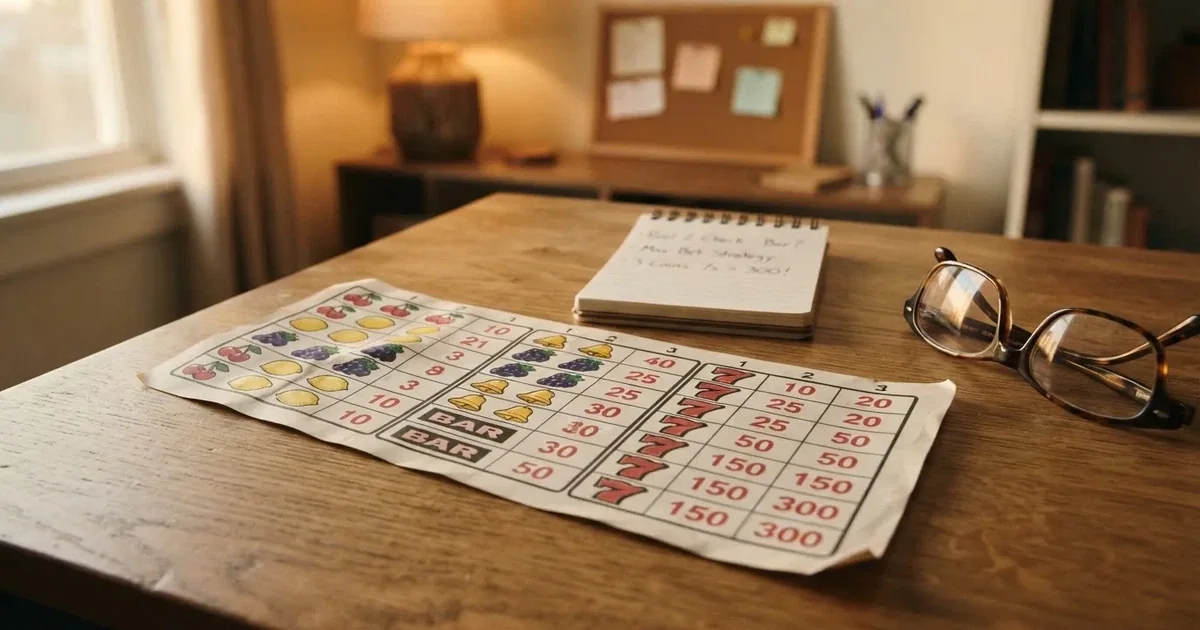
A paytable lists each symbol, the prize for three of a kind, the prize for four, and so on, up to the prize for the maximum count the format allows. On a seven-reel format the table runs longer than on a five-reel one because each symbol can land in more counts — three through seven, not three through five. A paytable never shows the odds of hitting each combination; it shows the prize if the player does.
Two numbers matter and neither of them is on the paytable:
- The return to player (RTP) is the share of every dollar staked that the machine returns to players in the long run. State regulators in the United States set minimums that vary by jurisdiction: Nevada at least 75%, Mississippi at least 80%, New Jersey at least 83%. Australian state regulators set their own minimums on licensed machines, which the paytable itself does not print.
- The house edge is the inverse of the RTP, expressed as a percentage the house keeps. On a table game the comparison is direct — baccarat’s Banker bet sits at 1.06%, the Player bet at 1.24%, the Tie at 14.36%; the Pass/Come bet in craps at 1.41%, the Don’t Pass/Don’t Come at 1.36%, Any Craps at 11.11%. On a slot, the house edge is implied by the RTP, but it is rarely printed as a percentage on the paytable itself.
Bonus features and what they cost
A “bonus feature” on a slot is a second mode the game enters under a stated condition — a particular symbol count landing on the reels, a wheel spin awarding a multiplier, a set of free spins with a different symbol set. The feature exists to break the base game’s payout rhythm. On a seven-reel format, the base game is already longer-odds than a five-reel one, so the feature is what carries most of the advertised payout.
Three terms recur in the bonus-feature copy, and each one is worth reading slowly:
- Free spins: spins the machine pays for rather than the player. The stake is zero; the win, if any, is paid in the game’s normal currency. Where free spins come with a multiplier attached — two times, three times, five times — the multiplier applies to the line win, not to the original stake.
- Bonus rounds: a separate mode with its own rules. The bonus round’s RTP is calculated against the stake that bought the entry to it, not against a separate meter of “bonus money.”
- Pick’em games: a choice mechanic where the player picks one of several options and the game reveals a prize. The choices are random, not strategic — the player’s input is the illusion of control.
What the reader should look for, and where
A paytable that does not state an RTP, does not name a maximum win cap, and does not say what the stake per line buys the player is showing a price list, not a contract. The contract is the full set of game rules, which the regulator approves on a licensed machine and which an offshore site may or may not publish in full. The difference between a price list and a contract is the difference between a marketing document and a binding one, and it is the same difference the offshore-versus-licensed question turns on.
How a comparison of seven-reel slots should be read in Australia
The structure a fair comparison would take
A fair comparison of seven-reel slots would weigh four things, in this order, with the regulator’s verdict taking the first seat rather than the last:
- Licensing: is the operator licensed in Australia? For online casino games and online pokies the answer is no, by definition. For wagering on races and sport before the event, the answer can be yes — through the Northern Territory Racing and Wagering Commission — and that is the only “yes” available. A site that displays a Curaçao or Cyprus badge is not licensed in Australia; it is licensed somewhere else, for the benefit of that other jurisdiction’s regulator.
- ACMA action: has the regulator issued a formal warning over this operator, or asked Australian ISPs to block the site? The published register of formal warnings is searchable, dated, and identifies both the operator entity and the brand the warning covered.
- Subject support: where a comparison touches a specific game, provider or feature, what do independent listings say? Where the listings do not cover a brand, the comparison leaves that brand out of the relevant column.
- Consumer protection: does BetStop apply, does the credit-card and crypto ban apply, and what does the operator’s own complaints process look like? On an offshore site the answer to the first two is no.
What the comparison cannot do in Australia
A comparison cannot rank Australian-licensed seven-reel slots because none exist. A comparison cannot recommend an offshore seven-reel slot because the regulator has been writing formal warnings to the operators offering them. A comparison can tell the reader which operators the regulator has named, when, and over what — that is the comparison that is on the table, and it is the one the rest of this page builds toward.
What the column set looks like in practice
The table that follows covers the eleven operators the ACMA has published a formal warning over. The columns are the four matters the comparison weighs: the brand, the ACMA action and its date, the operator entity the warning named, and what independent listings say about the brand’s subject coverage. A column whose research does not back stays out of the table; a cell whose research does not cover takes the no-data marker.
| Brand | ACMA action and date | Operator named by the ACMA | Subject support |
|---|---|---|---|
| RocketPlay | Formal warning, March 2026; earlier May 2022 over Dama N.V. | Pulsup Ltd (Rocketplay.com.au) | — |
| Level Up Casino | Formal warning, May 2022 | Dama N.V. | listings-only (Bgaming.com) |
| Woo Casino | Formal warning, March 2025 | Dama N.V. | — |
| Spirit Casino | Formal warning, May 2025 | Dama N.V. | — |
| National Casino | Formal warning, July 2025 | Consolutetish S.R.L. | listings-only (en.wikipedia.org) |
| Bizzo Casino | Formal warning, July 2025; earlier 2022 over TechSolutions | Consolutetish S.R.L. | — |
| Ignition Casino | Formal warning, July 2025 | Bamboo Media | — |
| Instant Casino | Formal warning, February 2025 | EOD Code SRL | — |
| Jackbit | Formal warning, April 2026 | Ryker B.V. | — |
| Casino Intense | Formal warning, April 2025 | Sterplay Holding Ltd | listings-only (Abc.net.au, acma.gov.au, Crownmelbourne.com.au) |
| Sky Crown | Formal warning, September 2022 | Hollycorn N.V. | — |
Three of the eleven — Level Up Casino, National Casino and Casino Intense — are the only ones where an independent listing carries any subject coverage in the research set; the remaining eight take the no-data marker on that column and stay on the table for the ACMA action they share. The point of the column is not to credit any of the eleven with subject coverage they do not have; it is to show where the listings speak and where they do not.
What the reader should take from the table
The reader who arrived looking for a top ten of seven-reel slot providers is looking at the wrong shape of answer. The shape of the answer in Australia is the regulator’s published list, and what the regulator has published is what the comparison builds from. Reading the table in that frame is the work the rest of this page is doing — not ranking operators, but laying out the eleven the ACMA has named, with the dates and the operator entities the warning covered, and the subject-coverage column showing where independent listings speak.
The eleven operators on the ACMA list
The write-ups that follow cover each of the eleven operators in the table above. They are not recommendations and they are not a ranking. They are the brands the regulator has named, with the action the regulator has taken, in the order the table presents them. Each write-up ends on the verdict the table’s own facts support — which operator the ACMA has acted against more than once, which operator’s earlier warning was carried by a different corporate entity, and which operator sits on the list without independent coverage in the research set.
RocketPlay
The ACMA published a formal warning over Rocketplay.com.au in March 2026, naming Pulsup Ltd as the operator. The brand had already appeared on the regulator’s list in May 2022, when the warning went to Dama N.V. and covered six casino brands including Rocketplay. Two warnings, four years apart, over the same brand: that is a record of an operator that moved from one corporate wrapper to another after the first warning and continued offering prohibited services to Australians under the new wrapper. The subject-support column for RocketPlay carries no listing data in the research set; the comparison keeps it on the table for the ACMA action it shares. In summary, RocketPlay is the operator whose two-warning history most clearly illustrates the regulator’s pattern — a warning issued, the operator reincorporates, the offering continues, and the regulator writes the second warning.
Level Up Casino
The ACMA’s May 2022 warning to Dama N.V. covered six brands, of which Level Up Casino is one. Dama N.V. was also the operator behind three other brands on the same list — Woo Casino, Spirit Casino, and the earlier Rocketplay warning. The subject-support column for Level Up Casino carries one listing in the research set, on Bgaming.com; the comparison notes it as a listings-only entry. Level Up Casino acts as the conduit for Dama N.V.’s 2022 warning, and the single independent listing is merely a third-party catalogue entry, not an official endorsement.
Woo Casino
Woo Casino was the subject of a formal warning in March 2025, again over Dama N.V.. Three years after the original 2022 warning to Dama N.V., the same operator entity was still offering prohibited services to Australians, under a brand the regulator named separately. As with many other operators, no independent listing data exists in the research set. Woo Casino is therefore associated with the 2025 warning that extended Dama N.V.’s exposure, and since there is no listing data, the comparison omits it from any coverage of seven-reel slots.
Spirit Casino
Spirit Casino was the subject of a formal warning in May 2025, again over Dama N.V.. Two months after Woo Casino, the same operator entity drew a second formal warning. It has no independent listing data in the research set. Spirit Casino is the brand through which the 2025 Dama N.V. exposure expanded, and the comparison excludes it from the subject-coverage column similarly to the other Dama brands.
National Casino
The ACMA’s July 2025 warning named Consolutetish S.R.L. as the operator and covered National Casino and Bizzo Casino. The subject-support column carries one listing in the research set, on en.wikipedia.org. National Casino is one of two brands covered by that Consolutetish warning, and the single independent listing mentioned is merely a third-party reference.
Bizzo Casino
Bizzo Casino was covered by the same Consolutetish S.R.L. warning in July 2025, and had earlier been the subject of a 2022 formal warning to TechSolutions (CY) Group Limited and TechSolutions Group N.V.. Two warnings, three years apart, under two different operator entities, over the same brand — the same pattern as Rocketplay, by a different pair of wrappers. Like the others, it has no listing data in the research set. Bizzo Casino is the brand whose two-warning history matches RocketPlay’s, and the corporate-wrapper shift between TechSolutions and Consolutetish is the regulator’s most direct illustration of an operator changing entities to continue offering prohibited services.
Ignition Casino
The ACMA’s July 2025 warning named Bamboo Media as the operator over Ignition Casino. Research data for this brand is absent. Ignition Casino is categorized here as the brand linked to the Bamboo Media warning, and given the absence of listing data, the comparison offers no independent subject coverage.
Instant Casino
The ACMA’s February 2025 warning named EOD Code SRL as the operator over Instant Casino. Like similar cases, no listing data exists for this brand. Instant Casino is linked to the earliest of the 2025 warnings, and it is excluded from the subject-coverage column for the same reasons as those stated for the Woo and Spirit Casino entries.
Jackbit
The ACMA’s April 2026 warning named Ryker B.V. as the operator over Jackbit and CasinOK. Jackbit appears as a second brand on that warning, with one operator entity covering both. No independent listing data exists here. Jackbit is identified by the April 2026 Ryker B.V. warning, and as no listing data exists, the comparison provides no independent coverage of the subject.
Casino Intense
The ACMA’s April 2025 warning named Sterplay Holding Ltd as the operator over Casino Intense. Three listings exist in the research set — all third-party references rather than endorsements. Casino Intense carries the most listings of any brand on the table, but these are purely reference pages.
Sky Crown
The ACMA published a formal warning over Sky Crown in September 2022, naming Hollycorn N.V. as the operator, alongside a warning over the same operator’s Blue Leo casino service. No listing data exists for this brand. Sky Crown is the brand through which the September 2022 Hollycorn N.V. warning was published, and the comparison excludes it from the subject-coverage column similarly to the other mentioned brands.
What the eleven share, and what the list does not say
Every brand in the table is an offshore operator of online casino games and online pokies — a prohibited interactive gambling service under the Interactive Gambling Act 2001. The ACMA’s formal warning is a published act, not a private one. Each warning identifies the operator entity, the brand, and the date; the register is searchable on the regulator’s website.
The list does not say which of the eleven offers a seven-reel slot library in particular. It says they are offering prohibited services to Australians. Whether their content library contains seven-reel titles specifically is a separate question the research set does not cover; the page leaves that question open rather than guessing at it.
The list also does not say any of the eleven is the only licensed brand in any category. The featured set is eleven brands, and a licence register lists many more; the comparison is among the eleven, not between the eleven and the offshore market as a whole. The reader who wants a fuller picture can read the ACMA’s blocking register, which lists 1,751 sites blocked since November 2019, and the published rounds of formal warnings, which continue to add to it.
Where the reader can go from here
The licensed route
The licensed route to seven-reel slots in Australia runs through the floor — the licensed club, pub and casino floor that operates under state and territory regulators. New South Wales had 87,298 pokies-style machines outside casinos as of June 2023, with Victoria at 26,380, Queensland at 21,122, South Australia at 11,672 and the ACT at 3,587. The seven-reel format is a small share of that count; the licensed floor is dominated by video five-reel cabinets. A reader who wants to play the format legally will find it on a licensed cabinet, not on a licensed online casino — and there is no licensed online casino, because the IGA prohibits the offering.
The responsible-gaming route
The format is the entry point; the question of how to play it responsibly is the same on a licensed cabinet and on an offshore site. BetStop, the National Self-Exclusion Register, has been live since August 2023. A player who registers with BetStop is barred from every Australian-licensed online and phone wagering service. An offshore casino is not connected to BetStop and will not honour an exclusion set there. The National Gambling Helpline, 1800 858 858, is free, twenty-four hours a day, with chat at Gambling Help Online. The number works from anywhere in Australia for any punter. If a game starts to feel compulsive or stressful, the call is the one a reader can make today, in confidence, at no cost.
The reading list
The ACMA’s register of formal warnings is the primary source for the table on this page. H2 Gambling Capital’s 2025 report, cited via industry trade press, is the source for the estimate of A$3.9 billion a year in losses to illegal gambling sites and the fall in the share of gambling going through legal channels from 74% in 2021 to 64%. The Interactive Gambling Act 2001 and the Interactive Gambling Amendment Act 2017 are the primary sources for the legal frame. The Casino Control Act 1992 in NSW and the Casino Control Act 1991 in Victoria are the primary sources for the licensed floor’s table-game approval process.
A note on the framing
This page is built around the choice the search presents — between a format that exists on the licensed floor and a market of offshore sites that the regulator has been writing formal warnings to. The page does not recommend an operator to play at, and it does not advertise any of the eleven on the table. It describes the format, the law, and the regulator’s published action, and it lays out the eleven brands the action covers so a reader can see what the offshore route actually looks like in practice. The “best” the title asks after is, in Australia, the licensed floor — and the reader who reaches that conclusion has the regulator’s published list to confirm it.
Frequently Asked Questions
What makes a 7-reel slot different from a standard five-reel video slot?
A seven-reel slot has two more reels than the modern five-reel video format. The extra reels expand the number of possible combinations dramatically — a classic three-reel machine with around ten symbols per reel offers roughly a thousand outcomes; a seven-reel machine with twenty symbols per reel runs into the hundreds of millions. The middle of the paytable does more of the work, and the top prize is harder to hit. The format is older than the video five-reel one and rarer in current releases.
Can 7-reel slot machines be found in licensed Australian pubs and clubs?
Yes. The licensed Australian floor operates under state and territory regulators, with 87,298 pokies-style machines outside casinos in New South Wales alone as of June 2023, plus tens of thousands more in Victoria, Queensland, South Australia and the ACT. The seven-reel format is a small share of that count, dominated by video five-reel cabinets, but the cabinets do exist on the licensed floor. Online, the Interactive Gambling Act 2001 prohibits the offering, and no Australian licence exists for it.
Do 7-reel slots typically pay out differently than newer five-reel formats?
The format implies a different payout structure because the longer odds on a top hit shift the machine’s return into the middle of the paytable. Whether the actual return-to-player differs in practice is a function of the specific game’s design, not the reel count. A paytable that does not state the RTP is showing a price list, not a contract. The contract is the full set of game rules, which state regulators approve on a licensed machine.
Is a 7-reel slot online the same game as a 7-reel machine on a casino floor?
Often, yes — the content is licensed from the same studios and runs on the same math. The licensed-floor version is approved by a state regulator under rules that include a published RTP and consumer protections; the online version is offered by an offshore operator whose RTP may or may not be published, whose consumer protections are those of the operator’s home jurisdiction, and whose offering the ACMA may have acted against. The math can be the same; the consumer protection is not.
Are 7-reel slots for real money available legally from an Australian-based site?
No. The Interactive Gambling Act 2001, strengthened by the Interactive Gambling Amendment Act 2017, makes it an offence to provide online casino games and online pokies to a person in Australia. No state or territory issues a licence for them. The licensable online products in Australia are wagering on races and sport before the event, lotteries and keno. Seven-reel slots for real money are available legally on the licensed Australian floor; they are not available legally from any Australian-based online site.
Is reel count still a useful way to compare volatility between older and newer slots?
Reel count is one input into volatility, not the whole picture. The number of symbols per reel, the symbol weighting, the bonus-feature frequency, and the maximum win cap all shape the volatility of the game. A seven-reel machine with a high maximum win cap and a sparse top-symbol distribution can be more volatile than a five-reel machine with a tighter cap, and the reverse is also possible. The reader who wants to compare volatility is better served by the published RTP, the published volatility rating where it is available, and the maximum win cap than by the reel count alone.
Prepared by the Casino Table Games Info editorial staff.