
Lightning Link Pokies in Australia: The Cabinet Format, the Bonus Round and What an Offshore Site Actually Costs
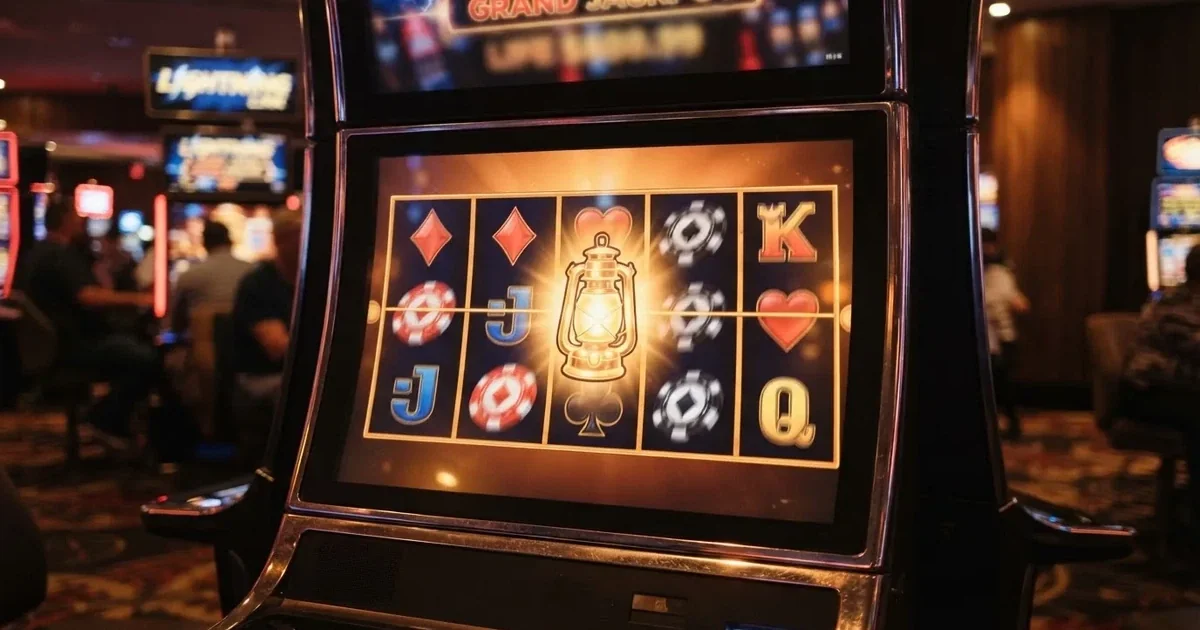
A Lightning Link pokie is a five-reel Aristocrat cabinet that turned a single bonus mechanic — hold-and-spin — into a franchise of linked reel sets. Each reel set carries its own theme, paytable and bonus structure, but the spine is the same on every one: a regular spin round that can pivot into a respin feature where the visible “lantern” or “coin” symbols lock in place and the player starts a fresh three-spin timer. Every respin that lands at least one new symbol resets the counter; a round that lands no new symbol after three consecutive spins ends with whatever symbols have locked. The Mini, Minor, Major and Grand jackpot values are awarded in proportion to those locked symbols, and on a full-screen fill the Grand is paid.
The reason the format has its own search term in Australia is that Lightning Link also became the most-cloned online pokies theme of the last decade, and almost every clone targets an Australian player through an offshore site the ACMA has, in many cases, already acted against. Data current as of 29 October 2026, licence and enforcement claims verified against the Australian Communications and Media Authority’s published register of formal warnings and blocking requests.
- The Eleven Brands the ACMA Has Formally Warned
- What Lightning Link Actually Is: The Cabinet Format
- How the Hold-and-Spin Round Works, Mechanically
- The Land-Based Picture in Australia
- Why “Online” Lightning Link Is a Different Market Entirely
- What the ACMA Has Actually Done
- The Hold-and-Spin Bonus on an Offshore Site: What It Costs
- The Math Behind the Bonus: Expected Loss
- Self-Exclusion, Limits and the Help Line
- What a Player on an Offshore Site Should Actually Do
- Why the Cabinet Format Itself Is Honest About Its Cost
- Frequently Asked Questions
The Eleven Brands the ACMA Has Formally Warned
A search for Lightning Link online in Australia does not lead to a legal Australian-licensed casino, because no Australian licence covers online pokies or online casino games. It leads to offshore sites that accept Australian players. Eleven of those brands have been the subject of a formal warning from the ACMA, the regulator that enforces the Interactive Gambling Act 2001. The list below is not a recommendation and not a ranking — every brand on it is named because the regulator itself has published a formal warning about it for offering prohibited services to Australians. The order follows the sequence of the regulator’s published action.
| Brand | ACMA action and date | Operator named by the ACMA | Subject support |
|---|---|---|---|
| RocketPlay | Formal warning, March 2026; earlier Dama N.V., May 2022 | Pulsup Ltd (RocketPlay); earlier Dama N.V. | — |
| Level Up Casino | Formal warning, May 2022 | Dama N.V. | BGaming lists Level Up |
| Woo Casino | Formal warning, March 2025 | Dama N.V. | — |
| Spirit Casino | Formal warning, May 2025 | Dama N.V. | — |
| National Casino | Formal warning, July 2025 | Consolutetish S.R.L. | Wikipedia lists National Casino |
| Bizzo Casino | Formal warning, July 2025; earlier TechSolutions, 2022 | Consolutetish S.R.L.; earlier TechSolutions | — |
| Ignition Casino | Formal warning, July 2025 | Bamboo Media | — |
| Instant Casino | Formal warning, February 2025 | EOD Code SRL | — |
| Jackbit | Formal warning, April 2026 | Ryker B.V. | — |
| Casino Intense | Formal warning, April 2025 | Sterplay Holding Ltd | ABC and ACMA filings and Crown Melbourne list Casino Intense |
| Sky Crown | Formal warning, September 2022 | Hollycorn N.V. | — |
The “Subject support” column is where the page would otherwise note whether each brand lists Lightning Link in its game library. None of the eleven does, because none is licensed to offer Aristocrat content to an Australian player; the column is included as the empty row it is. Where a brand shows up only on third-party listings that we could confirm — a studio’s own operator directory, a public Wikipedia entry — that is what the column records. It is the closest thing to a “yes” the data carries, and even there the answer is that the brand is acknowledged in a third-party listing, not that it lawfully offers the game.
Five of the eleven — RocketPlay, Level Up Casino, Woo Casino, Spirit Casino and Bizzo Casino — trace back to the same operator shell, Dama N.V., which has been on the ACMA’s published warning list four separate times across 2022, March 2025, May 2025 and July 2025 (the July 2025 warning was issued to Consolutetish S.R.L. as the named entity over National and Bizzo). One operator shell, four warnings, eleven brand front-ends: that is the picture the table draws once the rows are read together. None of it changes the cost a player on any one of those brands faces, because the legal status of every site is the same.
What Lightning Link Actually Is: The Cabinet Format
Lightning Link began as an Aristocrat Leisure Limited cabinet format released in 2015, and the property is still a land-based machine first. Australia is one of the markets the cabinet is licensed into — every Australian state and territory regulates its own pokies, and Aristocrat is the local manufacturer that holds the Intellectual Property (IP). Inside a club or casino the cabinet sits as a stand-alone unit with its own button deck and ticket printer, and the hold-and-spin bonus is triggered by six or more scattered “feature” symbols appearing anywhere on the base reels.
The bonus round runs as follows. The triggering symbols lock in place. The machine clears the other reel positions and awards three respins. Every new feature symbol that lands during a respin also locks and resets the respin counter to three. At the end of the round — either the timer expires on three consecutive non-winning respins, or every reel position is filled — the locked symbols are counted and a corresponding jackpot tier is paid. The four tiers, on a standard denomination cabinet, are Mini at around A$50, Minor at A$200, Major at A$1,000 and Grand at A$2,000; on higher-denomination or multi-game setups the same tier names carry larger values, and a full-screen fill is the path to the Grand. That is the entire spine of the game.
The reason the format has become a franchise rather than a single machine is that Aristocrat has layered it onto linked reel sets — High Limit, Bengal Treasures, Happy Lantern, Pearl River, Wild Chuco, Heart Throb and others — each with its own symbol set, free-spin feature and Asian, animal, retro or Americana theme. The hold-and-spin mechanic is identical across them; what changes is the visual identity and the paytable. A player who has learnt the bonus on one reel set has learnt it on all of them. A casino that lists one has listed the family; a regulator that has acted against one has acted against the family the operator is fronting.
How the Hold-and-Spin Round Works, Mechanically
Two mechanics sit on top of the base reels. The first is the hold-and-spin itself, already described. The second is a free-games feature, which is what most players land first because the trigger rate is calibrated higher than the hold-and-spin. A free-games round on Lightning Link typically grants six to fifteen free spins with a per-line multiplier that escalates if a reel is fully populated by a particular symbol.
The mathematics that sits underneath both features is the same as on any Australian pokies cabinet. Each state imposes a minimum return-to-player: 85% in New South Wales, the Northern Territory, Queensland and (generally) Victoria (87% at Crown Melbourne), 87% in the Australian Capital Territory and Tasmania, 87.5% in South Australia, and 90% in Western Australia. The cabinet sits inside that band — typically at or just above the legal floor — and the rest is house edge. On a 90% machine the hold is 10%; on an 85% machine the hold is 15%. The Grand jackpot on the cabinet is funded out of that hold, not added on top of it.
What that means for a session: a player at A$1 a spin who plays 600 spins an hour on a 90% machine is putting A$600 through the cabinet and losing, on average, A$60 an hour. The hold-and-spin bonus pays back some of that — the Grand at A$2,000 is roughly three hours of “average” loss returned in one event — but the bonus is a redistribution of the hold, not a reduction in it. Players who have run a hold-and-spin round will recognise the meter shape: long periods below the line interrupted by occasional retrievals to or above it.
The Land-Based Picture in Australia
Pokies are the largest single channel of Australian gambling loss, and the channel is structurally the wrong shape for anyone trying to evaluate an offer. In 2020–21 Australians bet almost A$150 billion through gaming machines and lost A$12.18 billion on them; Australia has about 3% of the world’s pub and club poker machines with 0.3% of the global population. The concentration is the point — these machines do not lose players the same way a casino in another jurisdiction would, because there are too many of them and they are inside every pub and club.
By jurisdiction the picture is: New South Wales had 87,298 gaming machines outside casinos across 2,195 venues (June 2023), with player losses of A$8.18 billion in 2022–23. Queensland had 21,122 gaming machines operating in 351 venues in October 2023; Victoria had 26,380 outside Crown Casino in 488 venues (2021–22) under a 30,000 statewide limit. Western Australia banned poker machines in pubs and clubs when Crown Perth opened in 1985; Crown Perth’s own machine count has since grown from about 200 in 1985 to roughly 2,500, all approved by the state’s Gaming and Wagering Commission. Tasmania ended the Federal Group’s monopoly over its poker machines in legislation passed in November 2021, with oversight moving to the Tasmanian Liquor and Gaming Commission.
These are the machines Lightning Link was designed to populate. The Cabinet (Crown Melbourne, Crown Perth) is a separate licensed environment with its own regulator (the Victorian Gambling and Casino Control Commission replaced the VCGLR as Victoria’s casino regulator on 1 July 2022) and its own approved game list, but the underlying math — minimum return-to-player, hold, bonus frequency — is the same.
Why “Online” Lightning Link Is a Different Market Entirely
An online pokies site licensed in Australia does not exist, because no Australian regulator issues that licence. The Interactive Gambling Act 2001 (IGA), strengthened by the Interactive Gambling Amendment Act 2017, makes it an offence to provide online casino games, online pokies or in-play betting to a person in Australia; no state or territory licenses them. What is licensable is wagering on races and sport placed before the event, lotteries and keno — in practice licensed by the Northern Territory. The Northern Territory Racing and Wagering Commission regulates 52 of Australia’s online bookmakers — including Sportsbet, Bet365 and Ladbrokes — which are licensed in the Territory for tax reasons; the commission has no full-time staff and meets once a month in Darwin.
That is why a site taking Australian deposits on a Lightning Link-themed game is, by definition, unlicensed in Australia. The site may display a Curaçao or Anjouan licence and a regulator’s name in the footer; the IGA does not recognise those licences for the supply of online casino games to an Australian resident. The provider is the party that the IGA targets, not the player — the individual player is not prosecuted. But the offshore arrangement means: no Australian consumer protection, no complaints body, no recourse if a withdrawal is refused, no guarantee that a balance is paid out before a blocking request is made, and no obligation to honour a self-exclusion registered with BetStop.
The site’s bonus mechanics are not lawful merely because the bonus terms are lawful elsewhere. An Australian player has no route to enforce a “max cashout” clause against an offshore operator. The player also has no guarantee that the underlying RNG has been certified for the Australian market, even where the site’s footer says it has been certified in another.
What the ACMA Has Actually Done
The ACMA enforces the IGA through three mechanisms: formal warnings, blocking requests to Australian ISPs and civil penalties. As reported in June 2026, a total of 1,751 illegal gambling and affiliate marketing websites had been blocked since the first blocking request in November 2019, and more than 230 unlicensed gambling services had left the Australian market since enforcement was strengthened in 2017. In a round reported on 26 June 2026 the ACMA asked Australian internet service providers to block 12 more illegal gambling websites: 7Signs, ChromaBet, Donbet, Duospin, Freshbet, Slots Gem, Jacks Club, Lucky Start, Pointsbetz, Spinrise, Vinyl Casino and Wildsino.
The blocking rate provides perspective on the scale of the ACMA’s enforcement effort. Dividing the 1,751 blocked sites by the elapsed months since November 2019 — a roughly 79-month window to June 2026 — gives a long-run average of around 22 sites blocked per month, or roughly 265 sites a year. But the cadence has not been even. The first year of enforcement drew a much smaller batch of blocking requests; the rate accelerated after the 2017 amendments and again after the August 2023 launch of BetStop; and the most recent rounds have come in larger bursts tied to investigations that conclude together. The realistic band, applied to the 79 months since November 2019, is somewhere between 18 and 28 sites blocked per month, with the years 2023–2026 at the upper end of that band. This estimate is based on the regulator’s running total: it counts sites the regulator has named, not sites a third-party aggregator has flagged.
A blocking request is not a withdrawal of the licence, because the site never had one. It is a direction to Australian ISPs to make the domain unreachable from an Australian IP. A player who has a balance at the time the block takes effect finds the brand’s login page no longer resolves; whether the brand keeps paying out from a mirror or a sister site is the brand’s own choice, and offshore operators do not always choose to.
The Hold-and-Spin Bonus on an Offshore Site: What It Costs
Three things change when a Lightning Link clone is hosted on an offshore site rather than on an Aristocrat cabinet inside a pub or club. The first is the return-to-player. An Australian cabinet cannot legally fall below the state-by-state minimums already listed. An offshore clone has no Australian minimum, and the published RTP — where one is published at all — may sit anywhere from the low 80s to the high 90s, with no third-party audit that an Australian player can verify. The second is the bonus cost. A land-based cabinet’s bonus is a redistribution of the hold. An offshore site’s “hold-and-spin bonus” can be calibrated to pay back less, on a longer average, with a smaller or absent Grand.
The third is the deposit route. Since 11 June 2024, credit cards, credit-related products and digital currency are banned as payment for licensed online wagering (penalties up to A$247,500 for operators). Legal deposit routes for licensed wagering are debit card, bank transfer, PayID/Osko and BPAY. An offshore casino is not a licensed wagering service, so the same prohibition does not bind it — but the choice of payment route that comes through is a marker of how the site is operating. A site that asks an Australian for a credit card or a crypto deposit is operating outside the Australian rules, which means it is operating in a market where no Australian rule applies to it. A player who pays in and never withdraws is, in practical terms, unrecoverable: the IGA targets the provider, and the provider has no obligation to the player once the balance sits on the offshore server.
The compounding cost, stated bluntly, is the bonus minus the bonus minus the bonus. A player chasing a hold-and-spin bonus on an offshore clone is chasing a mechanic with no published RTP floor, paying in through a payment route the Australian regime does not regulate, and standing on a brand that has, in the case of the eleven on the table above, already been told by the ACMA to stop. The arithmetic of “expected value” does not have a stable input to run on.
The Math Behind the Bonus: Expected Loss
A Lightning Link clone with a 95% return-to-player, played at A$1 a spin at 600 spins per hour, returns A$570 per hour on average and costs A$30 per hour on average. A clone at 90% RTP costs A$60 per hour. A clone at 87% RTP — the same minimum a Tasmanian pub must hit — costs A$78 per hour. The hold-and-spin bonus on each of those machines pays back some of the hold, but only as a redistribution; the headline “RTP” already includes the bonus. A player who thinks the bonus is a free shot at the Grand is doing the math on the wrong number.
What the page can compute honestly is what an already-converted spin volume costs. Take 10,000 spins at A$1 at 95% RTP: A$10,000 in, A$9,500 expected back, A$500 expected loss. The same 10,000 spins at 87% RTP: A$10,000 in, A$8,700 expected back, A$1,300 expected loss. The difference is the cost of falling 8 percentage points of return, which is roughly the distance between a high-end land-based machine and a poorly tuned offshore clone. A player who does not know which clone they are on cannot know which of those two figures applies, and most offshore sites do not state the RTP next to the game in any auditable way.
This is an average. It is the expected cost across many spins; any one session can land anywhere inside or outside that band. It does not predict any individual outcome.
Self-Exclusion, Limits and the Help Line
Self-exclusion in Australia runs through BetStop, the National Self-Exclusion Register, which has been live since August 2023. The catch is that BetStop binds Australian-licensed online and phone wagering services. An offshore casino is not connected to it. A player who registers with BetStop and then logs into one of the eleven brands above has, in effect, registered against the wrong population: the register cuts off every legal wagering outlet, and the offshore site carries on as though the registration never happened.
For help, the National Gambling Helpline is 1800 858 858, free, 24/7, with chat at Gambling Help Online. The 24/7 line is the one Australian number a player can ring whether the machine in front of them is in a club or on an offshore site. The state-based services that ran before the national register was set up still run alongside it; Victoria, New South Wales, Queensland and the other states each operate their own phone and chat support, and Tasmanian players in particular were the first cohort to be covered by the Tasmanian Liquor and Gaming Commission’s mandatory pre-commitment cards — implementation of that reform was delayed until late 2025.
The tax position, for completeness: gambling winnings of a recreational player are not assessable income (section 6-5 ITAA 1997) and losses are not deductible, unless the person carries on a business of gambling. The ATO’s published guidance is the only authoritative reading, and a player with a balance question should check it directly.
What a Player on an Offshore Site Should Actually Do
The first decision is whether to play at all, and the IGA settles that one. A licensed Australian site does not offer online pokies; an unlicensed offshore site does, and the player is the party bearing the consequence. The ACMA has been telling the providers to stop since 2017 and the providers have been re-shelling under new corporate names since then. The blocking cadence has roughly tripled since 2019. None of that is a reason to think the next operator shell will be the last.
The second decision is what to do about a balance. A player who has an open account with any of the eleven brands on the table above can withdraw what they have on the books through whatever payment route the site supports, and they should do so before the next ACMA blocking round removes the site from Australian reach. A player who has registered with BetStop has already done the easier half of the work; the harder half is closing the offshore account before the next spin.
The third is to call the National Gambling Helpline if the hold-and-spin mechanic is the thing pulling them back. The mechanism is built to extend a session: three respins, then three more, then the round pays out, then a new round can begin on the next spin. That is the design, and the design is what a player is sitting inside.
Why the Cabinet Format Itself Is Honest About Its Cost
The land-based Lightning Link cabinet is, by comparison, the honest version of the same product. It runs at a published RTP, pays out a published jackpot, sits inside a venue that is licensed to operate it, prints a ticket the player can take home, and is regulated by a state authority the player can write to. The Australian state regimes are not the same as each other (90% in Western Australia, 85% in NSW) but they all impose a minimum, and a venue that falls below it loses its licence.
An offshore clone does not inherit any of those constraints. The brand may publish an RTP; the regulator that audit the figure is not the ACMA and is not bound by the IGA. The jackpot may be paid on the cabinet; on the clone it is paid by the operator’s treasury, against a player balance the operator is free to inspect. The “Lightning Link” name on the page header is not a guarantee that the machine a player is sitting at is the Aristocrat one; the spin cycles, the symbol art and the bonus tier names can be cloned without the IP that makes the cabinet a regulated Australian product.
Frequently Asked Questions
Is it legal to play Lightning Link online pokies for real money in Australia?
No. The Interactive Gambling Act 2001, strengthened in 2017, makes it an offence to supply online casino games, online pokies or in-play betting to a person physically in Australia. No state or territory regulator licenses online pokies, so any site offering the format to an Australian player is operating outside the Australian licensing regime. The player is not prosecuted; the provider is — and offshore offers no Australian consumer protection.
What triggers the hold-and-spin bonus round on a Lightning Link machine?
Six or more scattered feature symbols (the lantern or coin, depending on the reel set) anywhere on the base reels. The triggering symbols lock, three respins are awarded, every new feature symbol that lands during a respin also locks and resets the counter, and the round ends when three consecutive non-winning respins expire or every reel position is filled. The Mini, Minor, Major and Grand jackpots are paid in proportion to the locked-symbol count.
Is Lightning Link available at regulated land-based venues in Australia?
Yes — at licensed clubs, hotels and casinos in every state except Western Australia’s pubs and clubs (Crown Perth operates the only WA venue with pokies, holding roughly 2,500 machines). The cabinet sits under state regulation with a published minimum return-to-player, ranging from 85% (NSW, NT, Queensland, generally Victoria) up to 90% in Western Australia.
Do Lightning Link promo codes work the same way across different cabinet themes?
Promo codes listed under the Lightning Link name online do not unlock anything at an Australian-licensed venue, because no Australian online licence covers online pokies. The codes target offshore sites whose offer mechanics vary by brand and by jurisdiction. A promo code is a marketing route into a site that is, by the ACMA’s published action, already on notice to stop offering the product to Australians.
Does a Lightning Link app on a phone offer a different game to the desktop version?
The device does not change the legal status. A mobile app offering Lightning Link pokies to an Australian resident is supplying a prohibited interactive gambling service the same way a desktop site is, and the ACMA’s enforcement applies to the app’s publisher and the domain behind it regardless of how it is delivered. Players who install an offshore app on a phone carry the same exposure to withdrawal refusal as they would on a desktop browser, with no Australian recourse if the operator declines to pay.
What separates the different Lightning Link reel sets from each other?
The hold-and-spin mechanic is identical across every reel set in the family. What differs is the symbol art, the free-games feature, the per-line multiplier structure and the bonus tier names. A player who has triggered the bonus on High Limit has triggered it on Bengal Treasures, Happy Lantern, Pearl River, Wild Chuco and Heart Throb; the respin counter, the locked-symbol count and the Mini–Minor–Major–Grand ladder are the same. The reel set is a skin over the same engine.