
Curaçao licence and Australian players: the legal picture in 2026
A Curaçao gaming licence does not turn an offshore online casino into a legal option for someone sitting in Australia. The Interactive Gambling Act 2001 prohibits offering online casino games and online pokies to people in Australia regardless of where the operator holds its licence, and the Australian Communications and Media Authority has been issuing formal warnings and asking ISPs to block sites for years. This page works through what the licence actually covers, what the ACMA has done about it, and what an Australian player is left with when the offshore route is the only one on offer.
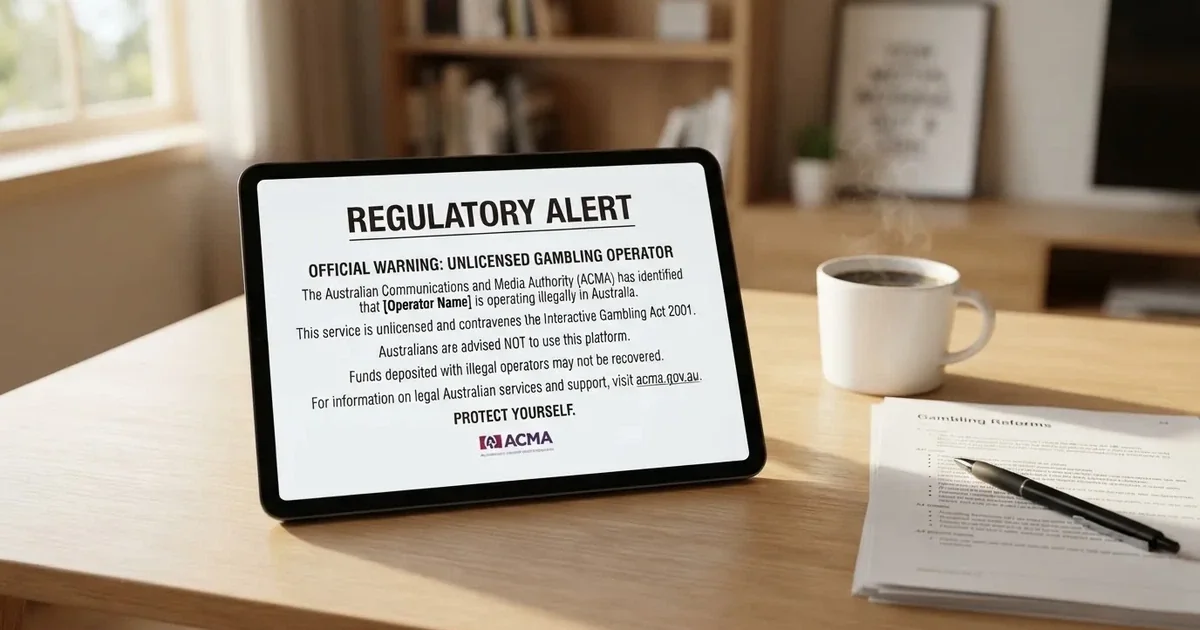
Current as of 29 October 2026 · Verified against the ACMA formal warnings register and the Interactive Gambling Act 2001.
- The two regimes: Curaçao licence vs. Australian prohibition
- What changed when Curaçao reformed in late 2024
- The ACMA’s enforcement record against Curaçao-licensed brands
- Player wellbeing around the Curaçao licence route
- Payment routes an Australian is likely to be asked to use
- The eleven brands the ACMA has acted against
- Choosing between the paths that are actually available
- Frequently asked questions
The two regimes: Curaçao licence vs. Australian prohibition
What a Curaçao licence authorises on its own terms
A Curaçao gaming licence is granted by the Curaçao Gaming Authority under the National Ordinance on Games of Chance, which came into force at the end of 2024 and replaced the older master-licence/sub-licence structure. The new framework splits activity into B2C and B2B licences, both of which carry an application fee of EUR4,592. A B2C licence costs EUR47,450 a year (a EUR24,490 National Treasury licence fee plus a EUR22,960 CGA supervisory fee), and a B2B licence costs ANG48,000 a year with no monthly fee attached. The licence entitles its holder to operate online gambling products under Curaçao’s own laws and to be supervised by the CGA for AML/CFT compliance, which runs through the National Ordinance on Identification and the National Ordinance on Unusual Transactions and is reported through the goAML portal.
The licence does something real on its own terms: it gives the holder a defined regulatory home, a reporting regime and a route for disputes through Curaçao’s own channels. None of that travels automatically. A Curaçao licence is a permission from Curaçao to operate from Curaçao; it is not a permission from any other country to accept that country’s residents.
What the Interactive Gambling Act 2001 prohibits in Australia
Australia’s Interactive Gambling Act 2001, strengthened by the Interactive Gambling Amendment Act 2017, makes it an offence to provide online casino games, online pokies or in-play betting to a person physically in Australia. No state or territory licenses online casino products. What is licensable is wagering on races and sport placed before the event, lotteries and keno — in practice licensed through the Northern Territory Racing and Wagering Commission, which regulates 52 of Australia’s online bookmakers (Sportsbet, Bet365, Ladbrokes among them) for tax reasons, and which the ABC reports has no full-time staff and meets once a month in Darwin.

The IGA targets the provider, not the individual player. An Australian punter does not get prosecuted for logging in. What the Australian player loses, by going offshore, is the consumer protection layer that comes with a locally licensed operator: a complaints body, dispute resolution, and the guarantee that a withdrawal request will be processed on the terms displayed. The offshore operator runs on its own house rules, and those house rules are the only contract the player has.
Where the two regimes meet: an offer made from Curaçao to a person in Australia
This is the case that matters in practice. An operator licensed in Curaçao offers online casino games to a customer in Australia. From the operator’s side, the offer is licensed in Curaçao and the operator is supervised by the CGA. From the Australian side, the offering of those games to a person in Australia is the prohibited act the IGA describes. The two readings are not in conflict because they are about different parties; they describe what each side is permitted to do in its own jurisdiction, and what neither side’s permission does is make the offering legal in the other jurisdiction.
The ACMA’s enforcement record makes this concrete. Between November 2019 and June 2026, the ACMA asked Australian ISPs to block 1,751 illegal gambling and affiliate marketing websites; in the June 2026 round alone, twelve more were added (7Signs, ChromaBet, Donbet, Duospin, Freshbet, Slots Gem, Jacks Club, Lucky Start, Pointsbetz.com, Spinrise, Vinyl Casino and Wildsino). More than 230 unlicensed services have left the Australian market since enforcement was strengthened in 2017. The regulator is not treating offshore sites as a grey area.
What changed when Curaçao reformed in late 2024
The National Ordinance on Games of Chance in plain English
Before the reform, Curaçao ran a system of master licences and sub-licences, in which a handful of master licence holders rented permission to sub-licensees. The new National Ordinance on Games of Chance moved to a direct B2C/B2B licensing regime under the Curaçao Gaming Authority, with each licensee supervised by the CGA itself rather than by a private master. The change tidied the supervisory structure; it did not move Curaçao toward recognising foreign jurisdictions, and it did not create any new standing for Curaçao-licensed operators to take customers from countries that prohibit what they sell.
What the reform did and did not change for an Australian player
For an Australian player, the reform is mostly a question of who supervises the operator, not a question of whether the operator is allowed to take Australian customers. The AML/CFT regime continues to rest on the same ordinances (the National Ordinance on Identification, PB 2017 no. 92, and the National Ordinance on Unusual Transactions, PB 2017 no. 99) and the same goAML reporting portal established under PB 2020 no. 157. A player who has a complaint about a Curaçao-licensed operator takes it up with the CGA, not with the ACMA and not with any Australian dispute resolution service.
The reform did, however, change one thing an Australian player can verify at the point of sign-up. Where a master-licence/sub-licence page could show a sub-licence number issued by a private master, a current page is supposed to show a CGA-issued B2C or B2B number. That is a check worth making — older numbers on older pages are not necessarily evidence of an unlicensed operator, but they are evidence the page has not been updated to reflect the current regime.
The ACMA’s enforcement record against Curaçao-licensed brands
Formal warnings by operator and date
The ACMA publishes formal warnings under the Interactive Gambling Act 2001 when it has grounds to believe an operator is providing prohibited interactive gambling services to people in Australia. The warnings named below are taken from the ACMA’s own register, and the operator named is the operator the ACMA named.
- Pulsup Ltd, March 2026, over RocketPlay (a separate RocketPlay listing; see the operator write-up below for the earlier Dama N.V. action against the brand).
- Dama N.V., May 2022, covering six casino brands: Bambet, Dazard, Level Up, RocketPlay, Wild Tornado and Cobra Casinos. Further formal warnings to Dama N.V. followed in March 2025 over Woo Casino and in May 2025 over Spirit Casino.
- Bamboo Media, July 2025, over Ignition Casino; Consolutetish S.R.L., July 2025, over National Casino and Bizzo Casino (Bizzo had already been the subject of a 2022 formal warning to TechSolutions (CY) Group Limited and TechSolutions Group N.V.).
- EOD Code SRL, February 2025, over Instant Casino.
- Ryker B.V., April 2026, over Jackbit and CasinOK.
- Sterplay Holding Ltd, April 2025, over Casino Intense.
- Hollycorn N.V., September 2022, over Sky Crown and Blue Leo.
What a formal warning actually does
A formal warning is the ACMA’s recorded statement that it has reasonable grounds to believe an operator has breached the IGA. It is not a prosecution, and it does not by itself block the site; the ACMA’s blocking power sits in a separate process, in which it asks Australian ISPs to make the site unreachable for Australian customers. A formal warning is, however, a public record, and it is the ACMA’s stated position that the named operator is offering prohibited services to Australians. The Gamblinginsider.com reporting on ACMA formal warnings notes explicitly that a Curaçao licence is not an Australian licence: no Australian jurisdiction licenses online casinos, and the ACMA has acted against Curaçao-licensed brands including RocketPlay and Bizzo.
The blocking rate since November 2019
Between November 2019, when the first blocking request was made, and June 2026, the ACMA asked Australian ISPs to block 1,751 illegal gambling and affiliate marketing websites. The June 2026 round added twelve more. The arithmetic on that run: roughly 1,751 blocked sites distributed across just over six and a half years of enforcement, which works out to a band of around 20 to 30 sites blocked per month on average over the life of the regime — somewhere in the order of one a day, with the actual pace uneven, since the rounds come in batches rather than daily. The figure is a measure of enforcement throughput, not of the size of the offshore market, and the H2 Gambling Capital 2025 estimate is the relevant cross-check on the latter: Australians lose about A$3.9 billion a year to illegal gambling sites, and the share of gambling going through legal channels fell from 74% in 2021 to 64%. The blocking list keeps growing because the supply does.
Player wellbeing around the Curaçao licence route
What BetStop covers and what it does not
BetStop, the National Self-Exclusion Register, has been live since August 2023 and binds Australian-licensed online and phone wagering services. A person registered with BetStop is excluded from those services for the period they nominate. A Curaçao-licensed online casino is not connected to BetStop and is not bound by a BetStop registration. The exclusion is enforced at the licensed end of the market, which means it does not extend to the offshore end of it. That is the practical limit of the register for an Australian player considering an offshore site.

Bank-side gambling blocks as a separate lever
The big four Australian banks run gambling transaction blocks at card level. Westpac’s gambling block refuses authorisation of transactions registered under the merchant category code for betting and casino gambling on eligible personal credit and debit cards. ANZ’s gambling block, activated in the ANZ app, blocks gambling transactions made through a digital wallet such as Apple Pay on an eligible card, not just the physical card; once it is on, removing it again requires a 48-hour waiting period, and the bank warns that not all gambling transactions will be blocked and that some non-gambling transactions might be blocked in error.
These blocks sit beside BetStop, not underneath it. They are a card-level refusal to authorise the transaction at the moment of payment, and they work for any merchant that uses the relevant MCC, which covers licensed Australian operators and a long list of offshore sites. They do not stop a transfer made through PayID or Osko to a payee the bank does not recognise as a gambling merchant, and they do not stop BPAY, since BPAY is a bill-payment service paid to a Biller Code and CRN rather than a merchant card transaction.
Where to get help if it has become a problem
The National Gambling Helpline is 1800 858 858, free, 24/7, with online chat at Gambling Help Online. The line is staffed for anyone affected by their own or someone else’s gambling, including the family of a player. It is the right first call for a person who is on an offshore site and has decided they want to stop, because the offshore site itself does not run an Australian complaints process and does not connect to BetStop. A bank-side block, a BetStop registration and a call to the helpline are three separate moves that work together rather than as substitutes.
Payment routes an Australian is likely to be asked to use
Cards, wallets and the credit-card ban
Since 11 June 2024, Australian-licensed online wagering services cannot accept payment by credit card or other credit-related products, with penalties up to $247,500 for operators. The restriction also constrains gambling use of linked digital wallets like Apple Pay, since the wallet is just a route to the underlying card. The Reserve Bank of Australia’s July 2025 review proposes removing surcharges only on eftpos, Mastercard and Visa transactions, and explicitly leaves American Express outside the scope of the proposed surcharge ban — Amex runs as a three-party scheme rather than a four-party network, which is why the RBA treats it separately.
By the end of 2025, Apple Pay, Google Pay and Samsung Pay transactions collectively accounted for around 45% of all card payments in Australia by number, which means the credit-card ban reaches a large share of what looks like wallet payments. Apple itself does not charge consumer fees for Apple Pay in stores, online or in apps — any surcharge comes from the merchant’s card-processing fees rather than from Apple — and Apple states that transaction limits and PIN requirements for Apple Pay purchases are set by the card issuer or merchant, not by Apple.
PayID, Osko and BPAY as the legal deposit routes
For an Australian-licensed wagering service, the legal deposit routes are debit card, bank transfer, PayID/Osko and BPAY. Osko is the instant part of the New Payments Platform, and a bank transfer between participating Australian banks arrives in under a minute, 24/7, including weekends, whether it is addressed to a BSB and account number or to a PayID. PayID shows the name of the account holder before the transfer is sent, and Australian Payments Plus warns that being asked to transfer money to a PayID on an illegal gambling site almost certainly means a scam site — which is a useful check, not a guarantee, but it is the kind of check a PayID transfer lets the punter make at all.
PayID-based instant transfers are available at over 100 Australian financial institutions, and more than 25 million PayID identifiers had been registered on Australia’s New Payments Platform as of April 2025. The platform itself became accessible to the public on 13 February 2018 and is owned by New Payments Platform Australia Ltd, a non-profit whose 13 shareholders include the Reserve Bank of Australia and the major banks; participants must keep the platform’s monthly outages to no more than two minutes. The ACCC authorised merging NPP Australia with BPAY and eftpos into a single company, Australian Payments Plus, in 2021, and AP+ now runs PayID, Osko and BPAY together.
BPAY has operated in Australia since 1997, is available in the online banking of over 140 banks and financial institutions, and is offered by over 95,000 businesses. It is a bill-payment service: the payer enters the Biller Code and the Customer Reference Number printed on the bill. It is run by Australian Payments Plus. AUSTRAC’s threshold-transaction-report rule requires reporting of transfers of A$10,000 or more, but only for physical cash; ordinary electronic bank transfers are not subject to that per-transaction reporting requirement regardless of amount.
What an offshore site asking for credit card or crypto tells the player
A site asking an Australian for a credit card deposit, or for a crypto deposit, is operating outside the rules that apply to Australian-licensed wagering services. That is not a verdict on the site’s honesty in any given transaction, but it is a flag. The credit-card ban and the digital-currency ban are written into the IGA regime for licensed Australian operators; an offshore operator is not bound by them and there is no Australian complaints route to enforce them if something goes wrong on the deposit.
The eleven brands the ACMA has acted against
How to read the entries below
Each entry below is one of the eleven brands the ACMA itself has issued a formal warning over for offering prohibited interactive gambling services to Australians. The operator named is the one the ACMA named. None of these brands is licensed to offer online casino games in any Australian jurisdiction. No bonus terms are listed here, because the only sources for bonus terms on these brands were affiliate marketing pages rather than the operators’ own terms.
RocketPlay
The ACMA named Pulsup Ltd as the operator behind RocketPlay in a formal warning issued in March 2026. The brand had earlier been the subject of a May 2022 warning to Dama N.V., which covered six brands including RocketPlay. A second operator on the same brand is itself the clearest signal the ACMA is sending: the brand has moved between operators and the activity has continued. Online casino games cannot be licensed anywhere in Australia, whatever licence the site displays. Industry reporting names the brand in listings of Curaçao-licensed operators. The honest read for a player: the brand has been the subject of ACMA action twice, in 2022 and again in 2026, and the second action was against a different operator than the first.
Level Up Casino
The ACMA named Dama N.V. as the operator behind Level Up Casino in a formal warning issued in May 2022, in the same round that covered Bambet, Dazard, RocketPlay, Wild Tornado and Cobra Casinos. The brand sits on the older Dama N.V. group of sub-licensed brands that the ACMA acted against in 2022. Industry listings on Westpac’s gambling-block page reference casino merchants in the same MCC family. The honest read: the formal warning is five years old at this point, but the prohibition is ongoing, and there is no Australian licence that has been issued in the interim.
Woo Casino
The ACMA named Dama N.V. as the operator behind Woo Casino in a formal warning issued in March 2025, as a follow-on to the 2022 Dama N.V. round. This brand has no public connection to local payment methods or exclusion tools. Our take: a current formal warning from 2025, against the same operator that the ACMA warned in 2022 about a different set of brands, and the prohibition is the same as it has always been.
Spirit Casino
The ACMA named Dama N.V. as the operator behind Spirit Casino in a formal warning issued in May 2025, in the same year as the Woo Casino action. No public source connects Spirit Casino to Australian-specific payment methods or self-exclusion tools. Key takeaway: a 2025 formal warning against a brand the ACMA had not previously named, from the same operator group as the Woo Casino action, and the prohibition applies.
National Casino
The ACMA named Consolutetish S.R.L. as the operator behind National Casino in a formal warning issued in July 2025, in the same round that covered Bizzo Casino. Industry listings name the brand in connection with AUSTRAC, BetStop and the ACMA register. Our take: the brand sits in the same 2025 round as Bizzo, with a different operator than the one named in the 2022 TechSolutions warning.
Bizzo Casino
The ACMA named Consolutetish S.R.L. as the operator behind Bizzo Casino in a formal warning issued in July 2025; Bizzo had already been the subject of a 2022 formal warning to TechSolutions (CY) Group Limited and TechSolutions Group N.V. Two separate warnings against two separate operators on the same brand is the same signal the RocketPlay entry carries, and the second warning was issued against a different operator than the first. Industry reporting names Bizzo among the Curaçao-licensed brands the ACMA has acted against. Bottom line: the brand has faced two warnings (2022 and 2025) across different operators, while the prohibited service remains unchanged.
Ignition Casino
The ACMA named Bamboo Media as the operator behind Ignition Casino in a formal warning issued in July 2025, in the same round as National Casino and Bizzo Casino. This brand has no public connection to local payment methods or exclusion tools. Takeaway: named in a 2025 ACMA warning, this brand holds no Australian licence.
Instant Casino
The ACMA named EOD Code SRL as the operator behind Instant Casino in a formal warning issued in February 2025. Industry listings name the brand in connection with ecoPayz and PayID. The honest read: the warning is recent, and the brand sits on payment routes an Australian player is likely to recognise. The presence of PayID in a listing is exactly the kind of signal the ACMA’s blocking action is reacting to — a deposit route aimed at Australian customers.
Jackbit
The ACMA named Ryker B.V. as the operator behind Jackbit in a formal warning issued in April 2026, in the same round as CasinOK. No public source connects Jackbit to Australian-specific payment methods or self-exclusion tools. Observation: a current 2026 formal warning, against an operator the ACMA had not previously named on this page’s set.
Casino Intense
The ACMA named Sterplay Holding Ltd as the operator behind Casino Intense in a formal warning issued in April 2025. Industry listings name the brand in connection with AUSTRAC, BetStop and Gamblinginsider.com’s coverage of ACMA formal warnings. Note: this 2025 warning links the brand directly to Australian regulatory architecture.
Sky Crown
The ACMA named Hollycorn N.V. as the operator behind Sky Crown in a formal warning issued in September 2022, in the same round that covered Blue Leo. No public source connects Sky Crown to Australian-specific payment methods or self-exclusion tools. Summary: the warning is the oldest in the eleven-brand set, and the prohibition is the same as it has always been — no Australian licence exists.
Choosing between the paths that are actually available
The onshore path: what it offers and what it does not
The onshore path is wagering on races and sport placed before the event, lotteries and keno, licensed through the NTRWC or a state regime. It runs under Australian law, takes Australian complaints, pays out under Australian consumer protection rules, connects to BetStop for self-exclusion and is paid through the legal deposit routes described above. It does not offer online casino games or online pokies, because no Australian jurisdiction licenses them, and it does not offer in-play betting on sport, because the IGA prohibits that too. An Australian player who wants a casino product cannot get it onshore, full stop; the onshore path is the right answer for wagering, lottery and keno, and it is not the right answer for casino.
The offshore path: what it costs the player
The offshore path is the only path on which online casino games and online pokies are actually available. It runs under the licence of the country the operator has chosen, which in most of these cases is Curaçao. What it costs the player is the layer the onshore path provides: no Australian complaints body, no BetStop connection, no guarantee of payout on the terms displayed, and the standing possibility that the site is blocked with a balance still on it. The marketing language used on offshore sites is built around the licence, not around the legal standing of the offer in the player’s country, and the two are not the same thing.
Where the choice actually sits
For a person who wants to bet on a horse race or a football match before the event, the onshore path is the answer. For a person who wants to play online casino games or online pokies, no Australian-licensed path exists, and any site offering them is offering them under a foreign licence in a country that prohibits the offer. That is the choice the rest of this page has been building toward: not which Curaçao-licensed casino is best, because the question does not have an answer that an Australian licensing regime recognises, but which path the player wants to be on given what each path actually delivers.
Frequently asked questions
Does a Curaçao gaming licence give an operator any legal standing to serve Australian players?
No. The Interactive Gambling Act 2001 prohibits offering online casino games and online pokies to people in Australia regardless of where the operator holds its licence, and no Australian jurisdiction licenses those products. A Curaçao licence is a permission from Curaçao to operate from Curaçao; it does not make the offering legal in Australia.
What changed when Curaçao’s National Ordinance on Games of Chance took effect?
The National Ordinance on Games of Chance replaced the older master-licence/sub-licence system with a direct B2C/B2B regime under the Curaçao Gaming Authority. The reform tidied the supervisory structure and changed the licence numbers displayed on a current operator page; it did not give Curaçao-licensed operators any new standing to take customers from countries that prohibit what they sell.
Who is the regulator behind a Curaçao gaming licence?
The Curaçao Gaming Authority (CGA) is the regulator under the current regime, and the AML/CFT reporting runs through the goAML portal established under PB 2020 no. 157. The underlying ordinances are the National Ordinance on Identification (PB 2017 no. 92) and the National Ordinance on Unusual Transactions (PB 2017 no. 99).
Does the ACMA treat a Curaçao-licensed site any differently from an unlicensed one?
In practice, no. The ACMA’s formal warnings over Curaçao-licensed brands including RocketPlay, Bizzo, Woo Casino and Spirit Casino name the licence status as a separate fact from the breach: the operator is licensed in Curaçao and is also offering prohibited services in Australia, and the ACMA acts on the second fact rather than on the first.
Can an Australian pursue a dispute against a Curaçao-licensed operator through an Australian regulator?
No. The ACMA’s role is to enforce the IGA against the provider, not to resolve individual player disputes. An Australian player with a complaint about a Curaçao-licensed operator takes it up with the CGA, and there is no Australian consumer protection body with jurisdiction over the dispute.
How does a Curaçao licence differ from the licences held by Australian land-based casinos?
Australian land-based casino licences are issued by state and territory regulators and cover physical venues. A Curaçao licence is issued by the CGA and covers online products operated from Curaçao. Neither licences the other jurisdiction, and the IGA prohibits online casino products from being offered to people in Australia regardless of the offshore licence held.