
Pokies in Sydney in 2026: Where They Are Actually Legal, What the Floors Cost, and What the ACMA Has Been Doing About the Rest
Sydney runs tens of thousands of poker machines. Two of them sit in casino towers overlooking the harbour; the rest live behind the bar in pubs and clubs across every suburb from Penrith to Parramatta, from Bondi to Blacktown. A search for the “best pokies in Sydney” in 2026 turns up a long tail of offshore sites branded with the word, and they have no lawful product to sell a person in NSW. The land-based scene is large, locally regulated, and very Australian. The online scene is something else entirely: a prohibited interactive gambling service, actively policed, and almost universally unlicensed for what it advertises. The honest page makes that split first and then walks the reader through what is actually on offer in each half.
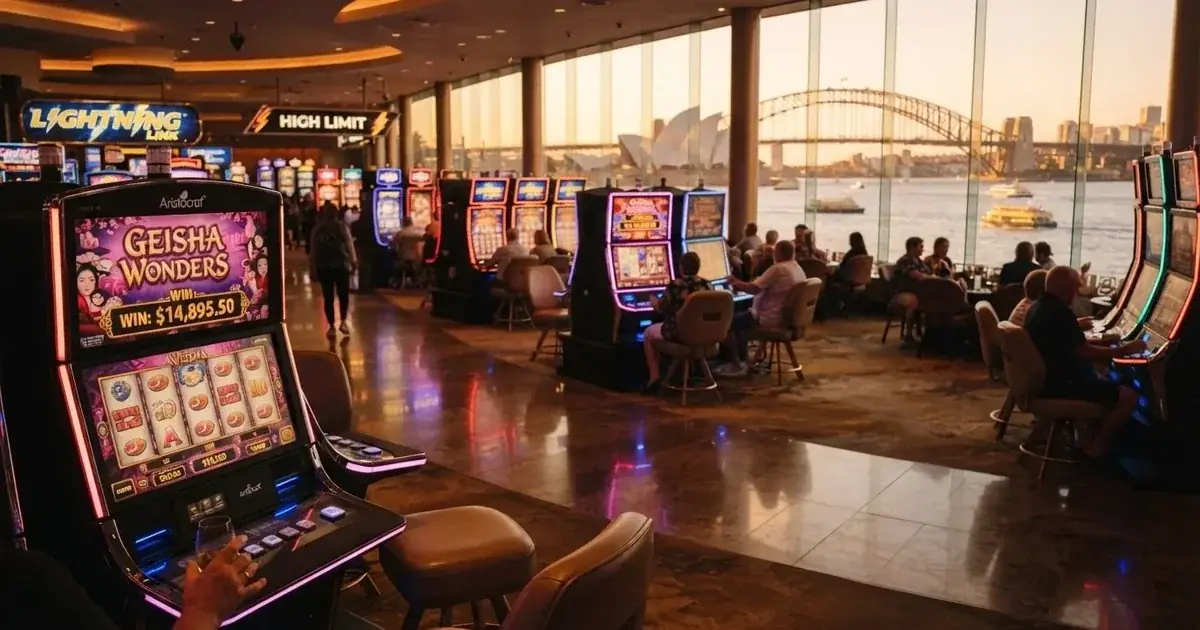
Data current as of 29 October 2026, checked against the Australian Communications and Media Authority register and NSW Liquor and Gaming NSW records.
- The shortlist: the venues and the offshore sites
- What “best” actually means for a Sydney punter
- Sydney’s two casino floors, side by side
- The pub and club network: 87,298 machines outside the two casinos
- The “near me” question and the CBD
- What offshore “pokies sites” actually are
- What the ACMA has actually done: the blocking-rate picture
- Why the offshore option is not really an option
- Responsible gambling: what is actually available in Sydney
- What the Crown and Star situation tells the regulator
- Sydney as a comparison: Sydney, Adelaide, Brisbane
- Tax and winnings: the boring bit that matters
- What to do with this page
- Frequently asked questions about pokies in Sydney
The shortlist: the venues and the offshore sites
Eleven names turn up most often when Australians search “best pokies in Sydney 2026”. Three of them are real venues with real floors. Eight are offshore casino brands the ACMA has formally warned. The split is not a stylistic preference; it is what the law looks like in this country, and naming it clearly is the first job of a useful comparison.
| Brand | ACMA action and date | Operator named by the ACMA | Sydney venue or offshore brand |
|---|---|---|---|
| The Star Sydney | No ACMA action; casino licence held, suspended September 2022, special manager since | n/a — Australian-licensed | Pyrmont, two gaming floors, 351 hotel rooms, Lyric theatre |
| Crown Sydney | No ACMA action; casino licence held | n/a — Australian-licensed | Barangaroo, 75-floor tower, tallest building in Sydney |
| SkyCity Adelaide | No ACMA action (SA regulator) | n/a — South Australian casino | Reference comparison, not a Sydney venue |
| RocketPlay | Formal warning March 2026 (Pulsup Ltd); earlier May 2022 (Dama N.V.) | Pulsup Ltd | Offshore; product prohibited in Australia |
| Level Up Casino | Formal warning May 2022 | Dama N.V. | Offshore; product prohibited in Australia |
| Woo Casino | Formal warning March 2025 | Dama N.V. | Offshore; product prohibited in Australia |
| Spirit Casino | Formal warning May 2025 | Dama N.V. | Offshore; product prohibited in Australia |
| National Casino | Formal warning July 2025 | Consolutetish S.R.L. | Offshore; product prohibited in Australia |
| Bizzo Casino | Formal warning July 2025 (Consolutetish); 2022 (TechSolutions) | Consolutetish S.R.L. | Offshore; product prohibited in Australia |
| Ignition Casino | Formal warning July 2025 | Bamboo Media | Offshore; product prohibited in Australia |
| Instant Casino | Formal warning February 2025 | EOD Code SRL | Offshore; product prohibited in Australia |
| Jackbit | Formal warning April 2026 | Ryker B.V. | Offshore; product prohibited in Australia |
| Casino Intense | Formal warning April 2025 | Sterplay Holding Ltd | Offshore; product prohibited in Australia |
| Sky Crown | Formal warning September 2022 | Hollycorn N.V. | Offshore; product prohibited in Australia |
A search for Sydney pokies rarely surfaces this distinction so baldly. Most affiliate pages list offshore casino brands as if they sat beside Crown in a city guide. They do not. Crown Sydney and The Star Sydney are licensed under the Casino Control Act 1992 (NSW). Everything below them on that table is an interactive gambling service that no Australian regulator licenses to provide casino games to a person physically in Australia, and the ACMA’s enforcement log shows it has said so in writing to each of their operators.
What “best” actually means for a Sydney punter
Any ranking worth reading starts with the criteria. For Sydney pokies, six separate things decide whether a venue is worth the trip, and they are not the six an affiliate page usually picks.
The first is licensing. A venue is either licensed by Liquor and Gaming NSW for pub and club machines, or by the NSW Independent Casino Commission for a casino floor, or it is not a venue at all. The Star Sydney is licensed; its licence is currently under special management. Crown Sydney holds a clean licence. Every offshore brand on the table above has been the subject of a formal warning under the Interactive Gambling Act 2001 — the regulator’s way of stating in writing that the service is unlawful.
The second is the return-to-player rate. NSW pub and club machines must return a minimum of 85.0% to players in the long run, though most modern machines sit in the 87–92% band depending on denomination and game type. Sydney’s two casino floors are not bound by that floor — Crown’s gaming machines are operated under the casino’s own published RTP, generally higher than pub machines because the maximum stake is also higher. South Australia sets a 87.5% minimum outside its casino, a number worth knowing for travellers comparing state to state.
The third is the stake band. NSW pubs and clubs are capped at A$10 per spin on most machines. Crown Sydney’s casino floor can take substantially higher bets and offers table games alongside the machines, which the pub does not. A “high limit pokies” session in Sydney in 2026 means a Crown or Star floor, not a suburban club.
The fourth is access hours. NSW pubs and clubs cannot open gaming machine areas before 10am and must close them by midnight (with extensions to 1am or 2am depending on the venue’s liquor licence conditions and trading hour approval). A 24-hour floor is not available outside the two Sydney casinos. That is a real answer to the “around the clock” question and it surprises visitors.
The fifth is self-exclusion. The Star Sydney and Crown Sydney are connected to the NSW self-exclusion register run by the Office of Responsible Gambling. Pub and club machines are connected to the same scheme through the venue. BetStop, the National Self-Exclusion Register, covers licensed online and phone wagering services; it does not reach an offshore casino, which is one of the practical costs of using one.
The sixth is the location, and “near me” is the phrase every searcher types but no affiliate answers honestly. Crown sits at Barangaroo on the western edge of the CBD, ten minutes’ walk from Wynyard. The Star sits at Pyrmont, a single stop on the light rail from Central. Both are close to the airport by comparison: 20–25 minutes by taxi or rideshare, longer in peak traffic. Pokies near Sydney Airport in the licensed sense means Crown’s Barangaroo floor; everything else claiming the convenience is an offshore brand without a venue.
Sydney’s two casino floors, side by side
Crown Sydney and The Star Sydney are the only two venues in the harbour city licensed to run a full casino floor with table games and poker machines operating under the Casino Control Act 1992. They are not interchangeable. They have very different recent histories, and a punter walking in for the first time in 2026 is choosing between two distinct buildings with two distinct reputations.
Crown Sydney at Barangaroo
Crown Sydney opened in December 2020 inside a 271.3 m residential and hotel tower — the tallest habitable building in Sydney, designed by WilkinsonEyre with interiors by Bates Smart. The tower is the building; the casino occupies a defined portion of its lower floors. Crown Resorts holds the licence. After the Bergin Commission findings into Crown Melbourne’s suitability, Crown’s NSW licence was made conditional on a period of independent oversight; that oversight was lifted in 2023 after Crown demonstrated remediation against money-laundering and responsible-gambling obligations. As of 2026 Crown Sydney operates a clean casino licence, and its gaming floor runs alongside the hotel, several restaurants, and a members’ area on the upper levels.
The machine selection at Crown is curated from the major international suppliers — Aristocrat and IGT (including the lightweight “Bombay” and “Wonder 4” series common to Australian floors), Konami, Ainsworth, and Scientific Games. Denominations stretch from one cent to five dollars on the main floor, with higher-limit rooms above. Table games cover baccarat, blackjack, roulette, and poker variants.
The Star Sydney at Pyrmont
The Star Sydney opened in 1995 as the Sydney Harbour Casino and has been through more corporate upheaval than any other Australian casino. It sits in Pyrmont, overlooking Darling Harbour, and is owned by Star Entertainment Group. As a venue it is large: two gaming floors, 351 hotel rooms, the 2,000-seat Sydney Lyric theatre, and a 3,000-seat Event Centre — the full entertainment complex rather than just a gambling floor.
The Star’s machine mix is similarly wide, leaning on the Aristocrat and IGT catalogues that dominate Australian floors, with a particular emphasis on the high-volatility titles that suit longer sessions. The Star’s table-game offering is broader than Crown’s and its poker room runs cash games and tournaments throughout the week.
What makes The Star unusual in 2026 is its regulatory position. On 13 September 2022 the NSW Independent Casino Commission found The Star unsuitable to hold its casino licence over money-laundering and responsible-gambling failures in what became known as the Bell Review. A A$100 million civil penalty followed in October 2022. A special manager, Nicholas Weeks, was appointed and remains in place through at least September 2025. On 10 February 2025 ASIC sued former Star directors over failures to track the same money-laundering risks. The Star Sydney is therefore a licensed casino under special management — open, operating, but supervised in a way that no other Australian casino currently is.
A punter walking in in 2026 is buying the gaming floor and not the operator’s reputation. The floor is the same set of machines and the same running of the same table games; the regulator’s findings sit in a stack of reports that the venue itself had no choice but to publish.
Which one to choose
Both venues sit within fifteen minutes of each other by taxi and either is reachable from the CBD on foot. The practical differences for a punter are these: Crown is newer, the building is more architecturally distinguished, and the operator is currently in good standing with the regulator. The Star is older, has the larger convention and theatre capacity, and runs a deeper poker schedule; the operator is supervised and the supervision is itself a public fact.
A high-limit machine player at Crown will find the curated high-limit room and the modern building worth the trip. A poker player heading to The Star is buying access to a more developed cash and tournament schedule and a venue that is used to hosting poker events. Neither venue charges an entry fee for general access to the gaming floor; the cost is what a player spends on the machines or tables.
The pub and club network: 87,298 machines outside the two casinos
Sydney’s real pokies footprint sits outside the two casino towers. As of June 2023, New South Wales had 87,298 gaming machines outside casinos across 2,195 venues. That is the actual scale of the licensed pokies market in Sydney: tens of thousands of machines in clubs and pubs spread across every local government area, from RSLs in the inner west to leagues clubs in the western suburbs to hotel pokies rooms in the CBD.
These machines operate under the Gaming Machines Act 2001 (NSW) and the regulations made under it. The rules are uniform: a minimum return to player of 85.0% (most venues run machines between 87% and 92%); a maximum stake of A$10 on most machines; mandatory shutdown between midnight and 10am unless the venue holds a specific extended-hour approval; mandatory pre-commitment and break requirements under the state’s responsible-gambling framework; mandatory signage about Gambling Help and the self-exclusion register; and mandatory ID checks against the NSW Photo Card database at the entrance to a gaming machine area.
The pub and club machines also operate under a “harm minimisation” levy. Money collected funds the Responsible Gambling Fund, which administers Gambling Help, the self-exclusion scheme, and counselling services across NSW. NSW recorded A$8.18 billion in annual player losses from poker machines outside casinos in FY22-23, which works out to A$986 per capita — the highest per-capita machine losses of any Australian state. That number is the real scale of the licensed pokies market in Sydney.
What “best paying” actually means in a pub
Search results for “best paying pokies in Sydney” tend to mix up two things: a particular machine’s published return-to-player, and the player share the venue reports to the regulator. A single machine has a single RTP — a property of the game and the denomination, not of the venue. The player share reported to Liquor and Gaming NSW is an aggregated figure across a venue’s whole machine bank and is updated quarterly. For a punter choosing between two venues, the higher reported player share is the more informative number, because it captures the average behaviour of every machine on the floor, not just one title.
The honest version of “best paying pokies in Sydney” is therefore a description, not a list. Most modern machines in the 87–92% band are within a few percentage points of each other; the practical difference over a session is dwarfed by stake size and time played. A punter asking which venue has the highest machine return is asking the right question; the answer is rarely a single name, and a page that names one without the underlying assumption (which machine, which denomination, which quarter) is selling confidence it has not earned.
The “near me” question and the CBD
Most of the searches for Sydney pokies are local. The phrase “pokies near me” is shorthand for “what licensed venues are within walking distance of where I am right now”, and the answer depends entirely on the suburb. The honest answer for a tourist asking “pokies in Sydney CBD” is the same Crown or Star recommendation as for a tourist staying in the CBD: Crown at Barangaroo, The Star at Pyrmont, plus the gaming machine floors of the larger CBD pubs and clubs (the City Tattersalls Club, the Castlereagh Boutique Hotel, the West Hotel Sydney’s gaming lounge, the CBD’s Hotel Establishment and a handful of others). None of those pubs match a casino floor for machine selection, hours, or maximum stake; they match the convenience question and stop there.
For a traveller landing at Sydney Airport, the closest licensed pokies are not actually at the airport. The airport’s gaming lounge operated for some years; the current configuration runs a small machine area inside the international terminal, but the licensed floor is the casino and the trip is fifteen to twenty minutes by taxi from the domestic terminal to either Crown or The Star.
What offshore “pokies sites” actually are
The other half of this page is the harder one to write, because the affiliate market around “best pokies in Sydney” is full of sites that do not have a venue and have no Australian licence. These sites take deposits in Australian dollars, market themselves with Sydney landmarks in their banner images, and run pokies as the centrepiece of their product. Several of them are on the table at the top of this page and all of them are formally prohibited interactive gambling services under the Interactive Gambling Act 2001.
RocketPlay, Level Up Casino, Woo Casino, Spirit Casino — the Dama N.V. cluster
Four of the brands above sit under the same operator name. The ACMA issued a formal warning to Dama N.V. in May 2022 covering six casino brands including RocketPlay and Level Up Casino. It then issued a further warning to Dama N.V. over Woo Casino in March 2025 and a fourth over Spirit Casino in May 2025. The pattern is the regulator repeatedly catching the same operator under different brand names after rebranding.
The Dama cluster illustrates the structural problem: warnings are formal, public, and dated, but the operators can register a new domain in a matter of days and continue. The ACMA’s blocking round reported in June 2026 covered 12 sites — 7Signs, ChromaBet, Donbet, Duospin, Freshbet, Slots Gem, Jacks Club, Lucky Start, Pointsbetz, Spinrise, Vinyl Casino and Wildsino — none of which are Dama brands. The next round will likely catch them again under different names. The takeaway is structural: the formal warning serves as the regulator’s primary intervention mechanism, though operators often circumvent it by cycling through new domain names.
National Casino and Bizzo Casino — Consolutetish S.R.L.
In July 2025, the ACMA issued a formal warning to Consolutetish S.R.L. covering both National Casino and Bizzo Casino. Bizzo had already been the subject of a 2022 formal warning to TechSolutions (CY) Group Limited and TechSolutions Group N.V., the entities that ran the brand before Consolutetish took over. The progression — TechSolutions to Consolutetish, 2022 to 2025, three years of rebranding — is the same shape as the Dama cluster. National Casino is the more recently launched of the two; Bizzo is the older brand with the longer enforcement history.
Ignition Casino — Bamboo Media
The ACMA’s July 2025 wave also covered Ignition Casino, operated by Bamboo Media. Ignition is one of the older offshore casino brands targeting Australian players; the formal warning acts as an unambiguous notice that the service is unlawful and provides no consumer protection for any Australian user.
Instant Casino — EOD Code SRL
In February 2025 the ACMA issued a formal warning to EOD Code SRL over Instant Casino. The Instant Casino brand markets heavily on Australian traffic and has been the subject of several rounds of affiliate promotion; the formal warning is the regulator’s standing answer.
Jackbit — Ryker B.V.
In April 2026, the ACMA issued a formal warning to Ryker B.V. covering both Jackbit and CasinOK. Jackbit had been on the affiliate circuit for some months before the warning; the formal warning puts the brand on the regulator’s published list and is the precursor to a blocking request.
Casino Intense — Sterplay Holding Ltd
The ACMA issued a formal warning to Sterplay Holding Ltd over Casino Intense in April 2025. Casino Intense runs a smaller product catalogue than the Dama cluster but has been named in Australian-facing affiliate promotion for years.
Sky Crown and Blue Leo — Hollycorn N.V.
Hollycorn N.V. was the subject of an earlier formal warning covering its Sky Crown and Blue Leo casino services. The Hollycorn warning dates from September 2022, making it one of the longer-running entries on the ACMA’s published list and a useful comparison for how long an offshore operator can continue to advertise to Australian traffic after a formal warning.
What the ACMA has actually done: the blocking-rate picture
The ACMA has been requesting that Australian internet service providers block illegal gambling websites since November 2019. As of June 2026, the running total stands at 1,751 illegal gambling and affiliate marketing websites blocked since that first request, with more than 230 unlicensed gambling services having left the Australian market since enforcement was strengthened in 2017.
Putting those figures together gives a clear measure of the regulator’s reach: from November 2019 to June 2026, approximately seven years of blocking requests have produced 1,751 blocked sites. That works out to roughly 250 blocked sites per year, or about 21 per month, or just under one per business day on average. The rate has been anything but even — the early rounds caught dozens of sites at a time and the recent rounds have caught twelve or fewer — but the long-run figure is a meaningful band for what Australian enforcement looks like in practice.
The condition on that band is the size of the affiliate-marketing universe behind it. The ACMA’s count covers both the casino sites themselves and the affiliate pages that funnel traffic into them. A useful comparison is the H2 Gambling Capital figure: Australians lose about A$3.9 billion a year to illegal gambling sites, and the share of gambling going through legal channels fell from 74% in 2021 to 64% across that window. The blocking-rate figure describes one side of the equation; the loss figure and the legal-share figure describe the other. Read together, they describe an enforcement programme catching about 250 sites a year against a market running several billion dollars of annual outflow.
The June 2026 round asked ISPs to block twelve more sites: 7Signs, ChromaBet, Donbet, Duospin, Freshbet, Slots Gem, Jacks Club, Lucky Start, Pointsbetz, Spinrise, Vinyl Casino and Wildsino. They are not on the page’s table above because the table tracks formal warnings, not blocking rounds, and the two are separate regulatory tools. The blocking request is what closes a site to Australian traffic; the formal warning is what the regulator issues before it gets there.
Why the offshore option is not really an option
A punter who tries one of the offshore brands above is doing four things that the licensed market does not require.
They are using a prohibited interactive gambling service. The Interactive Gambling Act 2001, as amended by the Interactive Gambling Amendment Act 2017, makes it an offence for a provider to offer online casino games, online pokies or in-play betting to a person in Australia. The IGA targets the provider, not the player; an individual Australian punter will not be prosecuted. That distinction does not make the service lawful; it makes the customer unprotected.
They are giving up Australian consumer protection. A licensed Australian operator is bound by Australian dispute resolution and consumer law; an offshore operator is not. A withdrawal refused by an offshore casino has no Australian complaints body to escalate to. The ACMA’s enforcement is one-directional: it blocks the site, it does not adjudicate the punter’s claim against the operator. A balance on a blocked site is, in practice, gone.
They are excluded from the Australian self-exclusion framework. BetStop, the National Self-Exclusion Register, has been live since August 2023 and binds Australian-licensed online and phone wagering services. An offshore casino is not connected to it. A punter who has self-excluded under BetStop and then plays at an offshore casino has stepped outside the framework entirely. The NSW Pub and Club Self-Exclusion scheme and the casino self-exclusion scheme are similarly local.
They are using payment methods the regulator has actively ruled out for the licensed market. Credit cards, credit-related products and digital currency have been banned as payment for licensed online wagering since 11 June 2024, with penalties of up to A$247,500 for operators accepting them. A licensed wagering service must offer debit card, bank transfer, PayID/Osko or BPAY. An offshore casino that takes a credit card or a Bitcoin deposit is operating outside the Australian rules; the punter is using a payment rail the regulator has said is unfit for the purpose.
H2 Gambling Capital’s 2025 estimate that Australians lose about A$3.9 billion a year to illegal gambling sites is the headline cost of this gap. The legal-share figure — 74% in 2021, 64% more recently — is the trend line, and the trend is towards the offshore option growing share against the licensed one. That is the policy frame behind the 2026 reform: the Interactive Gambling Amendment (Gambling Reform) Bill 2026 passed Parliament on 19 August 2026 and its advertising and inducement measures commence on 1 January 2027. The bill is law with a future commencement date, not law in force on a 2026 page.
Responsible gambling: what is actually available in Sydney
For a Sydney punter in 2026, the responsible-gambling framework is genuinely available across the licensed market and not at all across the offshore one.
Gambling Help Online is the national counselling service. It runs 24/7, free, with chat and phone at 1800 858 858. The service is funded by the Responsible Gambling Fund in NSW and its equivalents in other states. The phone line takes calls from anywhere in Australia and is the first call a punter, a family member, or a venue staff member should make when something is going wrong.
BetStop, the National Self-Exclusion Register, is the scheme for online and phone wagering. A punter can register with BetStop and the licensed Australian wagering operators are bound to refuse their service for the exclusion period. The scheme does not bind offshore operators; an Australian punter who has self-excluded under BetStop will not be protected at an offshore casino. The exclusion period is a minimum of three months and can be set longer.
In NSW, the pub and club self-exclusion scheme operates at the venue level. A punter who self-excludes from a particular pub or club is barred from its gaming machine area and the venue is required to enforce the exclusion. The Crown Sydney and The Star Sydney self-exclusion schemes operate at the casino level and are managed by each operator under the supervision of the NSW Independent Casino Commission. A self-excluded punter at Crown is barred from the casino floor; the same at The Star.
The NSW Office of Responsible Gambling runs the broader harm-minimisation programme, including signage requirements at venues, mandatory break and pre-commitment features on pub and club machines, and the funding of Gambling Help. The pre-commitment feature is built into every modern NSW pub and club machine: a punter sets a daily, weekly or monthly loss limit before play and the machine enforces it.
The Northern Territory Racing and Wagering Commission touches this list only obliquely: it regulates 52 of Australia’s online bookmakers — the major names including Sportsbet, Bet365 and Ladbrokes — because the operators chose to licence in the Territory for tax reasons. The commission has no full-time staff and meets once a month in Darwin, which is a structural curiosity of Australian gambling regulation but not directly relevant to a punter choosing between Crown and The Star.
What the Crown and Star situation tells the regulator
The Crown and Star cases are worth reading together because they are the regulator’s clearest statements about how the Australian casino licensing system actually enforces its standards.
The Bell Review, the formal name for the NSW Independent Casino Commission inquiry into The Star, ran across 2022 and produced the finding of unsuitability in September 2022. The findings covered money-laundering risk management, responsible-gambling controls, and corporate governance. The penalty was a A$100 million civil penalty in October 2022, the appointment of a special manager, and the suspension of the licence pending remediation. The ASIC civil action against former Star directors on 10 February 2025 is the second phase of the same response: it puts the directors personally on the hook for the conduct that the regulator found. Star’s Queensland operations were found unsuitable in late 2022 by the Gotterson review and Star was fined A$100 million on 9 December 2022; the 90-day suspension of the Treasury Brisbane and Star Gold Coast licences was deferred to 1 December 2023 to allow remediation.
Crown’s NSW position is the inverse. Crown Resorts was the subject of the Bergin Commission in NSW and the Finkelstein inquiry in Victoria over its own suitability findings; Crown’s NSW casino licence was made conditional on remediation, the remediation was demonstrated, and the conditions were lifted. Crown Sydney’s 2026 operation is therefore the working example of a casino that passed through the regulatory gauntlet and emerged with a clean licence.
The reading for a Sydney punter is not that one venue is “good” and the other “bad”. Both venues run licensed gaming floors under the Casino Control Act 1992 (NSW). The Star is under special management because the regulator found it unsuitable and is supervising the remediation; the supervision is itself the evidence that the regulatory system can act. Crown is the comparison case showing that remediation works and that the licence conditions come off when it does. A punter choosing between them in 2026 is choosing between two licensed floors with very different recent histories; the choice is about venue and operator reputation, not about whether the floor is lawful.
Sydney as a comparison: Sydney, Adelaide, Brisbane
The other state capitals give a useful reference frame for what Sydney’s licensed pokies market looks like.
Adelaide has SkyCity Adelaide, operating inside the heritage-listed Adelaide railway station on North Terrace. It is South Australia’s only casino, regulated by the state’s Independent Gambling Authority, and runs 90 gaming tables and 950 gaming machines. South Australia had 11,672 gaming machines outside Adelaide Casino in 471 venues in September 2023, and A$0.92 billion in losses outside Adelaide Casino in 2022-23, equivalent to about A$497 per adult. South Australia sets a minimum gaming-machine return-to-player of 87.5% and a general maximum bet of A$5.00 outside the casino; Adelaide Casino itself has no maximum-bet limit. Adelaide Casino’s table-game monopoly was extended to 30 June 2035 under a licence formalised on 11 October 2013.
Brisbane’s casino landscape is in transition. The Treasury Casino, which had operated inside the historic Treasury Building since April 1995, closed on 25 August 2024 to make way for the new Star casino at Queen’s Wharf. The Star Brisbane began a staged opening at the A$3.6 billion Queen’s Wharf precinct on 29 August 2024, with the main casino floor and premium gaming rooms opening first. The opening was clouded by the licence concerns around Star Entertainment Group that followed the Gotterson review. Queensland had 21,122 gaming machines operating in 351 venues in October 2023.
Sydney compares on size, not on per-capita intensity. The 87,298 NSW pub and club machines are well above Queensland’s 21,122 and well above South Australia’s 11,672, but NSW’s population is roughly twice either of those states, so the per-capita figure is closer. The per-capita loss is what makes the comparison sharp: A$986 per capita in NSW, A$497 in SA, both well above the national average.
Tax and winnings: the boring bit that matters
The Australian Taxation Office’s position on recreational gambling winnings is that they are not assessable income. The relevant provision is section 6-5 of the Income Tax Assessment Act 1997, which excludes “a prize” won in a recreational gambling activity from assessable income. The corollary is that gambling losses are not deductible, except where the taxpayer carries on a business of gambling — a different and narrower category.
The practical effect for a Sydney punter is that a A$5,000 jackpot from a Crown or Star poker machine is not reported as income and does not affect the punter’s tax return. A punter making a living from card games or sports betting would be a business and the ATO would treat them as such; the language used by the ATO is “check with a registered tax agent” rather than a one-line answer. Recreational gambling, by contrast, has no tax reporting attached.
What to do with this page
A reader who has got this far is one of three people, and the page is written for all three. A tourist who wants to play pokies in Sydney in 2026 needs Crown or The Star, the two licensed floors, with the rest of the city’s 87,000 machines across the licensed pubs and clubs. A Sydney local asking where the nearest pub machine is already knows the answer and is using the licensed system. A reader who has landed on an affiliate page promising “best pokies sites in Sydney” with a long table of offshore brands has been served the offshore product under a Sydney label, and the honest version of that table is the one at the top of this page.
The cost of getting the choice wrong is the regulated-versus-unregulated split. The licensed market gives a venue, a regulator, a dispute body, a self-exclusion scheme, and a payments framework. The offshore market gives none of those, and the regulator’s enforcement log is the receipt. The A$3.9 billion H2 Gambling Capital puts on the illegal market every year is the cost of choosing the offshore option; the choice itself is the one a Sydney punter actually makes.
Frequently asked questions about pokies in Sydney
Which venues in Sydney are licensed to run pokies?
Two casinos — Crown Sydney at Barangaroo and The Star Sydney at Pyrmont — and approximately 2,195 pubs and clubs across New South Wales holding gaming machine entitlements under the Gaming Machines Act 2001 (NSW). As of June 2023, those non-casino venues held 87,298 gaming machines. Every other brand advertising pokies to a Sydney audience is an offshore service operating outside the Australian licensing system.
Are pokies in Sydney available 24 hours?
No. NSW pub and club gaming machine areas must close between midnight and 10am, with extensions available under specific liquor licence conditions but not a general exemption. The two Sydney casino floors — Crown Sydney and The Star Sydney — operate on extended hours but are not 24-hour venues; their gaming floors close for several hours overnight for cleaning, surveillance and responsible-gambling checks. A punter asking for an all-night machine in Sydney in 2026 will not find one.
What identification do Sydney venues require for pokies?
Every licensed venue in NSW must check photo identification against the NSW Photo Card database at the entrance to a gaming machine area, and pubs and clubs must refuse entry to anyone under 18 or anyone who is barred or self-excluded. The Star Sydney and Crown Sydney run additional entry checks for the casino floor including secondary identification for high-limit rooms. An offshore site asking for ID is collecting the ID for its own anti-fraud purposes, not for an Australian regulatory check.
Can visitors to Sydney use self-exclusion at local pokies venues?
Yes for the venues that accept self-exclusion. Crown Sydney and The Star Sydney run casino-level self-exclusion schemes managed by the NSW Independent Casino Commission. NSW pubs and clubs operate the pub and club self-exclusion scheme at the venue level. BetStop, the National Self-Exclusion Register, binds Australian-licensed online and phone wagering services only and does not reach offshore casinos. A visitor who has self-excluded from a venue in another state is not automatically barred from Sydney venues and would need to register with the NSW scheme on arrival.
How does the payout rate on Sydney pokies compare to other cities?
NSW requires a minimum return to player of 85.0% on pub and club machines, with most modern machines sitting in the 87–92% band depending on denomination and game type. South Australia sets a higher minimum of 87.5% outside its casino. Crown Sydney’s casino gaming machines are not bound by the NSW pub floor minimum and operate under the casino’s own RTP. The Star Sydney’s machines operate similarly. Across the casinos, the floor’s average RTP is generally higher than the pub floor’s because the maximum stake is also higher.
Is it legal for an offshore site to advertise pokies to a Sydney audience?
No. The Interactive Gambling Act 2001, as amended by the Interactive Gambling Amendment Act 2017, makes it an offence for a provider to offer online casino games, online pokies or in-play betting to a person physically in Australia. The ACMA enforces the prohibition by issuing formal warnings, requesting that ISPs block illegal sites, and publishing the warnings on its register. The ACMA’s formal warning register includes every offshore brand mentioned in this article; the regulator’s position on each of them is in writing.