
The Honest Picture on RTP Pokies in Australia for 2026
A punter searching for the best RTP pokies in Australia in 2026 is reaching for one specific number: the share of every dollar a machine takes in that it eventually pays back, on average, over a very long run. The trouble is that almost every article in the space is selling that same number, and most of what it sells sits offshore, outside the reach of any Australian regulator. This page takes the figure seriously enough to explain what it actually means, where it has to be disclosed on a legal machine, and what a reader is being asked to do when an offshore site offers a “97%” headline.
Currency stamp: data current as of 29 October 2026 and checked against the Australian Communications and Media Authority’s published enforcement record.
- The legal frame around pokies in Australia
- Where the legal protections actually live
- What high RTP actually means on a real machine
- The pokies machine in the licensed estate
- What offshore sites are actually offering
- The eleven brands the ACMA has named
- What the offshore table actually shows
- The blocking arithmetic, and what it means
- Other live-table games an Australian player will encounter
- The tax picture for an Australian recreational player
- Where this leaves a punter searching for high RTP
- Frequently asked questions
The legal frame around pokies in Australia
What the Interactive Gambling Act actually prohibits
Online casino games, online pokies and in-play betting cannot be provided to a person physically in Australia. That is the working effect of the Interactive Gambling Act 2001 as tightened by the Interactive Gambling Amendment Act 2017, and no state or territory license overrides the federal prohibition. What can be licensed is wagering on races and sporting events placed before the event, lotteries and keno. In practice, Australian-licensed online wagering is run out of the Northern Territory, where the Racing and Wagering Commission oversees around 52 online bookmakers — Sportsbet, Bet365, Ladbrokes among them — for tax reasons; the commission has no full-time staff and meets once a month in Darwin. Pokies themselves are not on that list.

The IGA targets the provider, not the punter. An Australian player is not prosecuted for opening an offshore casino. The provider is. That distinction matters because the protections an Australian might assume exist — a complaints body, a payment dispute route, a regulator to write to when a withdrawal stalls — come from the licence the operator holds. An offshore operator’s “Curacao” or “Anjouan” line gives an Australian reader none of those things.
What enforcement looks like from the ACMA’s side
The Australian Communications and Media Authority is the body that investigates, issues formal warnings and asks Australian internet service providers to block illegal services. The cumulative figures tell their own story. By June 2026, the ACMA had asked ISPs to block 1,751 illegal gambling and affiliate marketing websites since the first blocking request in November 2019. More than 230 unlicensed gambling services have left the Australian market since enforcement was strengthened in 2017. A single June 2026 round added twelve more sites to the block list — 7Signs, ChromaBet, Donbet, Duospin, Freshbet, Slots Gem, Jacks Club, Lucky Start, Pointsbetz, Spinrise, Vinyl Casino and Wildsino.
Losses to the illegal channel give the picture its size. H2 Gambling Capital’s 2025 report estimated Australians lose about A$3.9 billion a year to illegal gambling sites, and the share of gambling going through legal channels fell from 74 per cent in 2021 to 64 per cent. That is the market the offshore “high RTP” headlines are chasing.
Where the legal protections actually live
BetStop and the National Self-Exclusion Register
BetStop, the National Self-Exclusion Register, has been live since August 2023. It binds Australian-licensed online and phone wagering services. An offshore casino is not connected to it. Registering with BetStop stops a person from opening new accounts with the licensed bookmakers and racing operators for a chosen period, but it does not close the door on an offshore site that never had to check. The register is the strongest self-exclusion tool Australia has; it is also exactly as wide as the licensed market, which means it does not reach the products this page is about.
The National Gambling Helpline
The National Gambling Helpline on 1800 858 858 is free, runs around the clock, and chat support is available through Gambling Help Online. The service is built for the harm Australian pokies cause — pub and club machines, the licensed online wagering market — and its counsellors are familiar with the offshore layer too. Anyone using the licensed market and anyone who has drifted onto the unlicensed one can reach it. The number is the same whichever side of the legal line a person sits on.
Payment rules an Australian punter can lean on
Since 11 June 2024, credit cards, credit-related products and digital currency are banned as payment for licensed online wagering; penalties for operators that breach the rule reach A$247,500. The legal deposit routes for licensed wagering are debit card, bank transfer, PayID and Osko, and BPAY. A site asking an Australian player for a credit card or a crypto deposit is operating outside the Australian rule-set, and the deposit path is the cleanest tell: licensed means debit and PayID, unlicensed means a wallet you cannot easily reverse.
What high RTP actually means on a real machine
The number, stripped of marketing
RTP — return to player — is the share of money wagered that a machine is programmed to return over a very large number of spins. It is not a per-session guarantee and it is not a forecast. A 90 per cent RTP machine returns A$90 of every A$100 wagered across the full population of spins, not to any individual player in any given hour. The Australian minimum return on a legal machine varies by state: 85 per cent in New South Wales, the Northern Territory, Queensland and generally Victoria (87 per cent at Crown Melbourne), 87 per cent in the Australian Capital Territory and Tasmania, 87.5 per cent in South Australia, and 90 per cent in Western Australia. Those are floors. The “high” machines a punter is hunting live further up the range and are usually found in the licensed casino estates rather than the pub floor.
The number the marketing keeps moving
RTP is also not the same thing as the chance of winning on any single spin. Every spin is independent. The figure is a long-run average over the design life of the machine, and the chance of hitting any given combination on the next spin is set by the symbol table, not by the headline percentage. A 96 per cent RTP machine with high volatility can produce long dry stretches punctuated by a single large payout; a 92 per cent RTP machine with low volatility returns smaller amounts more often. The percentage and the feel of the game are not the same number read twice. A “higher” figure is a friendlier average; it does not promise a friendlier next spin, and it does not promise larger individual wins — that is volatility, and volatility is a separate variable the marketing copy usually leaves out.
Where the figure is required to appear on a legal machine
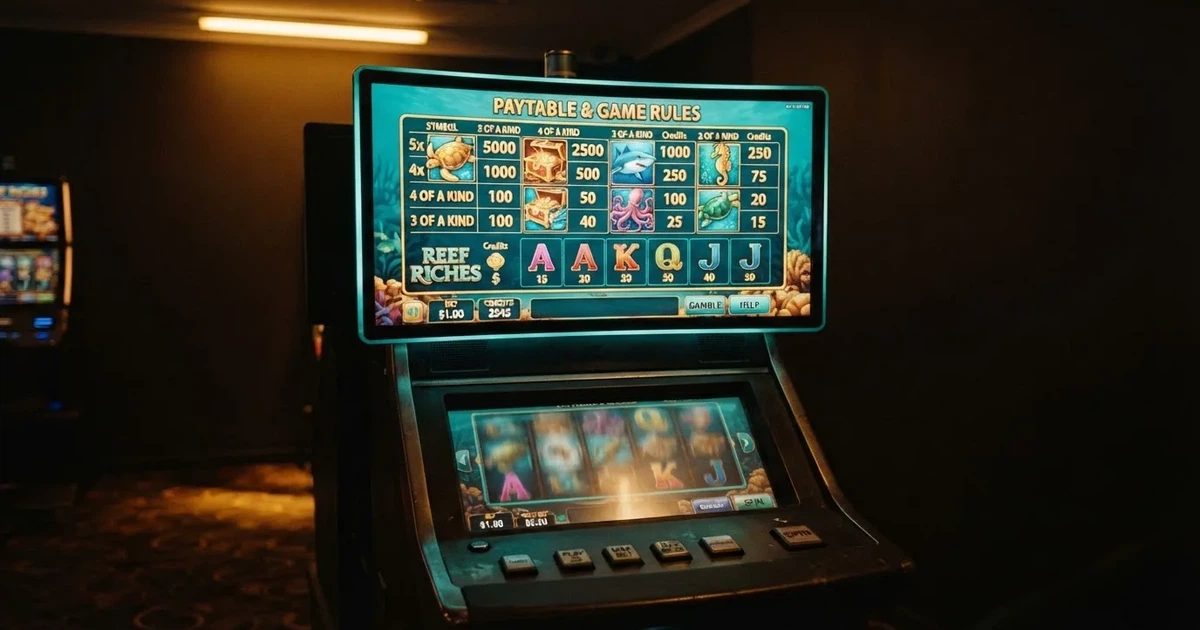
On Australian pub, club and casino machines, the RTP is disclosed on the machine’s information screen, normally accessible through a help or info button on the cabinet. The state regulators require it to be available to players on request. That is one reason a “97%” headline on an offshore site is so much harder to verify than the same number on a Crown Melbourne or Star Sydney terminal: a player in the venue can pull up the help menu and read the figure; a player at home has only what the offshore operator chooses to publish, which can be changed, retired or quietly replaced.
Whether a venue can change a machine’s RTP after install
A venue cannot lawfully vary the RTP figure published in the machine’s approval once the regulator has signed off on the game and its configuration. Any change to the return-to-player percentage requires re-submission to the state regulator. Players at a licensed venue can read the published RTP on the machine itself; players at an offshore site have no comparable route. That asymmetry — a regulated cabinet that must show its number, an offshore site that can move its number — is the difference a reader is paying for when an offshore site claims to out-RTP the Australian market.
The pokies machine in the licensed estate
How many machines there are, and where
Poker machines operate in every Australian state and territory, and each jurisdiction regulates their design and operation separately. In 2020–21 Australians bet almost A$150 billion through gaming machines and lost A$12.18 billion on them; Australia holds about 3 per cent of the world’s pub and club poker machines with 0.3 per cent of the global population. New South Wales alone had 87,298 gaming machines outside casinos across 2,195 venues in June 2023, with player losses of A$8.18 billion in 2022–23. Queensland had 21,122 gaming machines in 351 venues in October 2023. Victoria had 26,380 machines outside Crown Casino in 488 venues in 2021–22, sitting under a 30,000-machine statewide cap.
Tasmania’s machine: the long monopoly and the slow reform
Registered clubs operated Australia’s first legal poker machines from 1956, in New South Wales. Tasmania’s story is its own. The Federal Group held a monopoly licence over all of Tasmania’s poker machines from 1968; legislation passed in November 2021 ended that monopoly and moved oversight of the machines to the Tasmanian Liquor and Gaming Commission. Tasmania also planned a nation-leading mandatory pre-commitment card system — a card a player would tap before they could play — but implementation of that reform was delayed until late 2025.
Western Australia’s distinctive machine: banned at the pub, kept at the casino
Western Australia banned poker machines in pubs and clubs when Crown Perth opened in 1985; the casino’s own machine count has since grown from around 200 in 1985 to roughly 2,500, all approved by the state’s Gaming and Wagering Commission. The state remains the only one in which the pub floor is pokies-free, and the casino’s 2,500 machines are the entirety of the legal WA market. The 90 per cent WA minimum is the highest in the country, and the cabinet is the only place a WA resident can sit down at a real machine.
What offshore sites are actually offering
The shape of the pitch
The offshore pitch follows a recognisable shape. A “97%” headline on a pokies page, a “high RTP” badge, a curated list of titles and a bonus offer attached. Each element does a job. The percentage says “this machine pays more than your local one”; the list says “we have them”; the bonus says “claim here”. None of it is false on its own, and none of it is regulated in Australia. The percentage is the operator’s own publication, the list is the operator’s own catalogue, the bonus is the operator’s own promise, and the offshore licensing regime behind all of it has no obligation to an Australian player that the player can enforce from inside Australia.
What the ACMA’s formal warnings actually record
A formal warning from the ACMA is published on the regulator’s site and records the operator’s corporate name, the brand offered to Australians and the date. The full record covers a much longer list than the eleven brands this page writes about, but those eleven are the ones in scope for this comparison. The pattern is worth noting in itself: some operators surface more than once. Dama N.V. was warned in May 2022 over six brands — Bambet, Dazard, Level Up, Rocketplay, Wild Tornado and Cobra Casinos — and warned again in March 2025 over Woo Casino and May 2025 over Spirit Casino. The same operator, fresh brands, the same prohibited product. That is what the offshore layer looks like when the regulator looks at it.
What offshore licensing is and is not
An offshore licence — Curacao, Anjouan, the Philippines — authorises the operator to run a casino from that jurisdiction. It does not authorise the operator to take bets from Australians. The Interactive Gambling Act catches the offer itself, not the licence the operator chose. Two further points follow from that. First, an offshore licence does not put the operator under any Australian consumer-protection regime; there is no Australian complaints body that can compel a withdrawal. Second, an offshore licence gives the operator no standing to advertise in Australia; any inducement — a bonus, a free-spin offer, a “high RTP” headline — is an offer of a prohibited service if it reaches an Australian player.
The eleven brands the ACMA has named
RocketPlay
The ACMA issued a formal warning to Pulsup Ltd in March 2026 over Rocketplay; an earlier Dama N.V. entity covering the Rocketplay brand was warned in May 2022. The brand has cycled through operators but not through product: each iteration offered online casino games and online pokies to people in Australia, which is what the IGA prohibits. No bonus terms are reported on this page because the only sources for them are affiliate marketing pages.
Level Up Casino
The ACMA issued a formal warning to Dama N.V. in May 2022 covering Level Up alongside five other brands. Game-provider listings name BGaming as a studio supplying Level Up’s catalogue, but a studio supplying titles to an offshore site is not the same as a studio endorsing the site; the regulator’s action is the relevant record. Online casino games cannot be licensed in Australia, whatever licence the site displays.
Woo Casino
The ACMA issued a formal warning to Dama N.V. over Woo Casino in March 2025. Woo is one of the brands that surfaced after the original May 2022 warning cycle — the same operator, a different skin. The product on offer to Australians was the same prohibited product.
Spirit Casino
The ACMA issued a formal warning to Dama N.V. over Spirit Casino in May 2025. Same operator as Woo Casino, same product, fresh brand name. The pattern is the point: brand churn is the industry’s answer to the regulator’s record.
National Casino
The ACMA issued a formal warning to Consolutetish S.R.L. in July 2025 covering National Casino and Bizzo Casino. Public references to National Casino appear in encyclopedia listings of online casinos, which is the only sense in which the brand can be spoken of as “listed” — it is not a review and not an endorsement.
Bizzo Casino
The ACMA issued a formal warning to Consolutetish S.R.L. in July 2025 covering Bizzo Casino; Bizzo had already been the subject of a 2022 formal warning to TechSolutions (CY) Group Limited and TechSolutions Group N.V. Two regulators, two operators, one brand.
Ignition Casino
The ACMA issued a formal warning to Bamboo Media in July 2025 over Ignition Casino. Ignition is an offshore brand targeted at Australians through an affiliate channel. The same product, the same prohibition.
Instant Casino
In February 2025 the ACMA issued a formal warning to EOD Code SRL over Instant Casino. Instant Casino is one of the better-known offshore brands to Australian traffic, and the regulator’s notice is the cleanest signal an Australian reader can work from: a formal warning is the regulator’s record that the offer is a prohibited one.
Jackbit
In April 2026 the ACMA issued a formal warning to Ryker B.V. over Jackbit and CasinOK. Jackbit’s promotional material runs on the same “high RTP” frame as the rest of this layer; the ACMA’s notice is the regulator’s record that the offer is a prohibited one.
Casino Intense
In April 2025 the ACMA issued a formal warning to Sterplay Holding Ltd over Casino Intense. Casino Intense is mentioned in Australian media coverage of online gambling and in the ACMA’s own enforcement record, which is the only editorial sense in which the brand can be discussed on this page.
Sky Crown
The ACMA issued a formal warning to Hollycorn N.V. over its Sky Crown and Blue Leo casino services, in a notice published in September 2022. Sky Crown is one of the earlier entries in the post-2017 enforcement record; the regulator’s view of the product has not changed.
What the offshore table actually shows
The following table is built from the ACMA’s own published formal-warning record. Each row is a brand, the corporate operator the regulator named, and the date of the warning. The last column records whether the brand has any verified presence in independent listings of online-pokie providers or studio catalogues; where research did not turn up such a listing, the cell is empty, which is the honest answer and not an assertion that the brand is or is not legitimate.
| Brand | ACMA action and date | Operator named by the ACMA | Listed by independent sources |
|---|---|---|---|
| RocketPlay | March 2026 (Pulsup Ltd); May 2022 (Dama N.V.) | Pulsup Ltd / Dama N.V. | — |
| Level Up Casino | May 2022 | Dama N.V. | BGaming (studio listings) |
| Woo Casino | March 2025 | Dama N.V. | — |
| Spirit Casino | May 2025 | Dama N.V. | — |
| National Casino | July 2025 | Consolutetish S.R.L. | Encyclopedia listings |
| Bizzo Casino | July 2025 (Consolutetish S.R.L.); 2022 (TechSolutions) | Consolutetish S.R.L. / TechSolutions | — |
| Ignition Casino | July 2025 | Bamboo Media | — |
| Instant Casino | February 2025 | EOD Code SRL | — |
| Jackbit | April 2026 | Ryker B.V. | — |
| Casino Intense | April 2025 | Sterplay Holding Ltd | Encyclopedia and media listings |
| Sky Crown | September 2022 | Hollycorn N.V. | — |
The column that does the work is the middle one: the ACMA’s record is the only cell that is regulator-grade. Every row in this table is the regulator’s view of the product, not the operator’s. Reading the table across, the picture is not “eleven brands” — it is a small number of corporate entities cycling through brand names. Dama N.V. alone accounts for four of the eleven, and the regulator’s warnings on that operator span 2022 to 2025.
The blocking arithmetic, and what it means
The scale of the ACMA’s blocking work
A running total explains the picture better than any single round. By June 2026 the ACMA had asked Australian internet service providers to block 1,751 illegal gambling and affiliate marketing websites, with the first blocking request issued in November 2019. That is roughly six and a half years of enforcement work, ending at an average of around one blocking request every couple of days across the entire period — and accelerating, not slowing, in the most recent reporting. More than 230 unlicensed gambling services have left the Australian market since 2017, but the leave is not always permanent: the same operator can reappear under a new domain, and the ACMA’s work closes that door when it can.
What the rate of blocking actually implies
Treating the ACMA’s record as a rate gives the page its only piece of arithmetic. The first blocking request was issued in November 2019; the cumulative count reached 1,751 by June 2026. That works out to a band of roughly 250 to 270 sites blocked per year across the reporting window — and that is a working estimate, not a precise figure, because the count includes affiliate marketing sites as well as operator domains, and the regulator does not publish a clean per-year split. The conditional is plain: if the ACMA’s pace holds, the cumulative count passes 2,000 sites within a year or so of the current reporting date; if enforcement tightens further, it passes that line sooner. The arithmetic is the regulator’s, and the conclusion the reader can draw from it is simple — the supply of new illegal sites has not dried up under the existing enforcement weight.
Other live-table games an Australian player will encounter
Baccarat and its house edge
Baccarat’s house edge is set at 1.06 per cent on the Banker bet, 1.24 per cent on the Player bet and 14.36 per cent on the Tie. The Tie bet is the number to keep in mind when reading a “high payout” line about baccarat on an offshore site: a 14.36 per cent house edge is not a high-payout game in any meaningful sense. Baccarat’s origins are disputed — some accounts place it in nineteenth-century France, others say it was introduced from Italy at the end of the fifteenth century during the reign of King Charles VIII. Punto banco, the variant most played today, was developed in Havana during the 1940s; the casino banks the game at all times and plays out both hands by fixed drawing rules. Chemin de fer, French for “railway,” is a two-player variant named for being quicker to play than the original. In baccarat, cards 2 through 9 count at face value, 10/J/Q/K count as zero and aces count as one, with hand totals taken modulo 10; punto banco is dealt from a shoe of six or eight decks.
Where baccarat is offered on the Australian licensed estate
Crown Melbourne offers three baccarat variants — Traditional Baccarat, Crown Baccarat and 2 to 1 Baccarat — as approved table games regulated by the Victorian Gambling and Casino Control Commission, which replaced the VCGLR as Victoria’s casino regulator on 1 July 2022. Under section 66 of the NSW Casino Control Act 1992, a casino operator must not permit a game such as baccarat to be played unless the game and its rules are approved by the regulator, and the operator must make a copy of the approved rules available to patrons on request. Baccarat in Australia is a licensed-venue game, and the rule disclosures come with the venue licence.
Blackjack’s edge and how the game is played
With optimal strategy, blackjack’s house edge is about 0.28 per cent under liberal Las Vegas Strip rules — dealer stands on soft 17, double on any two cards, double after split, resplit aces, late surrender — and about 0.43 per cent under Atlantic City rules. Blackjack’s immediate predecessor was the English game vingt-un; a related game called veintiuno was described in Miguel de Cervantes’ Rinconete y Cortadillo, written around 1601–1602, and formal rules for the game were published in Britain in 1800. The game was renamed “blackjack” around 1899, with prospectors during the Klondike Gold Rush of 1896–99 credited with giving it its modern name. In blackjack, number cards count as their number, jack/queen/king count as 10 and an ace counts as 1 or 11; a starting two-card total of 21 is called a “blackjack” or “natural” and is the strongest hand; the dealer must keep drawing cards until reaching a total of 17 or higher. Established variants include Spanish 21, played without 10s but with liberal player-favourable rules, Double Exposure Blackjack, Blackjack Switch and Super Fun 21.
What the house edge tells the reader
Across baccarat and blackjack, the house edge numbers are the cleanest available summary of what a casino game costs the player. Blackjack under Las Vegas Strip rules is roughly a quarter of a per cent per hand at the table, played optimally; baccarat on the Banker bet is a touch over one per cent; baccarat on the Tie bet is more than fourteen per cent and is the bet to avoid. Pokies, by contrast, run from 85 per cent RTP at the floor of several state minimums up to 90 per cent in Western Australia, which is a 10 to 15 per cent house edge — an order of magnitude higher than blackjack at its best. The house edge on a “97%” offshore pokies headline, if it is honest, narrows that gap considerably. Whether the figure is honest is exactly the question the rest of this page is built to answer.
The tax picture for an Australian recreational player
Gambling winnings of a recreational player are not assessable income under section 6-5 of the ITAA 1997, and losses are not deductible, unless the person carries on a business of gambling. The point is model wording and the ATO is the right place to verify a specific case. Offshore winnings fall under the same principle — the income is not assessable because it is not income in the tax sense — but the punter cannot use an Australian regulator to recover an offshore loss, and the only route to a complaint runs through the offshore licence holder, if at all.
Where this leaves a punter searching for high RTP
What a legal venue gives the reader
A legal pub, club or casino in Australia gives a punter three things an offshore site does not. The first is a published RTP that can be checked on the cabinet and has been approved by a state regulator. The second is a complaints route — the regulator’s own contact, the venue’s own responsible-gambling officer, and for online wagering, BetStop. The third is a payment path that runs through Australian banking rails: debit card, PayID and Osko, BPAY, not credit card and not crypto. The minimum RTP varies by state and runs from 85 per cent to 90 per cent; the actual machines in the higher-paying casinos can run well above the floor.
What an offshore site offers, and what it does not
An offshore site offers a higher headline number and a longer catalogue, and the only piece of information it withholds by default is the audit trail behind the headline. The number on an offshore pokies page is the operator’s claim. The number on a Crown Melbourne terminal is the regulator’s approval. The former is a marketing line; the latter is an enforceable specification. A punter who cares about the RTP figure at the level the marketing promises has only one of those two available to them inside Australia.
The honest summary
A search for “best RTP pokies Australia” is a search for a number, and the page that answers it honestly has to say two things at once. The first is that the highest legally available RTP in Australia lives on the licensed estate — at the licensed casinos with the higher-paying cabinets and, in Western Australia, on the only legal estate in the state — and is disclosed on the machine. The second is that any “higher” headline offered by an offshore site sits outside the regulator’s reach, sits outside the player’s complaints route, and sits outside the federal prohibition on offering online casino games to Australians. The blocking arithmetic — 1,751 sites since November 2019, the cumulative count still climbing — is the regulator’s own answer to the offshore layer, and the formal warnings on the eleven brands above are its specific entries.
Frequently asked questions
What counts as a “high” RTP figure on an Australian pokies machine?
Australian state minimums sit between 85 per cent and 90 per cent, with Western Australia’s 90 per cent floor the highest in the country. Above the floor, the machines in the licensed casino estates can run several points higher, and a figure in the mid-90s on a licensed cabinet is genuinely a high-paying machine by Australian standards. Offshore “97%” headlines are a separate category: they sit above the Australian licensed estate on paper, but the figure is the operator’s own publication rather than a regulator-approved specification.
Is RTP the same thing as the chance of winning on any single spin?
No. RTP is the share of money wagered that the machine is programmed to return over a very large number of spins, not the chance of any single outcome. Every spin is independent, and the chance of hitting any given combination on the next spin is set by the symbol table rather than by the headline percentage. A higher RTP means a friendlier long-run average; it does not mean a friendlier next spin, and it does not mean larger individual wins — that is a separate characteristic called volatility.
Where is a pokies machine’s RTP figure legally required to be disclosed in Australia?
On Australian pub, club and casino machines, the RTP is disclosed on the machine’s information screen, normally accessible through a help or info button on the cabinet, and the state regulators require the figure to be available to players on request. Offshore sites have no comparable requirement; whatever they publish is the operator’s choice rather than a regulator’s approval.
Can a venue change a machine’s RTP setting after it is installed?
A venue cannot lawfully vary the published RTP figure once the state regulator has signed off on the game and its configuration. Any change to the return-to-player percentage requires re-submission to the regulator. Players at a licensed venue can read the published figure on the cabinet; players at an offshore site have no comparable route to confirm the figure is the one currently running.
Does a high RTP figure mean smaller or larger individual wins?
A high RTP figure says nothing directly about the size of individual wins — that is the volatility variable, and the two are reported separately. A high-RTP, high-volatility machine can produce long dry stretches punctuated by a single large payout; a lower-RTP, low-volatility machine returns smaller amounts more often. The headline percentage is the long-run return; the feel of the game is volatility, and the marketing copy usually leaves the second number out.