
Top 10 real-money online casinos in Australia: what the ranking actually buys you
A list of “top 10 online casino Australia real money” results promises a shortcut. The shortcut, when you press on it, is that almost every site behind it operates from offshore, that none of them can hold an Australian licence for casino games, and that the Australian Communications and Media Authority has spent the last three years moving through them with formal warnings and ISP blocks. The list is not a recommendation. It is a snapshot of what offshore operators are marketing to Australians this 2026, with an enforcement record attached.

This page reads that snapshot the way a careful player would. It explains what these rankings actually claim to measure, why the brands behind them cannot be Australian-licensed for casino products, what the ACMA has already said about each one, and what a person searching for “real money” play in Australia is actually choosing between. The angle is cost — what the offer takes from a player, not what the marketing copy returns.
Data current as of 29 October 2026. Operator claims cross-checked against the ACMA formal-warning register and the official Australian Payments Plus references for payment infrastructure.
- How mobile and app rankings actually work for Australian players
- The games, providers and live tables these lists keep recycling
- The top 10 shortlist itself, written by what the ACMA has done
- What “real money online casino” actually means in Australia
- The legal picture every top-10 ranking sits on top of
- What a careful player in Australia is actually choosing between
- Crypto, anonymity, and what “no verification” actually delivers
- Payments, payout speed and what the Australian stack actually offers
- Bonuses, free spins and the marketing line that costs the most
- What an Australian reader should take from all of this
- Frequently asked questions about top 10 Australian online casino rankings
How mobile and app rankings actually work for Australian players
Cluster 7 sits at the front because every top-10 page a reader meets is read on a phone first. The mobile ranking that an “Australian casino” affiliate publishes is built on three things the affiliate can verify from outside the country: whether the operator runs a downloadable app, whether that app is listed on the Apple App Store or Google Play in Australia, and whether the site itself is mobile-responsive. None of those things speak to whether the operator is licensed in Australia, and the App Store listings themselves say so — Apple and Google remove real-money gambling apps from their Australian stores unless the operator holds an Australian licence, which an offshore casino does not.

What the rankings measure instead is reach. They count daily active users through the web wrapper, they track how many payment methods render cleanly on iOS Safari and Chrome for Android, and they slot the operator into a “best mobile casino 2026” category without ever publishing the data behind the score. Apple Pay and Google Pay volume tells the same story from a different angle: by the end of 2025, Apple Pay, Google Pay and Samsung Pay together accounted for around 45% of all card payments in Australia by number. A mobile casino that does not accept those wallets at the checkout is failing a basic test of the local payment stack.
Two things never make it into those affiliate scores. The first is whether the operator’s gambling block tripwires actually fire when an Australian bank card tries to settle — Westpac’s gambling block, for instance, refuses authorisation of transactions registered under the merchant category code “Betting/Casino Gambling” on eligible personal credit and debit cards. The second is whether the operator’s terms of service cover Australian players at all. Most offshore terms say, somewhere in the small print, that play from Australia is not permitted; the affiliate ranking does not read those pages, because reading them would empty the list.
The practical upshot is simple. A mobile ranking ordered by app store presence and payment-method coverage measures the operator’s ability to take Australian deposits, not its legitimacy in taking them. The same operator can sit comfortably on a “top 10 mobile casino” list while the ACMA has asked Australian ISPs to block the very domain the reader is being told to download.
The games, providers and live tables these lists keep recycling
Cluster 8 is the part of the ranking a reader can verify by themselves, which is why the affiliate pages lean on it so heavily. The “top 10 pokies” content is built around a short roster of titles — Pragmatic Play’s Gates of Olympus, NetEnt’s Starburst, Play’n GO’s Book of Dead, Evolution’s Lightning Roulette — and around a small group of studios whose games turn up across the whole offshore market. A new casino brand that opens its doors today will, within a month, carry much the same catalogue as a casino brand that opened three years ago, because the games are licensed to the same aggregator.
That catalogue uniformity is what gives the illusion of depth. A list of “top 10 Australian online pokies” can name the same ten titles on every site because the same ten titles are licensed to every offshore operator. What changes between casinos is the bonus wrapper, the maximum stake on a single spin, and the design of the loyalty program — none of which is a different game. A player who treats the pokie ranking as a buying guide is being shown the same product on ten different shelves.
Live dealer works the same way but with fewer studios. Evolution and Pragmatic Play Live between them supply the bulk of the offshore live tables. When a “top 10 live casino” page ranks brands by “live game variety”, it is ranking the number of tables Evolution and Pragmatic have licensed to that brand, which is a procurement decision on the operator’s side and not a measure of how those tables perform for the player. The house edge on Lightning Roulette is the same regardless of which of eleven offshore casinos hosts the wheel.
This is also where the cost framing finally has something to bite on. The games themselves do not differ, so the cost to a player on one offshore casino versus another comes down to two things: what the bonus wrapper demands before a withdrawal unlocks, and what the maximum cash-out ceiling turns out to be. The next two sections take those apart.
The top 10 shortlist itself, written by what the ACMA has done
Cluster 9 is the comparison block, and it has to be written honestly, which means naming eleven offshore operators and the ACMA record against each one. The shortlist below is not a recommendation. Every brand here operates outside Australian law for casino games, and each one is listed because the ACMA itself has taken formal action against it for offering prohibited services to Australians. The order follows the ACMA record, most recent action first; the reader’s decision is not which of these is “best”, but whether to play on any of them at all.
Comparing the eleven offshore operators on the ACMA’s own record
| Brand | ACMA action and date | Operator named by the ACMA |
|---|---|---|
| RocketPlay | Formal warning, March 2026 | Pulsup Ltd |
| Jackbit | Formal warning, April 2026 | Ryker B.V. |
| Woo Casino | Formal warning, March 2025 | Dama N.V. |
| Spirit Casino | Formal warning, May 2025 | Dama N.V. |
| National Casino | Formal warning, July 2025 | Consolutetish S.R.L. |
| Bizzo Casino | Formal warning, July 2025; earlier 2022 | Consolutetish S.R.L. / TechSolutions |
| Ignition Casino | Formal warning, July 2025 | Bamboo Media |
| Instant Casino | Formal warning, February 2025 | EOD Code SRL |
| Casino Intense | Formal warning, April 2025 | Sterplay Holding Ltd |
| Level Up Casino | Formal warning, May 2022 | Dama N.V. |
| Sky Crown | Formal warning, September 2022 | Hollycorn N.V. |
The table is short for a reason. Each row tells the same story in slightly different words: an offshore operator, a date, an Australian authority noting that what the operator does is prohibited. The lack of any Australian licence entry in the third column is not a gap in the data — it is the data. No state or territory in Australia issues a licence to provide online casino games or online pokies to Australians, and the ACMA’s record is the practical consequence.
What each entry actually means for the reader
RocketPlay. Pulsup Ltd received a formal warning from the ACMA in March 2026 over the RocketPlay brand; the same brand had already drawn an earlier warning to Dama N.V. in May 2022. Two warnings three and a half years apart over the same product is the ACMA’s way of saying the operator moved on after the first contact and re-emerged under a new corporate wrapper. For a player reading this, the cost of signing up is not the welcome package — it is the structural fact that the operator has been told twice to stop and has continued anyway.
Level Up Casino. The May 2022 warning to Dama N.V. covered Level Up alongside five other brands under the same parent. Operators that run multiple skins under one licence are a common shape offshore, and the warning applies to the parent rather than to any one brand. A player who treats Level Up as a different entity from any other Dama N.V. property is being marketed to, not informed.
Woo Casino. Dama N.V., March 2025. The fresh formal warning, after the 2022 round, returns to the same pattern. The Australian market is not being courted in good faith; it is being re-entered.
Spirit Casino. Dama N.V., May 2025. Same parent as Woo and Level Up; the cycle repeats.
National Casino. Consolutetish S.R.L., July 2025. A newer parent company on the ACMA’s list, named for the first time in this warning round.
Bizzo Casino. Consolutetish S.R.L., July 2025, with a separate, earlier warning to TechSolutions (CY) Group Limited and TechSolutions Group N.V. in 2022. Bizzo is the only brand on this list with two independent corporate entities on its ACMA record.
Ignition Casino. Bamboo Media, July 2025. A different corporate structure again, and the only brand under Bamboo Media in this shortlist.
Instant Casino. EOD Code SRL, February 2025. The earliest 2025 action in the list, and another fresh corporate name on the ACMA’s register.
Jackbit. Ryker B.V., April 2026. Crypto-friendly by reputation; the formal warning makes plain that the brand accepts Australian customers on prohibited products.
Casino Intense. Sterplay Holding Ltd, April 2025.
Sky Crown. Hollycorn N.V., formal warning published September 2022, separate from the Dama N.V. round.
The verdict each block has to earn
The closing sentence on each block is not “this is the right casino for you”, because none of them is. What the verdict has to answer is what a reader comparing this set should take away. For RocketPlay, it is that two warnings on the same product is itself the result. For Level Up, Woo and Spirit, it is that Dama N.V. as a parent has now drawn the ACMA’s attention three times under three different skins. For Bizzo, it is the duplicate corporate history. For Ignition, Instant, Jackbit, Casino Intense, National, Sky Crown and the rest, it is that the brand exists on a list precisely because the ACMA has had to write to the parent company telling it to stop.
That is the only honest closing line for this comparison.
What “real money online casino” actually means in Australia
Cluster 1 is the foundation. Outside Australia, “real money online casino” is a product category — an account, a deposit, a stake, a withdrawal. Inside Australia, it is a prohibited product, and the distinction matters because every other shelf of this ranking rests on it. The Interactive Gambling Act 2001, as amended in 2017, makes it an offence to provide online casino games, online pokies and in-play betting to a person in Australia. No state or territory licences these products. What Australia licences is wagering on races and sport placed before the event, lotteries, and keno.
A search for “real money” casino is therefore a search for something that, for Australian residents, has no legal supply. The volume of marketing around the term exists because the prohibition does not stop offshore operators from accepting Australian customers — it stops Australian authorities from issuing a licence, and from offering consumer protection once a withdrawal is refused. H2 Gambling Capital’s 2025 estimate puts Australian losses to illegal gambling sites at about A$3.9 billion a year, with the share of gambling going through legal channels falling from 74% in 2021 to 64%. Those are the figures behind every “real money” headline an Australian reader sees.
Two practical points follow. The first is that an offshore operator displaying a Curaçao or Kahnawake licence is not, on the strength of that licence, licensed in Australia — those licences are authorisations from other jurisdictions and do not bind Australian consumer law. The second is that an offshore site carries no Australian dispute resolution. If a withdrawal is refused, the only remedy is the regulator that issued the licence the operator displays; that regulator’s process is the only one the player has, and it sits outside Australia.
The legal picture every top-10 ranking sits on top of
Cluster 2 is where the cost framing is sharpest, because the legal prohibition is the cost most of these rankings do not price in. The IGA’s 2023 amendment added the credit-card ban for Australian-licensed online wagering, in force from 11 June 2024, with penalties up to A$247,500 for operators that breach it. The practical effect is that any licensed Australian wagering service — sports and race betting, not casino games — cannot take a credit card or a credit-related product, and that the restriction extends to linked digital wallets. A reader who pays with Apple Pay into a licensed Australian bookmaker is paying through a wallet that is itself bound by the credit-funding test the bank applies at authorisation.
The 2026 reform layer sits on top of this. The Interactive Gambling Amendment (Gambling Reform) Bill 2026 passed Parliament on 19 August 2026, and its advertising and inducement measures commence on 1 January 2027. That is law with a start date, not law in force on a 2026 page; any affiliate “review” claiming to interpret the new rules as live is reading ahead of commencement. What is live now is the existing prohibition, the existing enforcement, and the existing credit-card ban.
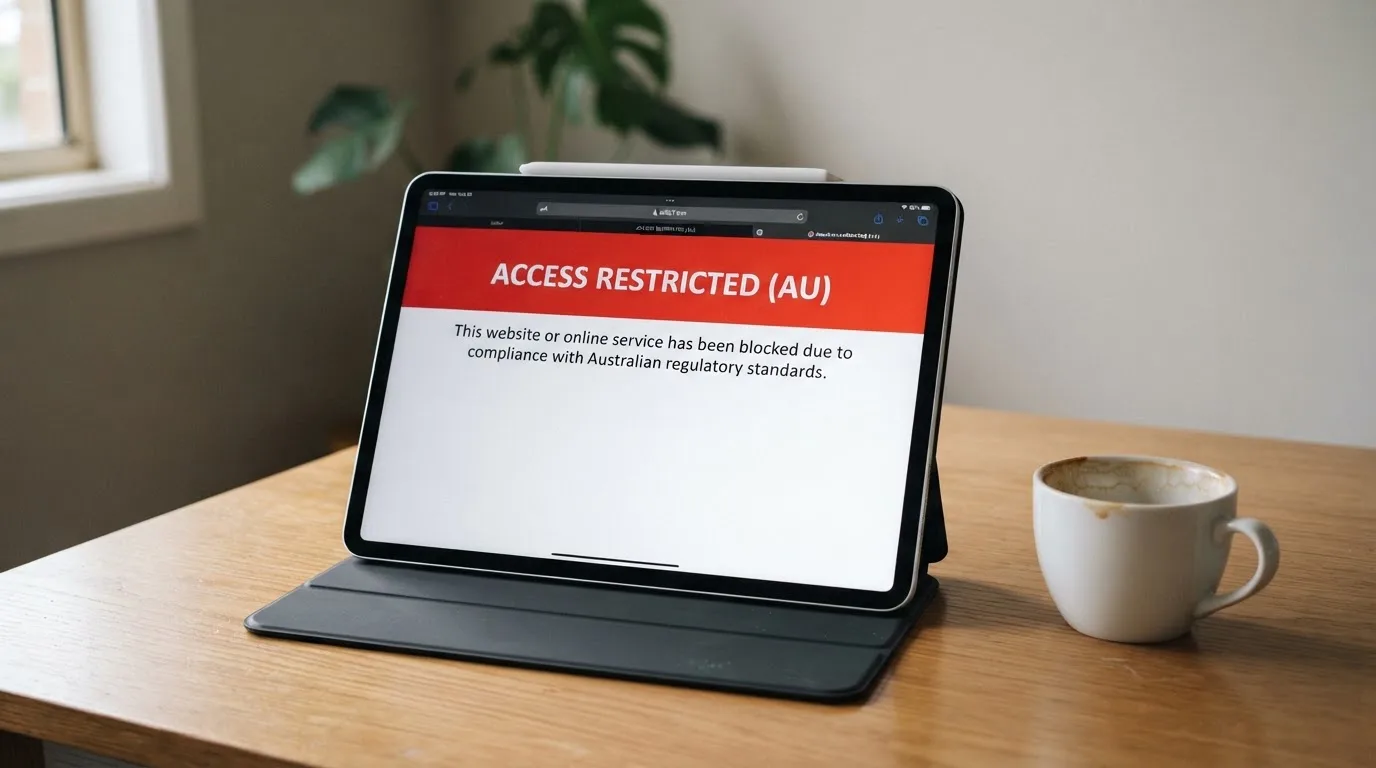
Enforcement is the part a top-10 ranking should be quoting but rarely does. The ACMA’s role is to investigate, to issue formal warnings, and to ask Australian ISPs to block illegal sites. The total blocked since the first blocking request in November 2019 reached 1,751 by June 2026, with more than 230 unlicensed services having left the Australian market since 2017. In one round alone, on 26 June 2026, the ACMA asked ISPs to block twelve more sites: 7Signs, ChromaBet, Donbet, Duospin, Freshbet, Slots Gem, Jacks Club, Lucky Start, Pointsbetz, Spinrise, Vinyl Casino and Wildsino. The reader sees “top 10”, but the ACMA sees a different list, and the second list is the one with enforcement behind it.
There is one further legal point that almost never makes it onto a top-10 page. The Northern Territory Racing and Wagering Commission regulates 52 of Australia’s online bookmakers — including Sportsbet, Bet365 and Ladbrokes — for tax reasons. The commission has no full-time staff and meets once a month in Darwin. That is the regulator for the largest licensed wagering operators in the country, and it is the model the offshore “top 10 casino” pages never hold themselves up to.
The blocking-rate calculation
The blocking-rate calculation is straightforward: 1,751 sites blocked over the period from the first blocking request in November 2019 to June 2026. That is roughly 81 months, which works out to about 22 blocked sites per month on average across the whole period. The rate is not constant — single rounds have taken out a dozen in one announcement — and the acceleration matters more than the average. In the first full year of enforcement, the monthly rate sat in low single digits; by 2025 and 2026 the monthly rate is closer to 30, with rounds in March 2025, April 2025, May 2025, July 2025, February 2026, March 2026 and April 2026 each adding to the running total. State the result as a band: somewhere between 20 and 30 blocked sites per month over the past two years, against a long-run average closer to 22 per month.
For a reader, the consequence is that any “top 10” list published more than a few months ago is likely to contain at least one site the ACMA has since asked ISPs to block. The list a reader saves in January 2026 may not resolve cleanly by July 2026.
What a careful player in Australia is actually choosing between
Cluster 3 is the responsible-gaming frame, and it has to come before the payment shelf because the legal protection layers change the cost calculation. The licensed alternative to an offshore casino, in Australia, is wagering on races and sport before the event — a different product, with the consumer protection the offshore casino cannot offer. BetStop, the National Self-Exclusion Register, has been live since August 2023 and binds every Australian-licensed online and phone wagering service. An offshore casino is not connected to BetStop, which means an Australian who self-excludes domestically and then opens an offshore account is unprotected on that account. The block follows the operator, not the player.
The gambling-block tools at the bank level sit one layer up. Westpac refuses authorisation on the merchant category code “Betting/Casino Gambling” for eligible cards. Commonwealth Bank applies a gambling lock via the CommBank app to eligible cards, and explicitly warns it cannot guarantee every gambling-related purchase will be stopped. ANZ’s gambling block, activated in the ANZ app, blocks transactions made through Apple Pay on an eligible card too — not just the physical card — and once turned on, removing it requires a 48-hour waiting period. The same bank warns that not all gambling transactions will be blocked and some non-gambling transactions might be blocked in error. These are blunt instruments; they are also the only instruments that sit between an Australian card and an offshore casino cashier.
For anyone whose play is past the point of managing on their own, the National Gambling Helpline is 1800 858 858, free and available 24/7, with chat at Gambling Help Online. A “top 10” ranking is not a substitute for those services, and no affiliate list is going to print that line voluntarily — but it is the line the ACMA’s own record points to.
Crypto, anonymity, and what “no verification” actually delivers
Cluster 4 is the cost shelf in disguise. “Crypto casino”, “Bitcoin casino” and “anonymous casino” read as different products; in practice they read the same way on the page, and they all sit on the same offshore structure. A casino that markets itself as anonymous is not licensed in Australia and is not subject to Australian identity checks; that is also true of a casino that does not market itself that way. Anonymity is the brand, not a feature. The cost to the player is that there is no Australian identity dispute mechanism if the account is closed with a balance inside it, and there is no AUSTRAC gate at the cashier — AUSTRAC’s threshold-transaction-report rule applies only to physical cash, and ordinary electronic transfers, regardless of size, are not captured by it.
PayID is the closer counterpart. PayID-based instant transfers are available at over 100 Australian financial institutions, and more than 25 million PayID identifiers had been registered on Australia’s New Payments Platform as of April 2025. Critically, paying to a PayID shows the name of the account holder before the transfer is sent; Australian Payments Plus warns that being asked to transfer money to a PayID on an illegal gambling site almost certainly means a scam site. The crypto wrapper is, in plain terms, a way to lose the name-check that the Australian banking stack would otherwise provide.
A “top 10 crypto casino” ranking is therefore ranking brands that have chosen to remove a layer of friction that exists for a reason. The friction costs nothing to a legitimate recipient, and its absence costs the player the only identity check the Australian banking stack was going to run.
Payments, payout speed and what the Australian stack actually offers
Cluster 5 is where the affiliate list is weakest and the reader’s wallet is strongest, because the Australian payments infrastructure is genuinely fast and the offshore casino does not improve on it. With Osko, a bank transfer between participating Australian banks arrives in under a minute, 24/7, including weekends, whether it is addressed to a BSB and account number or to a PayID. Participants in Australia’s New Payments Platform must keep the platform’s monthly outages to no more than two minutes. The NPP became accessible to the public on 13 February 2018 and is owned by New Payments Platform Australia Ltd, whose 13 shareholders include the Reserve Bank of Australia and the major banks. That is the layer any legitimate Australian operator runs on.
BPAY is the older layer. It has operated since 1997, is available in the online banking of over 140 banks and financial institutions and is offered by over 95,000 businesses. It is run by Australian Payments Plus, the same operator as PayID and Osko. None of these rails is a casino product; they are the rails a licensed Australian wagering operator deposits and withdraws through. An offshore casino that takes Visa, Mastercard and a handful of e-wallets is offering a narrower, slower and more expensive version of what the Australian stack provides natively.
Two practical points on the cost of the offshore payment path. American Express, where it is accepted, sits outside the Reserve Bank of Australia’s July 2025 surcharge review, which proposes removing surcharges only on eftpos, Mastercard and Visa transactions. Amex itself does not charge consumers for Apple Pay in stores, online or in apps; any surcharge is the merchant’s card-processing fee, not Apple’s. The licensed Australian bookmakers that have to comply with the credit-card ban will not take a credit-funded Apple Pay deposit at all; an offshore casino that does take one is operating outside the rule the licensed market is bound by.
The reader’s cost question on payment is not “which wallet is fastest”. It is “which deposit method actually protects me if the operator disappears”. A PayID deposit into a licensed Australian wagering account is recoverable through the Australian bank; a USDT transfer to an offshore casino is not.
Bonuses, free spins and the marketing line that costs the most
Cluster 6 is the marketing shelf, and it is where the cost framing finally has the most material to work with. A “top 10 casino bonus” ranking rates offers whose headline number — A$1,500 welcome package, 200 free spins — is rarely the figure the player actually keeps. The arithmetic is the same on every offshore bonus: the headline amount is matched by a wagering requirement, the wagering requirement is matched by a maximum cash-out ceiling, and the maximum cash-out ceiling is matched by game-weighting rules that exclude the highest-volatility games from the contribution table.
The audit’s own job is to point out what that structure does. A A$1,500 bonus at a 40x wagering multiple on the bonus only is A$60,000 of qualifying turnover before a withdrawal unlocks. At a 5-cent spin on a pokie with a 96% RTP, that is 1.2 million spins. The expected loss across those spins, on the bonus’s wagering requirement alone, sits in the high four figures against a headline bonus that was A$1,500. The player has paid to clear the bonus. The bonus did not pay the player.
That arithmetic does not depend on which of eleven offshore casinos the player is on, because the structural shape of the bonus is the same across the segment. What changes between brands is the multiplier, the cap and the weighting; the cost to the player is on the same order of magnitude whichever brand wins the comparison.
The same logic applies to “200 free spins” offers. Free spins credited at a low denomination, on a single named title, with the winnings paid as bonus money subject to a separate wagering requirement, are not 200 free chances at a jackpot. They are a small balance of bonus money with a withdrawal ceiling that is usually capped well below the headline value. The free spins have been counted; the math has not.
The honest version of the cost frame: a casino bonus is the price a player pays for the right to keep their own money after a withdrawal, denominated in turnover. Marketing reads it as a gift. The arithmetic reads it as a fee. Every top-10 ranking on the market prefers the first reading, because the second one would empty the list.
What an Australian reader should take from all of this
The single sentence the page has been building toward is not new, but the cost framing is: an offshore casino on a “top 10 real money Australia” list is not licensed for Australian players for casino products, has in most cases already been the subject of an ACMA formal warning, and offers a bonus structure whose real cost to the player exceeds its headline value once the wagering and the game weighting are run through. The licensed Australian alternative is wagering on races and sport before the event — BetStop binds, the credit-card ban binds, the bank-level gambling blocks bind, and the dispute resolution sits inside Australia.
That is what a top-10 ranking is, stripped back. The numbers behind it — 1,751 blocked sites, A$3.9 billion in estimated annual losses to illegal sites, 64% legal share in 2024 against 74% in 2021 — are the cost side of the same ledger. The reader came looking for a shortcut. The shortcut turns out to be a list of offshore brands the Australian regulator has spent the last three years moving through.
Frequently asked questions about top 10 Australian online casino rankings
What criteria do most “top 10” online casino lists actually claim to rank by?
The published criteria are usually bonus size, number of games, mobile compatibility, payout speed and customer support response time. None of those measures Australian licensing, because none of them can — the Australian market does not issue casino licences. The criteria measure the operator’s marketing effort, not its legal standing in Australia.
Does a site appearing high on a top-10 list mean it is licensed anywhere reputable?
No. A top-10 ranking measures what the affiliate has decided to rank by, which is almost never the jurisdiction the licence is issued in. Offshore casinos display Curaçao, Kahnawake or Anjouan licences, which are authorisations from other jurisdictions and do not bind Australian consumer law. A licence anywhere reputable, for an Australian player, is an Australian one — and there is no Australian licence for online casino games.
Is it legal for an Australian to sign up to a site simply because it appears on a top-10 ranking?
The Interactive Gambling Act 2001 targets the provider, not the individual player. An Australian is not prosecuted for opening an offshore account. That is not the same as legality, and it does not provide any consumer protection — no Australian dispute resolution, no BetStop coverage, no recourse if the withdrawal is refused and the site is then blocked.
Why do top-10 casino app rankings and top-10 casino bonus rankings often list completely different sites?
Because the rankings measure different marketing propositions. An app-friendly brand may run a small bonus with light wagering; a bonus-heavy brand may have no native app. The affiliate list is the affiliate’s selection, not a stable measure of the offshore market. The two rankings can both be honest about their own criteria and still produce two different shortlists.
How often do these top-10 rankings actually get updated, based on what is publicly checkable?
The faster-moving ones refresh monthly; the slower ones recycle the same ten brands across an entire year. The ACMA blocking record shows roughly 20 to 30 new sites blocked per month over the past two years. Any list older than a quarter is likely to contain at least one site the ACMA has since asked ISPs to block.
What should someone do instead of trusting a top-10 list when deciding where their gambling activity should happen?
Use the ACMA’s formal warning register as the primary check, BetStop as the self-exclusion tool if needed, and the National Gambling Helpline on 1800 858 858 (free, 24/7, with chat at Gambling Help Online) for support. For wagering that is licensed in Australia, the choice is a bookmaker licensed by the Northern Territory Racing and Wagering Commission or the relevant state regulator — wagering on races and sport before the event, not online casino games or online pokies.