Online Keno in Australia: What the Law Actually Says, and Where to Play in 2026
 Available in US
23 September 2026 · verified against the ACMA’s published enforcement list and the Interactive Gambling Act 2001
The phrase “best keno online casino Australia” gets typed plenty, and the page that ranks ten offshore sites for it exists in dozens of forms online — almost all written by affiliate marketers, almost none of them true. The honest answer is shorter than the question implies: offering online casino games to anyone in Australia is prohibited under the Interactive Gambling Act 2001, no Australian state or territory issues a licence for it, and the regulator has spent the past several years systematically blocking, warning and chasing the offshore brands that run the rankings. Keno is a different case in person and on paper — legal at licensed pubs, clubs and casinos across the country, illegal to offer online to an Australian customer from anywhere. That gap is what this page is actually about: where the line sits, how it gets enforced, what an Australian reader who wants to play keno can lawfully do, and which offshore brands the ACMA has named by operator and by month in 2026.
- What Online Keno Looks Like From Inside Australia
- The Interactive Gambling Act 2001 and What It Prohibits
- How the ACMA Enforces the Prohibition
- Player Protection: BetStop, the Helpline and What an Offshore Site Cannot Offer
- Crypto, Bitcoin and the Anonymity Question
- Gameplay Detail: How Online Keno Compares With Other Casino Tables
- Live Keno Versus an Automated Draw
- What an Australian Reader Can Lawfully Play
- Operators the ACMA Has Named: The Eleven Brands Behind the Rankings
- Comparison: ACMA Action Across the Eleven Brands
- The 2026 Reform Bill
- Tax, Withdrawals and the Practical Cost of an Offshore Account
- Where This Page Leaves the Reader
- Frequently Asked Questions
What Online Keno Looks Like From Inside Australia
Keno is, at heart, a numbers game with a long paper trail. The standard modern version lets a player mark up to twenty numbers from a field of one to eighty, then watches as the house draws twenty of its own — by ball machine in a live setting, by random number generator online — and pays out according to how many of the player’s picks match the draw. The legend says Han-dynasty strategist Zhang Liang invented the form during the Chu-Han Contention, with early Chinese ticket sheets printed with the first eighty characters of the Thousand Character Classic rather than numerals. The arithmetic has not improved with the centuries: a perfect twenty-of-twenty ticket carries odds of roughly one in 3.5 quintillion, which is the polite way of saying a player will never see one.

That structural mismatch — small payouts for common hits, life-changing payouts for a hit that will not come — is exactly what gives keno its unusually wide house edge. Wizard of Odds puts the edge on most casino keno at between 25 and 29 per cent, the highest of any common casino game and roughly four to five times wider than blackjack’s. Wikipedia’s keno article is even less generous, citing edges from under 4 per cent to over 35 per cent online, and 20 to 40 per cent in in-person casino play, both well above non-slot table games. Live keno surveys in Las Vegas have returned between 65 and 80 per cent to the player, meaning the house takes the other 20 to 35 cents of every dollar. For an Australian reader comparing that to baccarat’s 1.06 per cent on the Banker bet or even the soft 17 rule variant of blackjack, keno is the worst regular game on the floor by a wide margin — which is precisely why a serious comparison starts with the odds, not the marketing.
Online, two further wrinkles apply. The first is that the house edge on online keno is set by the operator’s published paytable rather than by any independent test, and research has documented those paytables ranging from generous to punishing. The second is that the draw is software, not a physical machine, which removes the spectacle of the live ball draw but does nothing to change the underlying math. Live keno, streamed from a studio with a real draw, exists at some offshore sites and aims at the player who misses the ritual — but the math is the same, and the licence question remains the same.
The Interactive Gambling Act 2001 and What It Prohibits
Australia’s federal gambling law is the Interactive Gambling Act 2001, tightened by the Interactive Gambling Amendment Act 2017. The 2017 amendments widened the prohibition to cover online casino games, online pokies and in-play betting — the products that the offshore sites spend the most marketing dollars pushing to Australian inboxes. No state or territory licenses any of those products. The penalty structure targets the provider, not the player: an individual punter who opens an offshore account is not prosecuted, but the offshore operator faces civil penalties, formal warnings, blocking requests to internet service providers and, in the most serious cases, referral for criminal investigation. The minimum age for any form of gambling in Australia is eighteen.
What the IGA does permit is wagering on racing and sporting events placed before the event, lotteries, and keno. Those products are licensable — in practice overwhelmingly through the Northern Territory Racing and Wagering Commission, which regulates fifty-two of Australia’s online bookmakers including Sportsbet, Bet365 and Ladbrokes, has no full-time staff of its own and meets once a month in Darwin. The NTRWC’s thinness is its own story: a de facto national regulator with the footprint of a local club, and the focus of an active reform bill. None of that covers an offshore site offering online roulette or live baccarat to a Brisbane resident at 2 a.m.
The 2017 amendments also closed one specific payment route. From 11 June 2024, credit cards, credit-related products and digital currency are banned as a means of paying for any licensed online wagering service, with penalties for operators up to A$247,500 for accepting them. The legal deposit routes left standing are debit card, bank transfer, PayID/Osko and BPAY. For an Australian reader, a simple litmus test sits in the cashier: if the site accepts a credit card or a Bitcoin deposit, it is operating outside Australian rules, whatever its Curacao or Anjouan badge claims.
How the ACMA Enforces the Prohibition
The Australian Communications and Media Authority does the enforcing. Its three tools are formal warnings to operators, requests to Australian internet service providers to block sites at the network level, and referrals to the police or the courts where the conduct warrants it. The published record of those tools is the most useful thing an Australian reader can read before clicking an affiliate link.
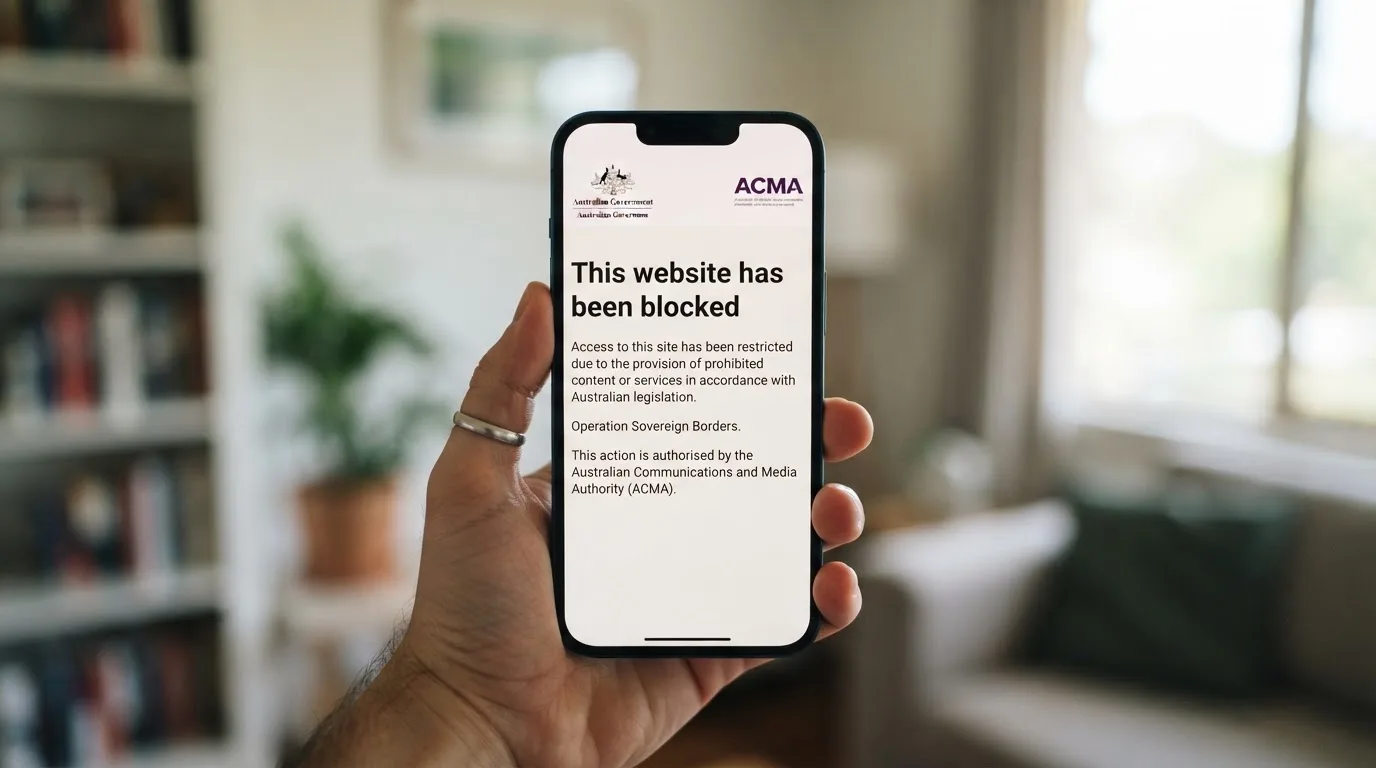
The headline figures, as reported in June 2026, are stark. Since the first blocking request in November 2019, 1,751 illegal gambling and affiliate marketing websites have been blocked at the Australian internet edge. More than 230 unlicensed gambling services have left the Australian market entirely since enforcement was strengthened in 2017. The most recent reported round, dated 26 June 2026, added twelve more names to the block list: 7Signs, ChromaBet, Donbet, Duospin, Freshbet, Slots Gem, Jacks Club, Lucky Start, Pointsbetz, Spinrise, Vinyl Casino and Wildsino. The block list compounds month on month; the gap between a site being warned and being blocked is typically months, not years, and an offshore operator that holds an Australian customer’s balance when the block lands cannot pay it out through Australian channels.
A formal warning is the first step. The ACMA publishes them by operator name and date, and the trail of those warnings shows how comprehensively the prohibition is being applied to the offshore brands ranked by affiliate sites. Dama N.V., a Curacao-registered operator that runs several of the names in those rankings, received a formal warning in May 2022 covering six brands at once — Bambet, Dazard, Level Up, Rocketplay, Wild Tornado and Cobra Casinos — and then further warnings in March 2025 over Woo Casino and in May 2025 over Spirit Casino. Consolutetish S.R.L. drew a warning in July 2025 over both National Casino and Bizzo Casino, with Bizzo having already been the subject of an earlier 2022 warning to its previous operator, TechSolutions Group. EOD Code SRL was warned in February 2025 over Instant Casino. Sterplay Holding Ltd was warned in April 2025 over Casino Intense. Ryker B.V. was warned in April 2026 over Jackbit and CasinOK. Pulsup Ltd was warned in March 2026 over Rocketplay, on top of Dama’s earlier action on the same brand. Hollycorn N.V. drew an earlier warning over Sky Crown and Blue Leo, dated September 2022. Bamboo Media was warned in July 2025 over Ignition Casino.
The pattern is the point. The ACMA is not chasing a handful of rogue sites; it is publishing a rolling list that names operators, dates and brands with the regularity of a weather report. For an Australian reader, that list is the only due diligence that matters, because none of the offshore licence badges — Curacao, Anjouan, the Philippines — affects Australian consumer protection. An offshore site gives no Australian complaints body, no local recourse if a withdrawal is refused, no guarantee that a balance is reachable once the site is on a block list. The estimated annual loss to illegal offshore sites is around A$3.9 billion, per H2 Gambling Capital’s 2025 report, and the share of gambling going through legal channels fell from 74 per cent in 2021 to 64 per cent. Those are not figures that improve on their own.
The first ACMA blocking request went out in November 2019, and the cumulative block count had reached 1,751 by June 2026. That span of roughly six and a half years works out to an average of around 270 sites blocked per year, or just over five a week, every week, since enforcement began. Some rounds have been smaller and some larger, but the cadence has not slowed.
Player Protection: BetStop, the Helpline and What an Offshore Site Cannot Offer
The Australian safety net for problem gambling is built around three layers, and an offshore casino sits outside all of them.
BetStop — the National Self-Exclusion Register, live since August 2023 — is the headline tool. A person who signs up through BetStop is excluded from every Australian-licensed online and phone wagering service at once, for a chosen period from three months up to a lifetime. The exclusion is binding on the licensed operator the moment it registers. The catch for an Australian reader weighing an offshore casino is exactly that word — licensed. BetStop does not bind an offshore site, because the offshore site is not on the register and has no integration with it. A self-excluded Australian who opens an account at an offshore casino has excluded themselves from nothing the casino cares about, and the casino has no obligation to honour the exclusion it never received.
The second layer is the National Gambling Helpline on 1800 858 858 — free, twenty-four hours a day, with web chat through Gambling Help Online. Financial counsellors, psychologists and peer-support workers take calls from anywhere in the country and can refer a caller to face-to-face services in their state or territory. The helpline is funded by the Australian government and by the states through a hypothecated share of gambling taxes. None of that funding, and none of those referral pathways, follows an Australian punter onto an offshore site.
The third layer is the consumer protection that comes from being on a licensed site in the first place: identity checks, deposit limits, time-out tools, dispute resolution through a state or territory regulator, and the obligation on the operator to pay out verified winnings. None of those apply offshore. The Interactive Gambling Act 2001 makes it an offence to offer the products at all; the offshore operator is, by definition, outside any Australian regime. A punter who wins at an offshore casino and is then refused a withdrawal has, in practical terms, no remedy — the operator is not subject to an Australian court, the winnings are not protected by Australian law, and the only leverage is whatever the operator’s own terms say and the operator’s own willingness to honour them.
For an Australian reader, the practical order is: if the urge to keep playing has gone past entertainment and into something else, BetStop first, the helpline second, and do not rely on an offshore site to do the policing on your behalf.
Crypto, Bitcoin and the Anonymity Question
A recurring search around this subject asks whether Bitcoin deposits let a player sidestep the credit-card ban and the IGA itself. They do not. Crypto is its own payment route, and the IGA’s prohibition is on the supply of the games, not on the payment. Paying with Bitcoin to an offshore casino does not make the casino legal, does not bring the casino inside BetStop, does not give the player Australian consumer protection and does not stop the ACMA from blocking the site. The site, once blocked, takes the Bitcoin balance with it.
What crypto does change is the friction for the player. No chargeback, no Australian bank flagging the transaction, no paper trail through PayID. That is part of why some readers find crypto routes attractive and part of why the law has moved specifically to cut them out of the licensed channels — the same 11 June 2024 ban that closed credit cards also closed digital currency for licensed wagering. The offshore route remains open in the technical sense that an Australian can still send Bitcoin to an offshore wallet, but the legal exposure of the receiving site has not changed, and the player’s exposure has not changed either. The block list does not care how the deposit got there.
A second, more practical point: crypto keno sites that claim provably fair draws lean on the player to verify the hash themselves. The marketing is reassuring; the verification, in practice, is rarely performed by the average punter. Provably fair is a step up from nothing, but it is not a substitute for the regulator sitting behind the operator, and it is not the consumer protection a Curacao licence buys. The same offshore licence, the same offshore operator, the same offshore complaint path that does not exist — those are what the player is buying with the Bitcoin deposit.
Gameplay Detail: How Online Keno Compares With Other Casino Tables
For an Australian reader who knows the licensed casino floor and is weighing an online version, the comparison starts with the games alongside it. Keno’s house edge, at 25 to 29 per cent in Wizard of Odds’ reading and up to 40 per cent in some in-person paytables, is several times wider than any serious table game. Baccarat, the closest rival in simplicity, runs 1.06 per cent on the Banker bet, 1.24 per cent on Player and 14.36 per cent on the Tie. Blackjack under liberal Las Vegas Strip rules sits around 0.28 per cent with optimal play, 0.43 per cent under Atlantic City rules. The reason those numbers matter to a comparison is that they bound what a reasonable return looks like; a keno paytable running above 30 per cent edge is not a better version of keno, it is a worse one.
The structural reason is the ticket. A keno ticket can run from one spot to twenty, with payouts scaling steeply. Hitting one of one is routine; hitting ten of ten is rare; hitting twenty of twenty is the one-in-3.5-quintillion event the marketing copy hangs on. The headline prize is so large and so unreachable that the paytable has to be generous to small hits to feel fair, and the generosity is calibrated so that the overall edge stays punishing. Blackjack’s edge, by contrast, comes from a roughly fifty-fifty proposition played out over a few cards; baccarat’s from a fixed draw rule on two hands. Neither game asks the player to fund a longshot prize.
For a player who likes keno specifically, the comparison does not argue against the game — it argues for honesty about what the game is. Keno is a low-skill, high-variance entertainment buy with a poor expected return. Treated as that, it is a perfectly reasonable occasional punt. Treated as anything else, the arithmetic punishes the player before the first draw.
Live Keno Versus an Automated Draw
The other recurring question is whether live keno, with a real ball machine, plays differently from the software-driven online version. The honest answer is that the math does not change — the draw is still twenty numbers from one to eighty, the payouts still run off the published paytable, the house edge is set by that paytable rather than by the mechanism. What changes is the experience and, marginally, the trust. A player who watches a physical draw can be certain the result was not retroactively edited; a player who takes the random number generator’s word for it is trusting software they cannot see.
Some offshore studios do stream live keno draws, with a presenter, a real ball machine and a chat window, and that format is what a keno player who misses the pub version is looking for. None of that changes the licence question, none of it puts the casino inside Australian law, and the ACMA’s block list has not distinguished between software keno and live-streamed keno — both are prohibited interactive gambling services if offered to a person in Australia. The mechanism is not the legal test; the offer to an Australian customer is.
What an Australian Reader Can Lawfully Play
For an Australian reader who wants keno, the lawful routes are well-defined and largely local. Keno is one of the gambling products that can be offered legally through state- or territory-licensed operators, unlike online casino games. New South Wales, Victoria and Queensland each run their own keno licences with their own regulators and their own game rules.
In New South Wales, the joint keno operator and product licence was extended in 2026 terms to 1 April 2050, with the licensees agreeing to pay the state more than A$230 million across the life of the licence, including a A$25 million upfront fee and ongoing annual licence duty. The Victorian regime runs under the Gambling Regulation Act 2003 and the Victorian Gambling and Casino Control Commission, which replaced the former VCGLR on 1 July 2022; twenty-year keno licences were issued from 15 April 2022 to Keno (VIC) Pty Ltd and Lottoland Australia Pty Ltd, the latter renamed to KenoGo Pty Ltd on 9 September 2025. Queensland runs a single exclusive keno licence under the Keno Act 1996 and the Keno Regulation 2007, held by Keno (QLD) Pty Ltd and regulated by the Office of Liquor and Gaming Regulation. Crown Melbourne, on the casino floor, offers three approved baccarat variants — Traditional Baccarat, Crown Baccarat and 2 to 1 Baccarat — under VGCCC-approved table game rules, and the same regulatory architecture approves the in-venue keno games at the state’s licensed venues.
For the player, the practical reality is that keno in Australia is the licensed pub game, the licensed club game and the licensed casino game. The draws run on screens at the bar, the tickets are sold over the counter, the payouts are made on the spot, and the regulator is the state body that approved the venue in the first place. None of that requires a Bitcoin deposit or a Curacao licence.
Operators the ACMA Has Named: The Eleven Brands Behind the Rankings
What follows is not a ranking and not a recommendation. Each of these brands is included because the ACMA itself has issued a formal warning over it for offering prohibited services to Australians. The licence badge the site displays — wherever that badge is registered — does not change the Australian legal position. No bonus terms are given, because the only sources for those terms were affiliate marketing pages and no affiliate page is a reliable description of what a reader in Australia will actually receive.
1. RocketPlay
Pulsup Ltd was issued a formal warning by the ACMA in March 2026 over Rocketplay. The brand had already been named in an earlier warning to Dama N.V. in May 2022 alongside five other Dama brands. For an Australian reader, the warning is the operative fact; nothing about the site being offshore changes that. The brand’s keno subject support is not documented from a non-affiliate source.
2. Level Up Casino
Dama N.V. received a formal warning over Level Up Casino in May 2022 as part of the six-brand action. While the brand appears in third-party listings for keno, the ACMA’s formal warning is the only detail that matters for a reader in Australia.
3. Woo Casino
Dama N.V. was issued a further formal warning in March 2025 over Woo Casino. The ACMA’s record names the operator and the date; the brand’s presence on the affiliate rankings does not put it inside Australian law.
4. Spirit Casino
Dama N.V. received a further formal warning in May 2025 over Spirit Casino. The pattern of repeated warnings to the same operator over multiple brands is itself informative: the ACMA names the operator, not just the brand, and a player who picks a fresh name on the same licence is gambling on the same enforcement exposure.
5. National Casino
Consolutetish S.R.L. received a formal warning in July 2025 over National Casino. The site appears in third-party listings of operators offering keno, but the warning is the operative record.
6. Bizzo Casino
Consolutetish S.R.L. was issued a formal warning in July 2025 over Bizzo Casino, and the brand had already been the subject of an earlier 2022 warning to TechSolutions Group. Two operators, one brand, and a warning trail that runs across both — exactly the kind of history the ACMA’s published list was built to expose.
7. Ignition Casino
Bamboo Media was issued a formal warning in July 2025 over Ignition Casino. The brand is positioned in some affiliate copy as a poker-and-casino site; the ACMA’s record names it among the operators warned for offering prohibited interactive gambling services to Australians.
8. Instant Casino
EOD Code SRL received a formal warning in February 2025 over Instant Casino. One of the more recent warnings on the list at the time of the ACMA’s June 2026 enforcement round.
9. Jackbit
Ryker B.V. received a formal warning in April 2026 over Jackbit, alongside CasinOK. Jackbit is one of the brands positioned around crypto deposits and esports betting; the warning does not change with the payment route.
10. Casino Intense
Sterplay Holding Ltd received a formal warning in April 2025 over Casino Intense. This brand is occasionally cited in third-party listings as a keno provider, though it remains under ACMA notice.
11. Sky Crown
Hollycorn N.V. received a formal warning over Sky Crown alongside Blue Leo, dated September 2022. The warning is older but remains on the ACMA’s published list.
Comparison: ACMA Action Across the Eleven Brands
The columns below are the columns that matter to an Australian reader: the brand as marketed, the ACMA’s formal warning with the month and year, the operator name as the ACMA published it, and what the brand’s own presence on a keno subject actually looks like in third-party listings. Where a subject column has no entry, the brand does not have a documented presence in that listing for online keno.
| Brand | ACMA action and date | Operator named by the ACMA | Subject support |
|---|---|---|---|
| RocketPlay | March 2026 (Pulsup Ltd); earlier May 2022 (Dama N.V.) | Pulsup Ltd; Dama N.V. | — |
| Level Up Casino | May 2022 | Dama N.V. | Listed by BGaming |
| Woo Casino | March 2025 | Dama N.V. | — |
| Spirit Casino | May 2025 | Dama N.V. | — |
| National Casino | July 2025 | Consolutetish S.R.L. | Listed on en.wikipedia.org |
| Bizzo Casino | July 2025 (Consolutetish); earlier 2022 (TechSolutions) | Consolutetish S.R.L.; TechSolutions Group | — |
| Ignition Casino | July 2025 | Bamboo Media | — |
| Instant Casino | February 2025 | EOD Code SRL | — |
| Jackbit | April 2026 | Ryker B.V. | — |
| Casino Intense | April 2025 | Sterplay Holding Ltd | Listed by the ABC, the ACMA and Crown Melbourne |
| Sky Crown | September 2022 | Hollycorn N.V. | — |
What the table actually shows is the rhythm of enforcement rather than the depth of any single brand’s offering. Dama N.V. appears four times across the eleven entries, on dates that span four years. The newer operators tend to be newer entities — Pulsup, Ryker, EOD Code — but the older ones have not gone away; Hollycorn’s 2022 warning still sits on the same record as Ryker’s 2026 one. For an Australian reader, the value of the table is not in picking a brand from it. It is in seeing that none of the brands on it has an Australian defence, and that the regulator’s published record has been naming operators by name for years.
The 2026 Reform Bill
The Interactive Gambling Amendment (Gambling Reform) Bill 2026 passed Parliament on 19 August 2026. Its advertising and inducement measures commence on 1 January 2027, which puts them squarely in the next calendar year for an Australian reader reading this in 2026. Law passed, start date ahead — not yet in force on a page dated to the current year, but on the runway. The bill tightens inducement rules around licensed wagering, and it lands against the background of the offshore block list continuing to compound. The enforcement tools already on the books have not changed; what has changed is that the advertising volume the bill addresses sits on the Australian-licensed side, not on the offshore side.
For a reader, the practical effect is that the legal picture in 2026 is the legal picture the IGA has drawn since 2017, plus the credit-card and crypto ban since 11 June 2024, plus a still-growing ACMA block list. The 2026 bill changes the inducement rules around what Australian-licensed operators can advertise; it does not retroactively legitimise any offshore site the ACMA has warned or blocked.
Tax, Withdrawals and the Practical Cost of an Offshore Account
For a recreational Australian player, gambling winnings are not assessable income under section 6-5 of the ITAA 1997, and losses are not deductible, unless the person carries on a business of gambling — and the ATO’s view of that bar is strict. The model answer from a tax agent is “check with the ATO”, because the line between recreational play and a business is the kind of question that needs a specific fact pattern rather than a general rule. None of that is the offshore operator’s concern; the operator reports what it reports under its own jurisdiction’s rules.
The withdrawal question is the practical one. An offshore casino that pays out is doing so under its own terms, in its own currency, through its own payment routes, with no Australian consumer protection if it declines. An offshore site that has been blocked at the Australian internet edge cannot be reached by the customer’s usual path; a balance held there is, in effect, in escrow with a party that has been told by an Australian court to leave the market. The ACMA’s record of blocks and warnings is the closest thing to a public scoreboard for that risk, and the scoreboard is not improving for the offshore side.
For an Australian player who has an existing offshore balance, the practical advice is to withdraw what can be withdrawn, by the routes the operator still offers, before the next block lands. For an Australian player who has not yet opened an offshore account, the practical advice is the simpler one: the legal routes for keno in Australia are the pub, the club and the licensed casino floor, the regulator is a state or territory body, and the ACMA’s enforcement record is what an offshore site cannot offer.
Where This Page Leaves the Reader
The honest read of the ACMA’s record is that the legal landscape in 2026 is not ambiguous. Online casino games, including keno, cannot lawfully be offered to Australians; the regulator has been naming operators and blocking sites for years; the eleven brands named above are not a recommendation set but a record of who has been warned, when and by which operator. The licensed venues are the lawful answer to the underlying question — keno, played live, paid out on the spot, regulated by a state or territory body. The credit-card and crypto ban took the friction out of the offshore payment routes in 2024. BetStop and the National Gambling Helpline are the safety net for the player, and that safety net is built around the licensed side of the market.
For the reader who arrived looking for a top-ten ranking of offshore keno casinos, the ranking the affiliate sites offer is built on operators the ACMA has named, on bonuses whose terms were sourced from those affiliate pages, and on payment routes the IGA specifically closed in 2024. The reader who arrived looking for what keno actually is — a high-edge numbers game with an unbeatable longshot prize — has a fair answer and a clear set of legal places to play it.
Frequently Asked Questions
What house edge does keno typically carry compared with other casino games?
Keno carries a much wider house edge than any other common casino game. Wizard of Odds puts the edge at 25 to 29 per cent on standard casino keno, and Wikipedia cites figures from under 4 per cent to over 35 per cent online and 20 to 40 per cent in in-person play. By contrast, baccarat runs 1.06 per cent on the Banker bet and blackjack around 0.28 to 0.43 per cent with optimal play. Keno is the widest of the regulars by a wide margin.
Is keno available at licensed pubs and clubs in Australia, not just casinos?
Yes. Keno is one of the gambling products that can be offered legally through state- or territory-licensed operators, including pubs and clubs, under state keno regimes such as the Keno Act 1996 in Queensland and the Gambling Regulation Act 2003 in Victoria. The licensed pub and club game is not the same product as the offshore online keno the affiliate rankings promote, and it is the legal option for an Australian reader.
Is it legal for an online casino to offer keno to players in Australia?
No. The Interactive Gambling Act 2001, as strengthened by the 2017 amendments, prohibits the supply of online casino games to anyone in Australia, and no state or territory licenses online casino products. Keno offered online from offshore to an Australian customer falls inside that prohibition. The ACMA enforces through formal warnings to operators and through blocking requests to Australian ISPs; the player is not prosecuted, but the operator is, and the site can be blocked with a balance still on it.
How does live keno differ from an automated keno draw?
Live keno is streamed from a studio with a real ball machine and a presenter; an automated draw uses a random number generator. The math does not change — the edge is set by the paytable, not the mechanism. What changes is the experience and the trust: a live draw is harder to retroactively edit than software output. The legal position is unchanged either way; the prohibition is on the offer to an Australian customer, not on the draw method.
Can keno be played with a Bitcoin deposit at an offshore site?
Technically yes, in the sense that an Australian can send Bitcoin to an offshore wallet. Legally, the offer of keno to a person in Australia remains prohibited under the IGA regardless of the payment route, and the credit-card and crypto ban that took effect on 11 June 2024 closes crypto for licensed wagering. Paying with Bitcoin does not bring the casino inside Australian law, does not register the player with BetStop, and does not protect a balance if the site is blocked at the Australian internet edge.
Why do keno returns vary so widely between venues?
The variance comes from the paytable, which the operator sets and which differs site to site and venue to venue. Wizard of Odds found live Las Vegas keno returns between 65 and 80 per cent, and Wikipedia’s keno article cites online edges from under 4 per cent to over 35 per cent. The wider the edge, the less the player gets back per dollar wagered, and offshore paytables tend to be calibrated by what the operator’s market will bear rather than by any published standard.
Written by the editors at Casino Table Games Info.