
Best casino in Hobart, 2026 — what the licensed option actually offers, and what to skip
29 October 2026 · verified against the Australian Communications and Media Authority register and the Tasmanian Gaming Commission public record

Hobart runs a single licensed casino, and it has done since 1973. That one fact settles the “best” question faster than any ranking: Wrest Point Hotel Casino in Sandy Bay is the only place in southern Tasmania where casino games are legal. Everything else a reader will see in their search results — the offshore brands with Australian-friendly sign-up forms, the .com.au-themed sites, the YouTube affiliates pushing welcome packages — is offering a product the Interactive Gambling Act 2001 prohibits supplying to anyone in Australia. That does not stop the offers arriving in Tasmanian inboxes. It does mean the right answer to the question is short, honest, and worth spelling out before any ranked list is read.
What follows is a full account of the licensed venue, the statutory frame around it, the responsible-gambling tools that apply to Tasmanian residents, and the eleven offshore names the ACMA has actually named in formal warnings — written so a visitor planning a Hobart trip, and a Tasmanian weighing whether to click any link that lands in their inbox, can both tell what they are looking at.
- The fundamentals: what “casino in Hobart” actually means
- How Australian casino law actually works in Hobart
- Responsible gambling tools that actually reach a Hobart resident
- Wrest Point in practice: visiting the only legal casino in Hobart
- Hobart versus the rest of Australia’s state casinos
- Walking distance: hotels near Wrest Point
- What the ACMA has actually said about offshore casino brands
- The eleven brands, read individually
- The blocking-rate calculation: how the ACMA’s enforcement record scales
- The federal frame: what 2026 actually changed
- The honest framing for a Hobart reader
- Frequently asked questions about Hobart’s casino
The fundamentals: what “casino in Hobart” actually means
Hobart’s casino story is a single building. Wrest Point Hotel Casino opened on 10 February 1973, the country’s first legal casino, after a 14 December 1968 Tasmanian referendum approved the development with 56% support. It sits on Sandy Bay Road, four kilometres from the CBD and a short walk along the waterfront from the University of Tasmania’s main campus. The 17-storey, 64-metre dodecagonal hotel tower — designed by Sir Roy Grounds, 269 rooms, with a revolving restaurant at the top — is still the tallest building in Tasmania.
Three practical points for anyone planning a visit:
- The minimum entry age is 18. Photo ID is required at the door.
- The casino floor carries more than 650 electronic gaming machines, alongside table games and a poker room.
- Wrest Point is a hotel-casino. Visitors staying on site do not need to walk anywhere afterwards, and visitors not staying on site can walk in for the gaming floor, the bars and the restaurants without booking a room.
A staged renovation worth roughly A$65 million ran between 2018 and 2023 in time for the venue’s 50th anniversary. The convention centre, built in 1984, cost more than $20 million at the time and remains one of Hobart’s larger function venues.
These details sit unusually far from a typical online-casino guide, because the underlying product is unusually far from one. Hobart does not have multiple competing casino floors; the choice is between Wrest Point and any number of offshore sites that promise the same games and cannot legally take an Australian customer.
How Australian casino law actually works in Hobart
The Interactive Gambling Act 2001, strengthened by the Interactive Gambling Amendment Act 2017, makes it an offence to provide online casino games, online pokies or in-play betting to a person physically in Australia. No state or territory issues a licence for those products. What is licensable is wagering on races and sport placed before the event, lotteries and keno — in practice licensed by the Northern Territory through the Northern Territory Racing and Wagering Commission, a body that regulates 52 of Australia’s online bookmakers and meets once a month in Darwin without full-time staff.

So when an offshore casino carries a “Curacao” or “Anjouan” or “Costa Rica” badge at the foot of its homepage, that licence is a permission to operate from another jurisdiction. It is not an Australian licence, because no Australian licence exists for the product it is selling. The minimum age at Wrest Point is 18; the same age applies to any licensed Australian wagering site a Hobart resident can otherwise sign up to. An offshore site asks for an Australian’s date of birth the same way, then offers them a product their own parliament has decided is illegal to provide to them.
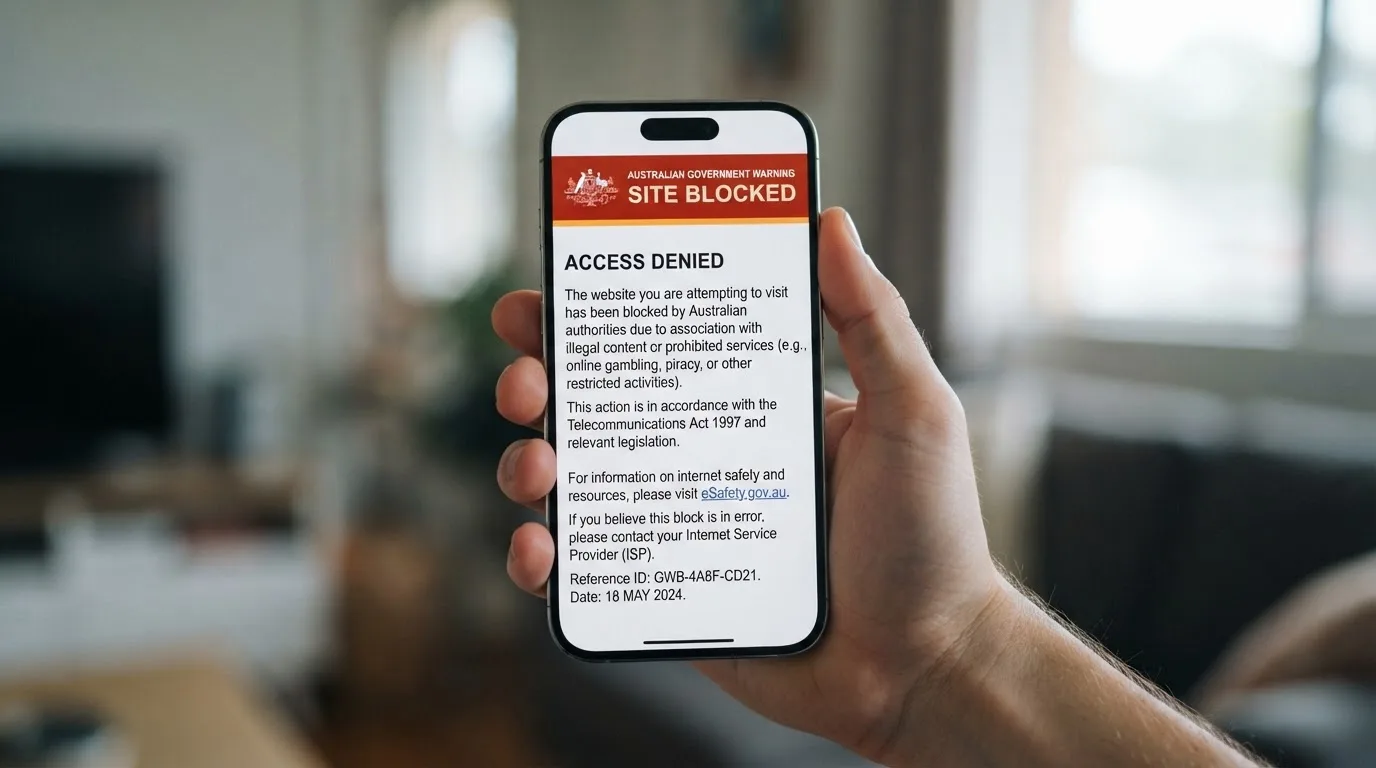
The ACMA enforces this. It investigates, issues formal warnings and directs Australian internet service providers to block illegal sites. By June 2026 the regulator had asked ISPs to block 1,751 illegal gambling and affiliate marketing websites since the first blocking request in November 2019, and more than 230 unlicensed services had withdrawn from the Australian market since enforcement was strengthened in 2017. A June 2026 round alone added twelve sites to the block list — 7Signs, ChromaBet, Donbet, Duospin, Freshbet, Slots Gem, Jacks Club, Lucky Start, Pointsbetz, Spinrise, Vinyl Casino and Wildsino.
The individual player is not prosecuted under the IGA; the law targets the provider. But the practical consequences fall on the player anyway: an offshore site offers no Australian consumer protection, no local complaints body, and no recourse if a withdrawal is refused or a balance is voided. A site can be added to the block list with funds still sitting on it.
H2 Gambling Capital’s 2025 report estimates Australians lose about A$3.9 billion a year to illegal gambling sites, and that the share of gambling going through legal channels fell from 74% in 2021 to 64%. Those figures are the size of the gap the offshore brands are pitching into.
Responsible gambling tools that actually reach a Hobart resident
Three tools matter, and only two of them work on the offshore brands. None of them work at all.
BetStop, the National Self-Exclusion Register, has been live since August 2023. It binds every Australian-licensed online and phone wagering service — Sportsbet, Bet365, Ladbrokes, the Northern Territory’s 52 licensed bookmakers and their peers. Register once, and the licensed operators cannot let you in. An offshore casino is not connected to BetStop. Exclusion from a Curacao-licensed site only works if you ask that site to exclude you, and the site has no obligation to honour it.
Gambling Helpline Tasmania, 1800 858 858, is run by Anglicare Tasmania’s Gamblers Help Service and provides free 24-hour phone counselling for anyone affected by gambling in Tasmania, including at Wrest Point. The same number connects to chat and email support through Gambling Help Online. In-person counsellors are based in Hobart, Launceston, Devonport and Burnie. The helpline can also help arrange venue self-exclusion at Wrest Point itself.
Tasmania’s cashless gaming card reform is a separate track that applies to poker machines in hotels and clubs — a category that does not include Hobart’s casino. Mandatory carded play came in for those venues from December 2025, with default loss limits of $100 per day, $500 per month and $5,000 per year, raisable only after a 24-hour wait, and mandatory 10-minute breaks after two continuous hours of play. Wrest Point’s own gaming floor is run under Tasmanian Gaming Commission rules that predate the cashless card regime.
The single sharpest fact in this section is the one most often missed: there is no Australian self-exclusion tool that can stop an Australian from signing up to an offshore casino. The block is on the operator, not the player. Anyone trying to step back from gambling in Hobart needs to combine the helpline, BetStop for the legal wagering channels, and a personal decision to leave the offshore sites alone — because no register will do that part for them.
Wrest Point in practice: visiting the only legal casino in Hobart
The casino sits at 410 Sandy Bay Road, Sandy Bay — a roughly ten-minute drive from the CBD, or a Number 4 or Number 5 Metro Tasmania bus from the city centre. It is open seven days a week, with hours running into the small hours on weekends.
Inside, three things tend to draw visitors:
- The gaming floor. More than 650 electronic gaming machines, a bank of table games — blackjack, roulette, baccarat, craps — and a dedicated poker room. The mix mirrors what most Australian state casinos offer; it is not a small regional floor. The 2015 Tasmanian Gaming Commission fine of $17,500 for allowing a faulty poker machine that did not function as designed to be played — and the $13,000 fine the previous year for six gaming machines operating outside approved game rules — came out of this machine count, and Federal Group agreed to audit every machine on the floor after the 2015 case. The venue does not publish a per-machine return-to-player figure; South Australia sets a 87.5% minimum outside its own casino, but Tasmania’s floor runs under a different regulator with its own testing regime.
- The bars and rooftop. The 17th-floor revolving restaurant and the bar level underneath it give Wrest Point its skyline presence, and the complex’s lower-level bars and entertainment venues fill out the rest of the night. The rooftop bar is what most searches for “Hobart casino rooftop bar” actually want.
- The hotel. 269 rooms, on site. A visitor can walk from the lobby to the gaming floor in under a minute, which is why Wrest Point is the default answer for “hotels in Hobart near casino” rather than a separate recommendation.
The convention centre, the function rooms and the multiple restaurants make Wrest Point a venue for weddings and conferences as well as gambling. That is part of why the place has lasted fifty years without serious local competition — it is not, in Hobart’s terms, just a casino.
A 2015-2021 Riverbank precinct redevelopment of Adelaide Casino, for context, cost about A$330 million. Wrest Point’s 2018-2023 staged renovation was around a fifth of that figure. The Tasmanian floor is mid-sized by Australian casino standards, behind SkyCity Adelaide (90 tables, 950 machines) and well behind the Star Brisbane at Queen’s Wharf, which opened in August 2024 on the back of a A$3.6 billion precinct development and displaced the old Treasury Casino.
Hobart versus the rest of Australia’s state casinos
For a Hobart reader, the comparison that matters most is with Brisbane, Adelaide and the country’s other capital-city casinos — because the question of where to play is, in practice, a question of where the next trip is going.
Adelaide Casino, commercially SkyCity Adelaide until 2009, sits in the heritage-listed Adelaide railway station building on North Terrace. It carries 90 gaming tables and 950 gaming machines and is the sole licensed casino in South Australia under the Casino Act 1997. Its table-game monopoly was extended to 30 June 2035 under a licence formalised on 11 October 2013, which also permits the casino to expand to up to 200 gaming tables and 1,500 gaming machines subject to redevelopment. South Australia outside the casino had 11,672 gaming machines in 471 venues in September 2023; gaming-machine losses outside Adelaide Casino totalled about A$0.92 billion in 2022-23, equivalent to about A$497 per adult. Adelaide Casino itself carries no maximum-bet limit, against the A$5.00 general cap outside the venue.
Brisbane’s market moved in 2024. Treasury Casino, operated by Star Entertainment Group in the city’s historic Treasury Building, closed on 25 August 2024 after a three-level gaming emporium of 80 gaming tables and over 1,300 gaming machines, plus a hotel, six restaurants, five bars and a nightclub. The Star Brisbane at Queen’s Wharf opened in stages from 29 August 2024, developed jointly by Star Entertainment and Hong Kong-based Chow Tai Fook Enterprises. The opening came against a difficult licence position: in late 2022 the Queensland Government, acting on an independent review by former Court of Appeal judge Robert Gotterson, found Star Entertainment unsuitable to hold its Queensland casino licences after concluding it had misled regulators and failed its anti-money-laundering duties; Star was fined $100 million on 9 December 2022, with a 90-day suspension of the Treasury Brisbane and Star Gold Coast licences deferred to 1 December 2023 to allow remediation. Queensland had 21,122 gaming machines operating in 351 venues in October 2023.
By those measures Hobart is small and steady. Wrest Point’s 650-odd machines sit between South Australia’s 11,672 outside the casino and the Star Brisbane’s 1,300-plus. The licensing record is the cleanest of the three venues: no Gotterson-style review, no deferred suspension, just two machine-related fines in successive years and a full audit of the floor after the larger one.
Walking distance: hotels near Wrest Point
Because Wrest Point is the only casino in Hobart, “hotels in Hobart near casino” is functionally a question about how close to walk from any of the central hotels to Sandy Bay Road. A shortlist of the obvious choices:
- Wrest Point itself. The on-site 269-room tower is the only hotel with a direct internal connection to the gaming floor, which is the reason most visitors who want the convenience stay there.
- The Old Woolstore Apartment Hotel and the Hadley’s Orient Hotel, both within the CBD, sit roughly 3.5 to 4 kilometres from Wrest Point — a ten-minute drive, a thirty-minute walk along the waterfront or a short taxi.
- The Salamanca Inn, the Salamanca Wharf Hotel and the Lenna of Hobart, all in the Salamanca Place / Battery Point area, sit closer to the harbour end of the route and a similar distance from Wrest Point.
- The Mona ferry terminal at Brooke Street Pier is the public-transport gateway to the Museum of Old and New Art; the ferry is a separate experience, not a casino transfer, but it puts the visitor within a short bus ride of Wrest Point’s door.
There is no second casino to compare against, which means the hotel question is really about how late a guest wants to stay on site and how much they want to spend on a four-kilometre cab back into town.
What the ACMA has actually said about offshore casino brands
This is the part of the page that earns its keep. Anyone Googling “best casino in Hobart” in 2026 is also being advertised at by a long list of offshore brands, almost none of which hold any permission to take Australian customers. The list below is drawn from the ACMA’s own formal-warning register. It is not a recommendation. The format is the ACMA’s own framing: who was warned, when, and what service was named.
| Brand | ACMA action and date | Operator named by the ACMA | Subject support |
|---|---|---|---|
| RocketPlay | Formal warning, March 2026 | Pulsup Ltd (Rocketplay.com.au); Dama N.V. warned earlier in May 2022 | — |
| Level Up Casino | Formal warning, May 2022 | Dama N.V. | listings |
| Woo Casino | Formal warning, March 2025 | Dama N.V. | listings |
| Spirit Casino | Formal warning, May 2025 | Dama N.V. | — |
| National Casino | Formal warning, July 2025 | Consolutetish S.R.L. | listings |
| Bizzo Casino | Formal warning, July 2025 (earlier TechSolutions warned in 2022) | Consolutetish S.R.L. (earlier TechSolutions) | — |
| Ignition Casino | Formal warning, July 2025 | Bamboo Media | — |
| Instant Casino | Formal warning, February 2025 | EOD Code SRL | — |
| Jackbit | Formal warning, April 2026 | Ryker B.V. (also named for CasinOK) | — |
| Casino Intense | Formal warning, April 2025 | Sterplay Holding Ltd | listings |
| Sky Crown | Formal warning, September 2022 | Hollycorn N.V. (also named for Blue Leo) | listings |
Two patterns are worth reading off the table before any individual row is examined. The first is the recurrence of named operators: Dama N.V. shows up four times across RocketPlay, Level Up, Woo and Spirit, with dates stretching from 2022 to 2025. A single operator getting four formal warnings over three years, across different brand shells, is the regulator’s record of an industry pattern rather than a series of mistakes. The second is the spread of operators behind a single brand over time: Bizzo Casino was warned as a TechSolutions operation in 2022 and again as a Consolutetish operation in 2025, with the consumer-facing brand unchanged. A Hobart reader looking at Bizzo’s homepage in 2026 sees a logo and a welcome bonus. The regulator’s record shows the same logo and the same welcome bonus sitting on top of two different offshore operators in three years.
The “Subject support” column carries what research actually located about whether the brand has any Australian-facing support mechanism beyond the ACMA’s own action. Em dashes mark brands where no listing, registry or public source was located. “Listings” marks brands that appear in directory listings but carry no Australian licensing and no ACMA-cleared consumer pathway. In every case, the operative rule is the same: online casino games cannot be licensed anywhere in Australia, whatever licence the site displays.
What the table does not contain is a bonus number, a wagering multiple or a payout time. Those figures circulate on affiliate marketing pages; the ACMA’s register does not carry them, and this page does not pull them in. A reader who wants the bonus terms has them available with a single click from the brand’s own site; the page is not the place that pulls those numbers into a register that does not contain them.
The eleven brands, read individually
Each row below takes the ACMA’s own entry and writes out what it means for a Hobart reader — and what it does not mean. There is no ranking; the order matches the table above and reflects the order in §6 of the research.
RocketPlay. Warned in March 2026 with Pulsup Ltd named as the operator. The brand sits inside an enforcement chain: the same brand name was warned as part of Dama N.V.’s May 2022 action over six casino sites. The brand is not licensed anywhere in Australia; the ACMA does not list it among Australian-licensed services. For a Hobart reader: the brand carries a sign-up form and a deposit page and has been on the regulator’s record twice in four years.
Level Up Casino. One of the six Dama N.V. brands named in May 2022. Appears in directory listings as a Curacao-licensed operation. The ACMA’s action is five years old at this point, which is itself information: a brand on the warning list since 2022 has had the time to come into compliance, leave the market, or do neither. Hobart readers will find Level Up Casino in listings but not in any Australian register of approved operators.
Woo Casino. Dama N.V., March 2025. The brand appeared in directory listings before the warning. After the warning it remains online and continues to be advertised to Australian-facing traffic through affiliate channels, which is the industry’s standard response to a formal warning that does not carry a financial penalty.
Spirit Casino. Dama N.V., May 2025. Newer than Woo and on the same operator. No directory listings carried the research, which is itself notable: newer brands with no third-party footprint are easier to drop and rebuild than brands with affiliate footprints.
National Casino. Consolutetish S.R.L., July 2025. The brand appears in directory listings and in Australian-facing affiliate material. The 2025 warning came after the brand had been operating to Australian customers for years.
Bizzo Casino. A two-warning brand. Consolutetish S.R.L. in July 2025; TechSolutions (CY) Group Limited and TechSolutions Group N.V. in 2022. The brand survived the operator change and continues to advertise. For a Hobart reader this is the cleanest case study on the list of how the offshore industry re-shells a brand after a regulator acts.
Ignition Casino. Bamboo Media, July 2025. The brand has no listing in any directory the research located, which is unusual for an offshore casino brand of its age and is consistent with the operator’s preference for low-profile affiliate acquisition over public listings.
Instant Casino. EOD Code SRL, February 2025. No directory listings located. One of the earlier 2025 warnings, which suggests a brand that was warned before it built a meaningful third-party footprint.
Jackbit. Ryker B.V., April 2026 — with CasinOK named in the same action. The warning is recent and the operator continues to hold both brands in market. No directory listings located.
Casino Intense. Sterplay Holding Ltd, April 2025. Appears in directory listings and in industry coverage. The brand is older than most of the 2025 cohort and was still the subject of an ACMA action in 2025, which means longevity on the warning list rather than removal from it.
Sky Crown. Hollycorn N.V., warned in September 2022 with Blue Leo named in the same action. Appears in directory listings. The oldest formal warning on this list and the brand that has stayed on the market longest under the same operator. The Hollycorn record reads more clearly than most: same operator, same brand, same product, ACMA action in 2022 and still being advertised to Australians in 2026.
Two verdicts sit across the eleven entries. The first is that no entry on this list offers a path that an Australian consumer can enforce. If a balance is voided, a withdrawal is refused or a self-exclusion request is ignored, the recourse is to the offshore operator’s own complaints process — which is not an Australian complaints process and not connected to BetStop. The second is that the ACMA’s record, read across the eleven rows, is a record of an industry that absorbs warnings the way any other regulated industry absorbs fines — it pays them, or it does not, and it continues. The regulator’s blocking list is the more consequential lever: 1,751 sites blocked since November 2019 is a number that affects whether a Hobart reader can reach a brand at all.
The blocking-rate calculation: how the ACMA’s enforcement record scales
The arithmetic on this page belongs to the relationship between two numbers from the ACMA’s own record: the running total of blocked sites (1,751 by June 2026) and the date of the first blocking request (November 2019). Between those bookends, roughly 79 months, the regulator has averaged a block rate in the low twenties per month — and the monthly pace has not been constant.
The honest framing is a band rather than a single figure. The early years carried single-digit monthly block rates; the 2024-2026 rounds have carried larger ones, with the June 2026 round alone adding twelve sites. The annualised pace from 2024 onwards is meaningfully higher than the 2019-2023 average. A Hobart reader who reads the headline “1,751 sites blocked” as “the regulator is closing the offshore market” overstates the result; a reader who reads it as “the regulator is suppressing it” understates it. The middle reading is the one the arithmetic supports: the ACMA is suppressing the market faster than the market is re-entering through new shells, but not by enough to make the offers stop arriving.
The true value in this calculation is the time dimension, not the headline number. 1,751 sites blocked is a count. The same count divided across the months since November 2019, and split by the period before and after the 2024 enforcement ramp, is a pace — and the pace is what tells a Hobart reader how fast the offshore offer to them will keep changing as brand shells turn over.
The federal frame: what 2026 actually changed
Two statutory points matter to a 2026 page even though neither is in force yet.
The Interactive Gambling Amendment (Gambling Reform) Bill 2026 passed Parliament on 19 August 2026. Its advertising and inducement measures commence on 1 January 2027. The Bill is law with a start date: a 2026 reader in Hobart is reading it as “passed”, not as “in force”. The measures that bite first are the ones aimed at inducements — bonus offers, sign-up credits, “free spin” promotions — which is exactly the surface the offshore brands use to reach Australian customers. From 1 January 2027 the inducement surface itself becomes a regulated line, not just a warning.
The payment ban came earlier. From 11 June 2024 credit cards, credit-related products and digital currency have been banned as payment for licensed online wagering, with penalties up to $247,500 for operators. Legal deposit routes for licensed wagering are debit card, bank transfer, PayID/Osko and BPAY. A site asking an Australian for a credit card or a crypto deposit is operating outside the Australian rules. The ban applies to the licensed wagering channel, where it can be policed; offshore sites are not subject to it, which is one reason they still accept credit cards from Australian customers.
The Tasmanian frame is unchanged. The Tasmanian Gaming Commission regulates Wrest Point; the Commonwealth regulates online casino through the IGA; and the IGA’s enforcement is the ACMA’s. There is no Tasmanian-issued online casino licence to point to because no Australian state or territory issues one.
The honest framing for a Hobart reader
Four observations close the page.
The first is that Hobart’s “best casino” is not a question with multiple competitive answers. It is Wrest Point, and the rest of the comparison is between Wrest Point and the offer to do the same thing offshore with no Australian recourse. The right way to read the table of eleven brands is as a register of who has been warned, not as a ranking.
The second is that the legal frame is unusually clear in Australia’s case. The Interactive Gambling Act 2001 prohibits the supply of online casino games to people in Australia. The ACMA enforces it. The enforcement is asymmetric — the provider takes the regulatory hit, the consumer takes the loss. The 2026 reform Bill that commences in January 2027 closes one of the inducement surfaces; it does not legalise online casino.
The third is that the responsible-gambling tools that work for a Hobart resident do not reach the offshore market. BetStop binds licensed wagering. Gambling Helpline Tasmania is open to anyone. Wrest Point has its own venue self-exclusion. None of these tools stop an offshore site from taking an Australian’s deposit and refusing their withdrawal.
The fourth is that the licensed venue is also the more accountable one. Wrest Point has been fined, audited, regulated and renovated under Tasmanian supervision; the offshore brands have been warned, blocked, re-shelled and re-advertised under ACMA supervision, and continue to advertise to Australians between rounds. A Hobart reader who wants to gamble has a clearly better regulated option inside the state. A Hobart reader who wants to be advertised to has eleven.
Frequently asked questions about Hobart’s casino
Which is the main casino in Hobart?
Wrest Point Hotel Casino in Sandy Bay. It opened on 10 February 1973 as Australia’s first legal casino, after a 1968 Tasmanian referendum approved the development, and remains the only licensed casino in southern Tasmania. The 17-storey, 64-metre dodecagonal hotel tower is the tallest building in Tasmania.
Where is the casino in Hobart located?
410 Sandy Bay Road, Sandy Bay, about four kilometres south of Hobart’s CBD. The Number 4 and Number 5 Metro Tasmania buses run from the city centre to the venue, and the drive from the CBD takes around ten minutes. Wrest Point is the address, not just the building — the venue covers the gaming floor, the hotel tower, the convention centre and the surrounding bars and restaurants.
What is the minimum age to enter the casino in Hobart?
Eighteen. Photo ID is required at the door. The same minimum applies to any Australian-licensed wagering service a Tasmanian resident can otherwise sign up to. An offshore casino site asks for an Australian’s date of birth the same way, but operates outside the Australian licensing regime entirely.
Does the Hobart casino offer blackjack, baccarat, craps and roulette?
Yes. Wrest Point runs a full table-game floor alongside its more than 650 electronic gaming machines and a dedicated poker room. The mix of blackjack, roulette, baccarat and craps is standard for an Australian state casino, and the venue also runs a separate bar and entertainment offering above and around the floor.
Are there hotels within walking distance of the casino in Hobart?
Wrest Point itself is the only hotel with an internal connection to the casino floor, which is the practical answer for visitors who want to walk from bed to gaming in under a minute. The Salamanca Place and CBD hotels — Hadley’s Orient, the Old Woolstore, Salamanca Wharf Hotel, Lenna of Hobart — sit roughly 3.5 to 4 kilometres away, a short drive or a thirty-minute walk along the waterfront.
Can Australians legally play at an online casino instead of visiting Hobart?
No. The Interactive Gambling Act 2001 prohibits the supply of online casino games to anyone in Australia, and no state or territory issues a licence for online casino. The ACMA enforces the prohibition by issuing formal warnings and directing ISPs to block sites — 1,751 sites have been blocked since November 2019, and offshore brands continue to be named in formal warnings through to April 2026. The individual player is not prosecuted, but no Australian consumer protection applies to an offshore site.