
Instant PayID Withdrawals at Australian Casinos: Speed Against the Law
The promise is sharp. A withdrawal at an online casino that clears through PayID in under a minute, 24 hours a day, with no queue and no office hours in the way. The page explains what that promise is built on, what it costs, and why none of the sites that make it are licensed to serve an Australian. The headline “instant” is the only fact about the offer that is settled before the player ever opens the cashier. Everything that follows is built on it.
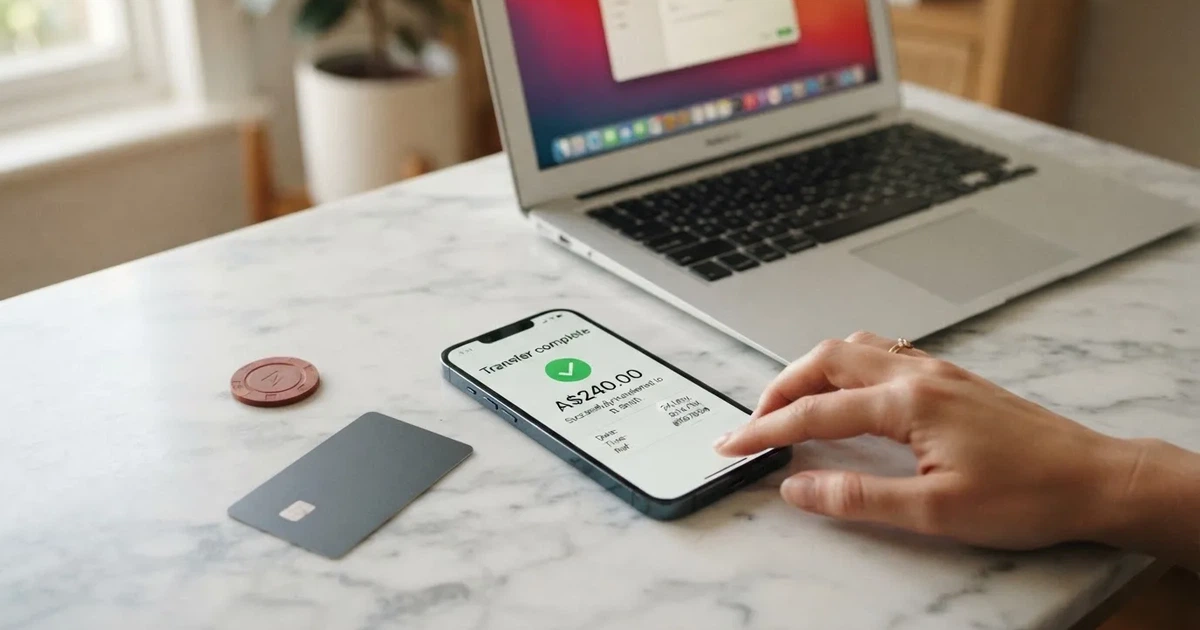
Data current as of 29 October 2026 and checked against the ACMA register of formal warnings and blocking requests.
- The legal frame: what no PayID casino can offer an Australian
- ACMA enforcement: what the formal warnings actually say
- Responsible play: what an instant withdrawal does and does not mean
- How a PayID withdrawal actually moves
- What an instant PayID withdrawal actually costs the player
- The eleven brands the ACMA has warned
- The shape of the offer: what every site in this list actually markets
- A practical reading: what the rest of the year looks like
- Frequently asked questions
The legal frame: what no PayID casino can offer an Australian
Online casino games and online pokies cannot be licensed in Australia. The Interactive Gambling Act 2001, tightened by the Interactive Gambling Amendment Act 2017, makes it an offence to provide those products to a person physically in Australia. What can be licensed is wagering on racing and sporting events placed before the event, lotteries and keno — and in practice the racing and sports side is licensed by the Northern Territory Racing and Wagering Commission, which oversees 52 online bookmakers including Sportsbet, Bet365 and Ladbrokes for tax reasons, holds no full-time staff of its own and meets monthly in Darwin.
The rule has two consequences a player feels immediately. The first is that any site marketing “instant PayID withdrawal casino” to an Australian is, by definition, operating outside the regime. The site may hold a Curaçao or Anjouan licence of its own; that licence authorises it somewhere, not here, and the ACMA has spent the last several years building a public record of the brands that hold them. The second is that the consumer protections the regime offers — a complaints body, dispute resolution, rules on advertised odds and a self-exclusion register that actually catches the player — sit on the licensed side of that line and stop where it begins.
Enforcement runs through the Australian Communications and Media Authority. The ACMA investigates, issues formal warnings and asks Australian internet service providers to block offending services. As of the figures reported in June 2026, the running total stood at 1,751 illegal gambling and affiliate marketing websites blocked since the first blocking request in November 2019, with more than 230 unlicensed services having left the Australian market since enforcement was strengthened in 2017. The June 2026 round alone added twelve more names — 7Signs, ChromaBet, Donbet, Duospin, Freshbet, Slots Gem, Jacks Club, Lucky Start, Pointsbetz, Spinrise, Vinyl Casino and Wildsino. The work is incremental, the list is public, and a brand that surfaces today can be blocked next month.
The individual player is not the target. The Act names the provider, not the punter, and there is no record of an Australian being prosecuted for placing a bet with an offshore site. That is not the same as the arrangement being safe. An offshore site gives no Australian consumer protection, sits outside any complaints body and offers no recourse if a withdrawal is refused — and a balance sitting on a blocked site is a balance the player cannot reach. H2 Gambling Capital’s 2025 work puts the cost at around A$3.9 billion a year lost to illegal sites, with the share of gambling going through legal Australian channels falling from 74% in 2021 to 64% by the time the report was written.
A player-protection point sits next to the legal one and needs to be made plainly. BetStop, the National Self-Exclusion Register, has been live since August 2023 and binds every Australian-licensed online and phone wagering service. An offshore casino is not connected to it; signing up with BetStop will not stop a PayID withdrawal landing in a bank account from one of them. The National Gambling Helpline on 1800 858 858 is free, runs 24/7, and offers chat through Gambling Help Online for anyone whose use of these sites has moved past the casual.
The 2026 reform timetable is the only place this picture changes within the year. The Interactive Gambling Amendment (Gambling Reform) Bill 2026 passed Parliament on 19 August 2026; its advertising and inducement measures commence on 1 January 2027. Law with a start date, not a regime in force on a 2026 page, and the rest of this article is written under the rules that apply to it now.
ACMA enforcement: what the formal warnings actually say
The ACMA publishes a register of formal warnings on its own site, and each one names the operating company behind the brand and the date the warning was issued. The register is the closest thing the Australian player has to a public list of which offshore casinos have been told to stop. The list below is not exhaustive — it covers only the brands whose details appear in the warning notices and is current to the most recent action; a name that is not here is not cleared, only not yet named.

The way to read a formal warning is straightforward. It is a written notice that the named operator has been offering prohibited interactive gambling services to customers in Australia and is required to cease. It is not a prosecution, it does not carry a fine in itself, and the ACMA does not publish what happens after a warning is issued if the operator complies quietly. The pattern across the register is the same: a brand surfaces, runs for a while, draws a warning, and either continues under the same operating company under a different name, changes hands, or fades. What changes is the public record.
A small calculation belongs here, because it is the only piece of arithmetic the page has to offer and it earns its keep. Between November 2019 and June 2026, the ACMA asked Australian ISPs to block 1,751 illegal gambling and affiliate marketing websites — 1,751 blocking requests over roughly 79 months, an average of around 22 per month across the period. The figure flatters the early years; recent rounds have been larger. The June 2026 round alone added 12 sites, and earlier rounds in the same period hit double digits. Treat the running average as a band rather than a number: somewhere between fifteen and twenty-five sites a month over the life of the regime, with a clear upward drift, and with no signal in the public record that the rate is about to fall.
ACMA Enforcement Overview
| Brand | ACMA action and date | Operator named by the ACMA | PayID at the cashier |
|---|---|---|---|
| RocketPlay | Formal warning, March 2026 (earlier Dama N.V., May 2022) | Pulsup Ltd | — |
| Level Up Casino | Formal warning, May 2022 | Dama N.V. | Per Westpac listings |
| Woo Casino | Formal warning, March 2025 | Dama N.V. | — |
| Spirit Casino | Formal warning, May 2025 | Dama N.V. | — |
| National Casino | Formal warning, July 2025 | Consolutetish S.R.L. | Per AUSTRAC and other listings |
| Bizzo Casino | Formal warning, July 2025 (earlier TechSolutions, 2022) | Consolutetish S.R.L. | — |
| Ignition Casino | Formal warning, July 2025 | Bamboo Media | — |
| Instant Casino | Formal warning, February 2025 | EOD Code SRL | Per ecoPayz and PayID listings |
| Jackbit | Formal warning, April 2026 | Ryker B.V. | — |
| Casino Intense | Formal warning, April 2025 | Sterplay Holding Ltd | Per AUSTRAC, ITNews and NAB listings |
| Sky Crown | Formal warning, September 2022 | Hollycorn N.V. | — |
Payment Methods Comparison
| Payment Method | Legal Licensed Wagering | Offshore Casino |
|---|---|---|
| Debit card | Allowed | Allowed |
| Credit card | Prohibited | Allowed |
| Bank transfer | Allowed | Allowed |
| PayID/Osko | Allowed | Allowed |
| Cryptocurrency | Prohibited | Allowed |
The table reads as a list because it is one — a list of brands the regulator itself has named, ordered by the date their ACMA action first appears in the register. The PayID column is the page’s own addition and the emptier it is, the closer it sits to the truth: in most of these cases the operator’s own cashier pages do not enumerate PayID at all, and the few listings that mention it are aggregator pages whose connection to the operator’s actual product is thin. Where the column carries a name, it carries it because an independent listing reported it, not because the operator confirmed it.
Two patterns are worth pulling out of the register before moving on. The first is operator concentration. Dama N.V. drew a warning in May 2022 covering six brands — Bambet, Dazard, Level Up, Rocketplay, Wild Tornado and Cobra Casinos — and was warned again in March 2025 over Woo Casino and in May 2025 over Spirit Casino. Consolutetish S.R.L. drew the same treatment in July 2025 over National Casino and Bizzo Casino, the second warning tied to Bizzo since 2022. A warning to one brand inside a stable is, in practice, a warning to the whole stable, and the timing of the warnings tells the reader something about how long the regulator’s attention stays on a group once it has started. The second is the brief shelf life of some of the names. Rocketplay drew a 2022 warning under Dama N.V. and a 2026 warning under Pulsup Ltd — the brand carried on, the operator changed, and the public record picked up the seam. Hollycorn N.V. is named in a single September 2022 warning covering Sky Crown and Blue Leo; the absence of later action is not a clearance, it is an absence.
Responsible play: what an instant withdrawal does and does not mean
A withdrawal that clears in sixty seconds is a fact about plumbing. It says the operator released the funds to its payment processor without delay and the processor put them on the New Payments Platform. It says nothing about whether the operator is licensed where the player sits, whether the games on offer have been independently tested, whether the player’s self-exclusion will be honoured if it needs to be, or whether a complaint will be heard by anyone with the power to order a refund. The speed at which money arrives is the cheapest part of a casino to build and the easiest to advertise, which is why it leads the marketing.
BetStop is the part of the Australian regime that handles the player who wants to stop, and it is worth being specific about what it does and what it does not do. Live since August 2023, the National Self-Exclusion Register is the single opt-out an Australian can place that is honoured by every Australian-licensed wagering service simultaneously — phone, online, sports and racing bookmakers all see the same flag and all refuse service. The minimum exclusion period is three months, with longer options available, and the register is run by Australian Communications and Media Authority–accredited providers on the regulator’s behalf. An offshore casino is not a signatory to BetStop and never will be, because BetStop is a condition of an Australian licence and an offshore casino cannot hold one. A player who has registered with BetStop and then opens an account with one of the brands in the table above is, in the regulator’s terms, someone who has stepped around their own exclusion.
The bank-side blocks are a parallel layer, and they catch transactions the operator would have taken. Westpac’s gambling block works at card level: it refuses authorisation of any transaction carrying the merchant category code ‘Betting/Casino Gambling’ on eligible personal credit and debit cards, and the bank publishes the block as a setting customers can turn on themselves. ANZ runs an equivalent block through the ANZ app, with two details that matter for anyone reading this page. The ANZ block applies to gambling transactions made through a digital wallet such as Apple Pay on an eligible card, not only to the physical card; and once the block is on, removing it requires a 48-hour waiting period so a player cannot turn it off in a moment of impulse. ANZ also publishes the caveat that not all gambling transactions will be blocked and a small number of non-gambling transactions may be blocked in error, which is a more honest line than the marketing on either side tends to offer.
A PayID withdrawal that arrives in under a minute travels on the same rails as any other bank transfer; the block layer that catches gambling at a merchant category code sits above PayID, not beside it. A player who has set the bank-side block has, in practical terms, taken themselves out of the path the speed promise depends on, because the funds will not arrive at the cashier to be wagered in the first place. The block does not reach a withdrawal the player has already won and is now trying to cash out — that money is theirs and the bank has no rule that says a withdrawal from a gambling merchant is treated differently from any other credit. What the block changes is the deposit side. That is also the side the offshore casino is advertising speed against, and the speed promise is for the cash-out, not the cash-in.
For anyone whose use of these sites has gone past the casual, the National Gambling Helpline on 1800 858 858 is free, runs 24/7 and connects to Gambling Help Online chat. The line is the one Australian number a player in trouble should have next to the page they were reading when they decided to call.
How a PayID withdrawal actually moves
PayID is an easy-to-remember identifier — a mobile number, an email address, an ABN or an Organisation Identifier — linked to an ordinary Australian bank account. It is operated by Australian Payments Plus, the country’s domestic payments provider, and it is offered by more than 100 Australian financial institutions, all of which have already built it into their online banking. There is no PayID app to download and no separate account to open; the identifier is a pointer to a bank account the customer already has.
The system runs on Australia’s New Payments Platform, which the Reserve Bank of Australia launched in February 2018 to let households, businesses and government agencies make simply-addressed, near real-time payments around the clock. The RBA regulates and oversees the platform, and separately owns and operates the Fast Settlement Service that settles NPP transactions individually in close to real time. As of April 2025 there were more than 25 million registered PayIDs in Australia — a figure that explains why every bank in the country now offers it without making a fuss. When a payer sends money to a PayID, the system shows the name linked to the identifier before the transfer is sent; that is the check that protects against mistyped numbers and against the kind of social-engineering scam that asks someone to pay a stranger. It is also the reason a casino asking for payment “to a PayID” can be checked against a real name before the customer commits.
The layer that matters for an instant withdrawal is Osko. Osko is the brand under which participating Australian banks deliver an NPP payment in under a minute, 24/7, whether the payment is addressed to a BSB and account number or to a PayID. The “instant” in “instant PayID withdrawal casino” is Osko’s promise — the casino’s payment processor pushes the funds onto the New Payments Platform, the platform routes them to the player’s bank, and the bank credits the account within seconds. The bank-side cost is zero on most accounts; the player-side cost is whatever the operator has already taken out of the withdrawal in fees or in an unfavourable exchange rate.
Two details sharpen the picture. The first is that “instant” is a property of the rails, not of the casino. The slowest part of a fast-looking withdrawal is almost always the casino’s own settlement review, the internal queue in which the operator checks the player’s identity, the bonus terms and any anti-money-laundering flag. A site that advertises instant withdrawals is, more often than not, advertising a queue that does not run on weekends or outside business hours, and the part of the journey that is genuinely under the operator’s control is the part the marketing tends to obscure. The second is that a PayID transfer shows the receiving name before it is sent, which means the cashier at the casino has to display a name that matches the account the player is withdrawing to. A mismatch between the registered account holder and the receiving PayID is the kind of detail that holds a withdrawal up regardless of how fast the rails are.
The cost of credit has been closed off at the cashier. Under the Interactive Gambling Act 2001 as amended in 2023, Australian-licensed online wagering services cannot accept credit cards or other credit-related products as payment, a restriction that also constrains how a PayID-linked bank transfer can be used for wagering where the underlying funding is credit. The offshore casino is outside that rule, and a player who pays a Curaçao-licensed casino by credit card is paying in a way the Australian regulator would not let a licensed operator accept. The licensed-side equivalent — debit card, bank transfer, PayID/Osko and BPAY — is the full list of legal deposit routes for an Australian punter. A site asking for credit or cryptocurrency is, by the same logic, asking the customer to fund an account in a way the licensed market has been told to refuse.
What an instant PayID withdrawal actually costs the player
The cost of a withdrawal, in money terms, is whatever the operator removes from the amount before it goes onto the New Payments Platform. The headline fees vary by brand and are usually hidden in a payments page the customer reads after deciding to play; some operators charge nothing, others charge a percentage or a flat fee on certain payment routes, and a few quote a fee that disappears once the player reaches a certain withdrawal volume in a month. The exchange-rate cost is harder to see, because most of these sites are denominated in euros or US dollars and the conversion to Australian dollars happens at the operator’s published rate, which is rarely the rate the player’s bank would have applied.
The time cost is the harder number to put a dollar value on. The “instant” promise covers the part of the journey that runs on Australian rails, after the operator has already decided to release the funds. The part the operator controls is the queue that runs before that release — the verification, the bonus-clearing check, the source-of-funds review for larger withdrawals and, in some brands, a manual review that holds anything over a threshold for twenty-four to seventy-two hours. A player who reads “instant PayID withdrawal” as a promise about the whole journey will find the queue is where the time goes.
The legal cost is the one no marketing page describes, and it is the one that does not depend on how the site performs. A withdrawal from an unlicensed site is a withdrawal from a business the Australian regulator has, in many of the cases above, named in writing as offering a prohibited service. The funds are the player’s when they arrive; the route they took to arrive is one the player cannot complain about through any Australian body if something goes wrong. A withdrawal that is refused, a balance that is left stranded when the site is blocked, a complaint that the operator simply does not answer — all of these are possibilities the licensed market has a body to handle, and the unlicensed market has nothing to handle them with. The legal frame is the cost the page opened with, and it is the cost the rest of this section is really describing.
The eleven brands the ACMA has warned
What follows is the ACMA’s own list, transcribed and commented on. Each brand has been the subject of a formal warning issued under the Interactive Gambling Act 2001 for offering prohibited interactive gambling services to customers in Australia. The brand name is the public-facing label; the operator is the legal entity behind it. The date is the date the warning was published on the ACMA register, not the date the conduct the warning describes began.
A reader scanning this section is not comparing eleven casinos the way a normal review compares them — there is no ranking here, no “best for” framing, and no recommendation to sign up. The reader is comparing eleven warnings to one another, and the question is what each one tells them about the operator behind it.
RocketPlay — Pulsup Ltd, March 2026 (and Dama N.V., May 2022)
RocketPlay is the only brand in this list that has been named twice. The earlier warning was issued in May 2022 to Dama N.V., one of the more familiar operator names on the Curaçao register, covering six brands in a single notice: Bambet, Dazard, Level Up, Rocketplay, Wild Tornado and Cobra Casinos. The March 2026 warning names a different company, Pulsup Ltd, attached to the same Rocketplay brand. The brand carried on across a change of operator, and the regulator’s public record picked up the seam. Two warnings on the same brand, four years apart, in two different corporate names.
Level Up Casino — Dama N.V., May 2022
Level Up is one of the six brands named in the May 2022 warning to Dama N.V. and the only one of the six that has not, on the public register, attracted a further warning under its own name. The implication is not that the brand is now compliant — there is no clearance of that kind on the ACMA register — only that the regulator has not added a fresh notice since 2022. The absence is an absence.
Woo Casino — Dama N.V., March 2025
Woo Casino was named in a formal warning to Dama N.V. in March 2025, three years after the May 2022 warning that hit the same operator across six other brands. A separate formal warning to Dama N.V. over Spirit Casino followed in May 2025, suggesting the operator’s conduct across its stable of brands had not changed enough to keep the regulator’s attention away. The interval between the 2022 warning and the 2025 ones is the only public signal of how long it takes before a fresh round begins.
Spirit Casino — Dama N.V., May 2025
Spirit Casino drew its warning in May 2025, two months after Woo Casino’s, with the same operator name. Two warnings to the same operator in three months is the kind of pattern that tells the reader the regulator’s attention had not moved off Dama N.V. by the second half of 2025, and the underlying conduct across the operator’s stable of brands was the target.
National Casino — Consolutetish S.R.L., July 2025
National Casino was named in a July 2025 formal warning to Consolutetish S.R.L., the same notice that named Bizzo Casino. AUSTRAC and other public-facing listings mention the brand in connection with payment routes, and the operator name is one that appears in the same shape in other regulatory filings. Two brands under one warning is the same pattern Dama N.V. produced in 2022, and the reader should treat the pair as one decision the regulator made about one operator.
Bizzo Casino — Consolutetish S.R.L., July 2025 (and TechSolutions, 2022)
Bizzo Casino is the second brand in this list to have been named twice. The first warning, in 2022, was issued to TechSolutions Group N.V. and TechSolutions (CY) Group Limited; the second, in July 2025, went to Consolutetish S.R.L. The brand is the same, the operator is not. The 2025 warning is the second formal action tied to the brand since 2022, and the public record shows the brand carrying on through an operator change in between.
Ignition Casino — Bamboo Media, July 2025
Ignition Casino is the third brand in the July 2025 round, named in a formal warning to Bamboo Media. There is no earlier warning on the public register tied to this brand under this operator name, and that is the whole of what the absence tells the reader.
Instant Casino — EOD Code SRL, February 2025
Instant Casino drew a formal warning to EOD Code SRL in February 2025, and the brand name is one of the closer matches to the search term that brings readers to this page. The brand name markets itself as instant — and the warning predates the marketing by some months. ecoPayz and PayID listings mention the brand in passing; the operator has not confirmed PayID as a cashier route on the public register, and that is the line this page holds.
Jackbit — Ryker B.V., April 2026
Jackbit was named in a formal warning to Ryker B.V. in April 2026, alongside CasinOK, in the most recent warning round covered by this page. Two brands under one operator in one notice, again — the same pattern the ACMA has used since at least the 2022 Dama N.V. warning.
Casino Intense — Sterplay Holding Ltd, April 2025
Casino Intense was named in a formal warning to Sterplay Holding Ltd in April 2025. AUSTRAC, ITNews and NAB listings mention the brand in passing. Sterplay is not a name that appears elsewhere on the ACMA register, and the single warning is the only public signal the regulator has sent about the brand.
Sky Crown — Hollycorn N.V., September 2022
Sky Crown was named in a September 2022 formal warning to Hollycorn N.V., the same notice that named Blue Leo. There has been no further warning under this operator name on the public register. The absence is, again, an absence and not a clearance; Hollycorn is an operator name that appears in other regulatory filings in other jurisdictions, and the ACMA’s silence on it since 2022 does not tell the reader what the brand is doing now.
The shape of the offer: what every site in this list actually markets
Every brand in the ACMA register is doing the same job, even if the marketing around it is dressed differently. Each is operating a cashier that takes payment from an Australian in a currency the player may or may not recognise, holds the funds while the player wagers, and pays out through a route the player chooses — including, in some cases, PayID. The brand name on the homepage is the part of the operation that changes; the operator behind it, the licence that authorises it somewhere, the games catalogue it loads and the payments page it links to all sit behind that name.
The payments page is where the marketing meets the bank. The routes the licensed market is allowed to take — debit card, bank transfer, PayID/Osko and BPAY — overlap with the routes an offshore site accepts, which is why PayID shows up in the cashier at all. The routes the licensed market is told to refuse — credit card, credit-related products and digital currency — are routes an offshore site can still take, which is why the same cashier page often lists a credit card option as well. A player who lands on an offshore cashier page is, in practical terms, looking at a list that is wider than the licensed list and a regulator that is not going to enforce the licensed restrictions.
What no payments page describes is what happens after the deposit. The licensed operator has to honour a self-exclusion registered with BetStop, has to answer a complaint to the relevant state or territory body, and has to keep player funds in a segregated account that can be returned if the operator fails. The offshore operator does none of these things as a matter of course. A player reading the cashier page at any of the eleven brands above is reading the part of the operation the operator is willing to put in writing, and the parts they are not willing to put in writing are exactly the parts that matter when something goes wrong.
A practical reading: what the rest of the year looks like
Three things are settled and three are not. The Interactive Gambling Act 2001 prohibits online casino games and online pokies from being supplied to Australians online, and that prohibition is in force today. The ACMA is blocking around fifteen to twenty-five illegal sites a month on a running average since November 2019, with recent rounds above the average, and the June 2026 round of twelve is the most recent data point the public record carries. The Interactive Gambling Amendment (Gambling Reform) Bill 2026 passed Parliament on 19 August 2026 and its advertising and inducement measures commence on 1 January 2027.
What is not settled is whether the rate of blocking will hold. The June 2026 total of 1,751 sites is the running figure, and the operator name that was new in March 2026 (Pulsup Ltd) will be replaced by another before the year is out. The reform timetable is fixed but the reform itself does not change the underlying prohibition on supply; what changes is the marketing around it, and that is a January 2027 story, not a 2026 one. The licensed side of the market will continue to take racing, sports, lotteries and keno wagers under the existing regime, and the NTRWC’s lack of full-time staff will continue to be the shape of the regulator that licences them.
What this means for the player reading the page in the back half of 2026 is straightforward. A withdrawal that clears in under a minute on PayID is real, and it is a property of the New Payments Platform rather than the casino. The casino behind the cashier page is, in every case on the ACMA register, an operator the regulator has named in writing for offering a prohibited service. The speed is genuine; the legality is not; and the choice between the two is the choice the rest of the page has been describing. The player who wants to stay inside the law uses a licensed wagering service for racing, sports, lotteries and keno, takes the routes the licensed cashier offers, and lets BetStop do the work it was built for if it needs to.
Frequently asked questions
Is it legal for an online casino to process a PayID withdrawal for a player in Australia?
No. Under the Interactive Gambling Act 2001 it is an offence to provide online casino games or online pokies to a person physically in Australia, and no state or territory licenses them. A PayID withdrawal at the cashier of an offshore casino is a payment from an operator the regulator has, in most cases on this page, already named in a formal warning. The individual player is not prosecuted, but the operator is, and the offer itself is the prohibited thing.
What steps does a casino usually complete before releasing an instant PayID withdrawal?
Identity verification, a check that any bonus terms have been met, a source-of-funds review for larger amounts and, in some brands, a manual review queue. The “instant” is the time the funds take on the New Payments Platform after the operator has decided to release them, which is the part the casino does not control. The queue before that release is the part the casino does control, and it is where most delays happen.
Does a PayID withdrawal clear any faster outside normal banking hours?
No. PayID runs on the New Payments Platform and Osko delivers payments in under a minute around the clock, including weekends and public holidays, whether addressed to a PayID or to a BSB and account number. The hour of the day does not change the speed. What changes is whether the casino’s own settlement queue is staffed; a withdrawal submitted at 02:00 may sit in the queue until business hours, then clear in under a minute once it is released.
Is there a maximum amount that can be withdrawn instantly through PayID at once?
The New Payments Platform itself carries a per-transaction ceiling, which is set at the bank level and varies between institutions. The casino side imposes its own threshold above which a withdrawal moves into manual review regardless of how it is paid. A player reading “instant” should treat the word as covering the rail journey, not the casino’s own decision to release.
What identity checks apply before a first PayID withdrawal is approved?
The casino will require a government-issued photo ID, proof of address and, in most cases, proof of ownership of the bank account the PayID is linked to. The Anti-Money Laundering and Counter-Terrorism Financing Act governs the casino’s obligations, and the casino applies them more strictly on a first withdrawal than on later ones. A player who has not completed verification before requesting the withdrawal is the player who waits the longest for it.
Can an instant PayID withdrawal be recalled once a casino has sent it?
Once the funds are on the New Payments Platform and credited to the receiving account, they cannot be recalled by the sender. The window in which a casino could attempt a recall is the window between release and credit, which is under a minute on Osko. The practical answer is that an instant PayID withdrawal, once it has cleared, has cleared; the player cannot be made to send it back, and the casino cannot pull it back through the rail.