
Plinko casino Australia: the offshore pitch, the ACMA file, and what the math does to a marketing claim
A ball drops through a pegboard. A multiplier flashes. A site advertises a 99% return. None of this is the question an Australian reader needs answered first. The question is whether any site offering it can legally be in the room at all, and what the rest of the pitch is worth once the answer is what it is. The page that follows works that out: the mechanics of the game, the legal prohibition that frames it, the operators the ACMA has named, and the arithmetic a “99% RTP” line actually performs under Australian conditions.

Data current as of 29 October 2026, verified against the Australian Communications and Media Authority’s published formal-warning register and blocking notices.
- Paytable: what a Plinko board actually shows you
- Legality: the IGA, the ACMA file, and why no offshore licence cures this
- Responsible gaming: where the player actually sits
- Crypto and anonymity: paying in Bitcoin does not move the legal position
- Payments and payout speed: the routes a Plinko page will name
- Specific games and providers: BGaming, the price-list, and what is not on it
- The ACMA blocking record: the arithmetic behind a domain being unreachable
- The eleven operators the ACMA has named
- The comparison: the operators and the ACMA file
- What the “99% RTP” actually costs in a session
- The single decision a reader can actually make
- Frequently asked questions
Paytable: what a Plinko board actually shows you
The shape on screen is borrowed from a US television set. Plinko premiered on The Price Is Right on 3 January 1983, where contestants drop chips down a pegboard into nine bottom slots. The outside-in values were $100, $500, $1,000 and $0, with the centre slot carrying $10,000, for a maximum possible win of $50,000. Before 1998 the centre slot was worth $5,000 and the cap was $25,000. That is where the visual language of the real-money game comes from. What a casino version does with it is a different proposition.

In BGaming’s online version, advertised by the game developer BGaming as carrying a 99% RTP and a ×1,000 top multiplier, the ball drops through a pyramid of pegs into slots holding multipliers. The player sets a risk level — low, normal or high — and a number of lines from 8 to 16, then plays either manually or on auto-bet. The pegboard is the same geometry the TV version uses; the multipliers are where the “casino” part lives. A ×1,000 top payout on a high-risk line with the right stake is the figure that gets pasted into marketing. The 99% RTP is the figure that gets pasted underneath it.
Those two numbers are not the same claim, and they do not work together the way the marketing assumes. A 99% RTP means a 1% house edge over a very large number of drops — millions of them, the kind of sample that flattens variance. The ×1,000 multiplier is a single-drop maximum that exists because the high-risk lines pay out rarely. The ratio between “how much the house keeps” and “how much one drop can win” is not a contradiction. It is the structure of the game.
The result of any individual drop is independent of every other drop. The 99% figure is an average over a long enough sample that the high-multiplier slots have come up their stated share of the time. A player walking in for fifty drops is not playing against an average. They are playing against a distribution where most drops land on the small-multiplier slots and the ×1,000 is the long tail. Treating the RTP as a per-session promise is the move the marketing invites, and it is the move the math does not support.
That is also what distinguishes the game from a pokie reel. A pokie’s RTP is similarly an average over spins, but a pokie masks the loss inside bonus rounds, free spins and feature triggers that read as activity. Plinko’s loss is visible on every drop: the ball lands, the multiplier flashes, the result is settled. There is no second screen to chase. The pace is also faster — a drop takes seconds rather than the multi-second reel-spin of a pokie, which is why a session can move through hundreds of drops in the time a pokie session runs through fifty spins. Faster turnover at the same edge compounds the cost per hour. That is what the “99%” does not say.
Legality: the IGA, the ACMA file, and why no offshore licence cures this
Australia’s federal position is unambiguous. The Interactive Gambling Act 2001, strengthened by the Interactive Gambling Amendment Act 2017, makes it an offence to provide online casino-style games, online pokies or in-play betting to a person in Australia. Plinko, as a casino-style multiplier game, falls inside that prohibition. The penalty structure is set out in the Act itself: up to A$220,000 per day for individuals and up to A$1.1 million per day for corporations. The Act targets the provider, not the player — an Australian punter is not the person the law pursues.
What is licensable is wagering on races and sport placed before the event, lotteries and keno. In practice those services are licensed in the Northern Territory. The Northern Territory Racing and Wagering Commission regulates 52 of Australia’s online bookmakers — Sportsbet, Bet365 and Ladbrokes among them — for tax reasons; the commission itself has no full-time staff and meets once a month in Darwin. That arrangement is the reason a search for “online gambling Australia” surfaces real-money bookmakers rather than real-money casinos. The bookmakers are licensable. The casinos are not.
An offshore casino carrying a Curaçao or Kahnawake or Malta licence is operating under that jurisdiction’s rules, not Australia’s. The licence is real in the sense that it exists and the operator has paid for it. It does not authorise the operator to take Australian customers. The Interactive Gambling Act applies to the act of providing the service to a person in Australia, not to whether the provider holds a foreign licence. The two questions are independent.
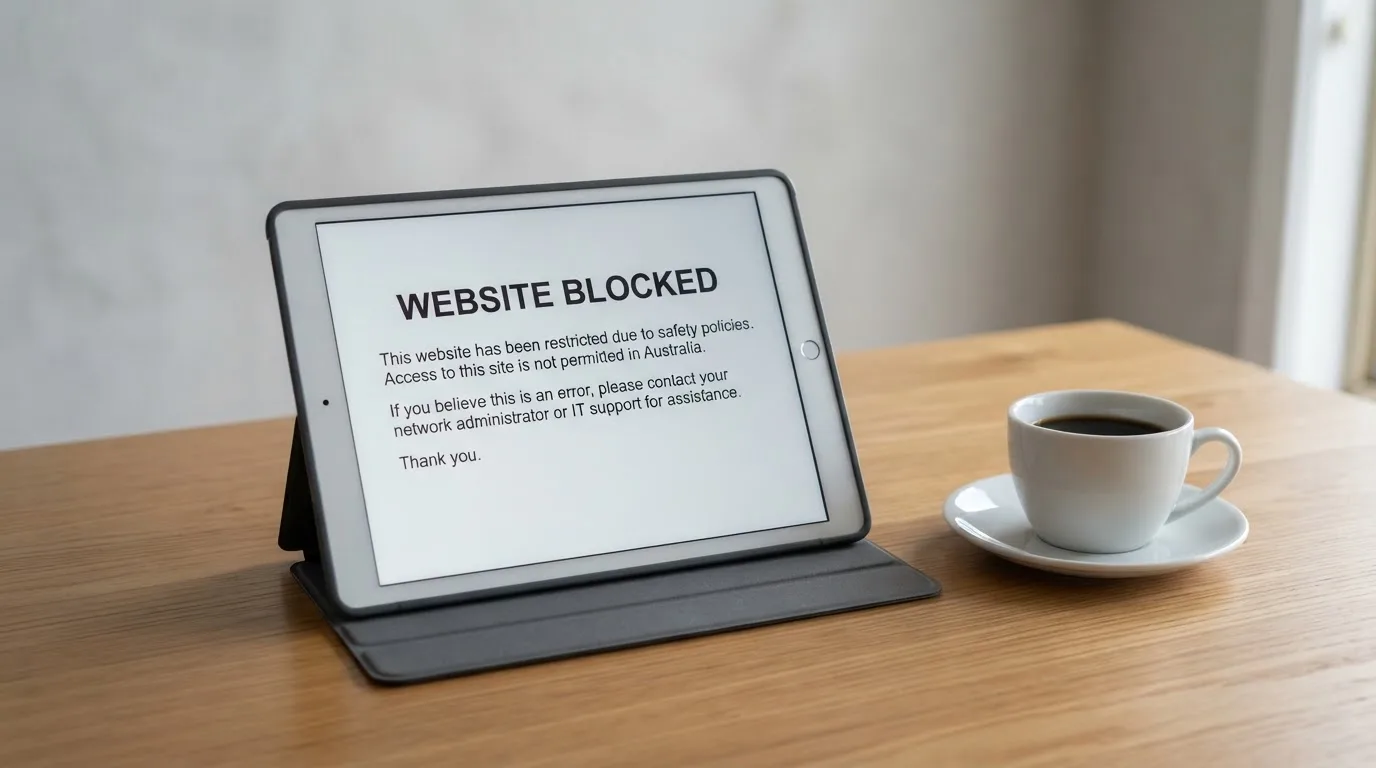
What the ACMA does with that is on the public record. The Authority investigates, issues formal warnings and directs Australian internet service providers to block illegal sites. The blocking power is the practical edge of the regime: an offshore site can be made unreachable from an Australian IP with a balance still on a player’s account. Refunds on a blocked balance are not part of the arrangement. There is no Australian complaints body to take a withdrawal dispute to, because the operator is not licensed here and the regulator has no jurisdiction over them.
The 2026 reform picture sits on top of this. The Interactive Gambling Amendment (Gambling Reform) Bill 2026 passed Parliament on 19 August 2026. Its advertising and inducement measures commence on 1 January 2027 — law with a start date, not yet in force on a 2026 page. The pre-existing prohibition is the one that binds today.
A separate reform fronts the payment side. Credit cards, credit-related products and digital currency have been banned as payment for licensed online wagering since 11 June 2024, with penalties of up to A$247,500 for operators. The legal deposit routes for licensed wagering are debit card, bank transfer, PayID/Osko and BPAY. A site asking an Australian customer for a credit card or a crypto deposit is operating outside the Australian rules, because the only Australian-licensed products that exist are wagering products, and those routes are closed for them.
Responsible gaming: where the player actually sits
The harm frame for a Plinko page is the same as the harm frame for any real-money casino game, and it is sharper here for the speed of the mechanic. The session turnover at Plinko is fast. A drop settles in seconds, the next drop is one click away, and a high-risk line can produce a string of low-multiplier results that read as “almost won” — a slot that paid ×0.5, ×1, ×0.2 in sequence — which is the same near-miss structure the pokie industry has been studied for. The 99% RTP does not soften that. It averages it.
The Australian support infrastructure exists. The National Gambling Helpline is 1800 858 858, free and 24/7, with chat at Gambling Help Online. BetStop, the National Self-Exclusion Register, has been live since August 2023 and binds Australian-licensed online and phone wagering services. The limit is structural: an offshore casino is not connected to BetStop, and a self-exclusion from an Australian bookmaker does not reach a Curaçao-licensed site the player also uses. The register covers the part of the market that is legal; the part that is not operates outside it.
The tax position is the one recreational players ask about and rarely get a clean answer to. Gambling winnings of a recreational player are not assessable income in Australia — section 6-5 of the ITAA 1997 — and losses are not deductible. The exception is a person who carries on a business of gambling, which a recreational player does not. The ATO is the body to confirm an individual position; the rule of thumb above is the model, not advice.
The age floor across Australian gambling products is 18. Plinko’s mechanical simplicity — drop, land, settle — makes the age restriction the same as for any other real-money game, and no different in practice.
Crypto and anonymity: paying in Bitcoin does not move the legal position
The Plinko pages that surface for Australian searches often carry a crypto-payment hook. The hook works like this: a casino advertises Plinko, accepts Bitcoin or Ethereum or USDT, processes deposits in minutes and withdrawals in hours, and presents the speed as a feature. The framing positions crypto as solving the offshore-customer problem — no card chargeback, no bank block, no trace.
It does none of those things for the legal question. The Interactive Gambling Act applies to the act of providing an online casino-style game to a person in Australia. The payment method does not enter the analysis. A Bitcoin deposit to an offshore casino is a payment to an operator that is providing a prohibited service; the payment itself is not separately regulated as gambling under the IGA, but the underlying transaction is the one the Act prohibits. The crypto angle changes the friction, not the legality. The ACMA’s blocking power operates at the domain level, not the payment rail. A site blocked by the Authority is blocked whether the customer paid in AUD or BTC.
The separate credit-and-crypto ban for licensed wagering, effective 11 June 2024, does not by itself reach an offshore casino. It reaches an Australian-licensed wagering service that accepts credit or crypto from an Australian customer. The offshore operator is outside that rule by being outside the Australian licensing system entirely. The rule and the offshore prohibition are two different enforcement fronts aimed at the same outcome: keeping the illegal product off Australian payment rails.
A crypto deposit also does not give the player anonymity in the way the marketing implies. Blockchain transactions are public; the address and amount are visible on the ledger. What crypto gives the player is a payment rail that the Australian banks cannot easily reverse. That is the opposite of consumer protection. If the offshore site refuses a withdrawal, the standard Australian chargeback path is not available, the bank’s dispute process is not available, and the ACMA’s complaint-handling does not extend to the operator. The crypto angle resolves the operator’s collection risk and leaves the player’s payout risk exactly where it was.
The result for an Australian reading the crypto angle is straightforward: a crypto deposit at an offshore casino does not license the operator, does not protect the balance, does not make the service legal, and does not move the product inside the BetStop register. It is a faster rail into a product that is prohibited. The speed is real; the protection is not.
Payments and payout speed: the routes a Plinko page will name
The payment methods a Plinko page mentions are background, not an endorsement. They describe what an offshore site typically accepts, which is the same answer for nearly every offshore casino: Visa and Mastercard where the card network still routes to the operator, bank transfer, e-wallets (Skrill, Neteller, MiFinity, Jeton, eZeeWallet), prepaid vouchers (Paysafecard, Neosurf), and crypto (BTC, ETH, LTC, USDT, occasionally DOGE and XRP). The set is broad because the operators compete on it.
What the set does not include, for an Australian customer, is anything that resolves the underlying prohibition. A payout via Skrill is fast in the same way a payout via BTC is fast: once the operator chooses to release it. The site’s stated payout time is a promise the operator has made, not a guarantee the Australian side can enforce. If the operator declines a withdrawal — a common enough pattern that the affiliate pages treat it as a footnote — the e-wallet’s speed is irrelevant. The fastest rail in the world does not help a customer who cannot reach the funds.
The Australian-side payment frame for a legal product is narrower than the offshore one and is closed to the casino product entirely. The licensed online and phone wagering operators accept debit card, bank transfer, PayID/Osko and BPAY. Crypto and credit are out for them since 11 June 2024. None of those operators offers Plinko, because none of them is licensed to offer online casino games. The payment-method map for a Plinko page is therefore a list of routes into a product that is not legally available, not a comparison of routes to a product that is.
The geo-block angle is the other piece. Some offshore operators block Australian IP ranges themselves, having decided the regulatory cost of accepting Australian customers is higher than the customer revenue. Others do not, and rely on the IGA’s enforcement risk being low for individual players. The result is a market where the same operator may accept a player in one session and refuse a withdrawal the next, on the grounds that the player should not have been allowed to deposit. That is the offshore contract in plain language.
Specific games and providers: BGaming, the price-list, and what is not on it
BGaming is the studio whose Plinko page the marketing screenshots come from. The studio’s own page for the game carries the 99% RTP line and the ×1,000 top multiplier; the studio describes the same game mechanics every other Plinko listing does — pegs, lines from 8 to 16, risk level set by the player, manual or auto play. BGaming is also the studio that distributes the same title across the operators named below. The price-list is the studio’s; the operator’s role is to host it.
The price-list is also where the comparison against other casino games is sharpest. Baccarat, played under punto banco rules with the casino banking both hands, has a house edge of 1.06% on the Banker bet and 1.24% on the Player bet — close to Plinko’s claimed 1%. The Tie bet sits at 14.36%, which is the cost the marketing never quotes. Blackjack with optimal strategy under liberal Las Vegas Strip rules carries a house edge of about 0.28%, and about 0.43% under Atlantic City rules. Craps has a Pass/Come line edge of 1.41%, a Don’t Pass/Don’t Come edge of 1.36% and an Any Craps edge of 11.11%. None of those edges is exotic; all of them are below the figures a casual player assumes. Plinko’s 1% sits at the low end of that set, not outside it.
The shape of the games is the bigger difference. Baccarat, blackjack and craps all involve a decision point: stand, hit, bet Banker or Player, take the odds or lay them. Plinko’s only decision is the size of the stake and the risk level — both chosen before the drop. The game executes the outcome with no further input. The faster pace and the absent decision make Plinko a higher-turnover-per-hour product than table games at the same edge, which is what makes the edge matter more in practice than the headline figure suggests.
The Price Is Right origin is the other piece of the picture. Plinko as a casino product borrows the visual grammar of a TV game show, which is a brand association the marketing leans on. The TV show pays out at fixed dollar amounts the show sets; the casino pays out at multipliers of the stake. The show’s $50,000 maximum is a programme budget number. The casino’s ×1,000 top multiplier is a function of stake size, and the size of the multiplier is what makes the rare payouts rare. The same board, very different product.
A note on the volatility framing: BGaming’s Plinko lets the player pick a risk level. Low risk flattens the multiplier distribution — fewer extreme outcomes, more low-and-middle results. High risk widens it. The RTP is constant across risk levels as advertised; what changes is the variance around it. A player on high-risk with a 99% RTP is buying a long tail, not a better average. That distinction is not on the marketing page.
The ACMA blocking record: the arithmetic behind a domain being unreachable
The Authority’s blocking record is the public measure of how aggressively the offshore market is being closed down. As reported in June 2026, a total of 1,751 illegal gambling and affiliate marketing websites had been blocked since the first blocking request in November 2019. More than 230 unlicensed gambling services had left the Australian market since enforcement was strengthened in 2017. The June 2026 round alone added 12 more domains to the block list: 7Signs, ChromaBet, Donbet, Duospin, Freshbet, Slots Gem, Jacks Club, Lucky Start, Pointsbetz.com, Spinrise, Vinyl Casino and Wildsino. The list is updated per round.
This calculation explains the frequency of the blocking rounds.
From November 2019 to June 2026 is roughly six and a half years, or about 79 months. A total of 1,751 sites blocked over 79 months is an average blocking rate of roughly 22 sites per month across the full enforcement window — call it a band of 20 to 24 per month depending on how the early-round months are weighted. The early rounds were heavier per request because the Authority was clearing the most exposed operators first; the recent rounds are smaller but more frequent. A monthly rate in the low twenties is the figure the record supports, and the band is the honest statement of it. The point is not the monthly average. It is that the Australian end of the offshore market is being trimmed continuously, not in a single sweep.
The estimate of harm sits beside the blocking record. H2 Gambling Capital’s 2025 report estimates that Australians lose about A$3.9 billion a year to illegal gambling sites, and that the share of gambling going through legal channels fell from 74% in 2021 to 64%. The first figure is the cost of the offshore market; the second is the share of the Australian gambling dollar that the legal product has lost to the illegal one over four years. A ten-point shift in channel share is the kind of move that gets a regulator to act, and the June 2026 round is one of the actions.
The eleven operators the ACMA has named
What follows is not a ranking. It is not a recommendation. Each brand is listed because the Australian Communications and Media Authority itself issued a formal warning over it for offering prohibited services to Australians. The descriptions cover what the ACMA file says about the operator and what is publicly verifiable about its Plinko offering. No reader should treat any of these as a place to play; the prohibition is the same for every entry.
RocketPlay
The ACMA issued a formal warning to Pulsup Ltd over RocketPlay in March 2026. The same brand had earlier been the subject of a May 2022 formal warning to Dama N.V., which covered six casino brands including Rocketplay. The brand has cycled through operating entities without leaving the Australian targeting picture, and the Authority’s warnings track those transfers. Public material does not give a verifiable read on whether the current operating entity hosts BGaming Plinko under that brand; the ACMA file is the only fixed point. The recurring pattern — same brand, new operator, fresh warning — is the read.
Level Up Casino
The ACMA issued a formal warning to Dama N.V. over Level Up in May 2022. Dama N.V. is a Curaçao-registered operator that has run a portfolio of casino brands, of which Level Up is one. BGaming’s Plinko is among the games listed at Level Up by aggregator pages, which is a marketing claim rather than a verified fact. The ACMA’s interest is the offering of prohibited games to Australian customers, not the specific game. Level Up’s standing under Australian law is unchanged from 2022: prohibited.
Woo Casino
The ACMA issued a formal warning to Dama N.V. over Woo Casino in March 2025. Woo has been one of the longer-running Dama brands and has cycled through the standard offshore payment set — Visa, Mastercard, e-wallets, crypto — without departing from the Australian-targeting pattern. There is no public read on whether BGaming’s Plinko is currently featured at Woo Casino. The Australian position is the same: the offering is illegal, and the ACMA has now said so twice across Dama’s portfolio in this window.
Spirit Casino
The ACMA issued a formal warning to Dama N.V. over Spirit Casino in May 2025. Spirit is one of the newer Dama brands and appears alongside Woo Casino in the same enforcement window. The pattern of fresh brands emerging from the same operating entity is what gives the ACMA’s blocking record its monthly cadence: each new brand is a new entry to investigate. Spirit’s standing under Australian law is prohibited; the warning is the documented form of that finding.
National Casino
The ACMA issued a formal warning to Consolutetish S.R.L. over National Casino in July 2025. The Plinko game’s association with National Casino is reported on listing pages as a background item rather than as the operator’s own fact; the operating entity is Consolutetish S.R.L., registered in a European jurisdiction, and the ACMA’s action is for the prohibited offering, not for the specific game. National Casino’s Australian status is unauthorized.
Bizzo Casino
The ACMA issued a formal warning to Consolutetish S.R.L. over Bizzo Casino in July 2025. Bizzo had already been the subject of a 2022 formal warning to TechSolutions (CY) Group Limited and TechSolutions Group N.V., which is the longer arc: same brand, two operators, two findings. Bizzo’s standing under Australian law is prohibited, and the file now reflects that the Authority will name a second operator over the same brand when the brand re-emerges. The recurring re-emergence is the read.
Ignition Casino
The ACMA issued a formal warning to Bamboo Media over Ignition Casino in July 2025. Ignition had previously been associated with a different operator; the Bamboo Media warning is the current Australian-law position. Plinko is not verified to be among Ignition’s currently featured titles on any independent listing; the ACMA file is what binds. The service is not authorised under Australian law.
Instant Casino
The ACMA issued a formal warning to EOD Code SRL over Instant Casino in February 2025. Instant Casino markets speed of withdrawal and crypto support as its core pitch, which places it in the same crypto-and-speed framing the section above addresses. The ACMA’s action is for the prohibited offering; the brand’s payment-rail marketing does not change the legal analysis. Australian customers fall outside the service’s legal remit.
Jackbit
The ACMA issued a formal warning to Ryker B.V. over Jackbit and CasinOK in April 2026. Jackbit is a crypto-first operator and the April 2026 warning is the freshest formal action in the ACMA file relevant to this list. The crypto angle does not move the legal question; the ACMA’s blocking power operates at the domain level regardless of how the deposit was made. The brand holds no legal standing in the Australian market.
Casino Intense
The ACMA issued a formal warning to Sterplay Holding Ltd over Casino Intense in April 2025. Casino Intense has been associated with BGaming’s catalogue on listing pages, though the listing pages are a third-party reporting of what the brand advertises, not a verified fact from the operator. The ACMA’s action is for the prohibited offering. Casino Intense remains an unauthorised service for local players.
Sky Crown
The ACMA issued a formal warning to Hollycorn N.V. over Sky Crown and Blue Leo, with the warning publication dated to September 2022. The Sky Crown warning is among the older items on the ACMA’s file relative to the rest of this list, and the brand has continued to operate since. The standing under Australian law is unchanged from 2022: the offering is prohibited. Hollycorn N.V. also operates Blue Leo under the same warning; both brands share the same legal position.
The comparison: the operators and the ACMA file
| Brand | ACMA action and date | Operator named by the ACMA | Subject support |
|---|---|---|---|
| RocketPlay | Formal warning, March 2026; prior warning May 2022 | Pulsup Ltd (March 2026); Dama N.V. (May 2022) | — |
| Level Up Casino | Formal warning, May 2022 | Dama N.V. | Listings-only (BGaming aggregator pages) |
| Woo Casino | Formal warning, March 2025 | Dama N.V. | — |
| Spirit Casino | Formal warning, May 2025 | Dama N.V. | — |
| National Casino | Formal warning, July 2025 | Consolutetish S.R.L. | Listings-only |
| Bizzo Casino | Formal warning, July 2025; prior warning 2022 | Consolutetish S.R.L. (July 2025); TechSolutions (2022) | — |
| Ignition Casino | Formal warning, July 2025 | Bamboo Media | — |
| Instant Casino | Formal warning, February 2025 | EOD Code SRL | — |
| Jackbit | Formal warning, April 2026 | Ryker B.V. | — |
| Casino Intense | Formal warning, April 2025 | Sterplay Holding Ltd | Listings-only |
| Sky Crown | Formal warning, September 2022 | Hollycorn N.V. | — |
The spread of dates tells a story the prose cannot. The earliest warning on this list is Sky Crown in September 2022. The latest is RocketPlay in March 2026 and Jackbit in April 2026 — within months of each other, with the June 2026 blocking round sitting behind both. The Authority is not retreating from the enforcement posture; the cadence of formal warnings is steady across the four-year window, and the operating entities named shift as the brands themselves shift operators. A reader comparing two brands on the list will see two different operator entities and the same legal finding. That is the comparison.
The “subject support” column is honest about what the file carries. Most rows show the no-data marker because the only sources for an operator’s Plinko offering are affiliate marketing pages, and the page does not treat those as verified facts. Where an aggregator or listing page reports a Plinko offering, the row says so in its own words: listings-only. None of the rows reads as the operator’s own statement, because none of them is one.
What the “99% RTP” actually costs in a session
This calculation models session costs rather than per-spin guarantees.
Take a 99% RTP. The house edge is therefore 1% of turnover. A player at A$1 per drop running 200 drops in a session — a pace a Plinko mechanic hits inside an hour — generates A$200 of turnover. The expected loss on that session, calculated as turnover multiplied by (1 minus RTP), is A$2. The figure is small in absolute terms; the rate is the point. A two-hour session at the same pace is A$4 of expected loss; a ten-session day across the same stake is A$20. The 99% RTP is not a small edge. It is a low edge that compounds because the game runs fast.
The same arithmetic at a higher stake — A$5 per drop, 200 drops — produces A$10 of expected loss per hour. The ratio of stake to loss is constant; the absolute loss is not. The marketing emphasis on the RTP obscures that the cost per hour is a function of stake size and pace, not of RTP. A reader who is told “99% RTP” and not told “the stake size is the budget dial” is being told half the picture.
The session-loss estimate is a statistical average. It is what the same session costs across many sessions at the same stake and pace. Any individual session can land above or below that average; the multiplier distribution that drives the variance is wide at high-risk and tight at low-risk. The estimate does not promise a payout, does not promise a win and does not promise a return. It is the cost a player should expect before they start.
The calculation is also not affected by the bonus structures the affiliate pages advertise, because the page does not print those structures and does not work the arithmetic against them. The cost above is the cost of playing the game at the stake and pace stated. A bonus attached to it would change the deposit economics, not the per-spin cost.
The single decision a reader can actually make
The decision an Australian reader can make from this page is not “which Plinko casino”. There is no legal Plinko casino in Australia; that is the section above. The decision is whether to play the game at all, and if so on which side of the border that decision sits. The legal Australian product is wagering — sports and racing before the event, lotteries, keno — through an NT-licensed operator, paid by debit card, bank transfer, PayID/Osko or BPAY, with self-exclusion available through BetStop. Plinko is not in that set. The offshore product is everything else: prohibited, unenforced at the player level, unenforced at the payout level, and reachable today and unreachable tomorrow depending on the next blocking round.
The reader who wants the game and accepts the offshore frame is making a choice the ACMA has named eleven times in the file above, and the Authority will continue to name operators as they emerge. The reader who wants the licensed frame does not get Plinko inside it. That is the trade the prohibition enforces, and it is the trade the marketing does not surface.
Frequently asked questions
What is the Plinko casino game, and how does the ball-drop mechanic actually determine a payout?
The online Plinko game borrows the geometry of the Price Is Right pricing game — a ball drops through a pyramid of pegs into slots carrying multipliers of the stake. The outcome is determined by where it lands; the player’s only inputs are the stake size, the risk level (low, normal or high) and the number of lines (typically 8 to 16). There is no decision point during the drop. The result is settled on landing, and the next drop is one click away.
Does a crypto version of Plinko pay out any differently to a standard real-money version?
Crypto and fiat versions of Plinko use the same game engine and the same random-number generator; the payout mechanics are identical. The difference is at the payment rail — crypto deposits and withdrawals can be faster than card or bank routes, but they carry no Australian consumer protection if the operator declines a withdrawal. The crypto angle is about payment friction, not payout odds.
Is playing Plinko for real money at an offshore casino something Australians are legally allowed to do?
No. The Interactive Gambling Act 2001 makes it an offence to provide online casino-style games, including Plinko-style multiplier games, to customers in Australia. The offence is the operator’s, not the player’s. No state or territory licenses online casino games. The ACMA enforces by issuing formal warnings and directing ISPs to block illegal sites. Offshore sites that accept Australian customers are operating outside Australian law.
What return-to-player rate do offshore sites typically advertise for their Plinko game?
BGaming’s Plinko, the title most commonly listed, is advertised with a 99% RTP, which is a 1% house edge as an average over a very large number of drops. The figure is real as a long-run average; it does not describe any individual session. The same RTP is common to most Plinko variants on offer, though individual operator pages may carry small differences depending on the risk level and lines setting.
Why do Plinko casino apps get advertised separately from ordinary Plinko casino websites?
A standalone app is a distribution channel that bypasses the browser and can carry a different install path. The marketing distinction is between a downloadable app and a browser-based version of the same game. Both routes deliver the same RNG and the same RTP; the app is the same product with a different container. Neither route changes the legal position under the Interactive Gambling Act.
How does a Plinko game’s payout table differ from a pokies reel in terms of the odds involved?
Both are average-over-many outcomes products with a fixed house edge. The differences are pace and decision structure. Plinko’s drop settles in seconds, the next drop is immediate, and there is no in-game decision once the drop starts. A pokie reel runs at a slower pace and includes bonus rounds and feature triggers that add decision and variance. Plinko’s faster turnover at the same edge compounds the cost per hour; a pokie’s bonus structure adds volatility. The math that flattens both is the long-run RTP, which neither session is guaranteed to hit.