
Mines casino game in Australia: the grid, the price, and the providers the regulator has named
Most Australian readers seeking Mines casino games expect to be told where to play them. In reality, Mines is a tile-revealing game with a stake attached. It belongs to the same family as every other online casino product offered to Australians, and under the Interactive Gambling Act 2001, every online casino game offered to a person physically in Australia is a prohibited interactive gambling service. There is no licence an operator could display that would change that. This page examines the real cost of a round of Mines: what it takes from a bankroll, what a bonus actually demands, and what an offshore brand costs when a withdrawal stalls. The focus is on the financial realities and the legal ground surrounding the game.
This material was checked against the Australian Communications and Media Authority’s published register of formal warnings and blocking actions as of 29 October 2026, and against the regulator’s own list of blocked sites. Where a brand named below has had action taken against it, that is recorded fact, not opinion.
- Where Mines sits among the brands the ACMA has named
- The fundamentals of Mines, and where the game came from
- The legal ground in Australia, and what it does to the page
- Player protection in Australia, and what an offshore site sits outside
- The operator file: what each brand on the table actually is
- What this leaves a reader with
- Frequently asked questions
Where Mines sits among the brands the ACMA has named
The page treats the comparison the way a regulator’s file would: each brand appears because the ACMA itself issued a formal warning over it for offering prohibited online casino games to Australians. The order below follows the regulator’s own publication record, newest action first, and within a single year alphabetical by the operator name the ACMA used in its notice. Nothing in this list ranks one brand above another. The column set below is the matters research could back with a named source for every cell; the things research could not source — withdrawal times, game counts, bonus terms — are not invented here, because a comparison on those fields would be a comparison on nothing.
| Brand | ACMA action and date | Operator named by the ACMA | Mines support |
|---|---|---|---|
| RocketPlay | Formal warning, March 2026 (Pulsup Ltd); earlier Dama N.V., May 2022 | Pulsup Ltd | — |
| Jackbit | Formal warning, April 2026 | Ryker B.V. | — |
| Casino Intense | Formal warning, April 2025 | Sterplay Holding Ltd | Listed by background sources, no first-party confirmation |
| Woo Casino | Formal warning, March 2025 | Dama N.V. | — |
| Spirit Casino | Formal warning, May 2025 | Dama N.V. | — |
| Instant Casino | Formal warning, February 2025 | EOD Code SRL | — |
| Ignition Casino | Formal warning, July 2025 | Bamboo Media | — |
| National Casino | Formal warning, July 2025 | Consolutetish S.R.L. | Listed by background sources, no first-party confirmation |
| Bizzo Casino | Formal warning, July 2025 (Consolutetish); earlier TechSolutions, 2022 | Consolutetish S.R.L. | — |
| Sky Crown | Formal warning, September 2022 | Hollycorn N.V. | — |
| Level Up Casino | Formal warning, May 2022 | Dama N.V. | Listed by background sources, no first-party confirmation |
Eleven brands, eleven formal warnings, and a single regulatory conclusion: under the Interactive Gambling Act 2001, no online casino game — Mines included — can be licensed for supply to a person in Australia. The licence a brand shows on its footer is a licence to operate in some other jurisdiction; it is not an Australian licence, because no Australian licence exists for this product. The table is a register of how the ACMA has enforced that fact, not a scorecard.
The fundamentals of Mines, and where the game came from
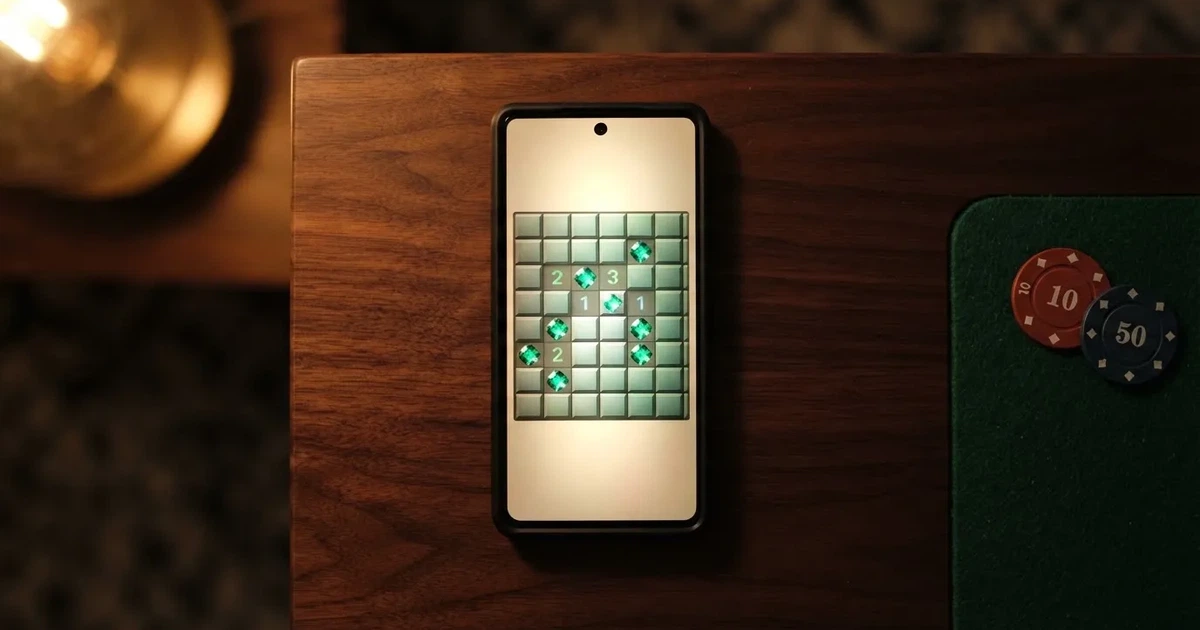
Casino “Mines” is a staked adaptation of Minesweeper, the tile-revealing puzzle Microsoft bundled with Windows for two decades. A grid is laid out, a number of hidden mines are placed under it, and the player uncovers tiles one at a time. Each tile that is not a mine raises a running multiplier; the first mine ends the round and forfeits whatever stake has not yet been cashed out. The decision the game is built around is when to stop: take the current multiplier and end the round, or reach for one more safe tile and risk losing the whole stake.

The Minesweeper concept itself traces back further than the casino version. Ian Andrew published a tile-revealing game called Mined-Out in 1983, and Tom Anderson built Mines for SunOS in 1987. Microsoft’s Minesweeper, written by Robert Donner and Curt Johnson, shipped with the Windows Entertainment Pack in 1990 and stayed on the operating system until Windows 8 dropped it as a built-in title in 2012. The casino game that runs under the “Mines” name today is not the puzzle Microsoft shipped — it is a paid adaptation with a stake attached and a multiplier that rises with every safe tile.
Spribe, the studio that builds the most widely deployed casino version of Mines, was founded in 2018 and is best known for its flagship crash-style game Aviator, which launched in January 2019. The studio’s UK regulatory standing has shifted during 2025: the UK Gambling Commission suspended Spribe OÜ’s UK remote gambling software licence on 30 October 2025 on suitability grounds, after finding the company had been hosting casino games without the separate remote casino game host licence its business model required. The commission’s public register shows the Gambling Software Remote licence (number 057302-R-333085-003) as active since 8 December 2020, with a separate Game Host (Casino) Remote licence application listed as in progress at the time of the register snapshot research drew on. Australian readers will read this as background on the studio behind the game; the relevant Australian fact is that an Australian licence does not exist for it.
The maths behind the grid
A round of Mines runs on a single parameter the player sets before the first tile is revealed: the number of mines on the grid. Everything else follows from grid size, mine count and the running multiplier the operator publishes in its paytable. A 5×5 grid with a single mine pays roughly 1.02× after the first safe tile and climbs from there; the same grid with twenty mines pays a much steeper multiplier after each safe reveal, and ends the round on a single misstep. The grid size is fixed in the casino version of Mines the way the puzzle fixed it: the casino game sets both the grid and the mine count, and the player chooses only the mine count and the stake.
The payout mechanic is straightforward and the house edge sits inside it. The operator publishes a multiplier for every safe-tile count, and that multiplier reflects the probability of reaching that count given the grid and the mine count, multiplied down by a margin. The published multiplier on a given reveal is always slightly less than the fair odds the probability would imply — that gap is the edge. A player who treats Mines as a series of independent bets with a known edge per round sees what the game actually is: a stake attached to a probability ladder, where the operator’s margin is taken at every rung rather than once at the end.
How a Mines payout climbs
The multiplier on Mines rises with each safe tile the player reveals, and the step size grows as the safe count approaches the mine count on a small grid. A round played on a 5×5 grid with one mine moves slowly at first and accelerates only toward the end; a round played on the same grid with five mines climbs faster from the first reveal and ends on a multiplier that looks dramatic against the stake risked. The shape of the ladder is not negotiable — the operator publishes it, and the player reads it before the first tile is uncovered. The only decision the player makes mid-round is when to stop, and that decision is the one a marketing line never asks a player to think about.
The legal ground in Australia, and what it does to the page
The Interactive Gambling Act 2001, strengthened by the Interactive Gambling Amendment Act 2017, makes it an offence to provide online casino games, online pokies or in-play betting to a person physically in Australia. No state or territory licences them. What the Act does licence is wagering on races and sport placed before the event, lotteries and keno — in practice administered by the Northern Territory Racing and Wagering Commission, which regulates 52 of Australia’s online bookmakers including Sportsbet, Bet365 and Ladbrokes for tax reasons, operates with no full-time staff and meets once a month in Darwin. Mines is not a wagering product, it is not a lottery, and it is not keno; under the Act it sits on the prohibited side of the line, and that placement is what every row in the table above reflects.
The Australian Communications and Media Authority investigates complaints, issues formal warnings and directs Australian internet service providers to block illegal sites. The individual player is not prosecuted — the IGA targets the provider — but a player who opens an account with an offshore brand accepts the consequences of that choice: no Australian consumer protection, no complaints body a player can lodge with, and no recourse if a withdrawal is refused. The site itself can be blocked mid-session, leaving a balance the player cannot reach. The regulator’s enforcement is not theoretical, and the page does not treat it as such.
The blocking record the ACMA has built since 2017
The ACMA has been asking Australian ISPs to block prohibited sites since November 2019. As of the regulator’s June 2026 published round, 1,751 illegal gambling and affiliate marketing websites had been blocked since that first request — a running total built up over roughly six and a half years of enforcement, against a market the regulator first moved against in 2017. More than 230 unlicensed gambling services have left the Australian market over the same enforcement window. The blocking round reported on 26 June 2026 alone added twelve more domains — 7Signs, ChromaBet, Donbet, Duospin, Freshbet, Slots Gem, Jacks Club, Lucky Start, Pointsbetz.com, Spinrise, Vinyl Casino and Wildsino — to a list that grows in every published round.
That blocking record translates to a pace. The first blocking request went out in November 2019; the cumulative total at the June 2026 snapshot is 1,751 blocked sites. Worked against the elapsed time — roughly six and a half years, or about 78 months — the regulator’s blocking action has run at a long-run rate of roughly 270 blocked sites per year, or just over 22 per month. The rate is not steady. The first rounds were small, the volume built as the regulator’s infrastructure for blocking requests matured, and the published total at any moment reflects years of accumulated action rather than a steady monthly cadence. The number to take from the record is the order of magnitude: a regulator that has blocked well over a thousand offshore gambling and affiliate sites in less than seven years is not signalling intent; it is running an ongoing programme, and a brand a reader is considering today is more likely than not to be a brand the regulator has already named or is about to.
What an offshore brand actually costs a player
A player who opens an account with a brand on the table above accepts three things the page does not dress up. The first is the legal ground the operator sits on: every brand in the table has had a formal warning issued against it for offering prohibited services to Australians, which is what put the brand on the regulator’s record in the first place. The second is the recourse the player does not have: no Australian complaints body, no Australian regulator with jurisdiction to order a payout, and no guarantee the site stays reachable long enough for the player to withdraw a balance. The third is the bonus terms that arrive with the welcome offer — terms the player cannot enforce on the operator’s home regulator either, because the operator does not have one in Australia.
A brand’s licence displayed in a footer is a licence to operate in some other jurisdiction — Curaçao, the Kahnawake territory, the Philippines — and that licence is the only one the player can complain to. The Australian regulator cannot compel a Curaçao-licensed operator to pay a disputed withdrawal; the Curaçao regulator can in principle, but the route runs through a foreign complaints process with no Australian consumer-protection fallback. That is the structural cost of choosing an offshore brand, and it is the cost the regulator’s enforcement record is built around.
Player protection in Australia, and what an offshore site sits outside
Player protection in Australia runs through three named channels. BetStop — the National Self-Exclusion Register — has been live since August 2023, and binds every Australian-licensed online and phone wagering service to honour a registered self-exclusion. The National Gambling Helpline is 1800 858 858, free, available 24 hours a day, with chat available at Gambling Help Online. The third channel is the state and territory gambling support services, which run on the same helpline infrastructure. A player who self-excludes through BetStop, who calls the helpline, or who lodges a complaint with a state regulator, gets the protection that flows from each of those routes. An offshore casino is not connected to any of them.
A self-exclusion on BetStop does not extend to an offshore casino. The register binds Australian-licensed operators only, and an offshore site has no obligation to honour an Australian exclusion — and no way to be told one has been registered. A player who self-excludes and then opens an offshore account has self-excluded in name only. A withdrawal that stalls at an offshore brand has no Australian complaints body behind it; the player’s only avenue is the foreign regulator the operator holds its licence from, and that route does not exist for a brand the ACMA has already warned off the Australian market. The player-protection architecture in Australia is built around Australian-licensed wagering services, and Mines is not one of those.
Where the cost concentrates: the bonus mechanics behind Mines
A Mines no-deposit bonus, where one is offered, still runs through the same review process as any other bonus before real money can be withdrawn. A no-deposit bonus does not mean a withdrawal is automatic: it means the operator credits a bonus amount to the account without requiring a deposit first, and the bonus carries the same kind of turnover requirement a deposit-gated bonus would. The turnover requirement is expressed as a multiplier of the bonus — a 40× wagering multiple on a A$10 no-deposit bonus asks for A$400 of qualifying play before any withdrawal is permitted, and the qualifying play has to happen on the games the bonus terms name. Mines is not always one of those games, and a player who spends the turnover on a game that does not contribute 100% to wagering finds the required play quietly doubled.
The maths on a no-deposit bonus is honest in a way the marketing line is not. Take a A$10 no-deposit bonus at a 40× wagering multiple: A$400 of qualifying turnover is required before a withdrawal is processed, and Mines contributes the full stake of each round toward that turnover at most operators. At a A$1 stake per Mines round, that is 400 rounds. At a five-second average round time, that is around 33 minutes of continuous play. A bonus of A$50 at the same multiple asks for A$2,000 of turnover, or 2,000 rounds at A$1 stake — about 2.8 hours of play, assuming the same round cadence and no interruptions. The marketing line does not publish any of those numbers; the bonus terms page does, and a player who reads the terms page before claiming a bonus knows what the bonus actually asks for.
The same arithmetic answers a different question on a deposit-gated bonus. A A$200 first-deposit bonus at a 35× multiple on the bonus plus deposit asks for A$200 × 35 = A$7,000 of qualifying turnover. At a A$2 stake per Mines round that is 3,500 rounds, or roughly 4.9 hours of continuous play. The time figure is the honest answer to the question “how long to clear the bonus”, and it is the figure the page does not soften.
The cost of a session, expressed as expected loss
A session cost is a different question. A Mines round played at A$1 stake on a 5×5 grid with three mines, played for twenty rounds with a cash-out on average after three safe reveals, returns an expected outcome close to the operator’s published edge on that mine count. The exact edge varies by operator and by mine-count setting, but the order of magnitude is what matters: a session of twenty rounds at A$1 costs the player the operator’s edge applied to A$20 of total stake, or somewhere in the order of A$0.20 to A$0.40 depending on the game variant. The session-cost number is small in absolute terms; the marketing line is built around a much larger multiplier on the rare round where the player reaches a long safe sequence, and the marketing line is what makes a session feel cheap when the maths says otherwise.
What the marketing line never publishes is the average outcome per round. The published multiplier on each safe-tile count is always less than the fair probability would imply, and that gap compounds across a session. A player who reads the paytable sees the gap on every line; a player who reads only the headline multiplier on a long safe run sees the gap only when the run ends on a mine and the stake is forfeit. Both players are looking at the same paytable; only one is reading it.
The operator file: what each brand on the table actually is
Every brand below appears because the ACMA itself issued a formal warning over it for offering prohibited online casino games to Australians. The file is organised newest ACMA action first, with the operator name the regulator used in its notice. The information on each brand comes from the regulator’s own publication; nothing here is added from affiliate pages or marketing copy, because the only sources for bonus terms on these brands were affiliate marketing pages and that is not a source the page draws from.
RocketPlay
The ACMA issued a formal warning to Pulsup Ltd over Rocketplay.com.au in March 2026, the most recent action on the file. The operator was previously named by the regulator in May 2022 as part of a Dama N.V. group action that covered six brands including RocketPlay, Bambet, Dazard, Level Up, Wild Tornado and Cobra Casinos. The brand’s product footprint in the Australian market is the one the regulator has acted against; the brand’s own pages describe a different product range the regulator cannot reach. The match between what the regulator names and what an Australian reader sees is what the file records.
Jackbit
The ACMA issued a formal warning to Ryker B.V. over Jackbit and CasinOK in April 2026. Both domains were named in the same regulator notice, which is the regulator’s first public action on either brand. Jackbit’s product is casino, not wagering, and a casino product offered to a person in Australia is the prohibited interactive gambling service the IGA names.
Casino Intense
Sterplay Holding Ltd was the subject of an ACMA formal warning in April 2025 over Casino Intense. The brand is listed by background sources as carrying a Mines title, though no first-party confirmation of Mines availability at the brand is in the record research drew on. The page does not assert Mines availability the research could not source; it records what the regulator named, and notes that Mines presence at the brand is reported rather than confirmed.
Woo Casino and Spirit Casino
The ACMA issued two further formal warnings to Dama N.V. in 2025 — over Woo Casino in March 2025 and over Spirit Casino in May 2025. Both follow the earlier 2022 group action against Dama N.V. brands. The pattern is what the regulator’s record shows: a single operator entity (Dama N.V.) drawing formal warnings across multiple brand names over more than three years, with no Australian-licence pathway that would change the regulator’s position.
Instant Casino
EOD Code SRL was the subject of an ACMA formal warning in February 2025 over Instant Casino. The brand sits in the same structural category as the rest of the file: an offshore operator offering casino games to Australians, named by the regulator for doing so.
Ignition Casino, National Casino and Bizzo Casino
The ACMA issued formal warnings in July 2025 to Bamboo Media over Ignition Casino and to Consolutetish S.R.L. over National Casino and Bizzo Casino. Bizzo Casino had already been the subject of a 2022 formal warning to TechSolutions (CY) Group Limited and TechSolutions Group N.V., which makes Bizzo the brand on this list with the longest regulator history — three years of formal warnings under two different operator entities, with no Australian-licence pathway in sight.
Sky Crown
Hollycorn N.V. was the subject of an ACMA formal warning over its Sky Crown and Blue Leo casino services, published in September 2022. Sky Crown is the longest-running brand on the regulator’s record by date of first formal warning, predating the 2025 wave of Dama N.V. actions by three years.
Level Up Casino
Level Up Casino was named in the ACMA’s May 2022 formal warning to Dama N.V. as one of six brands in the same operator group. It is one of the three brands on this list for which background sources list a Mines title; no first-party confirmation of Mines availability at Level Up is in the research record.
What this leaves a reader with
The arithmetic on a Mines round is honest in the way a stake-and-multiplier game is honest: the operator publishes a paytable, the player reads it, the house edge lives in the gap between published multiplier and fair probability on every line. A no-deposit bonus and a deposit-gated bonus both run on the same multiplier-of-bonus turnover requirement, and the time to clear a bonus is the turnover divided by the stake divided by the round cadence. None of that arithmetic is what makes this page difficult. What makes this page difficult is the legal ground the game sits on in Australia: no online casino game, Mines included, can be licensed for supply to a person physically in Australia under the Interactive Gambling Act 2001, no state or territory licenses online casino games, and the regulator’s enforcement record — 1,751 blocked sites since November 2019 and 230 unlicensed services that have left the Australian market since 2017 — is the response to that legal ground over six and a half years of action.
A reader who has read this far and is still considering playing Mines at any of the brands named above has read three things the page stands behind. The first is that no Australian-licence pathway exists for the product the brand is offering. The second is that the regulator has named each brand in this file for offering that product to Australians. The third is that the protection an Australian player would have at an Australian-licensed wagering service — BetStop, the National Gambling Helpline, the state complaints bodies — does not extend to an offshore casino. What the reader does next with those three facts is the reader’s call. The page’s job was to lay them down honestly.
Frequently asked questions
Is it legal to play the Mines casino game for real money in Australia?
No. Under the Interactive Gambling Act 2001, online casino games — Mines included — are prohibited interactive gambling services when supplied to a person physically in Australia, and no state or territory licenses them. The only products licensable for online supply are wagering on races and sport before the event, lotteries and keno. The player is not prosecuted, but the offshore operator is, and the site itself can be blocked mid-session.
How does the payout on Mines increase as more safe tiles are revealed?
A running multiplier is published by the operator for every safe-tile count, and the multiplier climbs as more tiles are uncovered. The shape of the ladder depends on grid size and mine count: a 5×5 grid with one mine climbs slowly, the same grid with five mines climbs much faster and ends on a sharper multiplier. The published multiplier on each rung is always slightly below fair probability — that gap is the house edge.
What determines how many hidden mines are placed on a Mines grid?
The grid size is fixed by the operator and the player chooses only the mine count and the stake. The mine count is the player’s main setting: more mines means a steeper multiplier per safe reveal and a much sharper end to the round when a mine is hit. The paytable reflects the mine count and the grid, and the player reads it before the first tile is uncovered.
What conditions usually apply before a Mines no-deposit bonus can be withdrawn?
A no-deposit bonus runs through the same review process as any other bonus: a turnover requirement, expressed as a multiplier of the bonus, has to be met on the games the bonus terms name before any withdrawal is processed. The qualifying games may not include Mines at 100% contribution, and a player who spends the turnover on a game with reduced contribution quietly doubles the play required. The terms page is the only place this is published honestly.
Is the Mines app a separate product from the browser-based version of the game?
The casino version of Mines is the same product regardless of how a player reaches it: a fixed grid, a chosen mine count, a stake and a running multiplier. A mobile app, where one exists, is a wrapper around the same game engine rather than a separate title. The relevant Australian question is the same for both — Mines is a prohibited interactive gambling service when offered to a person in Australia, by either route.
What is a sensible way to decide a stop point before starting a round of Mines?
Decide the multiplier at which the round will end before the first tile is uncovered, and stop there. The tile-by-tile format of Mines rewards a rule set in advance and penalises a rule rewritten mid-round after a run of safe tiles feels lucky. The stop point is the only edge a player controls on every round; everything else — the grid, the mine count, the multiplier ladder — is published by the operator before play starts.