
Bitcoin casinos and Australian players in 2026: the picture, the law, and the operators the ACMA has named
Data current as of 29 October 2026; verified against the ACMA’s published formal-warning register and operator listings.

A Bitcoin casino is, structurally, the same product as any other online casino: a website that takes a real-money deposit, lets a customer wager on pokies, table games or live dealer tables, and pays out whatever balance remains. The only difference is the rail the money moves on. Bitcoin sits on a public blockchain, deposits and withdrawals settle without a bank in the middle, and the site never holds the customer’s card number. None of that touches the legal question for an Australian resident, because the product the site is selling — online casino games and online pokies — is the part the Interactive Gambling Act 2001 prohibits, and the currency it sells the product in makes no difference to the prohibition. A search for a Bitcoin-accepting casino that is lawful for an Australian is, today, a search for an empty set, and what follows is an honest account of why that empty set exists, what a player who nevertheless uses one is signing up for, and which brands the ACMA has already named in the process.
- The landscape: what a “Bitcoin casino” actually is
- Legality and the Interactive Gambling Act 2001
- Responsible gambling under a non-Australian regime
- Bitcoin, anonymity and what the blockchain actually shows
- Games, providers and the live-dealer shelf
- The named operators: the ACMA’s own list
- Reading the ACMA’s blocking-rate over the period it has been enforced
- The individual operator entries
- What the page’s arithmetic adds up to
- Frequently asked questions
The landscape: what a “Bitcoin casino” actually is
The phrase does the marketing work the product cannot. A Bitcoin-accepting casino runs the same games as any other online casino, takes the same kind of bets, and pays out under the same rules, with one operational change: deposits credit after on-chain confirmation rather than after a card scheme’s authorisation. That change is real, and it is the reason offshore operators have leaned into the label. It is not the reason a player in Australia is in a different legal position. The Australian position flows from what is being bought, not how it is being paid for.

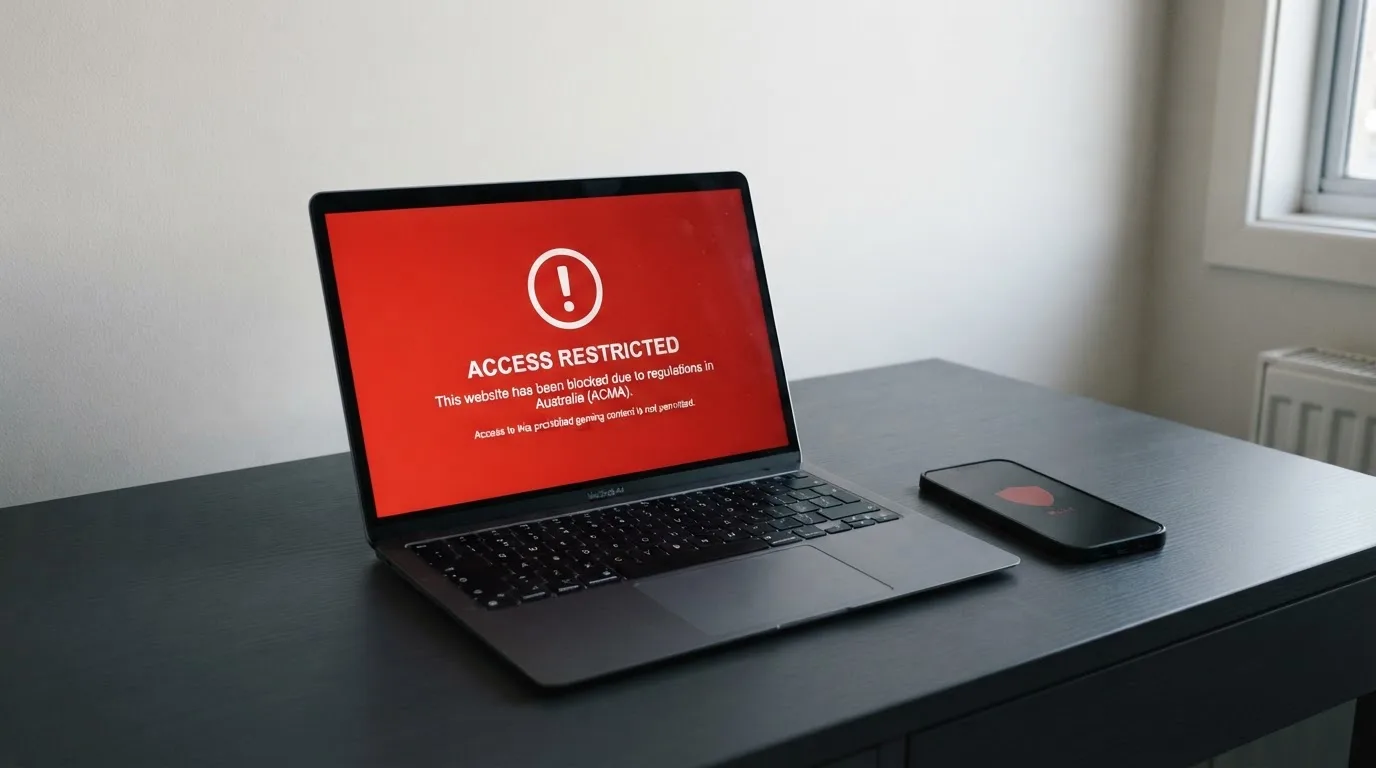
The Australian Communications and Media Authority tracks both sides of that equation. As of mid-2026, the ACMA has asked Australian internet service providers to block 1,751 illegal gambling and affiliate marketing websites since the first blocking request went out in November 2019, and more than 230 unlicensed gambling services have left the Australian market since the regulator stepped up enforcement in 2017. The most recent round reported on 26 June 2026 added twelve names to the block list in one pass — 7Signs, ChromaBet, Donbet, Duospin, Freshbet, Slots Gem, Jacks Club, Lucky Start, Pointsbetz, Spinrise, Vinyl Casino and Wildsino — which gives a sense of how steady the pipeline of new fronts is. An Australian DNS lookup simply does not resolve these addresses for most residential connections anymore. That does not make the brands disappear; it makes them harder to reach from a home connection, which is not the same thing.
The economic scale is large enough that the regulator treats it as a market, not a nuisance. H2 Gambling Capital’s 2025 estimate puts Australian losses to illegal gambling sites at about A$3.9 billion a year, and shows the share of gambling that goes through legal channels falling from 74% in 2021 to 64% in 2025. The leakage is into the offshore end of the market, and the offshore end is exactly where the Bitcoin-accepting operators sit. None of those offshore operators holds an Australian licence; none can, because the licence they would need does not exist under Australian law.
The result is that any Australian-facing Bitcoin casino is structurally an illegal gambling service from the regulator’s point of view, whatever licence footer the site happens to display. The footer usually names Curaçao or Anjouan. Both are real jurisdictions, both issue real licences, and neither licence authorises the holder to take bets from a person physically present in Australia. The footer is correct in the sense that the operator is licensed somewhere; it is misleading in the sense an Australian reader is most likely to take from it. The Australian end of the relationship is governed by the Interactive Gambling Act 2001, not by whatever gaming commission issued the footer.
Legality and the Interactive Gambling Act 2001
The Act, as tightened by the Interactive Gambling Amendment Act 2017, makes it an offence to provide online casino games, online pokies or in-play betting to a person in Australia. No state or territory licences those products.
| Product | Legal Status |
|---|---|
| Online Casino Games | Prohibited |
| Online Pokies | Prohibited |
| In-play Betting | Prohibited |
| Pre-event Sports Betting | Licensable (NT) |
| Lotteries and Keno | Licensable |
What is licensable is wagering on races and sport placed before the event, lotteries and keno — in practice, almost all of it sits with the Northern Territory Racing and Wethering Commission, which regulates 52 of Australia’s online bookmakers, including Sportsbet, Bet365 and Ladbrokes. The Commission meets once a month in Darwin and runs without full-time staff, a quirk of the historical setup that has prompted reform bills of its own but has not changed what falls inside the licensing net.
The Act targets the provider, not the player. An Australian punter using an offshore Bitcoin casino is not personally prosecuted. What the Act takes away is everything that makes a licensed market worth using in the first place: a regulator to complain to, a dispute resolution body to escalate to, and a legal framework that lets a court order a payout. The offshore operator runs on its own house rules. If a withdrawal is refused, there is no Australian body with jurisdiction over the operator, and the operator’s own licence is in a jurisdiction the customer has no practical way to reach. If the ACMA blocks the site, a customer with money still on the platform loses the connection entirely. Blockings happen on a running basis; balances do not get returned.
The credit-card ban, which took effect on 11 June 2024, is the second piece of the framework that matters here. It prohibits credit cards, credit-related products and digital currency as payment for licensed online wagering, with penalties up to A$247,500 for operators that take them. The ban was written for licensed wagering, so it does not bind an offshore casino — an offshore casino takes Bitcoin precisely because it is offshore and outside the ban’s reach — but it is the clearest signal the regulator has sent about how it expects Australian money to enter wagering. The deposit routes that are lawful for licensed wagering are debit card, bank transfer, PayID/Osko and BPAY. Anything else, including crypto, is a signal the site the customer is looking at is operating outside the Australian framework.
The 2026 reform package, the Interactive Gambling Amendment (Gambling Reform) Bill 2026, passed Parliament on 19 August 2026. Its advertising and inducement measures commence on 1 January 2027, so on a 2026 page the law has been passed but is not yet in force. The change will reach the affiliate and bonus side of the offshore market — the inducement language that has historically drawn Australian traffic to Bitcoin-accepting sites — without altering the underlying prohibition on the product itself. The product stays prohibited; what gets harder is the marketing.
Responsible gambling under a non-Australian regime
The Australian consumer-protection architecture assumes the operator is Australian-licensed, and an offshore Bitcoin casino is not part of that architecture. That matters in three concrete ways, and the three together are what a player is giving up by using an offshore site rather than a licensed one.
The first is self-exclusion. BetStop, the National Self-Exclusion Register, has been live since August 2023 and binds every Australian-licensed online and phone wagering service. An Australian who registers with BetStop is excluded by name from every licensed bookmaker in the country; the operator cannot open an account in that name, and an existing account is closed. An offshore Bitcoin casino is not connected to BetStop. Self-exclusion from the Australian register does not touch the offshore account, and the offshore account is unaffected by an Australian self-exclusion order. A player who wants to use BetStop as a circuit-breaker cannot extend it to the offshore product.
The second is dispute resolution. A licensed Australian wagering service is bound by internal dispute resolution and external alternative dispute resolution, and the customer has a regulator to escalate to if both fail. The offshore operator’s terms page stands as written, the offshore operator’s ADR body is the only one with reach, and an Australian court order is at best expensive to enforce and at worst unenforceable in the operator’s home jurisdiction. Withdrawals that are refused stay refused; complaints that are dismissed stay dismissed.
The third is the practical help line. The National Gambling Helpline, 1800 858 858, is free, 24/7, and the same number routes to Gambling Help Online with webchat. Both are Australian services and both take calls from anyone in Australia, including someone who has been playing at an offshore site. The line does not need the operator to be Australian-licensed to help the person on the other end of the call. That part of the framework is universal; what is not universal is the operator’s obligation to honour the limits a player has set elsewhere.
The credit-ban and self-exclusion rules are written for the Australian end of the market. The offshore end does not adopt them. A Bitcoin deposit to an offshore casino cannot be reversed once it has been confirmed on-chain, which makes a personal budget the only working limit, and a budget a player has set independently of any self-exclusion register is the only limit an offshore operator is bound to recognise.
Bitcoin, anonymity and what the blockchain actually shows
Bitcoin is commonly described as anonymous, and it is not. Bitcoin is pseudonymous: every transaction is recorded on a public ledger, the sending and receiving addresses are visible, and the only thing that is not directly attached to the addresses is the holder’s name. The pseudonymity is weaker than it looks the moment a wallet address has ever touched a KYC’d exchange. Once a wallet address is linked to an account that has passed identity verification, every address it has ever sent to and every address that has ever sent to it inherits that link, and the chain of inference extends backward and forward in time. Chain analysis companies sell exactly this product to exactly these customers.
The Australian regulator’s reach into the Bitcoin side of the market runs through AUSTRAC rather than the ACMA. Under the AML/CTF Act, any business providing digital currency exchange services to Australian customers must register with AUSTRAC as a Digital Currency Exchange provider; operating unregistered is an offence. From 31 March 2026 the registration requirement was widened beyond crypto-to-fiat exchange to cover crypto-to-crypto exchange platforms, digital asset transferors, digital asset custody providers, and stablecoin issuers and distributors. The offshore Bitcoin casino is not itself a Digital Currency Exchange in the AUSTRAC sense — it is the gambling operator, not the exchange — but the on-ramp the player uses to convert AUD into Bitcoin, and the off-ramp used to convert Bitcoin back into AUD, are. Both ends of the rail are inside the AUSTRAC perimeter, and both ends are reporting transactions that link wallet addresses to verified names.
The technical background is straightforward. New Bitcoin blocks are added roughly every ten minutes on average, but the timing is probabilistic — a confirmation can arrive in a few minutes on a quiet network or stretch across several blocks on a congested one, and there is no guaranteed minimum or maximum wait. Bitcoin Cash targets the same ten-minute block interval and uses the same SHA-256 proof-of-work, and charges sub-cent transaction fees, which is why a Bitcoin Cash option sometimes appears on the same cashier page. The ledger is the same shape as Bitcoin’s, and the on-chain pseudonymity story is the same.
The tax side reinforces the link. The ATO classifies crypto assets, including Bitcoin, as property rather than money or foreign currency, which means most disposals — selling for AUD, swapping for another coin, spending Bitcoin at a merchant, or withdrawing Bitcoin from a casino — are CGT events. There is a 50% CGT discount on assets held longer than 12 months, but from 1 July 2027 the flat discount is replaced by CPI-indexation of the cost base plus a 30% minimum tax rate on net capital gains. The ATO also operates a personal-use carve-out: a capital gain on a crypto asset held as a personal-use asset is disregarded, but only if the asset cost A$10,000 or less to acquire, and a capital loss on a personal-use asset is fully disregarded and cannot offset other gains. The framing is intended to apply to small, occasional spending, not to a gambling bankroll. A Bitcoin bankroll cycled through an offshore casino is, on the ATO’s own framing, an investment, not a personal-use asset, and the CGT event crystallises on every disposal.
The anonymity claim that Bitcoin casinos like to make is therefore a marketing half-truth. The wallet address is not visibly tied to a name on the blockchain itself, but the off-chain side of the rail — the exchange, the off-ramp, the tax record — has the name. A player who treats a Bitcoin casino as truly anonymous is one bad chain-analysis subpoena away from a paper trail.
Games, providers and the live-dealer shelf
The product shelf at a Bitcoin-accepting casino is, in content terms, indistinguishable from any other offshore casino. The same providers — Pragmatic Play, Evolution, Play’n GO, NetEnt and a long tail of smaller studios — supply the same pokies-style slots, the same table games and the same live dealer tables whether the cashier button says “Deposit with Bitcoin” or “Deposit with Visa”. Bitcoin is a payment rail, not a game supplier.
Pokies-style slots funded with Bitcoin run on the same reels, paylines and RNGs as the same game funded with a card. The RTP is set at the game level, not at the payment-method level, so the percentage the game returns over its full cycle does not move when the deposit rail changes. The volatility class is set the same way. A high-volatility pokie is high-volatility regardless of what was used to fund the spin, and a low-volatility pokie is low-volatility. Bitcoin does not change the math. It changes the cadence of the cashier.
The live-dealer shelf is the most labour-intensive product on offer, which is also the most visible: a live table with a real dealer running real cards or a real roulette wheel in front of a camera, dealing to a real-time interface. Evolution is the dominant supplier of this category, with Pragmatic Play Live and a handful of smaller studios filling specific niches. The Bitcoin angle is the same as for slots: the rail the bet is placed on does not change the dealing, the odds or the payout. The Bitcoin angle is purely operational, and the operational difference is settlement speed rather than game speed.
One practical difference is worth flagging because it affects the player experience rather than the math: a withdrawal funded by Bitcoin settles without a card scheme’s three-day hold period, which is the reason an offshore casino that already holds a balance tends to advertise the Bitcoin payout window rather than the game library. The library is the same as any competitor’s; the payout window is the thing that distinguishes it in the marketing. The marketing leads with the rail; the product is the rail’s host.
The named operators: the ACMA’s own list
The most useful comparison an Australian reader can make is not between Bitcoin-accepting operators on their own terms — none of them is offering a product that is lawful in Australia — but between them on the ACMA’s own terms. Eleven operators sit on the ACMA’s published formal-warning register, and each of them is on the register because the regulator found it offering prohibited services to Australians. The table below uses the ACMA’s own entries, with the date the warning was issued and the operator entity the ACMA named at the time. The order is the order the ACMA entries appear in the register, not a ranking and not a recommendation.
| Brand | ACMA action and date | Operator named by the ACMA | Subject support |
|---|---|---|---|
| RocketPlay | Formal warning, March 2026 (Pulsup Ltd); earlier formal warning, May 2022 (Dama N.V.) | Pulsup Ltd / Dama N.V. | — |
| Level Up Casino | Formal warning, May 2022 | Dama N.V. | — |
| Woo Casino | Formal warning, March 2025 | Dama N.V. | — |
| Spirit Casino | Formal warning, May 2025 | Dama N.V. | — |
| National Casino | Formal warning, July 2025 | Consolutetish S.R.L. | listings-only |
| Bizzo Casino | Formal warning, July 2025; earlier formal warning, 2022 | Consolutetish S.R.L. / TechSolutions Group | — |
| Ignition Casino | Formal warning, July 2025 | Bamboo Media | — |
| Instant Casino | Formal warning, February 2025 | EOD Code SRL | — |
| Jackbit | Formal warning, April 2026 | Ryker B.V. | — |
| Casino Intense | Formal warning, April 2025 | Sterplay Holding Ltd | — |
| Sky Crown | Formal warning, September 2022 | Hollycorn N.V. | — |
The column is sparse on purpose. The named brands are operators the regulator has already acted against; the table is the regulator’s list, not a comparison of game libraries or payout windows. Where a brand shows a Bitcoin-accepting cashier page in a third-party listing, that listing is what is being cited, not a confirmation from the operator itself, and the listing is named so a reader can see what kind of source is in play. None of the regulator entries rests on what the brand says about itself.
Two patterns are worth pulling out of the table. The first is that the ACMA names the corporate entity behind the brand at the time of the warning rather than the brand itself — Dama N.V. recurs across RocketPlay’s earlier warning, Level Up Casino, Woo Casino and Spirit Casino, and the same operator is the one the ACMA warned in March 2025 and May 2025 as well. A rebrand or a relaunch under a new name does not insulate the underlying entity from the existing warning. The second is that some operators pick up a second formal warning years after the first: Bizzo Casino was first warned in 2022 over TechSolutions and was warned again in July 2025 over Consolutetish S.R.L. A formal warning is not a final order — the ACMA returns to the same brand if the conduct continues.
The subject-support column reflects what the underlying listings actually say. Most entries show an em dash because no third-party listing was found that confirms a Bitcoin cashier for that specific brand on terms that can be cited; a couple of entries show “listings-only” because the brand appeared in third-party listings as a Bitcoin-accepting casino, and the listings are the source rather than the operator. The distinction matters: a listings-only entry is a thing those listings report, not a thing the brand itself has confirmed.
Reading the ACMA’s blocking-rate over the period it has been enforced
The ACMA’s enforcement has run for the better part of a decade. The first blocking request went out in November 2019, and the running total of blocked sites reached 1,751 by mid-2026, with more than 230 unlicensed operators having left the Australian market since 2017. Those two numbers, taken with the date the first blocking request went out, give the rate at which the regulator has been adding names to the block list across the period it has been enforcing it.
The arithmetic works out to a band in the high two-hundreds to low four-hundreds of sites added per year across the period the block list has been running, with a meaningful step-up in 2024 and 2025 once the credit-card ban had taken effect and offshore operators without an Australian-licensed payment rail were easier to identify and refer. The exact annual figure moves around, and a year with several large enforcement rounds sits beside years with fewer; the band, not the precise number, is what carries the information. A reader who treats the block list as a one-off event misses that it is an ongoing programme; a reader who treats it as a uniform year-on-year ramp misses that the pace has not been steady. The truth is in the band.
Two caveats sit alongside the band. The first is that the 1,751 figure counts sites the ACMA has directed to be blocked, which is not the same as the number of distinct operators — some operators run several brand fronts, and the regulator’s count is of the fronts, not of the parent companies. The second is that a blocked site is not a closed site; an offshore operator can keep running for customers outside Australia while Australians find their DNS lookup no longer resolves. The block list measures the regulator’s action, not the operator’s survival. A reader who conflates the two reads the number as good news it does not actually carry.
The individual operator entries
What follows is the same eleven operators the table covers, each in its own write-up. The verdicts are the page’s own judgments of what the regulator’s entry actually means for a person considering the brand; the figures in each block come from the regulator’s published entry.
RocketPlay
The regulator has acted twice. The first action was a formal warning to Dama N.V. in May 2022 covering six brands at once, RocketPlay among them. The second was a fresh formal warning to Pulsup Ltd over RocketPlay in March 2026, four years after the first, against the same product line and the same prohibited category. The brand has been on the regulator’s radar for the entire period the modern enforcement regime has been running, and the second action suggests the conduct the first action was supposed to address did not stop. A rebrand to a new corporate entity did not insulate the brand; the second warning names the new entity. The verdict for a reader: a brand that has been the subject of two formal ACMA warnings over the same product is not a brand that has resolved its regulatory standing in Australia. The ACMA’s published position, rather than the operator’s own claims, is the definitive record of its status.
Level Up Casino
The single formal warning is the May 2022 entry to Dama N.V. Level Up Casino was one of six brands named in the same enforcement action, which puts the brand in the same enforcement cluster as RocketPlay’s first warning, Woo Casino and Spirit Casino — the Dama N.V. cluster, all warned in the same regulatory action. The brand has not been the subject of a second formal warning in the regulator’s published register, which is a thinner record than RocketPlay’s but is not a clean one. The verdict: a brand in the original Dama N.V. enforcement cluster carries the same regulator-flagged status the cluster as a whole carries, and the cluster is large enough that the regulator’s action was the headline event of the 2022 enforcement round.
Woo Casino
A March 2025 formal warning to Dama N.V. over Woo Casino specifically. The brand is one of two Dama N.V. brands named in 2025, the other being Spirit Casino, which the regulator warned over the same operator two months later. The 2025 actions are a separate enforcement round from the 2022 cluster, and they suggest the regulator returned to Dama N.V. because the conduct the 2022 warning addressed had continued. The verdict: a brand that picks up a fresh formal warning three years after the original cluster warning is a brand the regulator has returned to in writing, and that return is a stronger signal than the original warning was.
Spirit Casino
A May 2025 formal warning to Dama N.V., two months after Woo Casino. The pattern is the same as Woo Casino’s: a fresh 2025 warning to the same operator that took the original 2022 cluster warning, on a brand the 2022 cluster did not name. The verdict for a reader is the same as for Woo Casino: the regulator returned to Dama N.V. in 2025 and the return covered Spirit Casino, which puts the brand in the second Dama N.V. enforcement round rather than the first.
National Casino
A July 2025 formal warning to Consolutetish S.R.L. National Casino sat in the same July 2025 enforcement action as Bizzo Casino, against the same operator. A third-party listing has named National Casino among operators showing a Bitcoin-accepting cashier, and that listing is the only source for the Bitcoin angle at this brand; the operator has not been cited as confirming a Bitcoin cashier page directly. The verdict: a regulator-warned brand whose Bitcoin-accepting status rests on third-party listings rather than the operator’s own statement is a brand whose Bitcoin position should be checked against the cashier itself, and the cashier’s status as a licensed or unlicensed Australian-facing service is the same as the regulator’s status applies to it.
Bizzo Casino
Two warnings. The first was a 2022 formal warning to TechSolutions (CY) Group Limited and TechSolutions Group N.V. The second was the July 2025 formal warning to Consolutetish S.R.L., in the same enforcement round as National Casino. A second warning three years after the first against a brand whose operator entity changed between warnings tells a reader the regulator returned to the brand regardless of which corporate vehicle it was running under at the time. The verdict: a brand with two formal ACMA warnings, against two different operator entities, shows a pattern of regulatory flagging that persists across corporate rebrands. The ACMA’s formal warning register remains the most reliable indicator of this brand’s standing.
Ignition Casino
A July 2025 formal warning to Bamboo Media. Ignition Casino was the only brand named in that enforcement action; the other July 2025 action, against Consolutetish S.R.L., was a separate one and named National Casino and Bizzo Casino. The verdict: a brand in its own enforcement round is harder to read as part of a cluster, but the warning is in the register on the regulator’s terms, and the regulator’s terms are the only authoritative ones.
Instant Casino
A February 2025 formal warning to EOD Code SRL. The brand is named in its own enforcement round, separate from the July 2025 Consolutetish S.R.L. round and the March 2025 Dama N.V. round. The verdict: a single formal warning at a recent date is a brand whose Australian-facing conduct the regulator has put on the record; whether it gets a second warning depends on whether the conduct continues.
Jackbit
A April 2026 formal warning to Ryker B.V. covering Jackbit and CasinOK in the same action. Jackbit is one of the most recent entries on the ACMA’s register, and the most recent brand the regulator has named in a Bitcoin-friendly operator context. The verdict: a brand the regulator has named in the current year carries the freshest signal the regulator is sending about the conduct it expects to stop, and the warning is in the register with the regulator’s own date attached.
Casino Intense
A April 2025 formal warning to Sterplay Holding Ltd. The brand is named in its own enforcement round. The verdict: a recent formal warning puts this brand’s Australian-facing activity on the regulator’s record. A reader should treat the ACMA’s warning register as the primary source for the operator’s current legal status.
Sky Crown
A September 2022 formal warning to Hollycorn N.V. covering Sky Crown and Blue Leo in the same action. This is one of the earliest entries in the ACMA’s modern register and is one of two brands named in a single enforcement action; the other, Blue Leo, sits in the same entry. The verdict: a 2022 formal warning that has not been followed by a second one in the published register is a brand the regulator warned once and has not returned to in writing, but the original warning stands and the brand’s status under the Act is unchanged.
What the page’s arithmetic adds up to
The blocking-rate band — high two-hundreds to low four-hundreds of sites added per year across the period the ACMA’s block list has been running — is the only arithmetic the page claims. It is a measurement of the regulator’s enforcement pace, not a forecast of what an individual reader will encounter. The band is wide because the year-on-year pace has not been uniform: some years carried several large enforcement rounds and some carried fewer, and a steady-state rate would smooth over that variability. A reader who wants a single number does not have one to read; a reader who wants the band has it.
The band also rests on the assumption that the 1,751 figure is a count of distinct sites rather than distinct operators, which is the only reading the ACMA’s published wording supports. A reader who treats the 1,751 as a count of distinct operators would arrive at a different band, and the ACMA’s wording is the authority that decides which reading is correct. The page reads the 1,751 as the ACMA writes it.
The reader-facing conclusion is that the regulator’s pace of action has been high enough that an offshore Bitcoin-accepting casino a reader is considering has a meaningful chance of being on the ACMA’s list, and a meaningful chance of being added to it within the next enforcement round. The pace is not, on its own, a reason to use or avoid a particular operator; the law that makes the product prohibited is the reason. The pace is a signal that the regulator’s position on the product is not theoretical.
Frequently asked questions
Is it legal for a casino site to accept Bitcoin from a player in Australia?
No. The Interactive Gambling Act 2001 prohibits providing online casino games and online pokies to a person in Australia regardless of the currency used; Bitcoin does not change the legal status of the product, and no Australian state or territory licences online casino games. The credit-card and digital-currency ban of 11 June 2024 reinforces the position for licensed wagering, but the underlying prohibition on the product applies to crypto just as it applies to cards.
How long does a Bitcoin deposit usually take to confirm before it can be used?
A new Bitcoin block is added roughly every ten minutes on average, but block discovery is probabilistic and a single confirmation can take much longer with no fixed maximum wait. Most offshore casinos credit a deposit after a small number of confirmations; the cashier page states the number. A player who needs the deposit to credit inside a specific window should check the cashier’s confirmation requirement rather than assume the average block time.
Does paying with Bitcoin make an online casino account harder to trace back to a person?
Bitcoin is pseudonymous, not anonymous. Wallet addresses are visible on a public ledger, and a wallet that has touched a KYC’d exchange inherits the link to the verified name. Australian exchanges are AUSTRAC-registered Digital Currency Exchange providers, the registration requirement was widened on 31 March 2026, and the off-ramp that converts Bitcoin back to AUD is inside that perimeter. A Bitcoin casino account is not a private account in the legal sense.
Are pokies-style slots any different when funded with Bitcoin instead of a card?
No. The game, the reels, the paylines, the RNG, the RTP and the volatility are set at the game level and do not change when the deposit rail changes. Bitcoin changes how the deposit settles, not how the slot behaves. The cashier experience differs; the math does not.
What happens to a Bitcoin deposit sent to the wrong wallet address?
A confirmed Bitcoin transaction cannot be reversed. The funds move to whichever address the transaction specifies, and there is no central party with the ability to claw them back. A player sending to a wallet address that differs by even one character from the address on the cashier page has, in practical terms, lost the deposit. The cashier page should be checked character by character before any deposit is sent. See also Bitcoin Cash casinos for Australian players .
Do Bitcoin casino withdrawals need the same identity checks as a bank withdrawal?
The casino’s own KYC policy decides, and an offshore Bitcoin casino that takes a deposit from an Australian resident is operating outside the Australian framework. A licensed Australian wagering service cannot accept crypto, so the Bitcoin casino’s KYC stance is the operator’s own policy rather than a regulatory requirement. A player who values the identity-check discipline of a licensed Australian bookmaker does not get that discipline at an offshore Bitcoin casino; an operator that does run KYC is doing so on its own terms, and an operator that does not is doing so on those same terms.