
Sub-one-hour withdrawal claims for Australian players: what sits behind the promise
Data current as of 29 October 2026 and checked against the Australian Communications and Media Authority’s published register of formal warnings and blocking requests.

A withdrawal landing inside an hour sounds like the obvious upgrade over the standard three-to-five business-day casino settlement window. The arithmetic is real — a Playtech or Pragmatic Play payout that triggers on the operator’s side at 10:42 am and sits in the player’s account by 11:08 am is a meaningfully better product than one cleared on a Wednesday when a human reviewer finishes a queue. But every offshore site making that promise to an Australian sits outside Australian law, and the speed at which a player can be paid out is the smallest of the three questions that follow from that.
The first is whether the site can lawfully take the deposit at all. The second is whether the bank the player pays from will let the transaction through. The third, which is the one most readers actually search for, is what shape the payout takes once it is in motion. Those three questions, taken together, are the substance of this page — the offshore brands, the settlement rails they actually rely on, and the part of the whole that an Australian reader can use.
- The legal wall: what the Interactive Gambling Act 2001 actually says
- Operator Comparison
- The arithmetic of offshore loss: what H2 Gambling Capital estimates
- The player-protection layer: BetStop and what it actually binds
- The settlement rails: Osko, PayID, and what “under a minute” actually means
- The reviewed brands: what each operator’s record looks like
- What the speed claim actually costs the player
- Tax position and what a recreational player needs to know
- What the settlement picture looks like for the legal alternative
- How to read the rest of this picture
- Frequently asked questions
The legal wall: what the Interactive Gambling Act 2001 actually says
No state or territory in Australia licenses an online casino. The Interactive Gambling Act 2001 (IGA), tightened by the Interactive Gambling Amendment Act 2017, makes it an offence to provide online casino games, online pokies or in-play betting to a person physically in Australia. Wagering on sport and racing placed before the event is licensable, and lotteries and keno sit outside the prohibition; casino games do not. The minimum age is 18.
In practice, fifty-two of Australia’s online bookmakers — Sportsbet, Bet365 and Ladbrokes among them — are licensed by the Northern Territory Racing and Wagering Commission, which is a body with no full-time staff that meets monthly in Darwin. Their product is pre-event betting, not roulette. An offshore casino advertising to Australians is not licensed for the product it sells, regardless of what other licence — Curaçao, Anjouan, Kahnawake — it displays in its footer.
The Interactive Gambling Amendment (Gambling Reform) Bill 2026 passed Parliament on 19 August 2026 and brings fresh advertising and inducement measures that commence on 1 January 2027. Law with a start date, not a law in force — the picture above is what applies across 2026.
How the ACMA enforces: formal warnings, blocking requests, the running total
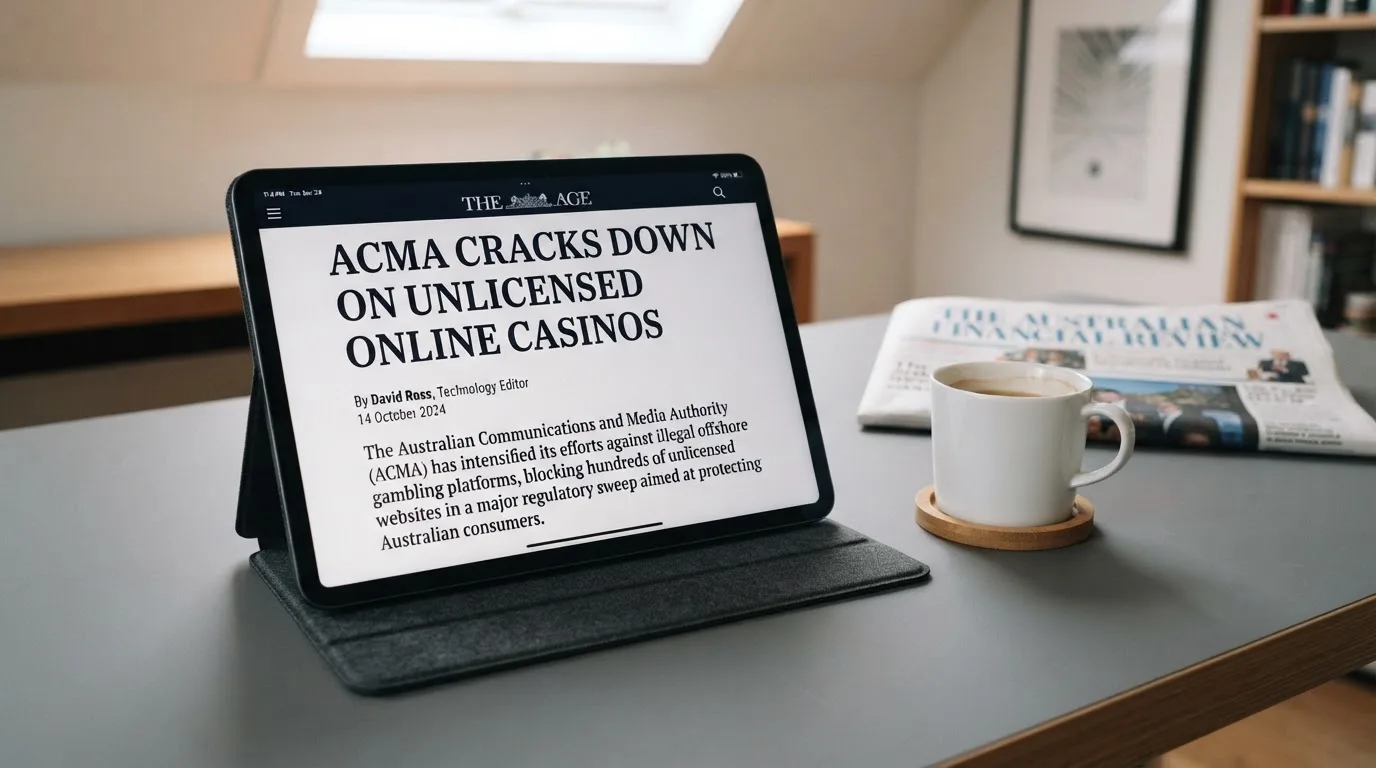
The ACMA investigates, issues formal warnings, and can direct Australian internet service providers to block sites. The blocking request power is the lever that matters: a single written request from the regulator to an ISP is what knocks a domain off Australian internet connections. As reported in June 2026, 1,751 illegal gambling and affiliate marketing websites had been blocked since the first blocking request was issued in November 2019, and more than 230 unlicensed gambling services had left the Australian market since enforcement was strengthened in 2017.
In the round reported on 26 June 2026, the ACMA asked ISPs to block twelve more: 7Signs, ChromaBet, Donbet, Duospin, Freshbet, Slots Gem, Jacks Club, Lucky Start, Pointsbetz, Spinrise, Vinyl Casino and Wildsino. The cumulative figure works out as a band of roughly 110–120 new blocks per year across the seven years since the first request in November 2019 — the rate of block issuance has held steady rather than accelerating, even as the warning pipeline ahead of a block has lengthened.
The blocking rate also has a condition. The 1,751 figure is a running total since November 2019; the 230 services that have left the market is a separate, narrower figure counting only the operators that have wound up their Australian-facing presence entirely. The two numbers do not add to each other. The blocking band of 110–120 per year should be read as new sites sent to ISPs in any given twelve months, not as the total market now denied to Australian players.
What the ACMA’s formal-warning list actually covers
The ACMA’s formal-warning register is the cleanest way to see which operators have run afoul of the regulator. Every brand reviewed below sits on that list. The pattern across 2026 and the recent past is consistent: the regulator names a corporate entity, sometimes two, and one or more brands, with the date the warning was issued.
Operator Comparison
| Brand | ACMA action and date | Operator named by the ACMA | Subject support |
|---|---|---|---|
| RocketPlay | formal warning, March 2026; earlier 2022 | Pulsup Ltd (March 2026); Dama N.V. (May 2022) | listings-only |
| Level Up Casino | formal warning, May 2022 | Dama N.V. | listings-only |
| Woo Casino | formal warning, March 2025 | Dama N.V. | no-data |
| Spirit Casino | formal warning, May 2025 | Dama N.V. | no-data |
| National Casino | formal warning, July 2025 | Consolutetish S.R.L. | listings-only |
| Bizzo Casino | formal warning, July 2025; earlier 2022 | Consolutetish S.R.L. (July 2025); TechSolutions (2022) | listings-only |
| Ignition Casino | formal warning, July 2025 | Bamboo Media | no-data |
| Instant Casino | formal warning, February 2025 | EOD Code SRL | listings-only |
| Jackbit | formal warning, April 2026 | Ryker B.V. | no-data |
| Casino Intense | formal warning, April 2025 | Sterplay Holding Ltd | listings-only |
| Sky Crown | formal warning, September 2022 | Hollycorn N.V. | no-data |
The Dama N.V. footprint is the most striking: the same corporate vehicle was warned in May 2022 over six brands, in March 2025 over Woo Casino, and in May 2025 over Spirit Casino. A site does not have to be new to be back on the register — it only has to keep operating against Australians under a fresh brand.
The arithmetic of offshore loss: what H2 Gambling Capital estimates
H2 Gambling Capital’s 2025 report puts Australian losses to illegal gambling sites at about A$3.9 billion per year. The share of gambling going through legal channels fell from 74% in 2021 to 64% — a ten-point swing in four years, with the movement explained by growth in offshore and unlicensed product rather than a contraction in legal spend. The figure that matters for an individual reader is not the absolute loss but the protection absent from the offshore column: no complaints body, no Australian recourse, and a blocking order can land with a balance still in the account.
The player-protection layer: BetStop and what it actually binds
BetStop, the National Self-Exclusion Register, has been live since August 2023. It binds Australian-licensed online and phone wagering services. An offshore casino is not connected to it. A player who has registered with BetStop is still reachable by an offshore operator — and a self-excluded player seeking speed rather than distance is precisely the profile an “under 1 hour” banner targets.
The support services that the regulator points to are designed for the licensed market, not the offshore one. The National Gambling Helpline is 1800 858 858, free, 24/7, with chat available at Gambling Help Online. For a player whose search for speed has led them to an offshore site, the substantive step is one that changes the entire relationship: a BetStop registration, a conversation with the helpline, or a deliberate move back to the licensed wagering market.
Banking-side blocks: what the major Australian banks actually do
The speed a player cares about depends on the bank being willing to process the transaction at all. Three of the four majors have moved on this. Westpac’s gambling block works at card level, declining any transaction registered under the merchant category code for betting and casino gambling on eligible personal credit and debit cards. ANZ’s block, toggled inside the ANZ app, blocks gambling transactions made through a digital wallet such as Apple Pay on an eligible card, not just the physical card; once turned on, removing it requires a 48-hour waiting period, and the bank warns that not all gambling transactions will be blocked and that some non-gambling transactions might be blocked in error. Commonwealth Bank’s gambling lock is set through the CommBank app on eligible cards and blocks most gambling transactions, with the same “cannot guarantee” caveat.
Apple Pay sits underneath those blocks in a particular way. Apple does not charge fees to consumers for using Apple Pay in stores, online or in apps, and any surcharge comes from the merchant’s own card-processing fees. Transaction limits and PIN requirements for Apple Pay purchases are set by the card issuer or merchant, not by Apple itself. By the end of 2025, Apple Pay, Google Pay and Samsung Pay transactions collectively accounted for around 45% of all card payments in Australia by number — meaning the bank-side block on the underlying card is what stops a wallet transaction, not anything at the wallet layer.
The Interactive Gambling Act 2001 as amended in 2023 also blocks credit cards and credit-related products as payment for licensed online wagering, a restriction that constrains gambling use of linked digital wallets. An offshore site asking for a credit card or a crypto deposit is operating outside the Australian rules even before the speed question comes up.
The settlement rails: Osko, PayID, and what “under a minute” actually means
The fastest settlement rail available to Australian consumers is Osko, which is the instant-transfer layer of the New Payments Platform. With Osko, a bank transfer between participating Australian banks arrives in under a minute, 24/7 including weekends, whether the transfer is addressed to a BSB and account number or to a PayID. PayID-based instant transfers are available at over 100 Australian financial institutions.
PayID also carries a friction layer that crypto and offshore wallets do not: when paying to a PayID, the sender sees the name of the account holder before the transfer is sent. Australian Payments Plus, the body that runs PayID and Osko, warns that being asked to transfer money to a PayID on an illegal gambling site almost certainly means a scam site. The PayID registry itself now holds more than 25 million registered identifiers as of April 2025.
The New Payments Platform itself is the infrastructure under all of this. It went live for Australian consumers on 13 February 2018, is owned by a non-profit whose thirteen shareholders include the Reserve Bank of Australia and the country’s major banks, and participants must keep monthly platform outages to no more than two minutes. In 2021 the ACCC authorised the merger of NPP Australia with BPAY and eftpos into a single company, Australian Payments Plus — the entity now operating Osko, PayID and BPAY together.
The settlement ceiling: what bank-side settlement means for “under 1 hour”
The ceiling on a withdrawal from an Australian bank account to an Australian bank account is Osko’s claim itself — under a minute, 24/7. The floor is the queue at the offshore operator’s payments team, which is where the hour actually gets spent. A casino that genuinely approves a withdrawal request inside the first ten minutes and pays it through Osko delivers the whole transaction inside the hour; a casino that holds withdrawals for manual review between 9 am and 5 pm on its own jurisdiction’s business hours can deliver the same advertised product and still pay a player out the next morning.
The other ceiling sits on the AUSTRAC side. AUSTRAC’s threshold-transaction-report rule applies only to physical cash; ordinary electronic bank transfers are not subject to per-transaction reporting regardless of the amount sent. So a large payout is not, by itself, what triggers additional reporting on the Australian side — but the offshore operator’s own compliance posture is its own matter, and a large first withdrawal from a new account is a routine cause of review at any operator, offshore or licensed.
What an offshore operator can actually claim: BPAY, BSB transfers, and the rest
BPAY is the older Australian bill-payment service, launched on 18 November 1997, available in the online banking of over 140 banks and financial institutions and offered by over 95,000 businesses. It is run by Australian Payments Plus, the same operator as PayID and Osko. It is not, however, a payout rail for an offshore casino — it is a bill-payment service for an Australian consumer paying an Australian biller. An offshore casino advertising BPAY deposits is advertising a deposit rail, not a withdrawal rail.
The legitimate withdrawal path from an Australian bank account to an Australian bank account is Osko, addressed to a PayID or a BSB and account number. Anything else — a withdrawal to a credit card, a withdrawal in cryptocurrency that has to be converted before spending, a withdrawal to an e-wallet that then takes its own settlement window — adds friction that the “under 1 hour” banner does not advertise.
The reviewed brands: what each operator’s record looks like
Every brand below has been the subject of an ACMA formal warning. The page’s purpose is to set out what is publicly known about each — operator entity, warning date, whether the regulator has named the operator behind the brand — and to make plain that “under 1 hour” claims from any of them are claims made outside Australian licensing, with whatever consequences follow from that for the player. None is a recommendation; none is a place to play.
RocketPlay
The ACMA issued a formal warning to Pulsup Ltd over RocketPlay in March 2026. An earlier formal warning covered Dama N.V. in May 2022, with RocketPlay among the six brands named at the time. The corporate trail — the same brand surfacing under two different operators across four years — is the kind of pattern that follows brand sales rather than brand closure.
What the public listings show for the brand is what affiliate marketing pages describe, not what the operator publishes in a regulated prospectus. The subject support for RocketPlay is exactly that — listings-only, drawing on Gambling Insider rather than the operator’s own page. The speed a player would experience at withdrawal is whatever the operator chooses to publish on its own cashier page.
The verdict on RocketPlay: a brand the ACMA has named twice in four years, operating outside Australian licensing, with no Australian consumer protection if the advertised speed does not deliver. The advertised speed is the only thing on offer that the page can summarise, and the only thing on offer that an Australian player cannot enforce.
Level Up Casino
Level Up Casino sits inside the May 2022 Dama N.V. warning, one of six brands named in that round. The Dama N.V. footprint across 2022, 2025 and 2025 — with Woo Casino and Spirit Casino following in 2025 — is the most visible pattern in the ACMA register, and Level Up Casino is the original entry point. Subject support is listings-only, drawing on Westpac’s own gambling-block page; the inference the page can draw from that is that Westpac’s merchant category code is broad enough to catch Level Up Casino’s deposit transactions at the bank side.
The verdict on Level Up Casino: an early instance of a recurring corporate pattern, where the regulator’s first warning to a corporate vehicle in 2022 did not prevent the same vehicle reappearing under fresh brands in 2025. The “under 1 hour” promise is the only product specification the brand advertises, and the protection underneath it is the same as for every other brand on this page — none.
Woo Casino
Woo Casino was the subject of a further formal warning to Dama N.V. in March 2025, three years after the original May 2022 round. The same operator, the same vehicle, a second warning two years on. Subject support is no-data: the public sources the research consulted carry no figure that the page can quote for the brand specifically, so the page describes the brand on its regulator record and leaves the speed and product claims where they sit — on the operator’s own pages.
The verdict on Woo Casino: a brand whose regulator record carries a 2025 fresh warning, with the implication that the operator’s Australian-facing activity did not end with the 2022 round. A player chasing a sub-one-hour payout from Woo Casino is chasing that speed from an entity the ACMA has warned twice in three years.
Spirit Casino
Spirit Casino was the subject of the same Dama N.V. wave in May 2025, two months after the Woo Casino warning. Subject support is no-data. The pattern is the same as Woo Casino’s — same operator, fresh brand, regulator warning follows.
The verdict on Spirit Casino: a brand whose regulator record is recent and whose subject support is empty. The substantive content is the ACMA warning and the offshore licence claim, and that is all the page has to carry for the brand.
National Casino
The ACMA issued a formal warning to Consolutetish S.R.L. over National Casino in July 2025. Subject support draws on three sources — the ACMA’s own register, AUSTRAC’s threshold-transaction-report guidance, and BetStop’s National Self-Exclusion Register page. The triangulation across regulator, financial-intelligence authority and self-exclusion body is more direct than what most entries on this page can show: the sources are not affiliate listings but Australian institutional pages.
The verdict on National Casino: a brand whose regulator record sits inside the most recent wave of formal warnings, and whose subject support draws on Australian institutional sources rather than marketing pages. The Australian institutional pages are not endorsements of the brand; they are pages the reader can use to verify the regulator’s position.
Bizzo Casino
Bizzo Casino carries the most layered history of any brand on this page. The ACMA issued a formal warning to Consolutetish S.R.L. in July 2025, and a separate earlier formal warning to TechSolutions (CY) Group Limited and TechSolutions Group N.V. in 2022. Two operators, two corporate vehicles, the same brand on the ACMA’s list across two distinct rounds. Subject support is listings-only, drawing on Gambling Insider.
The verdict on Bizzo Casino: the brand is on the ACMA’s list twice, under two different operators. The repeated appearance is not the same as a re-warning; it is what the regulator’s record looks like when a brand is sold between corporate vehicles. An Australian player reading either warning will reach the same conclusion — the brand has been the subject of regulator action across more than one operator.
Ignition Casino
The ACMA issued a formal warning to Bamboo Media over Ignition Casino in July 2025. Subject support is no-data. The brand sits inside the same July 2025 wave that includes National Casino and Bizzo Casino — three formal warnings in one round, the densest single month in the regulator’s recent record.
The verdict on Ignition Casino: a brand whose regulator record is from the most recent wave, with no public figure the page can quote beyond the warning itself. The page can describe the brand, name the operator, name the date; the page cannot quote a speed, a payout window, or a payment-method roster because no public source carries that for this brand.
Instant Casino
The ACMA issued a formal warning to EOD Code SRL over Instant Casino in February 2025, the earliest warning in the most recent wave. Subject support draws on two payment-rail sources — Ecopayz and PayID — which makes Instant Casino the brand on this page whose payment-rail picture is most concretely described. PayID’s own warning about scam sites is the relevant context here: the regulator’s own warning and the payment rail’s own scam warning point in the same direction.
The verdict on Instant Casino: the brand whose payment-rail picture is most fully described, where the regulator’s warning and the payment rail’s own scam-site warning align. An Australian player reading both will see that the regulator’s position and the payment rail’s position are not in tension.
Jackbit
The ACMA issued a formal warning to Ryker B.V. over Jackbit and CasinOK in April 2026, the most recent warning on this page and one of the most recent the regulator has issued. Subject support is no-data. Jackbit and CasinOK appearing in the same warning is a single operator moving against Australians under two brands at once.
The verdict on Jackbit: a brand on the most recent edge of the regulator’s record, named alongside a sister brand in the same warning. The “under 1 hour” promise sits on the operator’s own pages and has no Australian source the reader can hold it against.
Casino Intense
The ACMA issued a formal warning to Sterplay Holding Ltd over Casino Intense in April 2025. Subject support draws on three Australian institutional sources — AUSTRAC, BetStop and Gamblinginsider.com — the same triangulation the page carries for National Casino. Casino Intense is the second brand on this page with that kind of institutional cross-reference.
The verdict on Casino Intense: a brand whose regulator record is from April 2025 and whose subject support draws on Australian institutional sources. The same observation applies as for National Casino — the institutional sources are not endorsements; they are points of reference the reader can use to verify the regulator’s position.
Sky Crown
The ACMA issued a formal warning to Hollycorn N.V. over Sky Crown and Blue Leo casino services in September 2022. Subject support is no-data. Sky Crown is the oldest entry on this page, the brand with the longest gap between regulator action and the present moment — and a player reading it today would have to weigh the freshness of the warning against the brand’s continued Australian-facing presence.
The verdict on Sky Crown: the oldest formal warning on this page, and the brand with the longest gap between the regulator’s action and the present. The brand’s continued Australian-facing presence is what a reader would have to verify independently; the regulator’s record is fixed.
What the speed claim actually costs the player
A withdrawal that clears inside the hour is genuinely a better product than one cleared on a Wednesday — and the bank-side rails for delivering it, Osko and PayID, are available to any Australian consumer. What the “under 1 hour” banner does not say is that the operator’s own approval queue is where the time is actually spent, that an offshore site has no Australian complaints body to appeal to if the approval queue never moves, and that the ACMA’s blocking request power can knock the site offline with a balance still in it.
For a player whose search for speed has led them to an offshore site, the picture is the same whichever brand is on the page. The speed is real where the operator delivers it. The protection is absent in every case. The bank the player pays from may decline the deposit before the speed question arises. The choice that sits underneath the search is a choice between two products: the licensed wagering market that Australia actually allows, and the offshore market that delivers on speed at the cost of every other protection the licensed market carries.
Settlementa
With Osko, a bank transfer between participating Australian banks arrives in under a minute, 24/7, including weekends.
Fundamenta
In April 2026 the ACMA issued a formal warning over Jackbit and CasinOK.

Prohibiti
The ACMA issued a formal warning over Casino Intense in April 2025.
Tax position and what a recreational player needs to know
Gambling winnings of a recreational player are not assessable income under section 6-5 of the ITAA 1997, and losses are not deductible, unless the person carries on a business of gambling. A player whose relationship with offshore casinos is recreational, not professional, has no Australian income-tax obligation on winnings and no Australian income-tax relief on losses. The substantive obligation is to keep the activity outside the offshore market in the first place; the tax position is what falls out of that.
A player whose activity crosses into professional gambling — a category the ATO defines narrowly — should check with the ATO directly rather than rely on the standard position.
What the settlement picture looks like for the legal alternative
A withdrawal from a licensed Australian wagering operator follows a different path. The deposit rails are debit card, bank transfer, PayID/Osko and BPAY; credit cards and credit-related products are banned as payment for licensed online wagering since 11 June 2024, with penalties up to A$247,500 for operators. A licensed operator’s withdrawal typically clears inside one to three business days through Osko, with the operator’s own approval queue being the variable part. The speed is slower than the offshore promise; the protection is what the offshore market does not carry.
BetStop binds the licensed operator. The bank-side gambling block binds the licensed operator. A complaint to the regulator about a refused withdrawal has a body to receive it. None of those protections follow the player across to an offshore site.
How to read the rest of this picture
The “under 1 hour withdrawal” claim is real where the offshore operator delivers it, on rails — Osko, PayID — that Australian consumers already have access to without leaving the licensed market. The promise the offshore operator adds to the rail is approval speed and a payout window, and the cost is every protection the licensed market carries. For a player whose only goal is the speed, the licensed wagering market delivers it in one to three business days, and the licensed operator’s withdrawal approval queue is the variable that closes most of the gap.
The remaining gap — the hour versus the business day — is what the offshore banner sells. The arithmetic above shows that the gap is real but small. The protection that goes with it is what the licensed market carries and the offshore market does not. That is the choice, and it is the choice the rest of the page is built around.
Frequently asked questions
What would actually have to happen behind the scenes for a casino withdrawal to clear in under an hour?
Three things in sequence: the operator’s payments team approves the request inside minutes rather than queuing it for the next business day, the operator pays out through a rail that settles faster than a standard bank transfer, and the receiving bank credits the account without delay. The first step is the variable one, and the second is met by Osko for any Australian bank account.
Does an ‘under 1 hour’ withdrawal claim apply to every payment method a casino offers, or only some?
Only to the methods the operator’s payments team can push out instantly, which in practice means a subset of the deposit-method roster — usually e-wallets and instant bank-transfer rails, not credit cards or bank wires that go through a correspondent banking chain. The banner applies to the rail, not to the player.
Is a sub-one-hour withdrawal promise from an offshore casino something Australians can hold the site to?
No. The site sits outside Australian law, carries no Australian licence, and offers no Australian complaints body. A player whose withdrawal is held or refused has no domestic recourse, and a blocking order can land with a balance still in the account.
How does an under-1-hour claim compare with the real settlement time Australian banks describe for Osko transfers?
Osko settles in under a minute, 24/7 including weekends, between participating Australian banks. The “under 1 hour” banner is, in effect, advertising the bank-side ceiling rather than a casino-specific capability — the operator’s approval queue is the variable the banner does not name.
What’s the difference between an ‘under 1 hour withdrawal’ casino and a ‘same day payout’ casino as claims?
The sub-one-hour claim names a specific window and ties it to a settlement rail; the same-day claim names an end-of-business-day boundary without specifying the rail. Same-day is the looser of the two and the one most likely to mean an approval queue that clears once before close.
What might still delay a withdrawal even at a site advertising under-1-hour processing?
A first withdrawal from a new account is the most common cause of review at any operator, the operator’s own compliance posture can layer additional checks on large payouts, and an Australian bank with a gambling block toggled on will decline the deposit before any of the speed question arises.