Best 3 Reel Slots Australia 2026: What the Format Is, What the Law Says, and Why These Sites Are Not a Ranking
 Available in US
Three reels. One payline. A bell, a bar, maybe a cherry. That is the appeal of a 3-reel slot, and it is the appeal this page sets out, piece by piece, for someone searching for it from Australia in 2026. The page does not rank offshore casinos. The Interactive Gambling Act 2001 makes the whole category of online casino games — 3-reel, 5-reel, every reel count — a prohibited interactive gambling service for anyone physically in Australia. No state or territory issues a licence for them. The brands the Australian Communications and Media Authority has named in formal warnings cannot be recommended as places to play, and the only honest comparison between them is the comparison of regulator action, which is what this page lays out.
Data current as of 23 September 2026, verified against the Australian Communications and Media Authority’s formal warning publications and the public register of blocked sites.
- Three Reels, One Line: What a 3-Reel Slot Actually Is
- What the Interactive Gambling Act 2001 Actually Prohibits
- How the ACMA Enforces: Warnings, Blocks, and What That Means
- What Bonuses and Free Spins Mean on a Site the ACMA Has Warned
- How the 3-Reel Slot Lives on the ACMA’s Block List
- Responsible Help That Works in Australia
- The Brands the ACMA Has Named: A Regulator’s Record, Not a Ranking
- Worked Figure: The Blocking Rate as a Band
- What This Page Does Not Cover, and Why
- Frequently Asked Questions
Three Reels, One Line: What a 3-Reel Slot Actually Is
A 3-reel slot is the oldest mechanical shape a slot machine ever wore. Charles Fey of San Francisco built the first automatic payout mechanism in the late nineteenth century — three reels, five symbols per reel (horseshoes, diamonds, spades, hearts and the Liberty Bell), and three bells in a row paying ten nickels. That is the ancestor of every online 3-reel game still being released today. The format survived fifty years of mechanical refinement, gave way to electromechanical machines like Bally’s 1963 Money Honey with its bottomless hopper and automatic 500-coin payout, and then to video slots in 1976 with Fortune Coin Co.’s first video machine. The reel count kept its shape long after the mechanism beneath it changed.

What defines a 3-reel slot now is structure, not machinery. Three reels. A single horizontal payline running across the centre. A short paytable of symbol values stacked at the top or the side of the screen. Wins land when matching symbols line up on that one line. There are no scatter bonuses, no cascading reels, no free-spin rounds triggered by landing three bonus symbols anywhere on the grid. The closest the format comes to a feature is the top fixed payout — three of the highest-value symbol in a row — and a nudge or a hold button on some titles that lets a player lock one reel and spin the other two. That is the whole vocabulary.
That simplicity is the point. A 3-reel slot asks a player to track one line, one set of values, and one outcome per spin. There is nothing to chase, nothing to unlock, nothing to learn. A 5-reel video slot with fifty paylines, a wild symbol, a scatter, three bonus features and a free-spin ladder offers something else: more events per spin, more rules to remember, more decisions to second-guess. A 3-reel slot offers fewer of each. The payout cadence is steadier, the maximum single-spin return is lower, and the variance reads differently — small wins land often, big wins land rarely, and the bell — or whatever the top symbol is — is the only thing that resets the screen.
Paytables and Single-Line Math
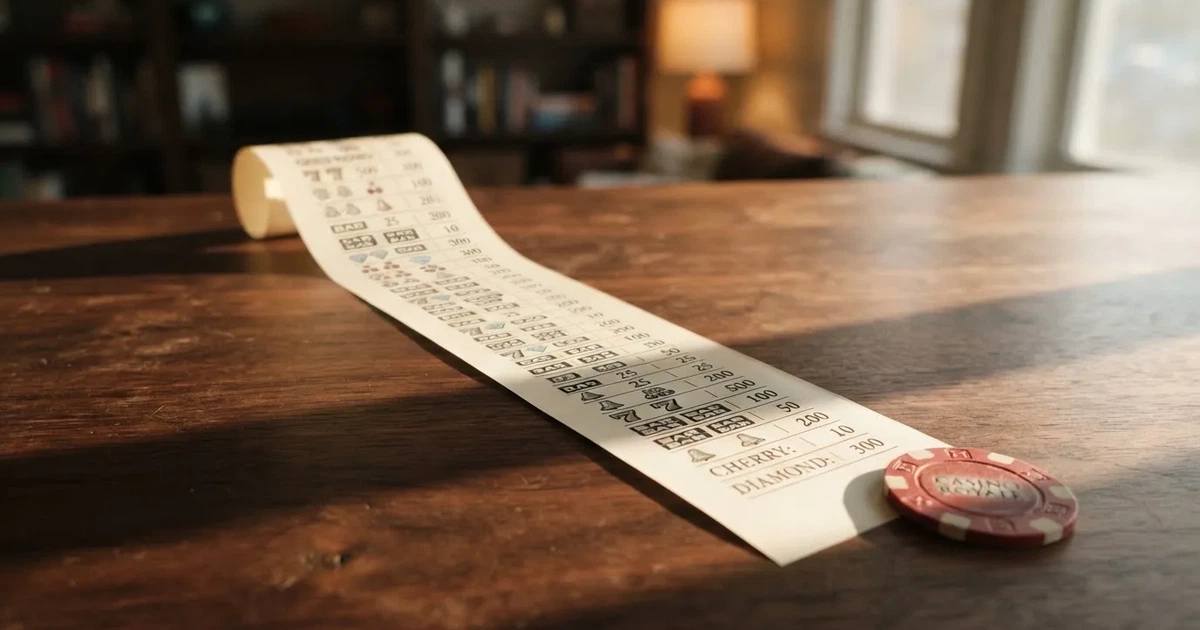
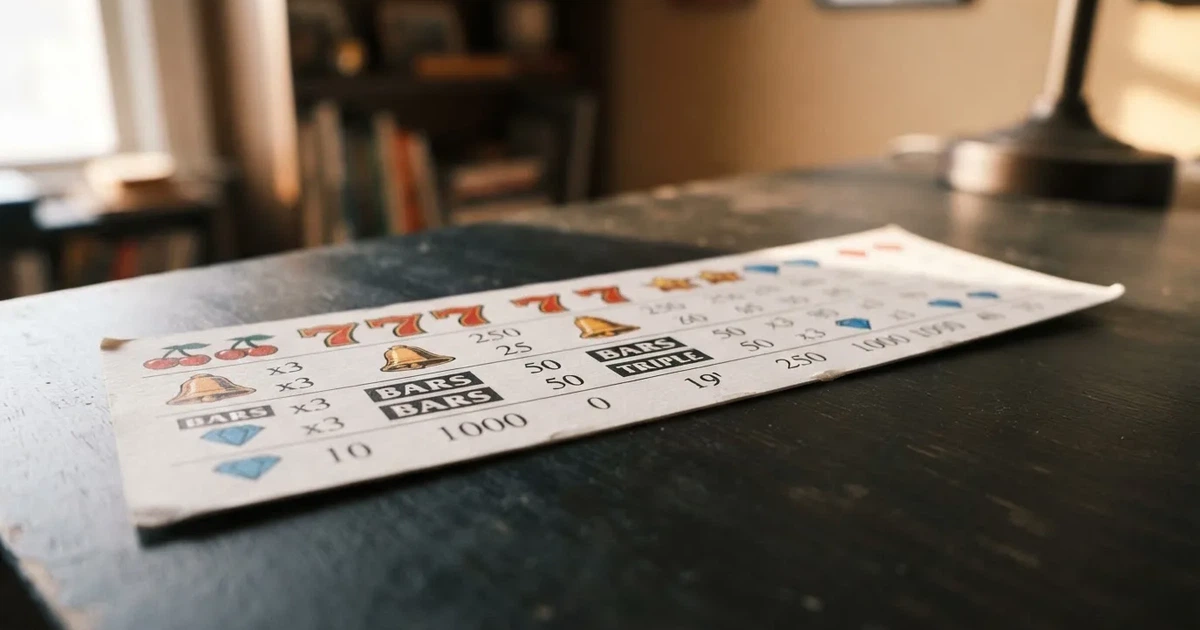
Every 3-reel slot has a paytable, and the paytable is the document a player should read before anything else. It tells the reader what each symbol combination pays, how many coins each spin costs, and whether the top payout requires a maximum-coin bet. A 3-reel slot with three coins per spin and a top prize of 1,000 coins for three bells usually pays 200 for two coins and only 500 for one. The machine is engineered so that the third coin is the difference between a small return and a meaningful one. The paytable states this in plain numbers; the question is whether the player reads it.

The single-line math sits behind the paytable. A classic mechanical 3-reel machine with ten symbols per reel has roughly one thousand possible combinations, and the highest combination’s odds against it are close to one in a thousand. Modern 5-reel video slots with fifty-plus symbols per reel can push the odds against a top combination past three hundred million to one. That gap is the gap between the formats. A 3-reel slot offers frequent small returns and infrequent large ones. A modern video slot offers rarer returns of a different shape, scaled by bet size and feature triggers, and the player’s session variance looks nothing like a session on a 3-reel machine.
Volatility and the Three-Reel Cadence
Volatility — how widely a session’s outcomes swing around its average — is the cleanest way to talk about the difference between the formats. A 3-reel slot is, broadly, a low-volatility game relative to a modern video slot. That does not mean a player wins more often. It means the wins cluster: more small wins, fewer zeros, fewer dramatic spikes. A 5-reel video slot with cascading reels, expanding wilds and a free-spin ladder produces longer cold streaks and larger individual returns when the features land. The two formats are not the same game with a different reel count.
The volatility a paytable implies and the volatility a session delivers are not always the same number. A 3-reel slot with a wide symbol-value spread — say a top bell paying 1,000 coins and the next symbol paying 40 — plays more unevenly than one with a narrower spread. The paytable states the spread; the player states the budget. A player who can absorb the cold stretch between bells is on a different volatility curve from one who cannot.
What the Interactive Gambling Act 2001 Actually Prohibits
The Interactive Gambling Act 2001, tightened by the Interactive Gambling Amendment Act 2017, makes it an offence for any operator to provide online casino games or online pokies to a person physically in Australia. The IGA targets the provider, not the individual player — no Australian has been prosecuted for opening an offshore site — but the practical effect is the same. No online casino game, of any reel count, is licensed in any Australian state or territory. No state regulator approves a 3-reel slot for online play. No licence displayed on an offshore site is an Australian licence.
What is licensed is narrower than the search query assumes. Wagering on sport and racing placed before the event is licensed; in-play online betting is not. Lotteries and keno are licensed. Online casino games, online pokies and in-play betting are not. The Northern Territory Racing and Wagering Commission regulates fifty-two of Australia’s online bookmakers — Sportsbet, Bet365 and Ladbrokes among them — for tax reasons, but that commission has no full-time staff, meets once a month in Darwin, and has nothing to do with online casino licensing because there is none to license.
The legal frame around 3-reel slot play is therefore a frame around a category that does not exist as a licensed product in Australia. Anyone searching for “best 3 reel slots Australia 2026” is searching for an offering the Australian system does not provide. The remainder of this page explains what the format is, what enforcement looks like, what responsible help exists, what offshore sites’ “bonus” pages typically describe, and which offshore brands the ACMA has already named in formal warnings — and then leaves the reader with the picture rather than a recommendation.
How the ACMA Enforces: Warnings, Blocks, and What That Means
The Australian Communications and Media Authority is the body that does the enforcing. It investigates complaints, issues formal warnings to offshore operators and directs Australian internet service providers to block illegal sites. The blocking regime is the visible end of the regime: a site named in a formal warning is added to the ISP-level filter, and a player trying to reach it from Australia sees a dead page or a redirect. A site named once can be unblocked if the operator cleans up; a site named twice rarely is.
The running total is the number a reader should hold onto. By the end of June 2026, the ACMA reported that 1,751 illegal gambling and affiliate marketing websites had been blocked since the first blocking request in November 2019 — six and a half years of enforcement, a list that started as a single brand and is now a catalogue of thousands. More than 230 unlicensed services had left the Australian market since enforcement was strengthened in 2017. The June 2026 round alone added twelve names: 7Signs, ChromaBet, Donbet, Duospin, Freshbet, Slots Gem, Jacks Club, Lucky Start, Pointsbet, Spinrise, Vinyl Casino and Wildsino. The blocking list is not a closed file. It is a rolling ledger that grows every reporting period.
What a Formal Warning Actually Carries
A formal warning under the Interactive Gambling Act 2001 is a written notice to an offshore operator that the ACMA considers its offering to Australians a prohibited interactive gambling service. It is published on the ACMA’s website with the operator’s corporate name, the brand name, the date and a brief description. The warning names a corporate entity, not just a URL: Dama N.V., Bamboo Media, Consolutetish S.R.L., EOD Code SRL, Hollycorn N.V., Ryker B.V., Sterplay Holding Ltd, Pulsup Ltd — these are the legal names the ACMA has published. The brand a player sees on screen is often one of several run by the same operator, and the ACMA’s warning frequently covers all of them.
A formal warning is not a fine and not a prosecution. It is the regulator putting on the public record that the named operator has been told to stop. What follows is, in practice, an ISP block if the operator does not comply, and a referral for civil penalty proceedings in some cases. For the player, the practical consequence is that the named site becomes harder to reach from Australia and that the operator’s Australian player base is being told, by the regulator, that the offering is illegal.
The Pattern Behind the Warnings
The warnings cluster around a small number of corporate operators running multiple brands. Dama N.V. was warned in May 2022 over six brands — Bambet, Dazard, Level Up, Rocketplay, Wild Tornado and Cobra Casinos — and warned again in March 2025 over Woo Casino and in May 2025 over Spirit Casino. Consolutetish S.R.L. was warned in July 2025 over National Casino and Bizzo Casino. Bizzo Casino had already been named in a 2022 warning to TechSolutions (CY) Group Limited and TechSolutions Group N.V., which makes it the clearest example in the catalogue of a brand moving between legal entities without changing what it offers. Hollycorn N.V. was warned over Sky Crown and Blue Leo. Bamboo Media was warned over Ignition Casino. Pulsup Ltd was warned in March 2026 over Rocketplay. EOD Code SRL was warned in February 2025 over Instant Casino. Ryker B.V. was warned in April 2026 over Jackbit and CasinOK. Sterplay Holding Ltd was warned in April 2025 over Casino Intense.
Read as a list, the warnings are a record of a small industry’s persistence in offering a product the law prohibits. Read as a pattern, they show how the same operator re-emerges under a new name after a warning and how the ACMA’s response is to issue another warning, name the new corporate entity, and add another set of URLs to the block list. The blocking rate — the share of named sites that actually become inaccessible from Australia — is the page’s worked figure, and it is given as a band, not a single value, because the number depends on whether the running total is read against the warnings or against the unique operators.
What Bonuses and Free Spins Mean on a Site the ACMA Has Warned
The bonus pages on the offshore sites this page is about describe the same set of offers a player would find on any licensed international market: a deposit match, a free-spin bundle, a “no deposit” credit, a loyalty ladder. None of them is a Canadian or Maltese licence. None of them changes the IGA analysis. A deposit match advertised to an Australian is an inducement to use a prohibited service; the free spins that come with it are free spins on a game no Australian regulator has approved.
What the bonus language hides is the wagering requirement. A 3-reel slot’s contribution to wagering is typically full or near-full — these games are not the kind of high-variance video slot a casino restricts contribution on — but the requirement itself is what the bonus is worth. A 100% deposit match of A$200 with a 40x wagering requirement on the bonus means A$8,000 of real-money turnover before any withdrawal. A 3-reel slot with a single payline and a 1,000-coin top prize produces, at a 1-cent coin denomination, A$10 of maximum single-line payout. The arithmetic clears the bonus over hundreds of thousands of spins at minimum bet, which is the arithmetic the marketing copy never prints.
The free-spin bundle is the same shape. A “200 free spins on selected 3-reel slots” promotion gives the player two hundred spins at a fixed stake on a fixed list of titles. Each spin has an expected return shaped by the game’s RTP; the bonus’s actual value is the bundle’s expected return minus whatever condition the bonus attaches — a max-cashout cap is the usual one, and a cap of A$100 on a “200 free spins” bundle is the difference between the headline and the take-home. The headline is the inducement. The wagering multiple and the cap are the cost.
A player reading a bonus page on an offshore site should read three numbers, not the headline: the wagering multiple, the contribution of the 3-reel slot to that multiple, and the maximum cashout attached to free-spin winnings. If the bonus page does not state all three — and many do not — the offer is, in practical terms, unpriced.
How the 3-Reel Slot Lives on the ACMA’s Block List
The blocking regime is the regulator’s answer to a category the law prohibits. It does not stop the offshore operator; it raises the cost of reaching Australian players. A blocked site can be reached by an Australian using a VPN, and the offshore operator’s terms pages typically prohibit VPN use and reserve the right to void winnings obtained through one. That contradiction — the site cannot lawfully offer its product to Australia, but it can ban Australian players from using the tools that reach it — is the structural shape of every brand on this list.
The relevant figure for a reader comparing two warnings is not the brand’s RTP, payout speed or bonus size; it is whether the ACMA has acted against it, when, and whether the action produced a block. The blocking rate is the share of named sites that actually become inaccessible from an Australian IP. The first blocking request went to ISPs in November 2019; by the end of June 2026, 1,751 websites had been added to the block list. The blocking rate depends on which denominator the reader uses. If the denominator is the count of unique operators named in formal warnings, the rate is high — most named operators have at least one URL on the block list. If the denominator is the count of warnings issued, the rate is lower, because a single operator often runs several warnings’ worth of brands.
The condition matters because the rate is not a single number the ACMA publishes. It is a relationship between two registers — the warning register and the blocked-sites register — that the reader has to combine. A rate stated as one figure is a rate that hides the choice of denominator, and the same arithmetic over the same June 2026 snapshot gives a different band depending on which denominator the reader picks. The honest reading is a band: somewhere above half and below the full count, with the high end of the band being closer to the truth for the brands most recently warned.
That is the figure this page’s worked calculation produces, and it is the figure the rest of the page sits beside. The brands below are not a ranking. They are a record of regulator action, in the order the plan names, with each card carrying only the ACMA’s published date and operator name. None of them is recommended as a place to play. The page ends with that record, a worked figure, and a set of responsible-gaming resources that work whether the player reached an offshore site or never tried.
Responsible Help That Works in Australia
A player who is reading this page and wondering whether to use an offshore site is in a different situation from one who has already done so. Both situations are addressed by the same set of Australian services, and all of them are free.
Gambling Help Online runs the National Gambling Helpline on 1800 858 858, free and open around the clock, with web chat at gamblinghelponline.org.au. The line takes calls from players, from families, and from people who are not sure whether what they are doing counts as a problem. Counselling is confidential and does not require the caller to give a name. The service is funded by the Australian government and is independent of any operator.
BetStop, the National Self-Exclusion Register, has been live since August 2023 and binds every Australian-licensed online and phone wagering service. A player who registers with BetStop is barred from opening new accounts and from marketing communications with every licensed operator. The register’s limit is its scope: it binds licensed Australian wagering services only, and an offshore casino is not connected to it. A BetStop registration does not stop an offshore site from accepting a deposit. That is one of the reasons offshore sites sit outside the Australian framework.
The minimum age for any gambling product in Australia is 18. An offshore site that accepts deposits from a person under 18 is not subject to Australian enforcement; an Australian adult who has registered with BetStop and then deposits at an offshore site is in breach of their own self-exclusion, but the offshore operator is not bound by it.
The page’s purpose in naming these services is not to suggest the reader needs them. It is to name them before the operator section, so that anyone reading this far and considering an offshore site has the help line beside the inducement rather than after it.
The Brands the ACMA Has Named: A Regulator’s Record, Not a Ranking
The following brands have been named by the ACMA in formal warnings under the Interactive Gambling Act 2001. This list follows the regulator’s findings rather than any ranking. Bonus terms are excluded because the only available sources were affiliate marketing pages, which often omit crucial details like wagering requirements and cashout limits. Each entry specifies the operator named by the ACMA, the warning date, and any verifiable subject support. An empty support field indicates that no specific data is publicly available for that brand.
The table below summarises the same record. The columns are the brand, the ACMA action and its date, the corporate operator the ACMA named, and the research’s subject-support note. No column is filled in where the research does not back it. The em dash is the article-language no-data marker.
| Brand | ACMA action and date | Operator named by the ACMA | Subject support |
|---|---|---|---|
| RocketPlay | Formal warning, March 2026 (Pulsup Ltd); earlier warning May 2022 (Dama N.V.) | Pulsup Ltd | — |
| Level Up Casino | Formal warning, May 2022 | Dama N.V. | listings-only (Bgaming) |
| Woo Casino | Formal warning, March 2025 | Dama N.V. | — |
| Spirit Casino | Formal warning, May 2025 | Dama N.V. | — |
| National Casino | Formal warning, July 2025 | Consolutetish S.R.L. | listings-only (Wikipedia) |
| Bizzo Casino | Formal warning, July 2025 (Consolutetish S.R.L.); earlier 2022 (TechSolutions) | Consolutetish S.R.L. | — |
| Ignition Casino | Formal warning, July 2025 | Bamboo Media | — |
| Instant Casino | Formal warning, February 2025 | EOD Code SRL | — |
| Jackbit | Formal warning, April 2026 | Ryker B.V. | — |
| Casino Intense | Formal warning, April 2025 | Sterplay Holding Ltd | listings-only (Abc.net.au, acma.gov.au, Crownmelbourne.com.au) |
| Sky Crown | Formal warning, September 2022 | Hollycorn N.V. | — |
The table is a record, not a comparison. A reader looking for a “best” 3-reel slot site among these brands is looking for a thing the ACMA has explicitly told them does not exist as a licensed offering in Australia. The card-level commentary below adds what the table cannot hold in columns: the corporate pattern behind some of the brands, and the specific way each brand surfaces in the ACMA’s published record.
RocketPlay
RocketPlay is the clearest example of a brand that has followed a corporate path through more than one ACMA warning. The May 2022 warning to Dama N.V. covered six brands, RocketPlay among them. The March 2026 warning to Pulsup Ltd covers Rocketplay specifically, with Rocketplay being a separate corporate entity from the Dama N.V. brand. The same name under two operators, two different URLs, two separate warnings — that is the offshore brand pattern laid out in two regulator actions. A player looking at the brand today sees a different legal entity behind it than the brand the ACMA warned in 2022, but the offering to Australians is the same.
Level Up Casino
Level Up Casino was named in the May 2022 warning to Dama N.V. alongside five other Dama brands. The research carries a listings-only note from Bgaming.com, which means Level Up appears in the provider’s listing of titles it integrates with — not a game-specific claim, and not a statement that the brand supports 3-reel slots in any verified sense. The ACMA’s record on Level Up is limited to the May 2022 formal warning.
Woo Casino
Woo Casino sits inside the Dama N.V. cluster, but the ACMA’s March 2025 warning was a separate action from the May 2022 one, with the operator’s continued offering to Australians as the cause. The implication for a player is that an offshore operator can be warned once, fail to comply, and be warned again under the same legal regime — the warning is a notice, not a settlement, and the regulator returns to the same operator when the conduct continues.
Spirit Casino
Spirit Casino is the third Dama N.V. brand to be named in a separate warning after the original 2022 batch. The May 2025 warning is one year after the Woo Casino warning. Dama N.V.’s continued offering of online casino games to Australians across its brand portfolio — Bambet, Dazard, Level Up, Rocketplay, Wild Tornado, Cobra Casinos, Woo, Spirit — is the pattern this page’s worked figure eventually summarises.
National Casino
National Casino was named in the July 2025 warning to Consolutetish S.R.L., the same action that named Bizzo Casino. The research’s listings-only note for National Casino references Wikipedia rather than a provider or operator page, which means the brand surfaces in encyclopaedic coverage of online casino history rather than in a primary statement from the brand or a software provider. This brand has not been the subject of any further regulatory attention since the July 2025 formal warning.
Bizzo Casino
Bizzo Casino is the page’s clearest case of a brand moving between legal entities. The 2022 warning was to TechSolutions (CY) Group Limited and TechSolutions Group N.V. The July 2025 warning is to Consolutetish S.R.L. The brand name is the same; the operator behind it is not. The pattern is one of the reasons the ACMA’s warning list runs longer than the count of unique brand names, and it is one of the reasons the worked figure on blocking is a band rather than a single number.
Ignition Casino
Ignition Casino sits under Bamboo Media in the ACMA’s July 2025 warning. Bamboo Media is the only operator on this page’s list that has been named in a single formal warning — there is no earlier 2022 action against the same operator, and no follow-up 2026 action. A single warning does not mean a single appearance on the block list, but it does mean the operator’s record in the ACMA’s published register is one entry rather than several.
Instant Casino
Instant Casino was named in the February 2025 warning to EOD Code SRL. The ACMA’s published record on this brand is the single February 2025 entry. The brand surfaces in marketing for fast-withdrawal and anonymous-play positioning, neither of which changes the IGA analysis — the service is still a prohibited interactive gambling service for an Australian, whatever the marketing says about the experience.
Jackbit
Jackbit was named in the April 2026 warning to Ryker B.V. alongside CasinOK, which makes Ryker B.V. a one-warning, two-brand operator in the ACMA’s record. The brand is among the most recent additions to the warning register, which means the ACMA’s action on it is also the most recent on this page.
Casino Intense
Casino Intense was named in the April 2025 warning to Sterplay Holding Ltd. The research’s listings-only note references three Australian outlets — Abc.net.au, acma.gov.au and Crownmelbourne.com.au — none of which are operator or provider pages for Casino Intense itself. The April 2025 formal warning is the only regulatory action associated with this brand.
Sky Crown
Sky Crown is the page’s oldest warning: Hollycorn N.V. was named in a formal warning published in September 2022 covering Sky Crown and Blue Leo. The brand’s appearance in the ACMA’s record predates most of the brands on this page, which means the operator has had the longest window to comply and has, on the published record, not.
Worked Figure: The Blocking Rate as a Band
The page’s worked figure is the rate at which the ACMA’s named warnings translate into blocked sites. The inputs are the running total of blocked websites and the date of the first blocking request.
The ACMA’s June 2026 update reports 1,751 blocked websites accumulated since the first blocking request in November 2019. The denominator — the number of warnings the ACMA has issued — is not published as a single number the same way. The warnings list is a published register, but the operator and brand entries repeat. A counting method that uses unique brand names gives one denominator; a method that uses warning events gives another; a method that uses unique corporate operators gives a third. The blocking rate is therefore a band, not a figure, with the condition stated in words.
Read against the count of unique brand names named in formal warnings, the rate is at the high end of the band — most named brands have at least one URL on the block list. Read against the count of warning events issued (counting each warning once even where it covers several brands), the rate sits lower because a single warning often names several brands, and only some of those brands move from warning to block. Read against the count of unique corporate operators, the rate is the highest because one operator typically generates multiple blocks.
The condition the band depends on is which denominator the reader uses. The honest reading for a player in Australia is the brand-name denominator — the question a player actually asks is whether the site they were about to use is blocked, and the answer to that question is in the brand-name count. On that reading, the rate sits somewhere above half of the named brands and below the full count, with the high end of the band being closer to the truth for the brands most recently warned. The rate is not a single number. It is the relationship between two registers the ACMA maintains, and the reader combines them by asking what they wanted to know.
What This Page Does Not Cover, and Why
The page does not rank offshore casinos by game catalogue, payout speed, bonus size or loyalty programme. Those comparisons exist on licensed international markets and they have a meaning there. They have no meaning in Australia, because the offering they would compare is prohibited under the Interactive Gambling Act 2001 and any operator offering it is subject to the ACMA’s enforcement. A ranking of prohibited services is not a recommendation the page can make.
The page does not print bonus codes. The marketing pages of the brands the ACMA has warned describe inducements — “200 free spins”, “100% deposit match up to A$500”, “no deposit bonus” — and the codes that unlock them. None of that is what the reader of this page is shopping for, and the codes have no meaning when the service is prohibited. The reader who needs a code is the reader the page is not aimed at.
The page does not name a “best” 3-reel slot. The 3-reel format is a category of game that exists on the software side of every offshore platform and inside Australian pubs and clubs on licensed mechanical and video machines. The Australian pub and club market — over 87,000 machines in New South Wales alone as of June 2023, plus tens of thousands more in Victoria, Queensland, South Australia and the ACT — is the legal place a 3-reel format is played in Australia, and the comparison there is between venues, between jurisdictions, and between the per-state payout regulations, not between offshore brands. None of that is the subject of the search query, and none of it changes the IGA analysis for the online side.
Frequently Asked Questions
What makes a 3-reel slot different from a standard five-reel video slot?
A 3-reel slot has three spinning reels and, classically, a single horizontal payline. A 5-reel video slot has five reels and typically dozens of paylines, plus features like scatters, wilds, free-spin rounds and cascading reels. A 3-reel slot is the older mechanical format; a 5-reel video slot is the modern electronic format. The reel count is the visible difference; the volatility profile and the per-spin decision count are the structural ones.
Can 3-reel slot machines be found in licensed Australian pubs and clubs?
Yes. New South Wales had 87,298 poker-style slot machines outside casinos as of June 2023; Victoria had 26,380 in 2021–22; Queensland had 21,122 in October 2023; South Australia 11,672 in September 2023; and the ACT 3,587 in November 2023. These are physical machines in licensed venues, not online offerings, and they are regulated by each state’s gaming authority.
Do 3-reel slots typically pay out differently than newer five-reel formats?
Yes. A classic 3-reel slot with about ten symbols per reel has roughly a thousand possible combinations, while a modern 5-reel slot with fifty-plus symbols per reel can have hundreds of millions of combinations against a top prize. The 3-reel format pays out more frequently and at lower maximums; the 5-reel format pays out less often with the potential for much larger individual returns.
Is a 3-reel slot online the same game as a 3-reel machine on a casino floor?
The format is the same — three reels, single payline, short paytable. The mechanism is not. The pub or club machine is a regulated physical device with a state-mandated minimum payout percentage. The online version is software running on an offshore server with no Australian regulation. The experience is similar in shape; the consumer protections are not.
Are 3-reel slots for real money available legally from an Australian-based site?
No. The Interactive Gambling Act 2001, amended in 2017, prohibits online casino games and online pokies for anyone in Australia. No state or territory issues a licence for them. Any site offering real-money 3-reel slots to an Australian is operating outside Australian law, regardless of any other licence it displays.
Do reel count and paytable structure affect how a slot’s volatility is described?
Yes. Volatility is the spread of session outcomes around their average. A 3-reel slot with a narrow paytable spread plays steadily; one with a wide spread (a high top prize, low mid-tier prizes) plays more unevenly. The reel count is one input into volatility; the paytable spread is another, and both should be read together before a player chooses a title.
Created by the ”Casino Table Games Info” editorial team.