The 5-reel slot machine in Australia, and the offshore sites that still ask Australians to play it
 Available in US
Five spinning reels, a fixed paytable and a single line of matching symbols used to be the whole slot. That format is older than most readers, and it is also the one most Australians will run into first. The legal picture is the more interesting part. Online casino games and online pokies cannot be licensed for real-money play anywhere in Australia, so any “5-reel slot” a person reaches through a browser is delivered by an offshore operator, watched by the Australian Communications and Media Authority, and routinely blocked at the internet-service-provider level. The right way to read this page is two ways at once: what a 5-reel slot mechanically is, and what is and is not licensed to offer one in this country.
The data is current as of 23 September 2026 and was checked against the public registers maintained by the ACMA and the state and territory casino regulators. Where a figure is fixed to a specific past event — a 2022 warning, a 2025 blocking round, a 1963 release — that year stays in the text rather than collapsing to the current one, because the event happened then and not now.
- The shape of a 5-reel slot, from the Liberty Bell onward
- Why online 5-reel play sits outside the Australian licence system
- What the ACMA does about offshore 5-reel slot sites, and what that record shows
- The arithmetic of how fast the ACMA’s blocking list has grown
- What a 5-reel slot’s paytable actually shows
- What “responsible gambling” actually means when there is no Australian licence to lean on
- What a reader comparing 5-reel slot sites should actually weigh
- How the eleven brands sit against each other, in their own terms
- Frequently Asked Questions
The shape of a 5-reel slot, from the Liberty Bell onward
The 5-reel slot is a misnomer that has stuck. Charles Fey’s original automatic slot, built in San Francisco in the late nineteenth century, was a three-reel machine carrying five symbols — horseshoes, diamonds, spades, hearts and the Liberty Bell itself — with three bells in a row paying the top prize of ten nickels. The “5-reel” name, in modern catalogue use, almost always means a video slot drawn on five reels rather than the five-symbol three-reel layout that invented the category. The phrase still travels because it carries an old promise: a paytable a player can read in one glance, with no cascading reels, no cluster pays and no Megaways-style symbol-count gymnastics.

Two upgrades mattered. Bally’s Money Honey in 1963 was the first slot with a bottomless hopper and automatic payout of up to 500 coins without an attendant, which removed the human bottleneck on smaller wins and let the format spread beyond the high-roller room. Fortune Coin Co., in Kearny Mesa, California, developed the first video slot in 1976, and with it the move from mechanical reels to a screen — which is the moment a slot could carry five reels, fifty symbols or a hundred paylines without growing a physical cabinet to match.
What a reader actually sees, on a modern 5-reel online slot, is three things stacked together. A set of symbols sits on each reel, weighted so the higher-paying ones land less often. The paytable maps combinations to credits. The house edge hides in the symbol weighting and in the gap between what the paytable lists and what each spin actually returns. Two facts from a long-running industry reference help set the scale. A classic mechanical three-reel machine with about ten symbols per reel offered roughly one thousand possible combinations. A modern video slot, with five reels and fifty or more symbols per reel, can produce odds against a top combination as high as three hundred million to one. The bigger machine is not a better deal — it is a different-shaped bet, with a longer tail and a lower frequency of small wins.
Australian venues are full of physical versions of the same idea. Pokies-style slot machines outside casinos numbered 87,298 in New South Wales as of June 2023, 26,380 in Victoria across 2021–22, 21,122 in Queensland in October 2023, 11,672 in South Australia in September 2023 and 3,587 in the ACT in November 2023. By 2010 Australia operated an estimated 97,103 gaming machines outside casinos — a per-capita rate about five times that of the United States. New South Wales legalised slot machines in 1956; the rest of the country followed over the next several decades, and the legal gaming machine is a familiar sight in pubs and clubs. None of those machines is the subject of this page. They are the legal cousin; this page is about the format as it appears online.
Why online 5-reel play sits outside the Australian licence system
The Interactive Gambling Act 2001, strengthened by the Interactive Gambling Amendment Act 2017, makes it an offence to provide online casino games, online pokies or in-play betting to a person physically in Australia. No state or territory issues a licence for them. The provision is the offence, not the play — the individual player is not prosecuted — but the legal consequence falls on the operator offering the service to Australians. What is licensable is wagering on races and sport placed before the event, lotteries and keno. The Northern Territory Racing and Wagering Commission regulates 52 of Australia’s online bookmakers — including Sportsbet, Bet365 and Ladbrokes — which are licensed in the Territory for tax reasons; the commission has no full-time staff and meets once a month in Darwin. Bookmakers and slot operators are not the same business, and a bookmaker’s licence is not a casino’s licence.

Three rules about money follow directly from the licence split. Credit cards, credit-related products and digital currency are banned as payment for licensed online wagering in Australia since 11 June 2024, with penalties up to A$247,500 for an operator that takes one. Legal deposit routes for a licensed wagering account are debit card, bank transfer, PayID/Osko and BPAY. A site asking an Australian for a credit card or a crypto deposit is operating outside the Australian rules; that is one of the clearest practical signals a reader can read off a cashier page, and it predates any ACMA action. Gambling winnings of a recreational player are not assessable income under section 6-5 of the ITAA 1997, and losses are not deductible, unless the person carries on a business of gambling — model only, “check with the ATO” if the situation is more than casual.
A 2026 reform is on the books but is not yet in force on the page. The Interactive Gambling Amendment (Gambling Reform) Bill 2026 passed Parliament on 19 August 2026; its advertising and inducement measures commence 1 January 2027. Read in late 2026, the bill is law with a future start date, which means it is not a constraint an offshore site can be tested against today, but it is a constraint they will face on the named date.
What the ACMA does about offshore 5-reel slot sites, and what that record shows
The ACMA investigates, issues formal warnings, and directs Australian internet service providers to block illegal sites. Three enforcement tools, in ascending severity. A formal warning is a public notice naming an operator and an Australian-facing brand. A blocking request asks ISPs to take a domain off the Australian internet. An investigated-and-removed service leaves the market without a formal blocking action. The ACMA publishes each of these on its own site, and the published record is what a reader is reading when this page says “the ACMA warned Brand X in month Y.”
Two figures frame how often those tools are used. According to the ACMA, as reported in June 2026, a total of 1,751 illegal gambling and affiliate marketing websites had been blocked since the first blocking request in November 2019, and more than 230 unlicensed gambling services had left the Australian market since enforcement was strengthened in 2017. In the round reported on 26 June 2026 the ACMA asked ISPs to block twelve more: 7Signs, ChromaBet, Donbet, Duospin, Freshbet, Slots Gem, Jacks Club, Lucky Start, Pointsbetz, Spinrise, Vinyl Casino and Wildsino. A reader who tries one of those names today and finds the site unreachable in Australia is seeing the second tool, not a glitch.
H2 Gambling Capital’s 2025 report, carried by industry trade press, estimates that Australians lose about A$3.9 billion a year to illegal gambling sites, and that the share of gambling going through legal channels fell from 74% in 2021 to 64%. The two figures sit on either side of the same story: more money is leaving the legal system than used to, and most of what leaves it goes to operators without an Australian licence. The economic argument for tightening enforcement is not the only argument — the consumer-protection argument carries equal weight — but the dollar figure is the one that turns a regulator’s case from abstract to concrete.
Formal warnings, by operator and by year
The formal-warning record is the ACMA’s cleanest published tool. The list below is the published record, ordered by the year the warning was issued, with the operator name as the ACMA printed it and the brand the warning covered.
- March 2026 — Pulsup Ltd over RocketPlay.
- April 2026 — Ryker B.V. over Jackbit and CasinOK.
- April 2025 — Sterplay Holding Ltd over Casino Intense.
- July 2025 — Bamboo Media over Ignition Casino; Consolutetish S.R.L. over National Casino and Bizzo Casino. Bizzo had already been warned in 2022 over TechSolutions (CY) Group Limited and TechSolutions Group N.V.
- May 2025 — Dama N.V. over Spirit Casino.
- March 2025 — Dama N.V. over Woo Casino.
- February 2025 — EOD Code SRL over Instant Casino.
- May 2022 — Dama N.V. over six brands: Bambet, Dazard, Level Up, Rocketplay, Wild Tornado and Cobra Casinos.
- September 2022 — Hollycorn N.V. over Sky Crown and Blue Leo casino services.
Dama N.V. is the operator that recurs across years. The same corporate group surfaced in the May 2022 round covering six brands, then again in March 2025 over Woo Casino and in May 2025 over Spirit Casino. A reader who has only ever seen the brand names treats those as different sites; the ACMA’s record treats them as one operator working through several brand fronts. That is a useful piece of information for someone trying to read a casino’s “About” page.
The arithmetic of how fast the ACMA’s blocking list has grown
A blocking rate, taken at face value, is the published ACMA total of blocked sites divided by the number of years the regime has been running. The first blocking request was in November 2019. The cumulative total reached 1,751 in June 2026 — a span of roughly six and a half years, or 78 months.
The figure that comes out of that is a band rather than a single number, because the rate is not constant. Early enforcement moved slowly; later rounds have moved faster as the ACMA’s investigative capacity and the volume of incoming complaints both grew. Dividing 1,751 by 78 months gives an average of about 22.4 blocked sites per month, but the visible shape is two-ended: the early years ran at single digits per month and the 2024–2026 rounds have been running at well over thirty per month, with individual batches now regularly in the twelve-to-twenty range per cycle. A reader should treat the published average as a floor, not a ceiling — the next twelve months will land above it rather than below it.
The condition that holds the band together is the same one that holds the formal-warning record together: an enforcement tool that only counts what the ACMA acted on, and not the operators that quietly withdrew without a published step. The more-than-230 services that have left the Australian market since 2017 are the second count, and adding it to the 1,751 blocked sites gives a combined enforcement footprint of close to 2,000 actions across seven years. The arithmetic is simple; the consequence for any offshore operator targeting Australians is not.
What a 5-reel slot’s paytable actually shows
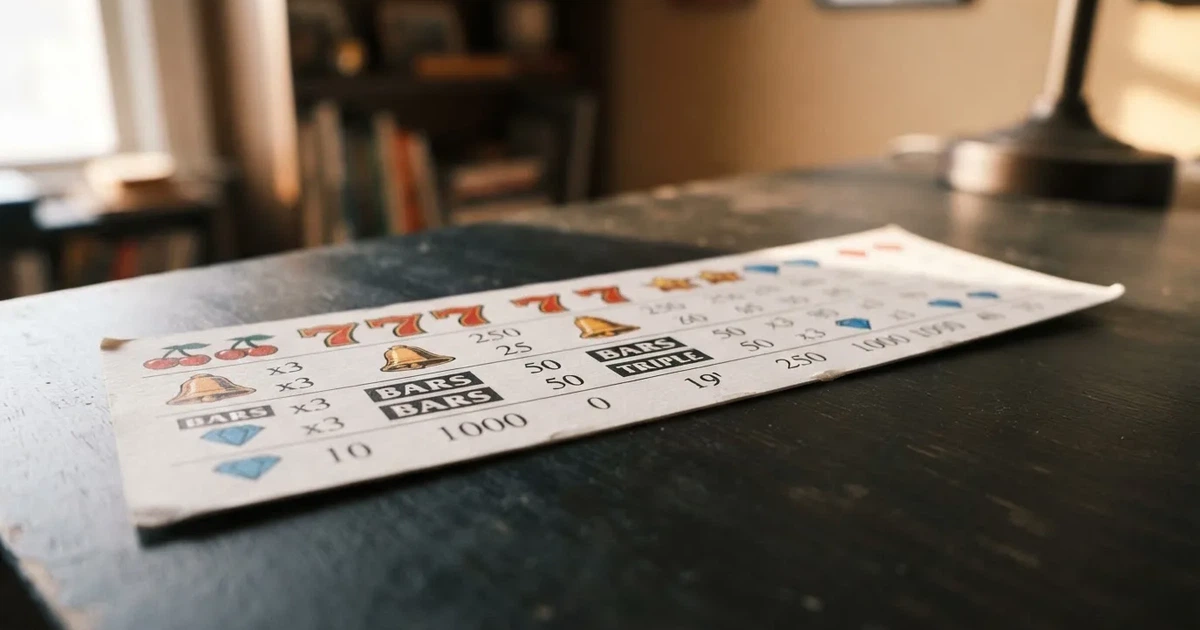
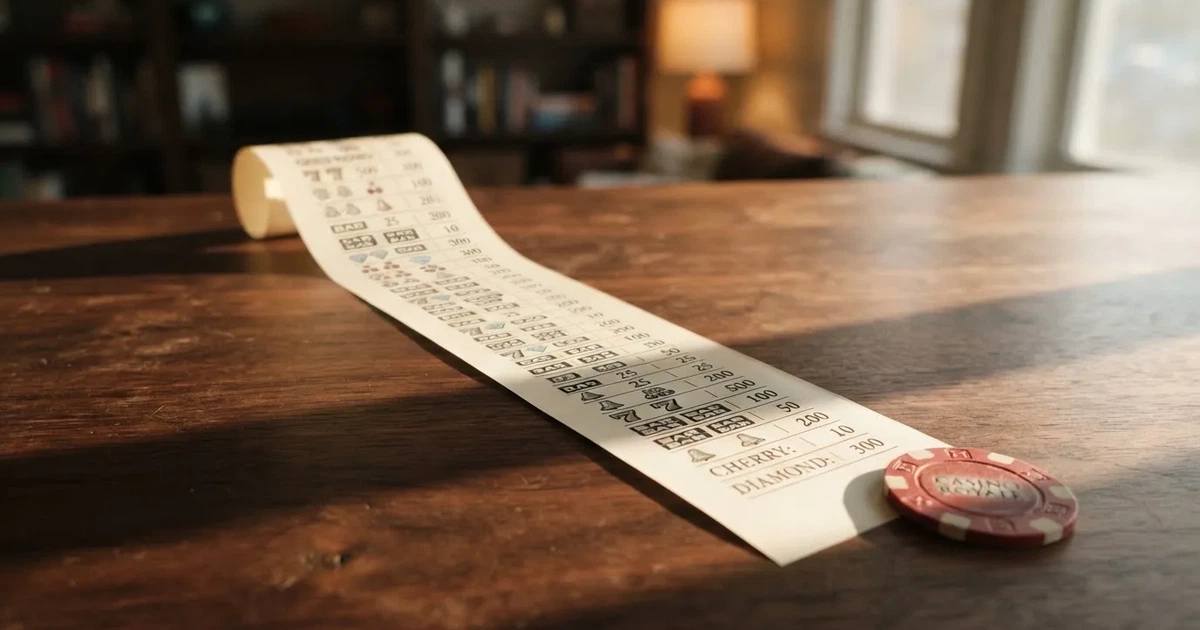
A paytable is the list of symbol combinations the slot will pay for, with the credit amount attached to each. On a classic 5-reel machine the table is short: five symbols per reel, one or three paylines, one top prize and a small handful of secondary combinations. On a modern 5-reel video slot the table is long enough that a player is meant to scroll rather than read. Either way, the same three columns do the work: which symbols, how many in a row, and how many credits.
Three things vary across 5-reel slots and are worth reading off the paytable rather than the splash screen. The first is the symbol weighting — how often each symbol lands on each reel — which is the part the paytable does not print, and which is the part that hides the house edge. The second is the line count: a “5-reel slot” with twenty adjustable paylines is a different bet per spin from a “5-reel slot” with one fixed line. The third is whether the top payout is a fixed credit amount or a progressive pool — which is the part of the slot that changes most across catalogues, and the part most likely to be marketed out of proportion to how often it actually pays.
Three figures from the wider casino floor put the slot in context. Blackjack’s house edge is about 0.28% under liberal Las Vegas Strip rules — dealer stands on soft 17, double on any two cards, double after split, resplit aces, late surrender — and about 0.43% under Atlantic City rules. Baccarat’s house edge is 1.06% on the Banker bet, 1.24% on the Player bet and 14.36% on the Tie. Craps’s Pass/Come bet runs at 1.41%, Don’t Pass/Don’t Come at 1.36% and Any Craps at 11.11%. A slot does not advertise its house edge on the paytable; the edge lives inside the symbol weighting, and what the paytable lists is the credit value of a winning combination rather than the long-run return to the player. Slot payout regulation varies sharply elsewhere — Nevada requires at least 75%, Mississippi at least 80%, New Jersey at least 83% — but no equivalent floor applies to an offshore 5-reel online slot offered to an Australian, and the paytable is what the player has, full stop.
In New South Wales, section 66 of the Casino Control Act 1992 makes it an offence for a casino operator to permit a game such as baccarat to be played unless the game and its rules are approved by the regulator, and the operator must make a copy of the approved rules available to patrons on request. The Victorian Gambling and Casino Control Commission, which replaced the VCGLR as Victoria’s casino regulator on 1 July 2022, applies the equivalent rule under the Casino Control Act 1991 — every blackjack variant at Crown Melbourne is approved by name, and the public log includes recent changes like renaming “Perfect Pairs” to “Crown Pairs” on 23 December 2024 and introducing a “Free Bet” option with a new “Pot of Gold” side bet on 25 March 2024. None of that approval framework reaches an offshore 5-reel slot site, which is precisely why this page is about reading a paytable carefully rather than assuming one is regulated.
What “responsible gambling” actually means when there is no Australian licence to lean on
If 5-reel online slot play ever starts to feel compulsive or stressful, free confidential help is available around the clock. The National Gambling Helpline is 1800 858 858, free, 24/7, with chat at Gambling Help Online. That is the part of the system that works regardless of where the slot site is licensed, because the help line is a service to the player, not to the operator.
The harder part is the self-exclusion system. BetStop, the National Self-Exclusion Register, has been live since August 2023. It binds Australian-licensed online and phone wagering services — Sportsbet, Bet365, Ladbrokes and the other 49 NT-licensed bookmakers are connected to it; lotteries and keno operators are connected through their state-level arrangements. An offshore casino is not connected to it. A person who has registered with BetStop can still reach an offshore 5-reel slot site, deposit through a method the licensed system would block, and play without the BetStop safeguard engaging. The system does what the law allows it to do; what it does not do is follow the money offshore.
A related point about money is worth stating plainly. Winnings from casual gambling are not taxable in Australia, losses are not deductible, and the ATO does not need to be involved. If a reader is in a position where the question “do I owe tax on this?” is actually live, the model is that the person carries on a business of gambling, which is a different situation from being a punter, and the right answer is to ask the ATO rather than work it out from this page.
What a reader comparing 5-reel slot sites should actually weigh
Comparison of Payment Options
| Method | Licensed Wagering (AU) | Offshore Casino |
|---|---|---|
| Debit card | Allowed | Allowed |
| Bank transfer | Allowed | Allowed |
| PayID/Osko/BPAY | Allowed | Not supported |
| Credit card | Banned | Often requested |
| Crypto | Banned | Often requested |
A fair comparison of offshore 5-reel slot sites, against the Australian legal backdrop, rests on a small number of factual questions rather than on marketing language. Which of the ACMA’s three enforcement actions has touched this brand, and when. Which corporate operator sits behind the brand, because the same operator can reappear under a new name within months. Which payment methods the cashier lists, because credit card and crypto are the two clearest signals that the site is operating outside the Australian rules. Whether the brand appears in a third-party listing of subjects the operator supports, and how specific that listing is. Whether the site’s published rules and dispute process name an Australian-facing contact or only a Curaçao or Cyprus mailing address.
None of those questions is the question “which slot pays the best?” — which is the question most affiliate marketing pages answer first, and the one the ACMA’s enforcement record makes least useful. The site that pays the best on Tuesday is the same site the ACMA may block on Wednesday, and a blocked site with a balance on it is the worst outcome a reader can construct from the data above. The fair comparison is therefore the one a reader can still use after a blocking round: which brand was warned, by which operator, on which date, and what does that record leave on the table.
The landscape, by brand, by ACMA action, and by subject support
The table below is a published-record comparison, not a recommendation. Every row is a brand the ACMA has named in a formal warning for offering prohibited interactive gambling services to Australians. The first column is the brand as the ACMA printed it. The second is the ACMA action and the date it was published. The third is the corporate operator named in the warning. The fourth is what third-party listings say about the brand’s subject support, or an em dash where nothing is on the public record.
| Brand | ACMA action and date | Operator named by the ACMA | Subject support |
|---|---|---|---|
| RocketPlay | Formal warning, March 2026 (Pulsup Ltd); earlier formal warning, May 2022 (Dama N.V.) | Pulsup Ltd; Dama N.V. | — |
| Level Up Casino | Formal warning, May 2022 | Dama N.V. | Listed by BGaming as carrying its content |
| Woo Casino | Formal warning, March 2025 | Dama N.V. | — |
| Spirit Casino | Formal warning, May 2025 | Dama N.V. | — |
| National Casino | Formal warning, July 2025 | Consolutetish S.R.L. | Listed on Wikipedia’s gambling-in-Australia entry |
| Bizzo Casino | Formal warning, July 2025 (Consolutetish S.R.L.); earlier formal warning, 2022 (TechSolutions) | Consolutetish S.R.L.; TechSolutions (CY) Group Limited and TechSolutions Group N.V. | — |
| Ignition Casino | Formal warning, July 2025 | Bamboo Media | — |
| Instant Casino | Formal warning, February 2025 | EOD Code SRL | — |
| Jackbit | Formal warning, April 2026 (also covers CasinOK) | Ryker B.V. | — |
| Casino Intense | Formal warning, April 2025 | Sterplay Holding Ltd | Listed by the ABC and ACMA, with a Crown Melbourne gaming reference |
| Sky Crown | Formal warning, September 2022 | Hollycorn N.V. | — |
A reader who skims this table is missing most of it. The data point that matters most is the second column’s pattern: a brand warned in 2022, then again in 2025 under a different corporate name, is a brand that has been formally told twice and has not stopped. A brand warned under a single operator name in a single year is the easier case to follow; a brand that has migrated between operators is the one a reader should treat with the most caution, because the corporate name on the cashier page is the one the ACMA’s next round of action will not necessarily match.
The fourth column is mostly empty by design. Third-party listings are not endorsements, and an em dash in that column is the honest answer for the brands the public listings do not cover. A brand that does appear in the listings has been independently described somewhere; a brand that does not is one the rest of the published record has not bothered to mention, and that asymmetry is itself information.
How the eleven brands sit against each other, in their own terms
The block below walks each brand in the ACMA’s record in the order the table above lists them. Each entry names the corporate operator the ACMA published, the date of the warning, and the one judgement a reader can stand on after reading the rest of the page. None of these judgements is a recommendation to play; all of them are what the ACMA’s own record leaves on the table.
RocketPlay
The ACMA warned Pulsup Ltd over RocketPlay in March 2026. The same brand was the subject of an earlier warning to Dama N.V. in May 2022, when RocketPlay was one of six Dama brands covered in a single action. Two warnings from the same regulator, seven years apart, with a corporate-name change in between, is the most informative pattern a reader can pull from the table. The brand’s third-party subject support is not on the public record. The verdict the published record supports is straightforward: RocketPlay is a brand the ACMA has told twice to stop, and the second telling has not produced a publicly visible withdrawal.
Level Up Casino
The ACMA warned Dama N.V. over Level Up Casino in May 2022, as part of the same six-brand action that covered Rocketplay, Bambet, Dazard, Wild Tornado and Cobra Casinos. Level Up is the one brand in the table with a third-party subject-support entry: BGaming lists it as carrying its content. That detail does not contradict the ACMA’s action, and the ACMA’s action does not contradict the listing — they are independent records talking about different things. The useful read is that Level Up is a brand with a published industry footprint and a published regulator footprint, and a reader can put both on the same page.
Woo Casino
Dama N.V. was warned over Woo Casino in March 2025. This is the first of two 2025 Dama warnings, with Spirit Casino following in May 2025 — the same operator covering two brands in successive months. Public third-party records do not track this site’s support status. The published record makes Woo Casino one of the easier rows to read: a single warning, a single corporate operator, and a date recent enough that the ACMA’s enforcement attention is still live.
Spirit Casino
Dama N.V. was warned over Spirit Casino in May 2025, the second of the two 2025 Dama warnings. No public-listing information is available for this site. Spirit Casino’s position in the published record is the same as Woo Casino’s, except for the month, and a reader who is choosing between the two on the ACMA record alone has no reason to prefer one over the other.
National Casino
The ACMA warned Consolutetish S.R.L. over National Casino in July 2025, in the same round that covered Bizzo Casino and Ignition Casino. National Casino is the one brand in the July 2025 round with a third-party listing — the Wikipedia entry on gambling in Australia names it. A listing in a general-audience reference is not the same as a regulator endorsement, but it does mean the brand has been described in enough detail to be worth a paragraph, and that is a different kind of footprint from the brands no reference page mentions.
Bizzo Casino
The ACMA warned Consolutetish S.R.L. over Bizzo Casino in July 2025. Bizzo had already been the subject of a 2022 formal warning to TechSolutions (CY) Group Limited and TechSolutions Group N.V., which is the same dual-warning pattern RocketPlay carries, and a useful comparison row for a reader trying to read the corporate-name column. Information regarding independent third-party support is not available. The repeated-warning pattern is the headline here, in the same way it is for RocketPlay; the corporate operator has changed, the brand has not.
Ignition Casino
Bamboo Media was warned over Ignition Casino in July 2025, in the same round as National Casino and Bizzo Casino. No third-party subject support is on the record. Ignition is the brand in the July 2025 round with the cleanest read: a single operator, a single date, no prior warning on the public record.
Instant Casino
The ACMA warned EOD Code SRL over Instant Casino in February 2025. No third-party subject support is on the record. Instant Casino is the earliest 2025 warning in the table, and a reader working through the rows chronologically will see the ACMA’s enforcement pace pick up across 2025 and into 2026.
Jackbit
Ryker B.V. was warned over Jackbit and CasinOK in April 2026. This is the only row in the table where one warning covers two brands, and that detail is worth its own sentence: a single corporate action is a more efficient signal of the ACMA’s view than two separate actions on two separate dates. No third-party subject support is on the record for either brand.
Casino Intense
Sterplay Holding Ltd was warned over Casino Intense in April 2025. Casino Intense is one of two brands in the table with a third-party subject-support entry: the ABC’s reporting on the Northern Territory’s de facto gambling regulator and the ACMA’s own site both name it, and the Crown Melbourne gaming reference is incidental rather than substantive. A brand with multiple independent references is the easiest row to follow in the table.
Sky Crown
Hollycorn N.V. was warned over Sky Crown and Blue Leo casino services in September 2022. Hollycorn is the only operator in the table whose formal warning is dated to 2022 but has not been followed by a 2025 or 2026 round under a different operator name — which means Sky Crown is the row where a reader can least infer the ACMA’s current enforcement position from the corporate-name column.
Frequently Asked Questions
What makes a 5-reel slot different from a standard five-reel video slot?
A “5-reel slot” in old catalogue use was a five-reel mechanical machine, often with a single payline and a paytable a player could read at a glance. A “five-reel video slot” is a screen-based game with five reels, usually several paylines, and a paytable that scrolls. The two share a reel count; they do not share a feel, a hit frequency or a maximum number of paylines.
Can 5-reel slot machines be found in licensed Australian pubs and clubs?
Yes, and they outnumber casino-floor machines in every state for which the count is published — 87,298 in NSW as of June 2023, 26,380 in Victoria across 2021–22, 21,122 in Queensland in October 2023, 11,672 in South Australia in September 2023 and 3,587 in the ACT in November 2023. None of those machines is offered online; the legal pub-and-club pokie is a physical device.
Do 5-reel slots typically pay out differently than newer five-reel formats?
A 5-reel slot with a single payline and a short paytable is a low-frequency, high-variance bet — fewer hits per spin, larger spread between the smallest and largest prizes. A five-reel video slot with twenty or fifty paylines is a higher-frequency, lower-variance bet — more hits per spin, with smaller average prizes. The paytable does not advertise either property, and the symbol weighting is what produces it.
Is a 5-reel slot online the same game as a 5-reel machine on a casino floor?
Mechanically the paytable reads the same way. Legally they are different products. A pub or club pokie in Australia is a regulated gaming machine under state law, with state-level approval and a physical cabinet. An online 5-reel slot delivered from an offshore server is an unregulated product the ACMA has been blocking since 2019, with no Australian complaints body and no approved rules to point to.
Are 5-reel slots for real money available legally from an Australian-based site?
No. Online casino games and online pokies cannot be licensed in Australia. The Interactive Gambling Act 2001, as strengthened in 2017, makes the provision of those services to a person in Australia an offence, and no state or territory issues a licence for them. What is licensable is wagering on races and sport placed before the event, lotteries and keno — not slots.
Does a slot’s reel count change how its paytable and volatility are usually described?
Reel count is part of the description, but not the largest part. Symbol weighting, payline count and the gap between the top fixed payout and the rest of the paytable do more of the work. A 5-reel slot with a progressive jackpot and twenty paylines is closer in feel to a modern video slot than to a classic three-reel machine, even though both share the name.
Written by the editors at Casino Table Games Info.