
Pokies Parlour, the ACMA record, and what an offshore casino costs an Australian in 2026
A site styled as Pokies Parlour has been advertised under several different domain names, each promising a sign-up package across the first handful of deposits. None of those domains is licensed to take a bet from anyone in Australia. The Australian Communications and Media Authority has acted against the brand directly: a formal warning to its operators Deloraze Limited and Versus Odds (BV) under section 64A of the Interactive Gambling Act 2001, and an order to Australian internet service providers to block Pokies Parlour alongside five other offshore sites after finding they breached the same Act. Other offshore casinos that share the marketing playbook — the same first-deposit match, the same free-spin bundles, the same Curaçao or Anjouan footer — have attracted their own ACMA formal warnings. The point of this page is to set out the public record on those brands and on the payment and regulatory environment they sit inside, so an Australian reader can see what an offshore offer is and is not.

Current as of 29 October 2026. Licence claims and ACMA actions cross-checked against the ACMA’s published formal warnings register and the official blocking notices.
- The eleven offshore brands the ACMA has warned
- What the ACMA has actually done
- How Australian law treats offshore casino games
- Where to get help if the gambling has gone too far
- What happens when an Australian tries to pay
- What the offshore offers actually are
- The games and the providers the offshore sites advertise
- How an Australian reader should read this page
- Frequently asked questions
The eleven offshore brands the ACMA has warned
The table below covers the brands the ACMA has acted against. Two things are worth saying before the columns. The first is that online casino games and online pokies cannot be licensed anywhere in Australia, whatever licence a footer displays; the Interactive Gambling Act 2001, as tightened in 2017, makes it an offence to provide those games to a person physically in Australia. The second is that the operator named on the warning is not always the brand name, and a brand can attract more than one warning over different years as it changes hands.

| Brand | ACMA action and date | Operator named by the ACMA | Where this brand showed up |
|---|---|---|---|
| RocketPlay | Formal warning March 2026; earlier warning May 2022 | Pulsup Ltd (2026); Dama N.V. (2022) | Industry listings only |
| Level Up Casino | Formal warning May 2022 | Dama N.V. | Card-issuer block documentation |
| Woo Casino | Formal warning March 2025 | Dama N.V. | — |
| Spirit Casino | Formal warning May 2025 | Dama N.V. | — |
| National Casino | Formal warning July 2025 | Consolutetish S.R.L. | ACMA register; AUSTRAC threshold reporting guidance; BetStop coverage notes |
| Bizzo Casino | Formal warning July 2025; earlier 2022 | Consolutetish S.R.L. (2025); TechSolutions (CY) Group Ltd and TechSolutions Group N.V. (2022) | Industry listings only |
| Ignition Casino | Formal warning July 2025 | Bamboo Media | — |
| Instant Casino | Formal warning February 2025 | EOD Code SRL | Ecopayz; PayID |
| Jackbit | Formal warning April 2026 | Ryker B.V. | — |
| Casino Intense | Formal warning April 2025 | Sterplay Holding Ltd | AUSTRAC; BetStop; industry listings |
| Sky Crown | Formal warning September 2022 | Hollycorn N.V. | — |
A dash in the fourth column means that none of the support channels the ACMA register or the surrounding documentation cross-referenced carries a record of that brand under the subject being checked. It is not a denial. It means the subject — the payment method, the self-exclusion register, the AUSTRAC threshold rule, an industry trade listing — does not name this brand anywhere the public record was searched. RocketPlay’s row is the exception: the same brand sits under two operators in two different years because the site changed hands between the warnings.
The recurring pattern in the operator column is Dama N.V., which owns or has owned at least four of the brands on this list. Dama N.V. first surfaced on the ACMA register in May 2022, when the authority warned the company over six casino brands — Bambet, Dazard, Level Up, Rocketplay, Wild Tornado and Cobra Casinos — and the same corporate vehicle returned in 2025 for Woo Casino and Spirit Casino. Consolutetish S.R.L. picked up National Casino and Bizzo Casino in July 2025; Bizzo had already been warned as TechSolutions in 2022. The pattern is what makes the ACMA’s blocking power look slow and patient rather than reactive: a brand can change corporate clothes, keep its marketing, and reappear on a different domain, and the authority’s register tracks the operator behind the brand, not the domain in front of it.
What the ACMA has actually done
The ACMA’s enforcement record against offshore gambling sites is the part of the public record most worth quoting because it lets a reader see, in numbers, how the law has been used. By June 2026, the ACMA had asked Australian ISPs to block 1,751 illegal gambling and affiliate marketing websites in total since the first blocking request went out in November 2019 — a figure that translates to roughly one blocking request every two or three weeks over the seven years the regime has been running. The June 2026 round alone added twelve more sites to the block list: 7Signs, ChromaBet, Donbet, Duospin, Freshbet, Slots Gem, Jacks Club, Lucky Start, Pointsbetz, Spinrise, Vinyl Casino and Wildsino.
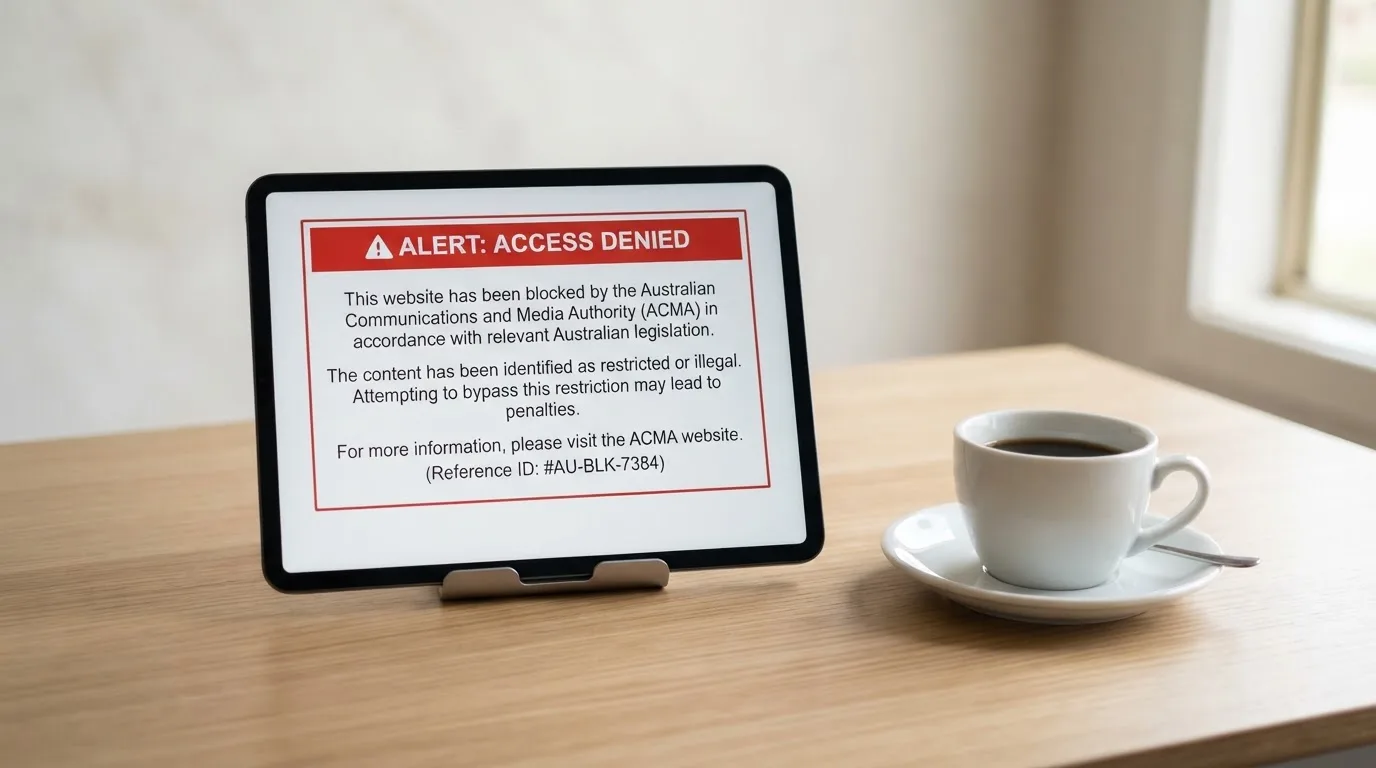
The ACMA also publishes formal warnings, which are the step before a block: a written record that the authority has formed the view a site is providing prohibited interactive gambling services to Australians. The 2025 cluster was a busy one. February 2025 brought the warning to EOD Code SRL over Instant Casino. April 2025 brought Sterplay Holding Ltd over Casino Intense. March 2025 and May 2025 together covered Dama N.V.’s Woo Casino and Spirit Casino. July 2025 added Bamboo Media over Ignition Casino and Consolutetish S.R.L. over National Casino and Bizzo Casino; Bizzo was on the register already under the TechSolutions corporate vehicles. April 2025 saw the action over Casino Intense. The first half of 2026 has continued the tempo: Pulsup Ltd over Rocketplay in March 2026, and Ryker B.V. over Jackbit and CasinOK in April 2026.
The rate is the page’s calculation: the running total of blocked sites — 1,751 by June 2026 — covers a span from the first blocking request in November 2019 to June 2026, which is roughly 79 months. The running average works out to between 22 and 23 blocked sites per month, or close to one new block every working day. That is the pace at which the ACMA has been able to push sites off Australian-visible infrastructure; it is not the pace at which new sites appear, which is faster. The same calculation can be read another way. By June 2026, 1,751 sites sat on the block list after roughly seven years of operation, and more than 230 unlicensed gambling services have left the Australian market altogether since enforcement was strengthened in 2017 — a smaller, harder-to-reverse outcome than a block, because a withdrawn service is one that no longer chases Australian deposits at all.
Two things the ACMA’s own register does not say. It does not say how many Australians played on any blocked site while it was live, and it does not say how much money was lost to it. H2 Gambling Capital’s 2025 estimate puts Australians’ annual losses to illegal gambling sites at around A$3.9 billion, and puts the share of Australian gambling going through legal channels at 64%, down from 74% in 2021. The figures are an estimate, not an audit, and the slide in the legal share is itself the consequence: a one-in-three chance that any dollar a punter puts through an Australian-facing channel goes offshore.
How Australian law treats offshore casino games
The Interactive Gambling Act 2001 is the statute, and what it does is narrow. It prohibits the supply of online casino games — slots, table games, live-dealer games — and online pokies to a person in Australia, and it prohibits in-play betting on sports. It does not prohibit the punter: the Act targets the provider, and an individual Australian who opens an account with an offshore casino is not personally at risk of prosecution under the IGA. The penalty sits on the operator, with civil penalties of up to A$247,500 per offence for Australian-licensed services and parallel criminal exposure for the people running the offshore side. The minimum age for any Australian-licensed wagering product is 18.
What is licensable in Australia is wagering on races and sport placed before the event, lotteries, and keno. In practice, online wagering is licensed by the Northern Territory Racing and Wagering Commission, which regulates 52 of Australia’s online bookmakers — Sportsbet, Bet365, Ladbrokes among them — for tax reasons, even though the customers of those bookmakers sit in other states. The NTRWC is itself a small body: it has no full-time staff and meets once a month in Darwin. The thinness of the regulator is part of why the offshore market has been able to grow — the front door is narrow, and the back door is open.
The 2026 reform layer sits on top of the 2001 Act. The Interactive Gambling Amendment (Gambling Reform) Bill 2026 passed Parliament on 19 August 2026, and its advertising and inducement measures commence on 1 January 2027. On a 2026 page, that means the law is made but not yet in force; the inducement rules apply to a 2027 calendar. Until then, the IGA’s existing prohibitions hold.
What the law leaves to the punter, by design, is the choice of whether to play offshore at all. The ACMA can block a site, and can warn the operator behind it, and can refer repeat offenders for civil penalty proceedings. It cannot recover a balance a player leaves on a blocked site. It cannot compel a payout a site refuses. It cannot slot the player into an Australian dispute resolution body. The whole reason offshore casinos look attractive in marketing — bigger bonuses, no Australian ID checks, payouts “in minutes” — is the same reason they sit outside the Australian consumer protection frame.
Where to get help if the gambling has gone too far
The Australian player-protection frame is built around licensed wagering services, not offshore casinos. BetStop, the National Self-Exclusion Register, has been live since August 2023 and binds every Australian-licensed online and phone wagering service — but it does not bind an offshore casino, because the offshore casino is not licensed to take Australian bets in the first place. Registering with BetStop excludes a person from licensed Australian wagering for a chosen period, and the licensed bookmakers must enforce it; offshore sites are not connected to the register and are not required to honour it. The National Gambling Helpline is 1800 858 858, free, open 24/7, with chat at Gambling Help Online. Counselling and self-exclusion arrangements at the state level — each state runs its own — sit underneath those national services.
The key caveat for a reader looking at any of the offshore brands on this page: signing up with BetStop will not stop the offshore casino from accepting a deposit, and an Australian bank that runs a gambling block will only block transactions routed through a recognised merchant code. The block architecture works at the licensed end, which is where most of the protection sits.
What happens when an Australian tries to pay
The payment architecture for an Australian player is set by two things that pull in opposite directions: the IGA’s ban on credit-card deposits for licensed wagering, and the offshore casino’s preference for payment methods that don’t sit inside the Australian banking perimeter.
The credit-card ban took effect on 11 June 2024, under amendments to the Interactive Gambling Act that made it an offence for an Australian-licensed wagering service to accept payment by credit card, by credit-related product, or by digital currency. Penalties for licensed operators accepting a credit card run up to A$247,500. The ban was deliberately extended to digital wallets linked to a credit card, because Apple Pay, Google Pay and Samsung Pay transactions are now around 45% of all card payments in Australia by number, and an outright card ban that left a wallet loophole would have been easy to route around. By the end of 2025, Apple Pay, Google Pay and Samsung Pay combined accounted for roughly 45% of card payments in Australia, which is why the wallet-routing question matters.
The wallet extension works in practice through the card-issuer block. Westpac’s gambling block works at the card level: it refuses authorisation of transactions registered under the merchant category code for betting and casino gambling, on eligible personal credit and debit cards. ANZ’s block, activated in the ANZ app, blocks gambling transactions made through a digital wallet such as Apple Pay on an eligible card, not just on the physical card — which closes the wallet workaround at the issuer end rather than at the wallet end. Apple itself charges no fee to consumers for using Apple Pay; any surcharge comes from the merchant’s own card-processing fees. Apple Pay’s transaction limits and PIN requirements are set by the card issuer or the merchant, not by Apple. ANZ’s block, once turned on, takes 48 hours to remove, and the bank warns that some gambling transactions might slip through and some non-gambling transactions might be blocked in error — both directions of error are possible.
The bank-transfer architecture sits on top of the New Payments Platform, which went live to the public on 13 February 2018 and is owned by New Payments Platform Australia Ltd, a non-profit whose thirteen shareholders include the Reserve Bank of Australia and the country’s major banks. Osko, the NPP’s instant transfer product, settles between participating Australian banks in under a minute, 24/7 including weekends, whether addressed to a BSB and account number or to a PayID. PayID had more than 25 million identifiers registered on the platform by April 2025, and PayID-based instant transfers are available at more than 100 Australian financial institutions. Participants in the platform are required to keep monthly outages to no more than two minutes; in 2021 the ACCC authorised the merger that created Australian Payments Plus, the operator of PayID, Osko and BPAY.
PayID’s behaviour when used at an illegal site is itself a signal. Paying to a PayID shows the name of the account holder before the transfer is sent, and Australian Payments Plus warns that being asked to transfer money to a PayID on an illegal gambling site almost certainly means a scam site. The check is the name; the warning is that the holder will not be a casino cashier account. BPAY, the older bill-payment service launched on 18 November 1997 and owned equally by the four major banks through Cardlink Services Limited, sits in the online banking of more than 140 Australian financial institutions and is offered by more than 95,000 businesses. It is a bill-payment system — payer enters a Biller Code and a Customer Reference Number — and the architecture is for paying bills, not for funding a casino cashier.
American Express is a separate question. The Reserve Bank’s July 2025 review proposes removing surcharges only on eftpos, Mastercard and Visa card transactions and explicitly leaves American Express outside the scope of the proposed ban. Amex is a three-party scheme — it issues cards and processes transactions itself, unlike the four-party Visa and Mastercard networks — and a surcharge on an Amex transaction reflects the merchant’s higher processing cost, not the network’s policy. For an Australian punter using an Amex, the surcharge is the cost of routing through a network that the IGA’s credit-card ban already excludes from licensed wagering. For an offshore casino, an Amex-funded deposit is a credit-card-funded deposit in the eyes of the law, and the licensed-wagering ban on credit is the rule that the offshore operator is operating outside of.
AUSTRAC’s threshold-transaction-report rule applies only to physical cash, and transfers of A$10,000 or more in cash trigger a report. Ordinary electronic bank transfers are not subject to that per-transaction reporting requirement, regardless of the amount. The rule is in the conversation because offshore casino deposit pages sometimes tell a player that “large” transfers attract regulatory scrutiny; they don’t.
What the offshore offers actually are
The promotional claim around Pokies Parlour and its sibling brands is consistent across the market: a sign-up package split across the first handful of deposits, free-spin bundles on selected pokies titles, and a VIP tier that scales with deposit volume. The number “A$2777 across the first seven deposits” is one of several versions of the same shape; others split the same total across three deposits or five. The structure is a deliberate one — a larger headline figure than a single-deposit match would allow, and a slower bleed of the welcome bonus across the first week of play rather than the first session.
The reason for the multi-deposit shape is mechanical, not promotional. A bonus has to be cleared before it is paid out, and the clearance rule is what an Australian player should read before claiming any of these offers. The typical clearance multiple runs at 35x to 50x the bonus amount on pokies, with table games often excluded or counted at a reduced rate. A$2,777 advertised across seven deposits is still $2,777 to clear at the multiple, and the time to clear it is the cost of accepting the offer. No bonus terms are printed on this page — the affiliate marketing pages that list them are part of what the ACMA has been blocking since 2019.
The free-spin bundles are advertised against specific pokies titles, which is the standard approach: a $0.10 spin on a fixed payline structure across a fixed number of spins, with any winnings paid as bonus money subject to the same clearance multiple. The combination of a deposit match and a free-spin bundle is what makes the headline figure look large without the cost of clearing it being obvious. The cost is the same in either case; only the framing differs.
The VIP tier is the third layer, and the one the ACMA’s formal warnings do not address. A typical VIP structure moves a player up a ladder based on deposit volume and play frequency, with cashback, higher withdrawal ceilings, and a personal account manager at the upper end. The mechanism is the one that keeps a player on the site long after the welcome bonus is cleared, and it is the one that drives the kind of repeat-deposit behaviour that an Australian consumer protection frame would treat as a marker of harm. The architecture exists offshore because it works; it is not a feature that licensed Australian wagering offers.
The games and the providers the offshore sites advertise
The pokies catalogue the offshore sites advertise is the standard supplier set for the Curaçao and Anjouan market: BGaming, Pragmatic Play, Betsoft, Playson, Endorphina and a handful of live-dealer studios, with the live-dealer side dominated by Evolution and Pragmatic Play Live. Paytables are quoted at 96% to 97% return-to-player for the top titles, with a small number of “high volatility” releases advertised at lower returns to support a larger top-end payout.
A 96% return-to-player is a long-run average over many spins, not a guarantee for any one session, and a 97% average still leaves the house with a 3% to 4% edge on every dollar wagered. The high-volatility releases sit at the lower end of the published return band, with the larger top-end payout funded by the wider spread of outcomes below it. The numbers are the marketing shape of the industry — a 96% headline and a real cost closer to A$0.04 per A$1 wagered across a session — and they are the same numbers on licensed Australian wagering products and on offshore pokies, because the maths is the maths.
What the offshore catalogue does not have is the Australian state-level game classification that licensed wagering products carry. Each Australian state runs its own pre-commitment and game-classification regime for licensed products; an offshore site operates outside it. The difference matters at the harm-prevention end, not at the math end.
How an Australian reader should read this page
The shape of the public record is this: a brand can sit on the ACMA’s formal warning register under one corporate operator, change hands, and reappear under a different operator and a different domain while keeping the same marketing. Pokies Parlour has its own formal warning and its own block; the other eleven brands in the table have theirs. The IGA’s credit-card ban and the IGA’s prohibition on the supply of online casino games are both Australian law, and both run past the offshore brand. The bank-transfer architecture will route a deposit to any account that asks for it; the card-issuer block architecture will refuse a deposit routed through a recognised gambling merchant code; the PayID holder-name check will show the destination before the transfer is sent.
A reader looking for a place to play has choices the law does not pretend to take away. A reader looking for protection from harm has BetStop, the National Gambling Helpline on 1800 858 858, and Gambling Help Online — none of which an offshore casino is connected to. A reader looking at the bonus headline should read the clearance multiple and the time-to-clear it, because the headline number is not the cost.
Frequently asked questions
Why does the site styled as Pokies Parlour appear across several different domain names?
The brand has been advertised through multiple domains over the years, and each domain tends to come and go as the ACMA’s block list catches up with it. The corporate operator behind the brand has changed at least once, which is why the ACMA’s formal warning register names Deloraze Limited and Versus Odds (BV) for Pokies Parlour rather than a single named licensee.
Is a site styled as Pokies Parlour actually licensed to accept Australian players?
No. Online casino games and online pokies cannot be licensed anywhere in Australia under the Interactive Gambling Act 2001. A licence displayed in a footer is a licence for some other jurisdiction — typically Curaçao or Anjouan — and does not authorise the site to take bets from a person physically in Australia.
What deposit bonus does a site styled this way typically advertise on its various domains?
The recurring claim is a multi-deposit sign-up package, often quoted across three to seven deposits and totalling several thousand dollars, plus a free-spin bundle on selected pokies titles. The exact figures and games vary by domain, and the only public source for them is the affiliate marketing pages that the ACMA has been blocking.
How can someone tell which of several similarly named domains is currently being advertised?
The active domain is the one being pushed through current affiliate marketing and search advertising. The ACMA’s block list is the negative signal — a domain that has been blocked is no longer reachable through Australian ISPs without a workaround — and the formal warning register is the underlying record.
What do reviews of a site like this usually say about its withdrawal process?
Reviews across the offshore market consistently report slow withdrawals, withdrawal fees, and limits on how much can be taken out in a week, with complaints concentrated on bonus-clearance disputes. The reviews are not a substitute for the consumer protection an Australian license would provide, and the offshore site has no Australian complaints body to appeal to.
Why would a brand like this run a sign-up bonus across the first several deposits rather than just the first?
Spreading the bonus across several deposits keeps the player depositing through the first week rather than the first session, which is the engagement mechanic the offer is built around. The headline figure is larger, the time to clear the bonus is longer, and the cost to the player is the same in turnover terms regardless of how the welcome package is split.