
Safe online pokies in Australia: what the marketing leaves out
Australians searching for a “safe” online pokies site land on a long list of offshore brands promising encrypted payments, audited games and instant withdrawals. None of those promises resolve the single question that matters first: online casino games, including online pokies, cannot be licensed anywhere in Australia. The Interactive Gambling Act 2001 makes it an offence to provide them to a person physically in Australia, and the regulator has spent six years quietly blocking the operators that try.
This page reads the situation for what it is. It lays out what “safe” can and can’t mean for an Australian playing offshore pokies, what the Australian Communications and Media Authority has actually done in recent rounds, and where to turn if pokies use stops feeling safe. The angle is choice: which paths exist, which reader each one suits, and which ones cost more than they look.
Current as of 29 October 2026 against the ACMA’s published register of formal warnings and blocked-site rounds.
- Player wellbeing comes first
- The ACMA action list, ranked against the offshore field
- The legal frame an Australian actually faces
- How to read an offshore site’s “safety” claims
- What an Australian-licensed wagering site actually offers
- Reading the ACMA’s blocking rate
- Operator write-ups: what each brand’s record shows
- What the spread tells a reader comparing these brands
- Where this page lands
- Frequently asked questions
Player wellbeing comes first
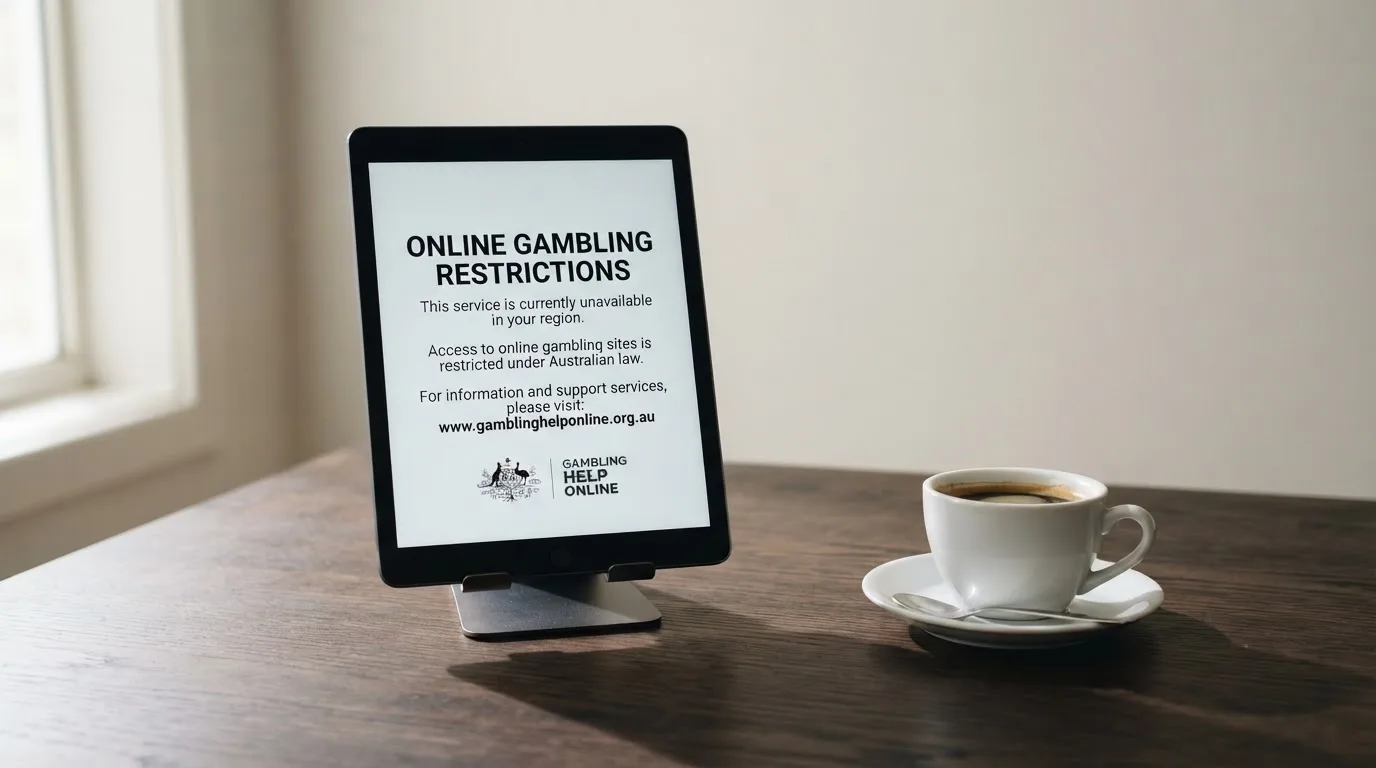
Responsible gambling is the opening shelf on this page because every other decision on it depends on a simple prior: an offshore site that says it offers “responsible gaming tools” is offering something the Australian framework does not bind it to. BetStop, the National Self-Exclusion Register, has been live since August 2023, but it covers Australian-licensed online and phone wagering services only. Offshore casinos have no obligation to check it, no obligation to honour it, and no Australian complaints body to answer to if they ignore a self-exclusion request.

For someone whose pokies use has started to feel out of control, the practical path runs through Australian services that operate independently of any casino:
- The National Gambling Helpline on 1800 858 858 — free, confidential, 24/7.
- Gambling Help Online, with web chat and self-help resources.
- State-based counselling services that handle financial counselling and family support alongside the gambling counselling line.
- BetStop registration, which excludes a person from every Australian-licensed wagering provider at once.
Each of these exists because harm from pokies is not theoretical. In 2020–21 Australians bet almost A$150 billion through gaming machines and lost A$12.18 billion on them, a figure drawn from Wikipedia’s summary of the Productivity Commission’s Gambling Inquiry data and still the reference number for harm modelling. The country has roughly 3% of the world’s pub and club poker machines against 0.3% of the global population, which is the kind of imbalance that gets written about for a reason.
This is also why the rest of the page does not recommend an offshore operator as a place to play. Whatever responsible-gaming page an offshore casino displays, no Australian regulator checks it, and an Australian player whose account is closed mid-session has no local route to argue the case.
The ACMA action list, ranked against the offshore field
Eleven offshore brands have come under formal ACMA action for offering prohibited interactive gambling services to Australians. The list below compares them purely on what the regulator has published — the operator named, the date of the action, and whether any third-party listing actually verifies the brand’s claimed subject coverage. It is not a ranking of which site is best; the legal status is the same for every row.
| Brand | ACMA action and date | Operator named by the ACMA | Subject support |
|---|---|---|---|
| RocketPlay | Formal warning, March 2026 (Pulsup Ltd); earlier Dama N.V., May 2022 | Pulsup Ltd | — |
| Level Up Casino | Formal warning, May 2022 | Dama N.V. | listings-only |
| Woo Casino | Formal warning, March 2025 | Dama N.V. | — |
| Spirit Casino | Formal warning, May 2025 | Dama N.V. | — |
| National Casino | Formal warning, July 2025 | Consolutetish S.R.L. | listings-only (en.wikipedia.org) |
| Bizzo Casino | Formal warning, July 2025; earlier warning 2022 (TechSolutions) | Consolutetish S.R.L. | — |
| Ignition Casino | Formal warning, July 2025 | Bamboo Media | — |
| Instant Casino | Formal warning, February 2025 | EOD Code SRL | — |
| Jackbit | Formal warning, April 2026 | Ryker B.V. | — |
| Casino Intense | Formal warning, April 2025 | Sterplay Holding Ltd | listings-only (acma.gov.au) |
| Sky Crown | Formal warning, September 2022 | Hollycorn N.V. | — |
The spread tells its own story. Six of the eleven operators sit under Dama N.V. or one of its successor entities, which suggests the regulator is following corporate shells rather than just domain names — a domain gets re-registered, the company behind it does not change. The “Subject support” column carries the no-data marker for most rows, because research could not find a third-party listing that confirms the operator’s claimed provider relationships beyond a single marketing page; an Australian player reading “Powered by Pragmatic Play” or “BGaming titles” on a casino’s own homepage is reading the casino’s word for it.
What the table can’t carry
The dates cluster in two waves. The 2022 cluster covers Dama N.V.’s broader portfolio and Hollycorn N.V.’s Sky Crown / Blue Leo brands, both warnings issued before the credit-card ban came into force on 11 June 2024. The 2025–2026 cluster is denser: a warning every couple of months, often over a freshly-named operator behind the same Dama shell. The June 2026 blocking round alone asked ISPs to block 12 more sites — 7Signs, ChromaBet, Donbet, Duospin, Freshbet, Slots Gem, Jacks Club, Lucky Start, Pointsbetz.com, Spinrise, Vinyl Casino and Wildsino — and the ACMA’s running total sat at 1,751 illegal gambling and affiliate marketing websites blocked since November 2019.
What the table doesn’t show is the asymmetry that the offshore marketing exploits: the regulator publishes a warning, the operator shuts down one domain and opens another, and a casual searcher two months later sees a clean-looking site with no warning in sight. The cycle is fast enough that any “safe offshore pokies” list published this week has a half-life measured in months.
The legal frame an Australian actually faces
Online casino gaming — including online pokies — is prohibited in Australia. The Interactive Gambling Act 2001, tightened by the Interactive Gambling Amendment Act 2017, makes it an offence to provide those services to a person physically in Australia. No state or territory issues a licence for them. What is licensable is wagering on races and sport placed before the event, lotteries and keno — and in practice the bulk of those licences sit with the Northern Territory Racing and Wagering Commission, which regulates 52 of Australia’s online bookmakers including Sportsbet, Bet365 and Ladbrokes. The Commission has no full-time staff and meets once a month in Darwin, a structural detail that recurs whenever an external review of Australian online gambling surfaces.
What that means for an offshore pokies site is straightforward. Whatever licence the footer of the site displays — Curaçao, Anjouan, the Malta Gaming Authority — it is not an Australian licence and confers no Australian consumer protection. A player whose withdrawal is refused, whose bonus winnings are voided on a technicality, or whose account is closed with a balance still on it has no local regulator to complain to and no local court with straightforward jurisdiction. The Interactive Gambling Amendment (Gambling Reform) Bill 2026 passed Parliament on 19 August 2026; its advertising and inducement measures commence 1 January 2027, so the law is enacted but not yet in force for this writing.
The credit-card ban that came into force on 11 June 2024 covers licensed Australian wagering services, with penalties up to A$247,500 for operators that breach it. Legal deposit routes for licensed wagering are debit card, bank transfer, PayID/Osko and BPAY. An offshore pokies site asking an Australian for a credit card or a crypto deposit is signalling, at minimum, that it is operating outside the Australian rules; the credit-card ban does not bind it directly, because it is not an Australian wagering service, but it is a useful tell about which side of the regulatory line the operator sits on.
What enforcement looks like in practice
The individual player is not the target. The IGA goes after the provider. The ACMA investigates complaints, issues formal warnings, and can direct Australian internet service providers to block illegal sites at the network level. The blocking round reported on 26 June 2026 brought the running total to 1,751 websites blocked since the first blocking request in November 2019, and H2 Gambling Capital’s 2025 report puts estimated Australian losses to illegal gambling sites at around A$3.9 billion a year. The same report estimates that the share of gambling going through legal channels fell from 74% in 2021 to 64%, a decline that tracks the same period during which offshore marketing to Australian players intensified.
The risk for an individual player is not prosecution. It is that a balance sits on a site that gets blocked, that the operator’s customer service channels go quiet, and that the only available dispute path is an arbitration service in whatever jurisdiction the operator claims to be licensed in — a process measured in months and in legal fees an Australian is unlikely to recover.
How to read an offshore site’s “safety” claims
The marketing language on offshore pokies sites converges on a small vocabulary: “licensed and regulated”, “RNG audited”, “SSL encrypted”, “responsible gaming tools”. Each of those claims means something different from what it implies in an Australian context.
A “licensed” footer usually means a Curaçao or Anjouan licence, both of which are easier to obtain than an Australian state or territory wagering licence and impose fewer ongoing obligations. The operator is licensed somewhere; it is not licensed for Australia, because no Australian licence for online pokies exists. An “RNG audited” claim refers to a third-party testing house such as iTech Labs or GLI, whose certificates are typically published as PDFs the player is unlikely to read. The audit covers the random number generator of the named games; it does not cover the operator’s solvency, its treatment of player balances, or its handling of disputed withdrawals. “SSL encrypted” is a statement about the transport layer of the website and says nothing about who controls the data on the other end.
“Responsible gaming tools” — deposit limits, time-outs, self-exclusion — are real features on most offshore sites, and they are also unenforceable from the Australian side. A self-exclusion request to an offshore casino can be honoured, ignored, or quietly reversed when the player logs back in, and the operator has no Australian reporting obligation either way.
The PayID question
PayID and Osko are real-time payment rails operated by Australian banks through the New Payments Platform. Using PayID to fund an offshore pokies account is faster than a bank transfer and carries the same chargeback exposure as any other push payment — which is to say, very little once the funds leave the sending account. PayID itself is a payments infrastructure, not a regulatory layer; it does not check whether the receiving merchant is licensed, and the receiving bank in an offshore transaction is often in a jurisdiction with looser KYC obligations than Australia.
So the practical answer to whether PayID makes a pokies site safer: it makes the deposit faster and cleaner, and it does not change the underlying legal position of the operator or the absence of Australian consumer protection. A reader comparing two offshore sites should treat PayID as a speed feature, not a safety feature.
What an Australian-licensed wagering site actually offers
The licensed side of the Australian market is narrower than the offshore side and clearer about what it is. Online wagering with an Australian licence covers racing and sport, placed before the event. The major operators — Sportsbet, Bet365, Ladbrokes, Tabcorp, bet365 — are all licensed by the Northern Territory Racing and Wagering Commission or a state equivalent, are bound by the credit-card ban, are connected to BetStop for self-exclusion, and answer to the ACMA and state regulators for advertising and inducement practices.
What licensed Australian wagering does not offer is online pokies. There is no licensed Australian online pokies site to compare an offshore one against. The closest the legal framework comes is the land-based poker machine, which is regulated state by state with separate design, return-to-player and operating rules in each jurisdiction. New South Wales had 87,298 gaming machines outside casinos across 2,195 venues as of June 2023, with player losses of A$8.18 billion in 2022-23. Queensland had 21,122 machines across 351 venues in October 2023; Victoria had 26,380 outside Crown Casino in 488 venues in 2021–22 under a 30,000-machine statewide limit.
The minimum return-to-player for poker machines varies by jurisdiction: 85% in New South Wales, the Northern Territory, Queensland and generally Victoria (87% at Crown Melbourne), 87% in the Australian Capital Territory and Tasmania, 87.5% in South Australia, and 90% in Western Australia. Western Australia banned poker machines in pubs and clubs when Crown Perth opened in 1985; Crown Perth’s own machine count has since grown from about 200 in 1985 to roughly 2,500, all approved by the state’s Gaming and Wagering Commission. Tasmania held a Federal Group monopoly on poker machines from 1968 until legislation passed in November 2021 ended it; the planned mandatory pre-commitment cards have been delayed until late 2025, an example of how harm-minimisation reform moves more slowly than the political cycle around it.
The niche-relevant games
The research underlying this page covers baccarat and blackjack in some depth because both are commonly marketed to Australian players on offshore casino sites. Baccarat’s house edge is 1.06% on the Banker bet, 1.24% on the Player bet and 14.36% on the Tie — a spread that explains why the Tie bet exists at all and why every serious baccarat strategy page warns against it. Punto banco, the variant most played today, was developed in Havana during the 1940s and is dealt from a shoe of six or eight decks; the casino banks the game and plays both hands by fixed drawing rules.
Blackjack’s house edge with optimal strategy is about 0.28% under liberal Las Vegas Strip rules (dealer stands on soft 17, double on any two cards, double after split, resplit aces, late surrender) and about 0.43% under Atlantic City rules. The game descends from the English vingt-un, with a related veintiuno described in Miguel de Cervantes’ Rinconete y Cortadillo around 1601-1602; the modern name dates to around 1899 and the Klondike Gold Rush. The numbers matter because they are the closest an offshore site comes to verifiable mathematics: a 0.28% house edge on blackjack is the same on a Curaçao-licensed site as in a Nevada casino, because the game design is what produces it. The operator’s licence changes nothing about the math.
Reading the ACMA’s blocking rate
The ACMA’s running total of 1,751 illegal gambling and affiliate marketing websites blocked since November 2019 is the most concrete number the regulator publishes. Over the roughly six-and-a-half years between the first blocking request in November 2019 and the June 2026 round, that works out to a long-run blocking rate in the low-200s per year — and the cadence has stepped up since 2024, with multiple rounds per year as the regulator catches up with domain churn.
This figure provides the context for the regulator’s impact. Read it as a band rather than a single number: somewhere in the range of 200 to 300 illegal or affiliate-marketing sites blocked per year since enforcement was strengthened in 2017, with the rate climbing as the ACMA’s blocking infrastructure matures. The condition that drives the band is enforcement intensity, which is policy-dependent and can rise or fall with the regulatory priorities of a given minister; the trend inside the band has been upward. More than 230 unlicensed gambling services have left the Australian market since 2017, an outcome that overlays on the blocking rate: some operators exit voluntarily when warned, others exit involuntarily when their domain is blocked.
For an Australian player, the practical read is that the offshore pokies landscape is a moving target. A site that looked clean in early 2026 may be on the ACMA’s blocking list by the end of the year; an operator that lost a domain in March may have a new one by May. Treating any single offshore site as a stable “safe” choice requires ongoing checking against the ACMA’s register, which is published and updated on the regulator’s own site.
Operator write-ups: what each brand’s record shows
The eleven operators below are not recommendations. Each is included because the ACMA has issued a formal warning over it for offering prohibited interactive gambling services to Australians, and the write-up closes with what that record actually means for a reader comparing them. None of them is licensed for online pokies in Australia, because none of them can be.
RocketPlay — warned twice under two operators
The ACMA issued a formal warning to Pulsup Ltd over Rocketplay.com.au in March 2026, and an earlier warning to Dama N.V. covering Rocketplay along with Bambet, Dazard, Level Up, Wild Tornado and Cobra Casinos in May 2022. Two warnings under two different operators for the same brand is the cleanest signal the regulator publishes that the operator’s structure has changed without the underlying offer to Australians changing. Rocketplay.com.au is a domain; the corporate shell behind it has shifted once already.
The site carries no third-party-verified subject support in research, so any “Powered by” claim on its homepage is the operator’s own assertion. For a reader weighing it against the rest of this list, the practical difference between RocketPlay and a brand with a single 2022 warning is that the ACMA has had to revisit it.
Level Up Casino — the original Dama N.V. cluster
Dama N.V. was the operator named in the May 2022 warning that covered six brands: Bambet, Dazard, Level Up, Rocketplay, Wild Tornado and Cobra Casinos. Level Up is one of that cluster. Research records one listings-only signal for Level Up’s subject support, drawn from Bgaming.com, which is the game provider’s own directory rather than an independent audit.
A reader looking at Level Up in 2026 is looking at a brand whose corporate structure has not been re-warned since 2022, which is a faint signal at best and says nothing about the site’s current Australian-facing operations.
Woo Casino — the 2025 Dama N.V. re-warning
Dama N.V. received another formal warning in March 2025 over Woo Casino, three years after the original six-brand cluster warning. Two warnings, same operator, four years apart. The regulator’s publication makes the implication plain: the corporate shell did not exit the Australian market after the first round, and the ACMA had to revisit it.
For a reader weighing Woo Casino, the second warning is the more relevant of the two: the regulator’s most recent action is what carries forward into any current assessment.
Spirit Casino — the May 2025 follow-up
Dama N.V. was named again in May 2025, this time over Spirit Casino. The May 2025 warning came two months after the Woo Casino warning, which suggests the regulator was working through Dama N.V.’s portfolio systematically rather than responding to a single complaint. Independent verification for Spirit Casino’s game providers could not be found.
The picture for a Spirit Casino reader is identical in shape to Woo Casino’s: one warning, recent, under a known operator name, with no Australian licence available to verify.
National Casino — Consolutetish S.R.L., July 2025
The July 2025 ACMA warning over National Casino named Consolutetish S.R.L. as the operator. The brand carries a single listings-only subject-support signal from en.wikipedia.org, which is not an operator-specific certification but a reference to the brand in passing.
National Casino’s record is one formal warning under one named operator, recent. For a reader comparing it to the rest of the list, the distinguishing feature is the operator name, which does not recur elsewhere in the table.
Bizzo Casino — the only brand warned twice as a brand
The ACMA issued a formal warning to Consolutetish S.R.L. over Bizzo Casino in July 2025, and an earlier warning to TechSolutions (CY) Group Limited and TechSolutions Group N.V. covered Bizzo Casino in 2022. Two warnings, two different operators, same brand — the same pattern RocketPlay shows, but earlier in the cycle. The brand has been in the regulator’s sights for four years across two corporate shells.
For a reader weighing Bizzo Casino, the relevant fact is not the most recent operator name but the persistence: a brand that survives a regulator warning by changing its corporate wrapper is a brand that has adapted to enforcement rather than exited the market.
Ignition Casino — Bamboo Media, July 2025
The July 2025 warning over Ignition Casino named Bamboo Media as the operator. Independent verification for Ignition Casino’s game providers could not be found. The brand is the only one in the table whose operator name (Bamboo Media) does not appear elsewhere on the ACMA’s recent action list, which is a single observation rather than a meaningful distinction.
A reader comparing Ignition Casino to the rest of the list is reading one warning, one operator, no other data points.
Instant Casino — EOD Code SRL, February 2025
The February 2025 warning over Instant Casino named EOD Code SRL as the operator. The brand carries no third-party-verified subject support in research. The February 2025 warning sits in the earlier part of the 2025 cluster, before the regulator’s July 2025 round and before the June 2026 blocking escalation.
For a reader weighing Instant Casino, the practical observation is that the brand has been on the regulator’s published list for over a year without further action visible in research — which is not a clean bill of health, only an absence of additional warnings.
Jackbit — Ryker B.V., April 2026
The April 2026 warning over Jackbit named Ryker B.V. as the operator, alongside a parallel warning over CasinOK. The April 2026 action is the most recent operator-level warning in research, and it landed in the same window as the June 2026 blocking round. The regulator’s pattern across 2025–2026 has been to issue formal warnings and follow up with blocking rounds; a brand warned in April 2026 is closer in time to a blocking request than a brand warned in 2022.
A reader weighing Jackbit is looking at the freshest operator-level warning in the table, which is the most informative single data point the ACMA publishes.
Casino Intense — Sterplay Holding Ltd, April 2025
The April 2025 warning over Casino Intense named Sterplay Holding Ltd as the operator. Casino Intense carries three listings-only subject-support signals from Abc.net.au, acma.gov.au and Crownmelbourne.com.au, none of which is an operator-specific certification; they are references to the brand in passing across news and regulator pages.
For a reader weighing Casino Intense, the absence of a third-party certification is the more useful observation than the listings, because the listings do not establish anything about the operator’s practices.
Sky Crown — Hollycorn N.V., September 2022
The September 2022 warning over Sky Crown (and Blue Leo) named Hollycorn N.V. as the operator. Sky Crown is the oldest entry in the table after the May 2022 Dama N.V. cluster, and it carries no third-party-verified subject support in research.
For a reader weighing Sky Crown, the observation is that the warning is older than every other entry except the May 2022 cluster, and there is no record of a follow-up warning against Hollycorn N.V. in research since then. That is not a clean record; it is a stale one.
What the spread tells a reader comparing these brands
A reader who treats the table as a shortlist of “less bad” offshore options will not find a clean answer. The brands cluster around three operators — Dama N.V. and its successors, Consolutetish S.R.L., and a long tail of single-brand shells — and the brands that have been warned more than once (RocketPlay, Bizzo Casino) share the trait of having survived a regulator warning by changing their corporate wrapper.
For an Australian player, the editorial position is the same across every row: no offshore pokies site is licensed in Australia, the ACMA’s enforcement tempo is climbing, and the only Australian consumer protections that actually bind an operator are the ones that don’t apply to online pokies at all. The responsible-gaming shelf at the top of this page is the shelf that survives contact with every row of the table.
Where this page lands
The framing of “safe online pokies” splits into two paths that don’t meet. One path is the licensed Australian wagering market, which is real, regulated, and excludes online pokies by design. The other is the offshore market, which offers online pokies and offers nothing else in the way of Australian consumer protection. A reader looking for online pokies has only the second path to walk, and every walk on it begins from the same legal position.
The cost of the offshore path is not the deposit. It is the absence of recourse when a withdrawal is delayed, a bonus is voided, or an account is closed. The arithmetic of the blocking rate — somewhere in the band of 200 to 300 sites blocked per year since 2017 — is the regulator’s version of the same cost, counted from the other side. Each blocked site is a balance a player may not have withdrawn in time.
The page is built so a reader can leave it with three things: an understanding that no offshore pokies site is licensed for Australians; a working list of what an offshore site’s “safety” claims actually mean and don’t mean; and a clear route to BetStop, the National Gambling Helpline on 1800 858 858, and Gambling Help Online if pokies use starts to feel unsafe. Those three are the only parts of the picture that survive contact with every brand in the table.
Frequently asked questions
Does using PayID for pokies deposits make a site safer, or just faster?
PayID and Osko are faster than a standard bank transfer because they settle in near-real-time through the New Payments Platform, but the payment rail is not a regulatory layer and does not check whether the receiving merchant is licensed. What PayID changes is the deposit experience; what it does not change is the underlying position of the operator or the absence of Australian consumer protection if a withdrawal goes wrong.
What should someone check before trusting a site’s own claim to be a “safe” pokies operator?
The licence the footer displays is the first thing to read: a Curaçao or Anjouan licence is not an Australian licence and does not bind the operator to Australian rules. The second is the ACMA’s own register of formal warnings, which lists every brand the regulator has acted against and the date of the action. The third is whether the operator is connected to BetStop, the National Self-Exclusion Register; offshore pokies sites are not, because the register only covers Australian-licensed wagering services.
Is there such a thing as a genuinely safe offshore online pokies site for an Australian player?
No. The Interactive Gambling Act 2001 makes it an offence to provide online pokies to a person in Australia, and no state or territory licenses them. An offshore site can be licensed in its own jurisdiction, but that licence confers no Australian consumer protection, no local complaints body, and no recourse if a balance is held. The regulator’s June 2026 blocking round brought the running total to 1,751 illegal gambling and affiliate marketing websites blocked since November 2019.
How does a site’s self-exclusion option relate to whether it is actually safe to use?
An offshore site’s self-exclusion feature is a setting on the operator’s own platform, with no Australian reporting obligation and no Australian enforcement behind it. BetStop, the National Self-Exclusion Register, has been live since August 2023 and covers Australian-licensed online and phone wagering services; an offshore pokies site is not connected to it. A self-exclusion request to an offshore casino is honoured at the operator’s discretion, and the Australian player has no independent route to confirm it has been applied.
What is different about assessing safety for pokies specifically versus table games or live dealer games?
Online pokies sit at the centre of the ACMA’s enforcement focus because they are the product the Interactive Gambling Act 2001 most clearly prohibits, and the harm profile of pokies is the highest of any casino game category. Table games such as blackjack and baccarat are typically offered alongside pokies on offshore sites, and the same offshore operator carries the same Australian regulatory position across its full lobby. The mathematics inside a game — blackjack’s house edge of about 0.28% with optimal strategy, baccarat’s 1.06% on the Banker bet — does not change with the operator’s licence, but the operator’s licence is what determines whether a player has any recourse at all.
Where can an Australian go for free, confidential support if online pokies use starts feeling unsafe?
The National Gambling Helpline on 1800 858 858 is free, confidential and available 24/7. Gambling Help Online provides web chat and self-help resources. State-based services handle financial counselling and family support alongside gambling counselling. BetStop, the National Self-Exclusion Register, excludes a registered person from every Australian-licensed wagering provider at once; an offshore casino is not bound by it, which is why the helpline and counselling services sit ahead of it for an offshore player.