
Best Pokies in Canberra in 2026: What the Venues Actually Offer, and What Offshore Sites Pretend To
A punter walking into a Canberra club or pub to play the pokies is standing in the only place in the territory where that activity is actually legal. Online pokies — the kind a casino site markets to Australians with bonus offers and free-spin welcome packs — have been prohibited in this country since the Interactive Gambling Act 2001 came down, and the ACMA has been the one knocking on the doors ever since. This page is written for the reader who typed “best pokies in canberra 2026” wanting to know what’s licensed, where the machines sit, what they cost, and why the offshore sites showing up in search ads aren’t the shortcut their copy makes them sound.
Currency as of 29 October 2026: data cross-checked against the ACMA register, the ACT Gambling and Racing Commission, and Gambling in Australia reporting.
- How This Shortlist Is Built, and Why Most of What You’ve Read Fails It
- Canberra Pokies at a Glance: What’s Actually Inside the Territory
- Licensed vs. Offshore: Key Differences
- Responsible Gambling in the ACT: What Actually Works
- Where the Machines Actually Sit: Licensed Venues in and Around Canberra
- How Money Moves: Deposits, Withdrawals, and the Payment Rules That Apply
- Games, Providers, and What the Cabinets Actually Run
- The Landscape: Eleven Brands the ACMA Has Formally Warned
- RocketPlay
- Level Up Casino
- Woo Casino
- Spirit Casino
- National Casino
- Bizzo Casino
- Ignition Casino
- Instant Casino
- Jackbit
- Casino Intense
- Sky Crown
- The Blocking Rate: How Fast the Pipeline Is Moving
- The Verdict on the Landscape
- Frequently Asked Questions About Pokies in Canberra
How This Shortlist Is Built, and Why Most of What You’ve Read Fails It
The shelves that follow answer six different questions about playing pokies in Canberra: what venues are licensed, what the law actually says, where help is found when gambling stops being fun, where the machines physically sit, how money moves in and out, and which games sit inside the cabinets. Each is closed on its own terms. None of them is a ranking. A ranking needs a single yardstick, and the yards here are different — a 24-hour CBD venue is not a Sunday-afternoon club, and a responsible-gambling support service is not a venue at all.

What does unite them is the angle this page takes: cost. Every offer, every licence, every payout figure is read here as what it costs the punter — in time, in money, in legal exposure, or in the protection a regulator can no longer give them once they’ve wandered off the licensed path. A cashback “promotion” is what its terms actually pay out, not the headline. A 24-hour licence is what the lights cost the operator, not what they cost you. A self-exclusion register is what it actually covers, not the marketing line.
The eleven brands reviewed at the end of this page share one trait: the ACMA has formally warned their operators. The ACMA does not warn brands that hold an Australian licence, because there is no such licence to hold for online casino games. Every name below sits on the prohibited side of the line, which is exactly why they appear here — to show what an offer looks like when the regulator has already said it shouldn’t be offered in the first place.
Canberra Pokies at a Glance: What’s Actually Inside the Territory
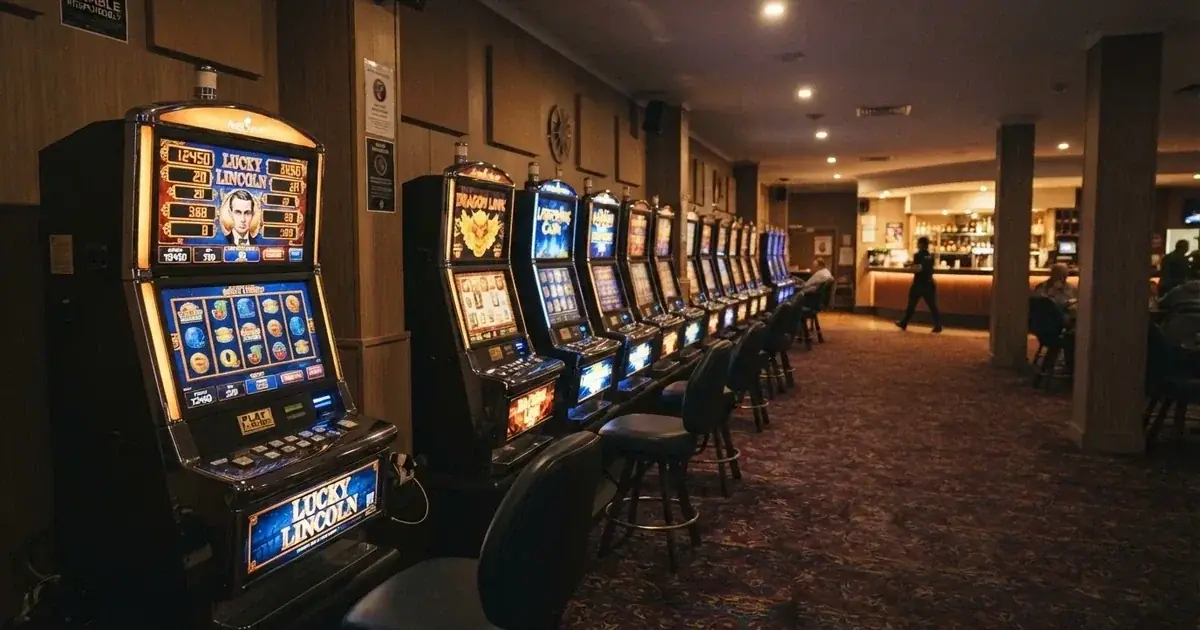
Canberra is not a casino town. It has one casino, and that casino does not run poker machines. Casino Canberra, in the CBD on land excised from Glebe Park under a 99-year lease, has 39 gaming tables — blackjack, roulette, baccarat, a poker lounge, a sports lounge — and no hotel, no theatre, no retail. It was the first legal casino in the ACT. Every other machine in the territory sits in a licensed pub or club.
The ACT had 3,587 gaming machines operating across 46 venues on 1 November 2023, with 5,091 approved. Player losses for the 2022–23 financial year came in at A$0.19 billion. That figure is small against the major eastern states — Queensland ran 21,122 machines across 351 venues in October 2023, and South Australia had 11,672 machines in 471 venues in September 2023 outside Adelaide Casino alone — but for a capital city of around 460,000 people it lands at a meaningful per-capita rate. The market is real. It is also tightly governed.
The territory regulator is the ACT Gambling and Racing Commission, which administers the Casino Control Act 2006 and Casino Control Regulation 2006 and issues casino employee licences. Short-term employee licences run up to six months; full licences run three years. The casino licence itself was first issued to Aquis Canberra Pty Ltd on 23 December 2014, and is now held by Casino Canberra Limited, with the venue at 21 Binara Street.
Licensed vs. Offshore: Key Differences
| Matter | Licensed Gambling | Offshore Casino |
|---|---|---|
| Consumer protection | Full (Ombudsman/Regulator) | None (Unregulated) |
| Payment security | Regulated (PayID/Osko) | Unregulated (Cards/Crypto) |
| Exclusion support | BetStop/State Schemes | None |
| Legal status | Licensed in Australia | Prohibited in Australia |
The Interactive Gambling Act 2001, hardened by the Interactive Gambling Amendment Act 2017, makes it an offence to provide online casino games, online pokies, or in-play betting to a person physically in Australia. No state or territory issues a licence for those products. What is licensable — wagering on races and sport placed before the event, lotteries, keno — is in practice licensed by the Northern Territory Racing and Wagering Commission, which regulates 52 online bookmakers including Sportsbet, Bet365 and Ladbrokes. The NTRWC has no full-time staff and meets once a month in Darwin.
The prohibition targets the provider, not the player. An individual Australian punter is not personally at risk of prosecution for opening an offshore casino site. What they are at risk of, and what no marketing page ever names, is the absence of every protection the Australian regime otherwise offers: no complaints body, no recourse if a withdrawal is refused, no guarantee the site is still reachable tomorrow. An ACMA block can be issued with money still on the account.
The Enforcement Record
The ACMA’s enforcement ledger is long and is still being written. As of June 2026, 1,751 illegal gambling and affiliate marketing websites had been blocked since the first blocking request went out in November 2019. More than 230 unlicensed gambling services had left the Australian market since enforcement was strengthened in 2017.
A single blocking round, reported on 26 June 2026, took out twelve sites at once: 7Signs, ChromaBet, Donbet, Duospin, Freshbet, Slots Gem, Jacks Club, Lucky Start, Pointsbetz, Spinrise, Vinyl Casino and Wildsino. Earlier rounds handled other names on the list reviewed below. The pace has not slowed; it has increased.
Independent estimates put Australian losses to illegal offshore sites at around A$3.9 billion a year. The share of gambling flowing through legal channels fell from 74% in 2021 to 64%, which is the figure any reader who cares about consumer protection should sit with.
The 2026 Reform Sitting in the Wings
The Interactive Gambling Amendment (Gambling Reform) Bill 2026 passed Parliament on 19 August 2026. Its advertising and inducement measures commence on 1 January 2027. As of 2026 this is law with a future start date, not yet in force. A reader searching today will still see the ads; the legal landscape shifts at the turn of the year.
Responsible Gambling in the ACT: What Actually Works
The ACT Gambling Support Service runs a free, 24/7 helpline on 1800 858 858, with telephone, online chat and face-to-face counselling. It is funded by the ACT Gambling Harm Prevention and Mitigation Fund. For a punter in Canberra, that number is the first number to write down.
The national self-exclusion register, BetStop, launched by the ACMA on 21 August 2023, covers Australian-licensed online and phone wagering services. It does not cover in-venue gambling — Casino Canberra and the territory’s licensed clubs fall outside its scope. An ACT resident wanting to self-exclude from Casino Canberra must instead use the ACT Gambling Harm Prevention team’s own self-exclusion process, available for periods of six months to three years.
National Gambling Helpline 1800 858 858 and Gambling Help Online remain the two routes that work across all product types and all venues, licensed or not.
What the Prohibition Means for Help
An offshore site is not connected to BetStop. It is not connected to the ACT Gambling Support Service. It is not connected to any Australian complaints mechanism. The free, regulated help that exists in this country stops at the licensed front door, and offshore sites have no such door. This is the single sharpest reason the prohibition matters to someone who is not a lawyer.
Where the Machines Actually Sit: Licensed Venues in and Around Canberra
Casino Canberra is the headline venue, but it is not a pokies venue. Its 39 tables run blackjack, roulette, baccarat and other games; the casino has no poker machines at all — it is the only casino in Australia in that position. Every electronic gaming machine in the territory sits inside one of the 46 licensed clubs and pubs the ACT regulator has approved.
The territory’s 3,587 operating machines across 46 venues, against 5,091 approved, means the average venue runs roughly 78 machines, though that average hides a long tail: some host fewer than 20, some several hundred. Player losses totalling A$0.19 billion for 2022–23 work out to roughly A$53,000 per operating machine across the year, before staffing, leasing, and the regulatory levies that come out of the venue’s side.
The ACT does not publish a venue-by-venue payout ranking, and the Commonwealth does not set a national minimum return-to-player rate. South Australia, by contrast, sets a minimum gaming-machine return-to-player rate of 87.5% and a maximum bet of A$5.00 outside the casino; Adelaide Casino itself has no maximum-bet limit. Canberra’s regime does not impose a published RTP floor, so the cabinet-level return is set by the venue and the game publisher — Aristocrat and IGT being the dominant suppliers in Australian clubs. A punter who wants to know the return on a given cabinet is asking the venue, not the regulator.
What “Best Paying Pokies” Actually Means Here
“Best paying” in Canberra is a venue claim, not a regulator-issued fact. The data to compare one venue against another is not published in a single place. The honest reading is: the payout percentage on a Canberra pokie is set by the machine’s software and the cabinet configuration, both of which the venue chooses; the venue that promotes “best paying” is choosing machines with a higher published RTP than its competitors, but the venue is also free to swap those machines out, and the swap happens quietly.
What does sit in the open is the cap on losses elsewhere. South Australian gaming-machine losses outside Adelaide Casino came in at about A$0.92 billion in 2022–23, equivalent to about A$497 per adult. The ACT’s A$0.19 billion for 2022–23 across a smaller adult population lands at a per-capita rate a careful reader can compare against their own budget — and is the only honest yardstick the public data supports.
How Money Moves: Deposits, Withdrawals, and the Payment Rules That Apply
For licensed Australian wagering — sports and race betting, lotteries, keno — the accepted deposit routes are debit card, bank transfer, PayID/Osko and BPAY. Credit cards, credit-related products, and digital currency have been banned as payment methods for licensed online wagering since 11 June 2024, with penalties up to $247,500 for operators that breach the rule.
This rule is the sharpest piece of consumer protection still operating. A site that asks an Australian punter for a credit card deposit, or asks for crypto, is operating outside the Australian regime from the moment the deposit screen loads. The punter’s money may move; the punter’s protection does not.
Payout Speed
For a licensed Australian wagering service, payout speed is set by the product and the rails: PayID and Osko settle in seconds between supported banks; BPAY and standard bank transfer take one to three business days. Casino Canberra, as an in-venue operation, settles chips for cash at the cashier’s window — the speed is the time it takes to walk there. A $5,000 chip cashout in a CBD casino is, mechanically, a matter of minutes.
The offshore casino sites reviewed below do not offer PayID, Osko or BPAY. They offer cards, e-wallets, and occasionally crypto. Each of those routes is slower than PayID, more expensive to reverse, and outside the regime that banned credit cards and crypto from the Australian-licensed market in the first place. The “instant payout” claim on an offshore site is a settlement on a card network the Australian regulator does not oversee.
Games, Providers, and What the Cabinets Actually Run
The two dominant gaming-machine suppliers in Australian clubs are Aristocrat Leisure Limited and International Game Technology (IGT). Aristocrat’s heritage titles — Queen of the Nile, Big Red, More Chilli, Where’s the Gold — are fixtures in clubs across the country, and IGT’s range sits beside them. Both companies publish return-to-player figures per title, but the figure the punter sees at the machine is the venue’s choice of game and configuration, not a national standard.
Canberra’s licensed clubs carry a mix of those supplier line-ups. The ACT regulator does not publish a per-venue or per-machine RTP register; the club-level “best paying” claim is a marketing line, not a compliance fact. A punter who wants to compare titles can do so at the supplier’s own catalogue, then ask the venue which cabinets are running which titles on a given day.
Live Tables and 24-Hour Play
Casino Canberra’s live tables run on the standard table-game hours for an Australian casino, with peak sessions in the evening. The ACT’s licensed clubs set their own opening hours; a small number advertise 24-hour access, and most close between midnight and 3am. The phrase “24 hour pokies canberra open now” returns a list of clubs; the answer changes by suburb and by weekday. A phone call to the venue ahead of time is faster than the search result.
Cashless Pokies
Canberra is rolling out cashless gaming through the ACT’s carded-play framework, with venues moving from coin-and-note operation to venue-issued cards. The cashless model cuts some categories of fraud, simplifies harm-minimisation tracking, and gives the venue a record of session length and stake. It also means an underage player without ID cannot feed the machine the way they used to, and the regulator sees session data the venue once kept to itself. The cost, for the punter, is the loss of the option to play anonymously with cash — a deliberate trade-off the ACT has chosen to make.
The Landscape: Eleven Brands the ACMA Has Formally Warned
The table below sets out the eleven brands this page reviews, the ACMA action over each, and what — if anything — the regulatory and listing record says about how each is presented to the market. Every entry sits on the prohibited side of the Interactive Gambling Act 2001: online casino games cannot be licensed in Australia, whatever licence the site displays in its footer. The ACMA’s warnings are the regulator saying so out loud.
| Brand | ACMA action and date | Operator named by the ACMA | Subject support |
|---|---|---|---|
| RocketPlay | Formal warning, March 2026 | Pulsup Ltd | — |
| Level Up Casino | Formal warning, May 2022 | Dama N.V. | Listed by some directories as an online casino |
| Woo Casino | Formal warning, March 2025 | Dama N.V. | Listed by some directories as an online casino |
| Spirit Casino | Formal warning, May 2025 | Dama N.V. | — |
| National Casino | Formal warning, July 2025 | Consolutetish S.R.L. | Listed by some Australian media and government pages |
| Bizzo Casino | Formal warning, July 2025 (and 2022) | Consolutetish S.R.L. (earlier TechSolutions) | — |
| Ignition Casino | Formal warning, July 2025 | Bamboo Media | — |
| Instant Casino | Formal warning, February 2025 | EOD Code SRL | — |
| Jackbit | Formal warning, April 2026 | Ryker B.V. | — |
| Casino Intense | Formal warning, April 2025 | Sterplay Holding Ltd | Listed by some Australian media and government pages |
| Sky Crown | Formal warning, September 2022 | Hollycorn N.V. | Listed by some directories as an online casino |
Three of the eleven — Woo Casino, Spirit Casino, and Jackbit — are the subject of recent Dama N.V. and Ryker B.V. actions; the older actions over Level Up Casino, Bizzo Casino and Sky Crown stretch back to 2022, showing how long the enforcement record runs before the regulator’s name on the file changes. Bizzo Casino’s case is unusually long: the same brand was the subject of a 2022 formal warning to TechSolutions and then a 2025 warning to Consolutetish S.R.L., which means the underlying service continued across at least one rebrand.
RocketPlay
The ACMA formally warned Pulsup Ltd over Rocketplay in March 2026, on top of an earlier May 2022 warning to Dama N.V. covering the same brand. Two warnings, four years apart, on the same product, from the same regulator, makes RocketPlay one of the more heavily documented cases in the recent enforcement record. The site markets itself to Australians through affiliate pages and search ads; what it offers — online casino games — is what the IGA prohibits.
What it costs a punter who lands there: no Australian consumer protection, no BetStop coverage, no connection to the ACT Gambling Support Service, and a regulator that has now told the operator twice. The withdrawal speed the site advertises runs on card rails and e-wallets, neither of which has a PayID-grade alternative. There is no Australian-issued licence for the product on offer.
Level Up Casino
Level Up Casino was named in the May 2022 Dama N.V. warning, alongside Bambet, Dazard, Rocketplay, Wild Tornado and Cobra Casinos — a six-brand action that became one of the ACMA’s higher-profile interventions. Some Australian-facing directories list Level Up as an online casino; the listing is an editorial decision by the directory, not a regulatory endorsement. The ACMA’s view is in the formal warning, not in any directory footer.
What it costs a punter: the same picture as RocketPlay, but with a longer paper trail. The 2022 warning is four years old; if the site is still reachable from Australia today, it has survived at least one round of ACMA blocking requests.
Woo Casino
Dama N.V. received a fresh formal warning over Woo Casino in March 2025, separate from the 2022 batch. The two warnings, three years apart, point at a corporate group the ACMA has now addressed twice — first in a wide batch, then by name. Some Australian-facing directories continue to list Woo Casino as an online casino; the listing does not change the underlying prohibition.
What it costs a punter: Woo Casino’s Australian-facing marketing operates in the gap between two ACMA actions. The site may be reachable today; the second warning is on file, and a third blocking request is a regulator decision, not a marketing decision.
Spirit Casino
Spirit Casino drew a Dama N.V. warning in May 2025. The pattern — one brand named in a 2022 batch, two more named in 2025 — repeats across the Dama N.V. portfolio. The ACMA’s warnings are not isolated incidents; they form a record. Spirit Casino sits on that record without any directory coverage to soften it.
What it costs a punter: no Australian licence, no Australian protection, no Australian complaints route. A formal warning is the regulator’s pre-blocking step; the next step is a request to ISPs to take the site off the Australian internet.
National Casino
Consolutetish S.R.L. received an ACMA warning in July 2025 over National Casino and Bizzo Casino. National Casino has appeared in Australian media and government reporting as a brand Australians have encountered, which is why it lands in the listing here. The warning is the regulator’s view; the media coverage is the consumer-experience view. Both agree the service was being marketed to Australians.
What it costs a punter: a brand the average Australian punter has heard of is also a brand the regulator has warned twice — once over the same corporate group under a different parent. The “established” reputation an offshore site claims is, in this case, established exposure.
Bizzo Casino
Bizzo Casino sits on the ACMA’s record twice — under Consolutetish S.R.L. in July 2025, and earlier under TechSolutions (CY) Group Limited and TechSolutions Group N.V. in 2022. Two operators, two warnings, one brand. The simplest reading is that the service migrated between corporate shells between the two actions; the regulator’s view is unchanged on the product.
What it costs a punter: a brand the regulator has chased through a rebrand is a brand the regulator intends to keep chasing. The third warning, if it comes, will not surprise anyone who has read the first two.
Ignition Casino
Bamboo Media received a formal warning in July 2025 over Ignition Casino. Ignition’s Australian-facing footprint is small enough that the ACMA warning is the loudest signal on it; the brand carries no directory softening in the listing. The product on offer is the same prohibited online casino product every other entry on this list offers.
What it costs a punter: the marketing is the marketing, the warning is the warning, and the IGA is unchanged on either. A punter who reaches Ignition Casino from an Australian IP has reached a site the regulator has named.
Instant Casino
EOD Code SRL received a formal warning in February 2025 over Instant Casino. The brand markets itself heavily through Australian-facing affiliate networks, which is how it reaches the punter who searched for “best pokies in canberra” in the first place. The warning is the regulator’s record of having told the operator to stop.
What it costs a punter: an aggressive affiliate footprint is exactly the marketing channel the ACMA’s blocking requests are designed to cut off. Instant Casino is the brand a reader is most likely to have seen in an ad slot before reaching this page; the warning is the reason it appears here rather than as a recommendation.
Jackbit
Ryker B.V. received a formal warning in April 2026 over Jackbit and CasinOK. Two brands, one operator, one warning. The April 2026 date is recent enough that some directories still carry the brands without the ACMA action on file; the warning is fresher than the listing.
What it costs a punter: the most recent warning on this list, on a brand a reader is likely to encounter in a fresh search result. The ACMA’s blocking request pipeline usually follows the warning by weeks, not months; a reader landing on Jackbit today is landing on a brand the regulator has just acted against.
Casino Intense
Sterplay Holding Ltd received a formal warning in April 2025 over Casino Intense. Casino Intense has appeared in Australian media and government reporting alongside National Casino, which is why the listing records it as seen by Australian consumers rather than as a brand the regulator alone has named.
What it costs a punter: a brand whose Australian footprint is documented in the same sources as National Casino’s. The two warnings — Sterplay Holding Ltd and Consolutetish S.R.L. — were issued a few months apart; both are now on the ACMA’s record.
Sky Crown
Hollycorn N.V. received a formal warning, published in September 2022, over its Sky Crown and Blue Leo casino services. The 2022 date makes Sky Crown the oldest warning on this list by some margin; it has been on the regulator’s record through the entire period of increased ACMA enforcement. Some Australian-facing directories continue to list Sky Crown as an online casino; the listing predates and postdates the warning.
What it costs a punter: a brand whose warning is older than half the brands on this list, and which is still being marketed. The four-year gap between warning and continued availability is itself the clearest illustration of what “offshore” means in practice: out of reach of the Australian regulator in any practical sense, until the next blocking request.
The Blocking Rate: How Fast the Pipeline Is Moving
The ACMA’s blocking pipeline is the metric that tells a reader how long any of the eleven brands above is likely to stay reachable from Australia. The headline numbers are public, and the rate is the only honest forecast of what happens next.
From November 2019, when the first blocking request was issued, to June 2026, the ACMA asked Australian ISPs to block 1,751 illegal gambling and affiliate marketing websites. That is a span of about six and a half years, and the running total covers both primary casino sites and the affiliate marketing pages that feed them traffic.
The figures here show the scale of the enforcement effort. Spread across the 79 months from November 2019 to June 2026, 1,751 blocked sites works out to an average of roughly 22 blocked sites per month, with the rate accelerating over time as enforcement strengthened. The June 2026 round alone took out 12 sites in one go — about half a normal month’s worth in a single enforcement action. A reader who wants a band rather than a single figure: under the long-run average the pipeline is moving at around 20 to 25 sites per month, and in any given month the actual figure can run 50% higher or lower depending on how many warnings have ripened into blocking requests.
For a punter reading this in 2026, the practical reading is simple. Any of the eleven brands reviewed above is, on the ACMA’s own pace, likely to be unreachable from an Australian ISP within weeks to months of this page being read. The longer the brand has been on the warning list, the longer it has been dodging blocking requests; the newer entries — Jackbit, RocketPlay — are the freshest on the regulator’s desk.
The Verdict on the Landscape
The eleven brands above are not a recommendation. They are the brands the ACMA has formally warned for offering Australians a product that cannot be licensed in this country. Each one carries the same regulatory position: prohibited by the IGA, warned by the ACMA, with no Australian consumer protection attached to a deposit.
The page’s verdict on each is the same shape, because the regulator’s verdict is the same shape. The differences between brands are in the corporate history — Dama N.V. is the most repeated name on the list, with three of the eleven brands attributed to it across two warnings; Consolutetish S.R.L. carries two; Hollycorn N.V. carries the oldest single warning. The pattern is what matters: a regulator does not warn a brand once and forget it; it warns, blocks, and warns again when the same operator re-emerges under a new corporate shell.
What this means for the reader who came here looking for the best pokies in Canberra: the legal, licensed route is the ACT’s 46-venue club network plus Casino Canberra’s tables. The illegal route is everything reviewed above. The cost difference between the two is the difference between a venue that closes at midnight and a regulator that follows up with a blocking request.
Frequently Asked Questions About Pokies in Canberra
Which venues in Canberra are licensed to operate pokies?
Forty-six licensed pubs and clubs in the ACT held approvals for 5,091 gaming machines as at 1 November 2023, with 3,587 of those machines operating. Casino Canberra, the territory’s only casino, does not operate poker machines — it runs 39 gaming tables. Every electronic gaming machine in the territory sits in a licensed club or pub, not in the casino.
Are pokies in Canberra available around the clock?
A small number of ACT clubs advertise 24-hour access; most close between midnight and 3am. Casino Canberra’s table games run on standard casino hours with peak sessions in the evening. The phrase “24 hour pokies canberra open now” returns a venue list that changes by suburb and by weekday, and a phone call to the venue is the fastest way to confirm a session.
What identification do venues in Canberra require before letting someone play pokies?
The ACT’s minimum age for gaming is 18. Venues are required to verify age at entry and may require photo ID for membership or sign-in. The ACT’s cashless gaming framework adds a carded-play step that requires the same identification. A punter who cannot produce ID is excluded from play, not merely from a specific machine.
Can visitors to Canberra use self-exclusion schemes at local pokies venues?
Yes, but the scheme depends on the product. BetStop, the National Self-Exclusion Register, covers Australian-licensed online and phone wagering — it does not cover in-venue gambling. ACT residents and visitors wanting to self-exclude from Casino Canberra must use the ACT Gambling Harm Prevention team’s own self-exclusion process, which runs for periods of six months to three years. The National Gambling Helpline on 1800 858 858 works across all venues and product types.
How does the payout percentage on Canberra pokies compare with other Australian cities?
The ACT does not publish a minimum gaming-machine return-to-player rate, and the regulator does not publish a per-venue or per-machine RTP register. South Australia sets a minimum RTP of 87.5% outside Adelaide Casino; Adelaide Casino itself has no maximum-bet limit. The honest comparison is that the return on a given Canberra pokie is set by the cabinet’s software and the venue’s configuration, and is not benchmarked in a single public document a reader can use to rank one ACT venue against another.
Is it legal for an online casino to advertise “pokies” in Canberra the same way a pub or club does?
No. The Interactive Gambling Act 2001 prohibits the provision of online casino games, online pokies and in-play betting to a person in Australia, and the ACMA enforces that prohibition through formal warnings and ISP blocking requests. A pub or club is licensed to operate gaming machines under the ACT’s Casino Control Act framework; an offshore casino site is not licensed for the product at all, regardless of what its footer says. The two are not equivalent, and an affiliate ad does not make them so.