
Best Pokies in Geelong 2026: Where the Machines Are, What They Pay, and What the ACMA Keeps Blocking
Anyone searching for pokies in Geelong is really asking one of two questions. Either they want to know which pub or club on the Bellarine Peninsula actually has good machines and decent opening hours, or they want to know what the difference is between a real Victorian pub pokie and an offshore website that has “Geelong” somewhere in its URL. The two questions sound similar and the answer to each runs in opposite directions. This page handles both.
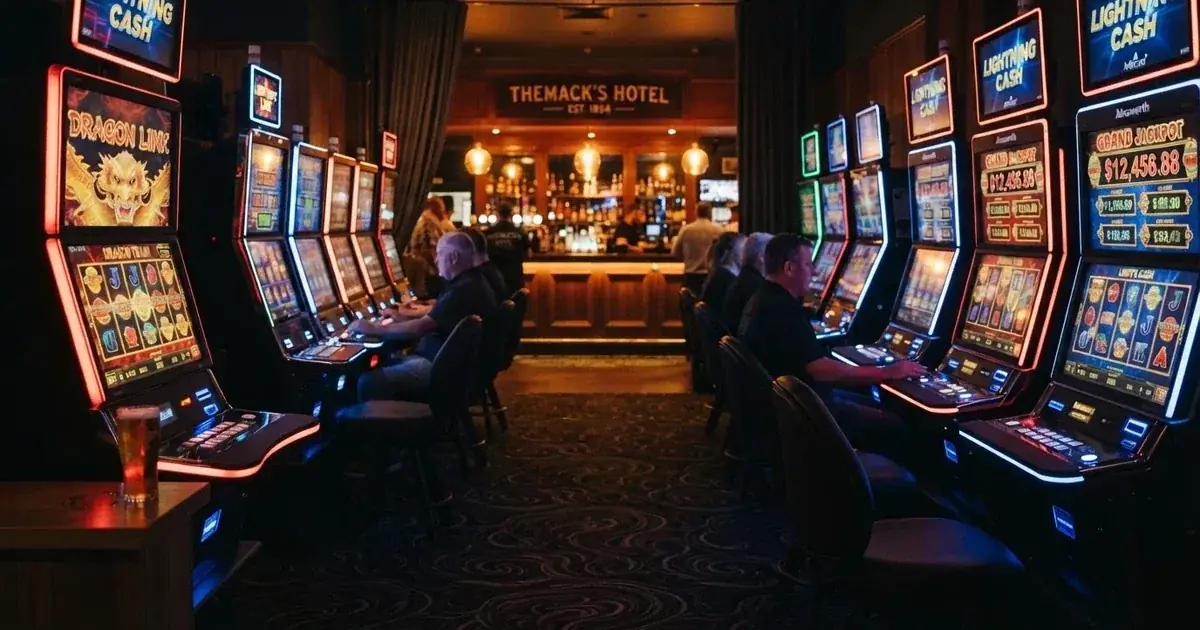
Data current as of 29 October 2026, cross-checked against the ACMA’s formal warning register and the Victorian Gambling and Casino Control Commission’s venue data.
- Where Pokies Actually Exist in Geelong
- How Pokies Got Their Reputation in Geelong
- What “Best” Actually Means for a Pub Pokies Venue
- What a Payout Percentage Looks Like in Real Money
- Trade-off: Pub vs Casino Floor
- How This Page Compares Geelong Venues
- The Land-Based Reality of Pokies in Geelong
- Legal Status of Online Pokies Aimed at Geelong
- The Real Cost of the Offshore Market
- What the ACMA Has Formally Warned
- Why the Warning Alone Is Not Enough
- How Many Sites Have Actually Been Blocked
- What the IGA Does and Does Not Cover
- The Player-Payment Angle
- What that Means for an Aussie Punter on an Offshore Site
- Harm-Minimisation Tools Available at Licensed Venues
- Where This Page Sits on Recommendation
- Comparison: Local Pub vs Offshore Site
- What the 2026 Reform Bill Changes
- How to Read the Costs in a Pokies Session
- Why Punters Compare Cities on Payout
- Closure
- Frequently Asked Questions
Where Pokies Actually Exist in Geelong
A pokie in Geelong is an electronic gaming machine that sits inside a venue that holds a Victorian gaming licence. It is physical hardware, bolted into a pub or club, governed by Victorian law, and reported on by the VGCCC. It is not a website. The distinction matters because the same word — “pokies” — is used by both, and the offshore sites rely on the confusion.

In the City of Greater Geelong and the Borough of Queenscliffe, somewhere north of $141 million was lost on those machines across the 2024–25 financial year, which works out as roughly $388,000 a day going through them. That is the most recent year on the VGCCC’s public ledger and it is a record rather than a one-off: the total climbed steadily across the previous decade as new venues came onto the register and existing venues added machines. Geelong is not a quiet market for pokies. It is one of the heavier regional markets in Victoria by money put through the machines.
Statewide, Victoria runs more EGMs than any other Australian jurisdiction outside New South Wales — 26,380 machines across 488 non-casino venues in 2021-22, returning about $3.02 billion a year in player losses at the time the most recent comparative figures were compiled. Crown Melbourne carries the rest. The relevant point for Geelong readers is that the local venue roster is large enough that the choice between pubs is meaningful, and small enough that every club on the Bellarine is within a short drive.
How Pokies Got Their Reputation in Geelong
The word itself comes from “poker machines” — the early Australian slang for video poker, which is what the first generation of EGMs essentially ran. It stuck because the machines stuck. By the time the current generation of gamers in Geelong turned eighteen, pub pokies had already been part of the social furniture of Victoria for the better part of two decades. The clubs and pubs of Geelong West, Geelong East, Corio, Norlane, Belmont, Highton and Ocean Grove carry machines that range from older stepper-style games to the latest multi-line video releases.
What the public record shows is that this furniture is being used heavily. The $141 million local figure is the bottom line of years of licensing decisions about where EGMs could be placed, how many, with what harm-minimisation settings, and under what pre-commitment conditions. None of that has slowed the dollar throughput. The settings in Victoria include mandatory carded play on every machine from late 2024 onwards — every spin in every pub must be tied to a player card before the bet is accepted — and that has produced the data set the VGCCC publishes venue by venue.
What “Best” Actually Means for a Pub Pokies Venue
The marketing word on most pub windows is “best.” It is a comparison-free superlative — it does not say best at what. So it helps to specify what a venue might be best at, because the criteria split.
Return to player is the technical starting point. The state-set floor in Victoria sits at 87.5 per cent for EGMs in pubs and clubs — meaning every dollar put in returns, on average across the machine’s lifetime, no less than 87.5 cents in prize money. That is a legislated floor, not a venue choice. Venues cannot offer higher RTPs as a perk; the games that pay 90 per cent or more are the games the manufacturer publishes, and the venue chooses which machines to host.
What a venue can do is control the mix. A pub with many low-stake, low-variance titles has a different feel from one with a handful of high-stake jackpot games. A venue near the waterfront that opens late attracts a different crowd than a suburban RSL that closes at midnight. The machines themselves are largely the same across Victoria; what changes is the venue’s hours, its atmosphere, its food, its parking, its crowd.
What a Payout Percentage Looks Like in Real Money
Eighty-seven and a half per cent is the Victoria-wide legislated floor. To put it in concrete terms, every $100 put through a Victorian pub pokie returns about $87.50 in prizes over the lifetime of the machine. The remaining $12.50 per hundred is the house edge — the venue’s cut, the state’s cut, the operator’s margin, bundled together. It is the cost of the activity, charged per dollar played.
That ratio is what makes the $141 million local figure inevitable rather than accidental. It is the edge multiplied by the throughput. Halve the throughput and the loss halves. Double the edge — even by a single percentage point — and the loss escalates sharply across a regional venue count.
What a single session looks like depends almost entirely on the machine’s variance — the technical term for whether wins are frequent and small, or rare and large. A low-variance title returns small line hits every few spins, which feels busy. A high-variance title can swallow $50 without a feature trigger, then suddenly pay several hundred. Both have the same long-run 87.5 per cent return. The path to it differs.
Trade-off: Pub vs Casino Floor
Crown Melbourne, on the south bank of the Yarra, sits about 75 minutes’ drive from Geelong and is the only casino in Victoria. Its pokie floor is regulated under different rules from a pub. Crown’s machines run on a different return-to-player range, often closer to the low-90s on the premium titles, and table limits are higher. For someone who wants to play a single $5 spin on a busy machine, the pub down the road does the job. For someone chasing a jackpot worth thousands on a single line, Crown is closer to the relevant game.
The practical difference for a Geelong punter who is not a regular at either is the round trip. Crown is closer than the average Shepparton casino that does not exist — it is the only one — and an evening there means parking, dress code on the premium floor, a tram back to Southern Cross if anyone has had too much, and a late drive home on the Princes Highway. A local pub is a five-minute walk for most readers and an Uber home if needed.
How This Page Compares Geelong Venues
Any shortlist that ranks Geelong venues has to declare what it is sorting on. The criteria that actually separate one pub from another in the same suburb are limited:
- Operating hours. Some venues close at midnight, others run to 4 a.m. or later on weekends.
- Machine mix. How many EGMs are on the floor, what games are stocked, and whether cashless or carded play is mandatory.
- Return to player range. All Victorian pub EGMs sit above the 87.5 per cent floor, but the actual published RTPs by game vary by several percentage points.
- Atmosphere and amenities. Bistro, sports coverage, family section, parking.
Venue-level data, including machine count, expenditure and location, sits in the public dataset the VGCCC publishes each quarter. Anyone comparing two pubs on the same street is comparing on the same machine mix more often than not; the meaningful comparison is the venue’s hours, its feel, and its commitment to carded-play harm controls.
The Land-Based Reality of Pokies in Geelong
The licensed pokies venues in Geelong are pubs and clubs regulated under the Victorian Gambling and Casino Control Act. The VGCCC publishes venue-level data, including machine numbers and expenditure, for every gaming venue in the state. The Greater Geelong and Queenscliffe cluster is a heavy one by regional standards.
To play a pokie in any of these venues, a person must be eighteen or older and must register with a player card or have a daily cashless limit configured under the state-mandated carded-play regime that took effect late 2024. The venue is required to verify identification for any prize over a threshold that varies by machine configuration; the player’s identity is held against the card on file with the venue.
If a person has signed up to the Victorian self-exclusion register, the venues are required to refuse entry to the gaming floor. That mechanism is run by the state and binds every licensed venue in the same jurisdiction.
Legal Status of Online Pokies Aimed at Geelong
What cannot happen — and what is happening anyway through offshore sites — is an Australian-licensed online casino offering pokies for real money. The Interactive Gambling Act 2001, tightened in 2017, makes it an offence to provide online casino games or online pokies to anyone in Australia. Sport and race betting placed before an event can be licensed; casino games and live in-play betting cannot, in any state or territory.
The relevant enforcement body is the Australian Communications and Media Authority. The ACMA investigates, issues formal warnings, and can direct Australian internet service providers to block non-compliant sites. The latest publicly reported round, dated 26 June 2026, brought the running total of blocked illegal gambling and affiliate websites to 1,751 since the first blocking request in November 2019. Twelve more went on the block in that single round: 7Signs, ChromaBet, Donbet, Duospin, Freshbet, Slots Gem, Jacks Club, Lucky Start, Pointsbetz.com, Spinrise, Vinyl Casino and Wildsino.
Offshore sites that take Australian dollars and run a “pokies” section are illegal to operate from outside Australia, which is why none of them can hold an Australian licence: none can be issued one. The minimum age of 18 for gambling in Australia is enforced across every channel.
The Real Cost of the Offshore Market
Two figures from the research make the case for treating the offshore market as something other than an alternative to the pub.
The H2 Gambling Capital 2025 estimate is that Australians lose about $3.9 billion a year to illegal offshore gambling sites. That sum leaves the country. None of it returns in tax revenue to the states, none of it funds harm-minimisation services in Victoria, none of it runs through the player-protection regime the VGCCC administers at the licensed venues. The punter’s loss is the same category of loss as the pub punter’s, but no part of the offshore stream cycles back to local services.
Equally revealing is the longer trend. The share of Australian gambling flowing through legal channels fell from 74 per cent in 2021 to 64 per cent in the H2 2025 report. Every percentage point that migrates offshore is a percentage point the licensed venues and licensed online bookmakers do not see — and a percentage point the regulator cannot touch. The 74-to-64 drop is the single clearest measure of how aggressively the offshore market has grown into the gap the Interactive Gambling Act was written to close.
What the ACMA Has Formally Warned
The ACMA’s enforcement register is the public ledger of the operators it has had cause to act against. A formal warning is the formal step before an ISP block and the cleanest evidence an offshore site has been operating against Australians without a licence. The 2025–26 entries below are the most recent, all relating to offshore casino or pokie brands:
| Brand | ACMA action and date | Operator named by the ACMA | Subject support |
|---|---|---|---|
| RocketPlay | Formal warning, March 2026 | Pulsup Ltd | — |
| Level Up Casino | Formal warning, May 2022 | Dama N.V. | Listings-only |
| Woo Casino | Formal warning, March 2025 | Dama N.V. | Listings-only |
| Spirit Casino | Formal warning, May 2025 | Dama N.V. | — |
| National Casino | Formal warning, July 2025 | Consolutetish S.R.L. | Listings-only |
| Bizzo Casino | Formal warning, July 2025 | Consolutetish S.R.L. (earlier TechSolutions, 2022) | — |
| Ignition Casino | Formal warning, July 2025 | Bamboo Media | — |
| Instant Casino | Formal warning, February 2025 | EOD Code SRL | — |
| Jackbit | Formal warning, April 2026 | Ryker B.V. | — |
| Casino Intense | Formal warning, April 2025 | Sterplay Holding Ltd | Listings-only |
| Sky Crown | Formal warning, dated register entry | Hollycorn N.V. | Listings-only |
The “subject support” column reflects whether independent listings in research registers (encyclopaedic references, regulator pages, public broadcaster items) carry these brands in any form; for some entries no such listing exists outside the ACMA’s own warning record.
Why the Warning Alone Is Not Enough
The ACMA’s enforcement chain runs: investigation, formal warning, civil penalty proceedings, then a directive to Australian ISPs to block the site at the network level. Each step takes months. The 12 brand blocks in the June 2026 round show what the final step looks like — but the warnings logged earlier in 2025 and 2026 had been on the file for a year or more before that step was reached in similar cases.
By the time a brand is on the ACMA block list, it has typically attracted Australian customers for one to two years. The licensing register the ACMA is working against — operator-issued licences from Curaçao, Anjouan or comparable jurisdictions — keeps the operator one corporate re-shuffle away from spinning up a fresh domain under a new name.
How Many Sites Have Actually Been Blocked
The ACMA’s blocking arithmetic shows how the enforcement effort is tracking.
The running total of blocked illegal gambling and affiliate websites stood at 1,751 as of the ACMA’s June 2026 round. The first blocking request was issued in November 2019. That gives roughly six and a half years of enforcement and a working average of about 270 blocked sites per year, or close to 23 a month — though the monthly rate has grown as the ACMA has streamlined its process and the ISPs have grown more cooperative. As a band, the current pace sits closer to one block per day than to the slower 2019–2021 rate.
The “blocked sites” number is not the same as “operators shut out of Australia.” Many of the warnings the ACMA logs name a parent company that runs several brands — Dama N.V., for example, is the named party for Woo Casino, Spirit Casino and the older Level Up entry, and others. Removing one site does not remove the parent. The result is that new domains for the same operator keep appearing faster than the block list can absorb them.
What the IGA Does and Does Not Cover
What the Interactive Gambling Act prohibits is straightforward. It is unlawful for an offshore or domestic operator to provide online casino games, online pokies, or in-play betting to a person who is physically in Australia. The penalty falls on the operator, not the customer.
What it permits is also clear. Wagering on sports and racing placed before the event can be licensed. Lotteries and keno can be licensed. None of these licences exist under a federal gambling regulator — the actual issuing authority is mostly the Northern Territory Racing and Wagering Commission, which regulates 52 of Australia’s online bookmakers (Sportsbet, Bet365 and Ladbrokes among them) under Northern Territory licences, administered by a commission that has no full-time staff and meets once a month in Darwin.
That quirk is the structural reason offshore casino operators find Australian winnings attractive: licensed wagering is real, but it is a slice of the gambling market, and casino games sit outside the licence menu entirely.
The Player-Payment Angle
The federal government’s response on payment methods started to bite in June 2024. From 11 June 2024, credit cards, credit-related products, and digital currency are banned as payment instruments for licensed online wagering. Penalties for operators using them run as high as $247,550. The legal routes that remain are debit card, bank transfer, PayID, Osko and BPAY.
A licence for online wagering does not give a customer bitcoin, USDT, or a credit-card option. An offshore site that accepts all three is operating outside the Australian framework, which is consistent with it also operating outside the Australian licensing regime.
What that Means for an Aussie Punter on an Offshore Site
The simplest version: there is no Australian regulator to complain to. The site’s own licence — wherever it claims one — sits with a foreign authority. A withdrawal that takes months, a bonus that wins but cannot be cashed, an account that is closed for “verification” the day a big win lands: every one of these is a dispute the player cannot take to the VGCCC, the ACMA, or any other Australian body, because the body has no jurisdiction over the operator.
There is also the exit side. If a player has registered for self-exclusion through BetStop, the National Self-Exclusion Register that went live in August 2023, BetStop binds only Australian-licensed services. An offshore casino is not connected. Self-exclusion as a harm-management decision is real; for an offshore site it is a paper exercise, and a player relying on it has not actually closed off the channel they meant to close.
Harm-Minimisation Tools Available at Licensed Venues
At a Victorian pub, the harm-minimisation regime is layered. Mandatory carded play means every spin is registered against a player. Daily, weekly, and session loss limits can be set on the card. A cooling-off period after a long session is a default behaviour the machine prompts. Self-exclusion through the Victorian register is binding across every licensed venue in the state. A punter who has self-excluded cannot enter the gaming floor of any venue; staff are required to refuse entry.
The same regime in some form operates across every other Australian state, with state-specific differences. Victoria’s carded play is among the more intrusive — it makes anonymous play essentially impossible — and it is the reason the venue-level data is so granular.
The National Gambling Helpline, 1800 858 858, is free, available 24 hours, and offers web chat. It is funded federally and reachable from anywhere in the country.
Where This Page Sits on Recommendation
This page does not recommend a venue to play at. The “best” in the title is a comparative word, not a verdict: it asks which venues meet the criteria that matter to a Geelong punter, and it leaves the personal choice to the reader.
What it does name are the offshore casino operators the ACMA has formally warned for offering prohibited services to Australians. They are listed below in the order the ACMA’s own register gives them, with the ACMA-published date and the operator named in the formal warning. They are not reviewed, recommended or scored. Each entry exists to do one job: name the brand, the action and the date.
RocketPlay
Pulsup Ltd was the operator named in the ACMA’s March 2026 formal warning over Rocketplay.com.au. The same brand had previously been the subject of an earlier ACMA action in May 2022, when Dama N.V. was named in a separate warning covering six brands including Rocketplay. The site offers the standard mix of online casino products that no Australian operator is licensed to provide. The relevant decision for the reader is that the brand has appeared on the ACMA’s action register twice in four years; what a punter does with that is their call.
Level Up Casino
Level Up was one of six Dama N.V. brands named in the ACMA’s May 2022 warning. The site operates under a Curaçao-issued licence that does not authorise providing casino games to Australians. No Australian consumer protection regime covers disputes with the operator. The brand’s only entry on the ACMA’s action register is the 2022 warning; there has not been, in the public record the research covers, a more recent ACMA action directly against the Level Up site itself.
Woo Casino
Dama N.V. was named again by the ACMA in March 2025, this time over Woo Casino. The warning post-dates the original 2022 action by nearly three years and confirms that corporate re-shuffling inside Dama N.V. has not put the brand outside the ACMA’s reach. The site’s marketing language to Australian players continues in the same register as the other brands on this list. Punter takeaway: the warning is current, the licence the site displays is not Australian, and the IGA treats every offering of casino games to Australians as prohibited.
Spirit Casino
A third Dama N.V. brand, this time named in the ACMA’s May 2025 formal warning. The same operator, the same category of product, a different brand name on the front. The pattern is the one the ACMA’s blocking-rate arithmetic makes obvious: it is faster to spin up a new domain than to clear a warning off the register.
National Casino
Consolutetish S.R.L. was the operator named in the ACMA’s July 2025 warning covering National Casino. The same formal action named Bizzo Casino under the same operator. National Casino appears in some general listings as a “casino” brand but holds no Australian licence for any gaming product. The site accepts Australian customers without any of the harm-minimisation infrastructure the Victorian pub regime requires.
Bizzo Casino
The same operator as National Casino — Consolutetish S.R.L. — was named in the ACMA’s July 2025 warning over Bizzo Casino. Bizzo had previously been the subject of a 2022 ACMA warning to a different operator (TechSolutions), so this is the second time the brand has appeared on the action register. Each appearance is a separate formal warning; the operator keeps re-entering the market under corporate restructures.
Ignition Casino
Bamboo Media was the operator named in the ACMA’s July 2025 warning. Ignition is an offshore casino brand with no Australian licence, no Australian dispute mechanism, and no connection to BetStop or the Victorian self-exclusion register. The ACMA action was the most recent documented regulator intervention at the time of writing.
Instant Casino
EOD Code SRL was named in the ACMA’s February 2025 warning over Instant Casino. The “instant” in the brand name is the marketing pivot — fast withdrawal, no waiting — but the financial reality under Australian consumer law is that no offshore site is regulated by any Australian body, so the contract a punter has with the operator sits outside the reach of the Australian Federal Court.
Jackbit
Ryker B.V. was the operator named in the ACMA’s April 2026 formal warning, covering both Jackbit and CasinOK. The April 2026 entry is the latest date on the section’s table. The site’s offering sits squarely in the prohibited category under the IGA.
Casino Intense
Sterplay Holding Ltd was named in the ACMA’s April 2025 warning over Casino Intense. The brand surfaces in independent listings the research covers. The relevant shift across the 2022–2026 register is the patience gap: the ACMA moved from warning to blocking faster on newer entries than on the 2019–2022 vintage.
Sky Crown
Hollycorn N.V. was the operator named in the ACMA’s September 2022 formal warning covering Sky Crown and Blue Leo. This is the oldest entry in the section’s table. The Hollycorn corporate group has multiple brand shells on the offshore market — Sky Crown is one of them — and the ACMA’s pattern has been to name the corporate, not just the brand.
Comparison: Local Pub vs Offshore Site
The two options do not overlap.
A local Geelong pub is a Victorian-licensed venue, regulated by the VGCCC, with mandatory carded play, a legislated minimum RTP of 87.5 per cent on EGMs, harm-minimisation tools wired into the machine itself, and self-exclusion that binds every venue in the state.
An offshore site is none of those things. It is a website registered to a foreign company, displaying a foreign licence, offering the same kind of games to anyone with a credit-card, debit-card or crypto deposit rail. It cannot be licensed in Australia; it cannot connect to BetStop; it cannot be complained about to the ACMA. The ACMA can only block it — which it does, with 1,751 cases on the register since November 2019.
For someone who lives in Geelong and prefers to play at the pub, the rationale is mostly straightforward: legal, regulated, accountable. For someone who wants the offshore offering, the rationale is exactly the inverse — convenience, range of games, different bonus structures. The Interactive Gambling Act treats the second option as a service the operator is not permitted to provide. The reader is not prosecuted; the operator is.
What the 2026 Reform Bill Changes
The Interactive Gambling Amendment (Gambling Reform) Bill 2026 passed Parliament on 19 August 2026. Its advertising and inducement provisions take effect from 1 January 2027. The bill exists, is law, but is not yet in force. What it changes for the punter is the visible advertising environment — affiliate marketing in particular is tightened, and the consumer-facing inducements the offshore sites rely on to acquire Australian customers are restricted.
The bill does not legalise online casino or online pokies. It tightens what is already prohibited. The IGA continues to make it an offence to provide those services to Australians, with a new layer of advertising controls layered on top.
How to Read the Costs in a Pokies Session
The dollar figures across this page come from the same place: the legislated 87.5 per cent RTP floor in Victoria, multiplied by the regional throughput reported in the VGCCC ledger. The $141 million lost across Greater Geelong and Queenscliffe in 2024-25 is the edge across that throughput. Halve the throughput and the loss halves; double the edge and the loss jumps disproportionately.
The ordinary session cost — what a single punt at a pub actually removes from a wallet — is small in dollars and large in frequency. Three one-dollar spins a minute across a two-hour session is about $360 turnover, with the long-run expected loss sitting around $45 by the 12.5 per cent house edge. That is the cost of an average evening at a venue that is neither exceptionally generous nor punitive. A higher-stakes session at premium titles widens the absolute figure; the percentage stays the same.
Why Punters Compare Cities on Payout
The cross-city comparison the research supports sits on three datapoints. South Australia, where the legislated EGM minimum RTP is also 87.5 per cent and the general maximum bet outside Adelaide Casino is A$5.00 — running a similar model to Victoria. Queensland, which had 21,122 EGMs across 351 venues as of October 2023 — a higher venue count but a similar RTP floor. NSW, where the venue count is the largest in the country.
For a Geelong punter, the relevant comparison is the same state, because that is where the closest licensed alternatives sit. Within Victoria, the relevant comparison is the venue — the machine mix, the hours, the amenities. The state-level RTP floor is uniform. What shifts is everything around it.
Closure
The pub pokie market in Geelong is heavy, regulated, and surveyed closely. The $141 million annual loss is the real cost of a service the licensed venues are entitled to provide under Victorian law, and the harm-minimisation tools are real, mandatory, and increasingly intrusive at the venue level. The offshore market is illegal to provide from outside Australia, blocks at the rate of about one site a day on average across the ACMA’s 2019–2026 enforcement record, and gets re-entered by the same operators under new brand names faster than the warnings expire.
A reader who wants to play pokies in Geelong can do so at the local pub — every venue in the City of Greater Geelong and the Borough of Queenscliffe holds a Victorian licence and is listed in the VGCCC dataset. A reader who wants to play at an offshore site does so outside the Australian regulatory frame, with no recourse to an Australian dispute body if the site withholds a payout. Those are the two options. The data, the law and the ACMA’s enforcement ledger all line up the same way.
Frequently Asked Questions
Which venues in Geelong are licensed to operate pokies?
Pubs and clubs across the City of Greater Geelong and the Borough of Queenscliffe hold Victorian gaming licences and run EGMs under VGCCC oversight. The Commission’s quarterly dataset lists every venue by name, with machine count and expenditure. Crown Melbourne is the only licensed casino in Victoria, about 75 minutes north of Geelong.
Are pokies in Geelong available around the clock?
Trading hours vary by venue. Many pubs close their gaming floors at midnight; others run to 4 a.m. on weekends. No Victorian venue runs 24-hour gaming by default, and the Club/Pub licence categories each carry their own trading-window rules. The only 24-hour option is Crown Melbourne.
What identification do venues in Geelong require before letting someone play pokies?
Carded play is mandatory across every Victorian pub EGM. The card ties each spin to a registered player. A prize over the threshold the machine is configured for requires matching identification, normally held on file with the venue. A punter cannot play anonymously at a licensed venue.
Can visitors to Geelong use self-exclusion schemes at local pokies venues?
The Victorian self-exclusion register binds every licensed venue in the state. BetStop, the federal National Self-Exclusion Register, covers Australian-licensed online and phone wagering. An offshore site is not part of either scheme, so a self-exclusion registered against an offshore operator is not enforceable through any Australian body.
How does the payout percentage on Geelong pokies compare with other Australian cities?
Victorian pub EGMs sit on a legislated minimum RTP of 87.5 per cent, identical to South Australia and broadly in line with other states. Per-venue differences come down to machine mix — which games the venue chooses to stock — rather than the RTP floor. Crown Melbourne’s premium titles run closer to 92 per cent on specific games, distinct from the pub-floor range.
Is it legal for an online casino to advertise ‘pokies’ in Geelong the same way a pub or club does?
No. The Interactive Gambling Act 2001 prohibits offering online casino games and online pokies to anyone in Australia, full stop. The ACMA enforces the prohibition by investigation, formal warning, and ISP blocking — 1,751 sites have been blocked since November 2019. A pub or club that runs pokies does so under a Victorian licence; an offshore site that uses the word “pokies” does not.