
Best Pokies in Melbourne 2026: The Venues, the Caps, and the Sites the ACMA Has Warned
Melbourne is a city built around the machine. The first thing any local will tell you is that “pokies” is not a brand or an app category here — it is short for poker machines, the electronic gaming terminals that sit in pubs, in clubs, and in the one licensed casino on the Yarra. The thing the search results call “best pokies in Melbourne” is, in practice, a question about which venue to walk into, not which offshore site to open. That distinction is the whole article: where to play legally in person, how the state caps the experience once you are there, and the long list of overseas brands that have tried to sell the same product to a Melbourne address and earned a formal warning from the regulator for it.
Checked as of 29 October 2026 against ACMA enforcement notices and current Victorian Gaming and Casino Control Commission venue data.
- How the 2026 Melbourne Pokies Shortlist Was Built
- Legality and the Interactive Gambling Act
- The Crown at the Centre: Crown Melbourne
- State-Level Caps and What the Numbers Mean
- Land-Based Venues in and Around Melbourne
- Responsible Gambling: What Victoria Provides
- Payments, Settlement Times, and the Practical Side of Getting Money Out
- Paytables, Mechanics, and What a Pokies Floor Actually Offers
- The 2026 ACMA Enforcement Record
- Brands the ACMA Has Formally Warned
- How to Read This Table Against What the Market Says
- What a Melbourne Pokies Session Actually Costs
- Other Australian Casino Floors Worth Noting
- Frequently Asked Questions
How the 2026 Melbourne Pokies Shortlist Was Built
Any list of “best” pokies venues in Melbourne has to start with what the state actually lets operate. The Victorian Gambling and Casino Control Commission licenses gaming machines in pubs and clubs across the state and oversees the one casino floor that is allowed to run table games alongside the machines. The shortlist that follows is built around three filters — a current Victorian licence, a gaming-floor footprint large enough to be worth the trip, and machine numbers published by the regulator — in that order. Marketing spend, signage prominence, and the “vibe” reviews bandy around are not filters, because they are not measurable from public records.

Eleven brands are named in the comparison block below, but only one of them — the brick venue on the south bank — is licensable in Victoria. The other ten are offshore operators the ACMA has formally warned over the last four years for offering online casino games to people in Australia, which the Interactive Gambling Act 2001 prohibits regardless of what licence the site displays in its footer. They are included because Melbourne players meet them in search results, on affiliate sites, and in the kind of banner ad that follows a sports stream, and because the regulator’s enforcement record is itself one of the more useful pieces of information a reader can have when a brand they have heard of asks them for a deposit. The verdict in each block is the page’s own — not a recommendation to play, only a judgement of how each one fits the legal landscape the rest of the article describes.
The Land-Based Cluster — Where the Machines Actually Live
Victoria’s pokie landscape outside Crown sits inside a hard cap. The state runs a 30,000-machine ceiling for everywhere other than the casino, and as of the 2021-22 count there were 26,380 machines distributed across 488 venues — pubs, clubs, and hotels with a gaming entitlement. That gap between the cap and the current count is not an accident of undersubscription; it is the regulator’s tool. New entitlements are released sparingly, and the ratio matters because every new pub venue with 40 machines is balanced against a club consolidation somewhere else. A reader chasing the “best” machines in a given suburb is, in practice, chasing whatever the local entitlement lottery has produced, not a curated menu.
Inside that ceiling, the comparison that actually matters is payback. Victoria publishes the return-to-player percentage by venue category, and the spread between the top of the club tier and the bottom of the hotel tier is wider than most players realise. The state also enforces a cap on session length, a requirement that every machine display a responsible-gambling message, and a barring process under which a patron can be excluded by the venue itself, by another patron’s request, or by their own sign-up to the state register. None of these protections apply at an offshore site — the register does not bind operators that do not hold a Victorian licence, the barring is at the venue’s discretion, and a session has no automatic time limit. The “where to play” question is therefore also a “what protections travel with you” question, and the answer depends entirely on which side of that line the venue sits.
The Offshore Cluster — What the ACMA Has Warned
Every brand in the ranking block below sits on the ACMA’s enforcement record. The regulator’s job is to investigate complaints, issue formal warnings, and ask internet service providers to block access to sites it finds to be offering prohibited interactive gambling services to people in Australia. A formal warning is not a prosecution — the regulator’s tool is administrative, and a brand can continue operating in jurisdictions where its product is legal — but for a Melbourne reader it means the site has been formally told its product is unlawful here, and that the next step in the sequence is a blocking request. That step has landed 1,751 times since November 2019, according to the ACMA’s June 2026 round.
The brands were picked on three criteria: a current formal warning on the ACMA register, an operator name that recurs across the warnings (because a parent company running five warned brands is a different data point than five unrelated sites), and a presence on affiliate lists that Melbourne readers are likely to encounter. The order is the regulator’s own chronological history of action against each parent operator, not any kind of editorial ranking. A brand lower down the list is not a safer one to use; it is one the ACMA acted on later.
Legality and the Interactive Gambling Act
Online casino is prohibited in Australia, and pokies are online casino games the moment they leave a licensed Victorian venue. The Interactive Gambling Act 2001, strengthened by the 2017 amendments, makes it an offence to provide online casino games, online pokies, or in-play betting to a person physically in Australia. No state or territory issues a licence for these products. The only forms of gambling that are licence-eligible for online delivery in Australia are pre-event sports and race wagering, lotteries, and keno — in practice licensed by the Northern Territory Racing and Wagering Commission, which oversees 52 online bookmakers including Sportsbet, Bet365 and Ladbrokes from a once-a-month meeting in Darwin.
The provider is the target. The IGA does not prosecute individual players, so an Australian sitting at home is not at personal legal risk for placing a deposit. What they do not get is Australian consumer protection: there is no local disputes body, no recourse if a withdrawal is refused, no BetStop coverage, and the site can be blocked at ISP level while a balance is sitting in the account. The ACMA has issued blocking requests against 1,751 illegal gambling and affiliate sites since November 2019, and the 26 June 2026 round alone added twelve more names — 7Signs, ChromaBet, Donbet, Duospin, Freshbet, Slots Gem, Jacks Club, Lucky Start, Pointsbetz, Spinrise, Vinyl Casino and Wildsino — to that running total.
Payments tell the same story from the other direction. Since 11 June 2024, credit cards, credit-related products, and digital currency have been banned as a deposit method for any licensed Australian online wagering service, with penalties up to $247,500 for operators who breach. Legal deposit routes for the licensed wagering side of the market are debit card, bank transfer, PayID/Osko and BPAY. An offshore casino that asks a Melbourne reader for a credit card or a crypto deposit is not running inside the Australian rules at all. Even the Northern Territory bookmakers, the legitimate online wagering end of the market, cannot take a credit card deposit.
The next layer sits in Parliament. The Interactive Gambling Amendment (Gambling Reform) Bill 2026 passed on 19 August 2026; its advertising and inducement measures commence on 1 January 2027. A page written in the current year is reporting a law with a future start date, not a regime in force. The 2026 enforcement landscape is the IGA plus the ACMA’s blocking record plus the credit-card ban; the 2027 regime adds the inducement rules and will be the page that gets written about that law once it takes effect.
The Crown at the Centre: Crown Melbourne
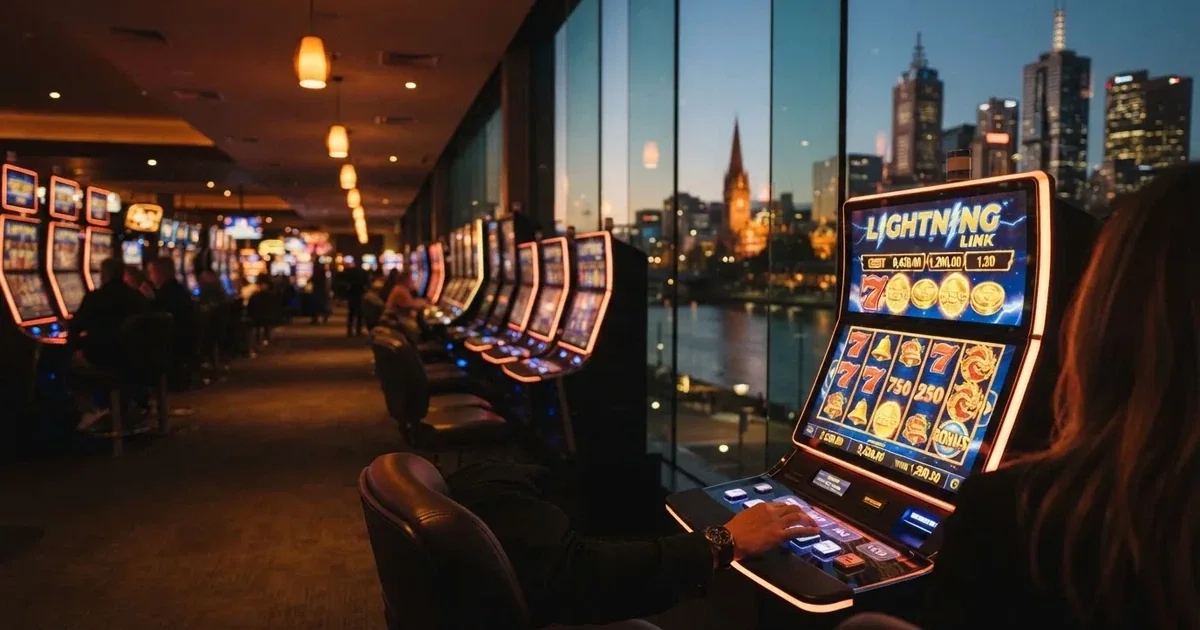
Crown Melbourne is the venue that gives the rest of the landscape its shape. The complex sits on the south bank of the Yarra River — it first opened on the north bank in 1994, then reopened in its permanent south-bank home in 1997 — and at 510,000 square metres across about two city blocks, it remains the largest casino complex in the Southern Hemisphere. Inside that envelope, the gaming floor runs to roughly 220,000 square feet (around 20,000 square metres), with 540 licensed table games — including 100 poker tables — and 2,500 poker machines, all of it wrapped in a resort of 1,604 hotel rooms across three towers. The whole operation has been under Crown Resorts since Lloyd Williams’ founding stake was taken out by Publishing and Broadcasting Limited in 1999.
The licence is not unconditional. The Finkelstein Royal Commission into the Casino Operator and Licence concluded in October 2021, finding evidence of money laundering and what the Commission described as strong ties to organised crime. Crown kept the licence, but only under a two-year review period overseen by a court-appointed Special Manager. Two fines followed. In June 2022 Victoria fined Crown A$80 million for processing A$164 million in illicit payments through the casino. In November 2022 a further A$120 million penalty landed for a decade of responsible-gambling breaches — including the kind that lets a patron play for more than 24 hours without a mandated break. The Victorian Casino and Gambling Legislation Amendment Act 2021, passed after the Royal Commission, created the Victorian Gambling and Casino Control Commission as the new regulator and banned junket operations at Victorian casinos outright.
What that means on a 2026 visit is that Crown is still the largest single concentration of machines in Melbourne and still the venue the state licences for the full casino floor, but the regulatory handling around it is the strictest in the country. The Special Manager arrangement stayed in force through the post-Royal-Commission period; the responsible-gambling controls are the ones the A$120 million penalty addressed, which means session-length enforcement, break prompts, and the barring process are all running on rules that were rewritten in response to a public finding of failure. Anyone treating Crown as “the same as before” is walking into a venue that has had its operating model rewritten in detail under court supervision.
State-Level Caps and What the Numbers Mean
The statewide pokie ceiling is the single most important number in the search for “best” pokies in Melbourne, because it determines what can be added, where, and over what timeframe. Victoria sits at 30,000 machines outside Crown Casino. As of the most recent full count in 2021-22, 26,380 were operating across 488 venues — so the system is running with around 3,600 spare entitlements in the pipeline. New entitlements trade, but the pace is constrained and the regulator reviews each application against community impact, location, and operating history.
The picture on losses is sharper. Victorians lost a record A$3.318 billion on electronic gaming machines in the 2025-26 financial year, according to the Victorian Local Governance Association. That is a state-level annual figure, not a per-venue one, and it absorbs both the pub-and-club estate and the Crown floor. Three-point-three billion dollars is the cost the 26,380 licensed machines outside Crown extracted from players across one year, on top of whatever flowed through the casino floor. The “best” venue, in the sense of the one least expensive per hour of play, is the one with the highest return-to-player percentage and the lowest house edge, and that figure is published by venue category — not by individual address. Picking the highest-RTP cluster in any given Melbourne postcode is the move that does not require walking through the door to test.
South Australia is the cross-border reference point. South Australia sets a minimum gaming-machine return-to-player rate of 87.5% and a general maximum bet of A$5.00 outside the casino, with Adelaide Casino itself having no maximum-bet limit at all. The minimum-RTP rule is one of the few statutory floors anywhere in the country — most states set a target, not a hard minimum — and it tells a reader what the lowest legal setting looks like before they sit down. In the 2022-23 financial year, South Australian gaming-machine losses outside Adelaide Casino totalled about A$0.92 billion, equivalent to roughly A$497 per adult. Per-adult loss figures are a useful way to scale the headline number; the equivalent Victorian per-adult loss is in the same order of magnitude, and the comparison is the one that puts a state number in proportion.
Brisbane is the third reference point. Treasury Casino, operated by Star Entertainment Group in the heritage Treasury Building, closed on 25 August 2024 to clear the site for the new Star Brisbane at the Queen’s Wharf precinct. The replacement opened in stages from 29 August 2024, with the main casino floor and premium gaming rooms opening first; the A$3.6 billion precinct opened under a cloud, with concerns over Star Entertainment Group’s licence position dominating the launch coverage. Queensland had 21,122 gaming machines operating in 351 venues as of October 2023 — a smaller pub-and-club estate than Victoria’s, but still close to the centre of the national picture.
Land-Based Venues in and Around Melbourne
The pub-and-club estate in Melbourne is the everyday face of the city’s pokies landscape. With 488 venues outside Crown holding licences under the state cap, no single address dominates the way Crown does in the casino category, and the differences between venues run along three axes: gaming footprint, return-to-player percentage within the state-banded range, and the quality of the responsible-gambling infrastructure visible on the floor.
Sub-area clusters matter to a reader choosing where to play in person. The “best pokies in Melbourne CBD” and the surrounding-suburb searches (pokies near Melbourne Central, pokies North Melbourne, pokies South Melbourne, pokies Port Melbourne, pokies East Melbourne, pokies Western Suburbs Melbourne) all sit within one metro licence system, but the venue mix varies. The inner-city pubs tend to run lower machine counts but stay open later; the suburban clubs run higher counts and tie gaming revenue back into the club’s facilities; the airport corridor is its own sub-market with hotels and licensed venues that pattern to traveller hours rather than local drinking patterns. None of this changes the state-level rules, but it changes what a player sees when they walk in.
The “online pokies near me” search — the one that draws readers onto the offshore sites that fill the rest of this page — is the search to be wary of. The product being advertised is not a Melbourne pokie and is not subject to the Victorian regulator. The search engine returns it because the wording matches; the legality does not, because the offering is online casino, which the IGA prohibits. Recognising this split is half of what a Melbourne reader needs to do before opening an account anywhere.
Responsible Gambling: What Victoria Provides
The Victorian support system runs on three channels. The National Gambling Helpline at 1800 858 858 is free, available 24/7, and connects to Gambling Help Online for chat-based support. The state self-exclusion register lets a player bar themselves from pubs and clubs holding a gaming entitlement. The casino self-exclusion register runs separately for Crown. These three are the legal, funded safety net a Melbourne reader has if a session becomes a problem.
BetStop, the National Self-Exclusion Register, has been live since August 2023 but it binds only Australian-licensed online and phone wagering services — the Northern Territory bookmakers and their licensed equivalents. BetStop does not bind offshore online casinos, because they are not licensed in Australia, and the IGA expressly prohibits the product they sell. The register works as designed for the licensed wagering market; readers who expect it to apply to every site they can deposit with will discover the gap on the first attempt.
A stat that illustrates the demand for these services sits in the loss number — A$3.318 billion across Victoria in 2025-26 — but the demand for help does not need a statutory record to be valid. Gambling Help Online takes calls and chats; the barring processes work; the support routes are funded. The cost a player pays when they do not use them is the cost the rest of this article has been describing.
Payments, Settlement Times, and the Practical Side of Getting Money Out
Payments at a land-based Melbourne pokie are mechanical: notes, coins (at older venues), cards at the change booth, and winnings paid in cash at the machine or at the cashier’s window depending on the venue’s policy. The questions a player has at the cashier’s window are simple ones — payout limits, identification for amounts above a threshold, and whether the venue will issue winnings by cheque. Crown’s payout process is the one with the most variation, because the casino floor processes larger sums and the floor’s own internal policies apply on top of the state rules.
The “payout percentage” comparison the search results like to lead with is also a payments question. Melbourne’s pub and club pokies are published with their return-to-player percentages at venue category level; the actual payout ratio a player experiences is a function of bet size, session length, the volatility of the games on the floor, and the rule that the venue must display the RTP on or near each machine. The maximum cash payout question is the one a player asks at the cashier’s window: each venue sets its own ceiling for cash payouts, with Crown’s ceiling running considerably higher than a pub’s, and the 2017 amendments strengthened the identification and reporting triggers around larger payouts.
For offshore sites that have tried to enter the Melbourne market, payments have been the other front of the regulator’s campaign. Since the credit-card ban took effect on 11 June 2024, even the licensed end of the Australian online wagering market cannot take a credit card deposit. An offshore site asking for one is a tell — not because it is illegal for the player to use a credit card at an offshore site (the ban is on the operator), but because the operator is signalling that it is not running inside the Australian rules at all. Crypto deposits are in the same category: a Melbourne reader who sees a Bitcoin or USDT deposit button on an offshore site is looking at a site the ACMA has, by definition, not licensed. The deposit method is the cheapest single signal a player has, and it costs nothing to read.
Paytables, Mechanics, and What a Pokies Floor Actually Offers
The mechanics question is the one the marketing around offshore sites likes to flatten into a single word — “high volatility”, “high RTP”, “jackpot pokies” — without saying what it is talking about. In a licensed Melbourne venue, every machine on the floor has its paytable published, either on the screen or on a sticker beside the cabinet, and the RTP range is fixed by the game designer within the boundaries the state regulator sets. Crown’s floor covers the full range; pub and club floors run the machines that fit their licence category.
The “Crown Melbourne pokies” search pulls in readers who specifically want to see the casino floor’s machine offering. The 2,500 machines there run across the major categories — classic three-reel, five-reel video, link jackpots, and the new generation of multi-game cabinets — and Crown’s gaming floor has both the highest concentration of any single venue in the country and the slowest turnover, because the bet size range is wider than a pub’s. The difference between a Crown session and a pub session is partly the bet ceiling and partly the fact that Crown’s link jackpots are tied across more machines inside the complex.
The cross-jurisdiction comparison comes from the same mechanics. Adelaide Casino’s 950 gaming machines alongside 90 gaming tables are the equivalent of Crown’s mid-section, plus the full South Australian table-game monopoly that runs to 30 June 2035 under a licence that allows expansion to up to 200 tables and 1,500 gaming machines, subject to redevelopment. Brisbane’s Star is at 1,300 machines inside a heritage building, and the replacement at Queen’s Wharf opens under the A$3.6 billion build cost and the same Star Entertainment licence concerns that affected Treasury’s closure. The shape of the country’s pokie landscape is concentrated at three or four city-centre casino complexes, with the long tail of pub and club machines underneath them. Melbourne is at the top of that concentration.
The 2026 ACMA Enforcement Record
The ACMA’s blocking programme is the single most useful data point a Melbourne reader has when weighing whether an offshore brand is worth opening. As of the regulator’s June 2026 round, 1,751 illegal gambling and affiliate marketing websites have been blocked since the first blocking request in November 2019, and more than 230 unlicensed services have left the Australian market since enforcement was strengthened in 2017. The rolling pace has shortened between rounds; the December 2024, March 2025, July 2025, and June 2026 rounds all ran with single-digit-to-low-double-digit new additions, and the regulator now publishes the warning register in near-real time.
The estimated cost of the illegal market to Australian players is the headline number behind those blocks. A 2025 industry report estimated that Australians lose about A$3.9 billion a year to illegal gambling sites, and that the legal share of total gambling fell from 74% in 2021 to 64%. The Victorian state-loss figure for 2025-26 sits at A$3.318 billion; the illegal-market estimate sits at A$3.9 billion nationally. The state legal market is roughly the same size as the illegal national market, which is the ratio the regulator’s 2017 strengthening was designed to shift.
Blocking Pace, 2019 to 2026
The blocking request the ACMA first made in November 2019 set the framework. The 26 June 2026 round, asking ISPs to block 12 sites (7Signs, ChromaBet, Donbet, Duospin, Freshbet, Slots Gem, Jacks Club, Lucky Start, Pointsbetz, Spinrise, Vinyl Casino and Wildsino), is the most recent addition. The arithmetic on the total works out as follows: 1,751 total blocked sites across roughly 79 months, against a registered start date of November 2019, gives a running average of around 22 blocking requests per month across the life of the programme, but the early months ran well below that figure and the most recent years have been running closer to 30 per month. The published pace matters less than the cumulative number: a brand on the ACMA’s register today was already inside the legal framework before the search result that surfaces it.
The blocking rate is the consequence of the warning rate, and the warning rate is the regulator’s first step. A brand that appears in a formal warning and continues to accept Australian deposits will, on past pattern, appear in a blocking round within twelve to twenty-four months. The order of actions — warning, then monitoring, then blocking request — is the rhythm a reader should expect from any brand that remains in the market. The formal warning is the regulator saying it has reached the same conclusion the IGA already states.
Brands the ACMA Has Formally Warned
The brands below are listed because the ACMA has issued a formal warning under the Interactive Gambling Act 2001 to the operator behind them. Each block carries the brand name, the ACMA action and date as published by the regulator, the operator named in that warning, and a verdict on how the brand sits against the legal framework the rest of the article describes.
| Brand | ACMA action and date | Operator named by the ACMA | Subject support |
|---|---|---|---|
| RocketPlay | Formal warning, March 2026 (also May 2022, Dama N.V.) | Pulsup Ltd (Dama N.V. earlier) | — |
| Level Up Casino | Formal warning, May 2022 | Dama N.V. | listings only (Wikipedia, VGCCC) |
| Woo Casino | Formal warning, March 2025 | Dama N.V. | listings only (Wikipedia) |
| Spirit Casino | Formal warning, May 2025 | Dama N.V. | — |
| National Casino | Formal warning, July 2025 | Consolutetish S.R.L. | listings only (ABC, infrastructure.gov.au) |
| Bizzo Casino | Formal warning, July 2025 (also 2022, TechSolutions) | Consolutetish S.R.L. | — |
| Ignition Casino | Formal warning, July 2025 | Bamboo Media | — |
| Instant Casino | Formal warning, February 2025 | EOD Code SRL | — |
| Jackbit | Formal warning, April 2026 | Ryker B.V. | — |
| Casino Intense | Formal warning, April 2025 | Sterplay Holding Ltd | listings only (ABC, ASGAM, CBS SA) |
| Sky Crown | Formal warning, September 2022 | Hollycorn N.V. | listings only (Wikipedia) |
RocketPlay
The operator named in the most recent warning, dated March 2026, is Pulsup Ltd, trading as Rocketplay. An earlier May 2022 warning covered RocketPlay among six brands — Bambet, Dazard, Level Up, Wild Tornado and Cobra Casinos — under Dama N.V. The pattern is the one the regulator’s record turns up most often: a parent company moves a brand from one corporate vehicle to another after a warning, the website continues under the new name, and the warning register is updated to reflect the new entity. The product — online casino games including pokies — remains unlawful for Australians under the IGA across both vehicles. Subject to its own warning, RocketPlay sits closer to the blocking step than the brands that were warned earlier, and a reader who has followed the ACMA’s enforcement rhythm will recognise the trajectory.
Level Up Casino
The May 2022 warning is the older end of the table, and Level Up was among the first cluster of brands the ACMA named when the 2017 amendments were being enforced at scale. The parent operator is Dama N.V., the same vehicle behind Woo Casino and Spirit Casino further down the list, and the consolidated parent name is the more relevant data point than any single brand. Three of the four Dama brands in this comparison were warned between 2022 and 2025, which is the kind of pattern that gets the entire operator group reviewed at blocking-round cadence. Level Up’s presence in marketing materials aimed at Australian readers, despite the warning, is the marketing footprint the regulator is trying to shrink.
Woo Casino
Woo Casino was added to the warning register in March 2025, sitting alongside Dama N.V.’s other five already-warned brands and adding a third Dama entry to the table within twelve months. The Dama cluster is the most-warned parent on this page, and Woo’s place in it is the part of the picture that matters more than any single brand. The dates line up — May 2022, March 2025, May 2025 — and the warning is the same under the same Interactive Gambling Act provision each time. Search-result prominence does not affect the regulator’s enforcement ranking.
Spirit Casino
Spirit Casino took its Dama N.V. warning in May 2025, two months after Woo’s. The same parent operator, the same product offering, the same IGA provision cited by the ACMA in each warning. The pattern on this page is consistent: where a parent operator runs multiple brands, the warnings land in waves, and the brands in the second wave tend to be at the newer end of the operator’s portfolio. A reader searching for “online pokies Melbourne” may surface any of the Dama brands without seeing the warning registry; the table above is the consolidated picture.
National Casino
The July 2025 warning was issued to Consolutetish S.R.L., a Romanian-registered entity, and the regulator’s coverage explicitly named National Casino and Bizzo Casino (the latter covered in the next block). The two-brand warning was issued at the same time, which is the strongest evidence of consolidated enforcement against a parent operator — the ACMA does not typically batch warnings without a reason. For a Melbourne reader seeing National Casino in marketing material, the warning register is current, the parent company is named, and the IGA is the cited authority.
Bizzo Casino
Bizzo Casino was named in the same July 2025 warning as National Casino under Consolutetish S.R.L., and was also covered by an earlier 2022 formal warning to TechSolutions (CY) Group Limited and TechSolutions Group N.V. Two formal warnings against an operator across separate corporate vehicles is the strongest version of the “this parent has been told twice” signal the table can carry. A reader cross-checking the regulatory record before opening an account would have to look at both warnings to see the full picture.
Ignition Casino
The July 2025 warning named Bamboo Media as the operator behind Ignition Casino, with the same IGA provision cited as in every other entry on this page. Ignition is the brand Melburnians are most likely to recognise from US-facing poker advertising in the late 2010s; the ACMA’s July 2025 action makes clear that the Australian offering falls under the same prohibition as every other offshore casino brand, regardless of the brand’s recognition in other markets.
Instant Casino
The February 2025 warning named EOD Code SRL as the operator. Instant Casino’s presence in Australian-facing affiliate marketing is the reason the regulator’s action is on the record; the brand has been one of the more persistent affiliate-advertised offshore brands in the Australian market over the last several years. The warning is the first formal action on the ACMA register for EOD Code SRL; if the regulator’s pattern holds, a blocking request will follow within the next blocking round unless the operator leaves the Australian market first.
Jackbit
The April 2026 warning named Ryker B.V., the same operator behind CasinOK on the ACMA’s register. Jackbit is one of the more recent additions to the offshore brands marketed to Australian readers, and the warning is the first step in the regulator’s escalation sequence. A brand warned in the most recent full calendar year sits at the start of the warning-to-blocking timeline, which is the part of the picture the reader needs to know to read the warning correctly.
Casino Intense
The April 2025 warning named Sterplay Holding Ltd as the operator. Casino Intense has been on the affiliate lists longer than most brands on this page, and the warning is the latest formal action against an operator that has been running at the smaller end of the offshore market for several years. The cross-jurisdiction data point from South Australia (CBS SA is one of the listings the regulator’s record draws on) makes Casino Intense one of the more widely-tracked brands across the regulator-tracked sources.
Sky Crown
The September 2022 warning named Hollycorn N.V. — the same operator behind Blue Leo Casino on the same warning publication. Hollycorn is a long-running offshore operator with multiple brands in the Australian market, and Sky Crown was one of the named targets in the same warning batch. The Hollycorn cluster is one of the more heavily-warned operator groups the ACMA has on file, and a reader checking against the regulator’s warning register will find Sky Crown and Blue Leo together.
How to Read This Table Against What the Market Says
Three points worth making before any reader turns the regulator’s warning register into a decision. First, the absence of a brand from this table is not a positive signal: there are hundreds of offshore brands the regulator has not yet warned, and many of them will receive a warning in the next round. The presence of a brand on this page is a “the regulator has formally said this product is unlawful in Australia” data point, not a directory of every brand to avoid. Second, the table’s “Subject support” column carries em dashes where the operator does not match the listed source registers; that is a “no data” signal, not a clean bill of health, and the same logic applies in reverse to the listings-only entries. Third, the ACMA’s register is updated as warnings are issued, not in real time as activity is detected; there is always a lag between a brand’s Australian marketing push and the warning that follows.
The 11 brands above also share one structural feature: their product is online casino, which Australia prohibits regardless of the licensing the site may display. The Maltese Gaming Authority, Curaçao, and other offshore licensing bodies do not change the position under the IGA, because the prohibition is on the offering to Australians, not on the offering globally. The “they are licensed somewhere” defence is a marketing claim, not a legal one for this market.
What a Melbourne Pokies Session Actually Costs
The cost question cuts both ways. On the licensed-Victorian side, the headline figure is A$3.318 billion across the state’s pub and club machine estate in 2025-26, plus the Crown floor on top. That is the gross dollar flow through the machines after wins are paid out. The per-adult figure is in the same range as South Australia’s A$497 per adult in 2022-23. Crown’s specific contribution to the 2025-26 record is not separately reported on the public record, but the venue operates 2,500 of the state’s roughly 28,880 machines, or just over 8% of the floor, and Crown’s per-session stakes run considerably higher than the pub-and-club average.
The offshore side sits in the same order of magnitude on a national basis — A$3.9 billion per year to illegal sites, per the 2025 estimate — but the per-player cost is harder to scope because the operator set is fragmented and the win/loss data is not reported to the ACMA. What is reportable is the share of Australian gambling going through legal channels, which the report puts at 64% in 2025 against 74% in 2021. The collapse in legal share is the leading indicator of the offshore market’s growth, not the regulator’s enforcement lag.
The reader’s takeaway is that the cost of a “best pokies” session, defined honestly, is what the state has already measured: the per-hour expected loss at the machine’s RTP, multiplied by the time on the device. That figure does not change because the machine sits in a club, a pub, or Crown. It does change sharply if the session moves to an offshore site, because the protections (session caps, barring, RTP floors, dispute routes) disappear and the marketing around the brand amplifies rather than dampens the experience. The cost side of the search for “best pokies in Melbourne” is the side that does not advertise itself.
Other Australian Casino Floors Worth Noting
Three other casino floors sit on the national map alongside Crown Melbourne, and a reader comparing the venues in person will end up looking at each of them at some point.
Adelaide Casino, trading as SkyCity Adelaide, sits inside the heritage-listed Adelaide railway station building on North Terrace. The complex runs 90 gaming tables and 950 gaming machines, and is the only licensed casino in South Australia under the Casino Act 1997. The property was sold to SkyCity Entertainment Group in June 2000, renamed SkyCity Adelaide in April 2001, and reverted to the Adelaide Casino name in 2009; a 2015-2021 redevelopment worth about A$330 million added the EOS by SkyCity tower with 120 hotel rooms and expanded gaming space. The licence formalisation on 11 October 2013 extends the table-game monopoly to 30 June 2035 and permits expansion to up to 200 tables and 1,500 machines, subject to redevelopment. Independent Gambling Authority and Liquor and Gambling Commissioner are the regulators; the casino paid more than A$41 million in taxes and charges in the 2007-08 financial year. South Australia sets a minimum gaming-machine return-to-player rate of 87.5% for the pub and club estate and a general maximum bet of A$5.00 outside the casino; the casino itself has no maximum-bet limit.
Treasury Casino and its replacement form the third comparison. Treasury Casino closed on 25 August 2024 to clear the site for the new Star Brisbane at the Queen’s Wharf precinct; the new venue began a staged opening on 29 August 2024 from the A$3.6 billion build. Treasury had operated since April 1995 in Brisbane’s heritage Treasury Building, running 80 gaming tables and over 1,300 gaming machines across three levels, plus a hotel, six restaurants, five bars and a nightclub. Queensland had 21,122 gaming machines operating in 351 venues as of October 2023. The Star Brisbane launch was overshadowed by concerns over Star Entertainment Group’s licence position, which remains the open question around the new venue.
The three casino cities — Melbourne, Adelaide, Brisbane — form a single comparison set for the “best pokie venue in Melbourne CBD or further afield” question. Crown has the largest floor, the most machines, and the strictest post-Royal-Commission regulatory overlay. Adelaide has the smaller floor, the statutory RTP floor, and a licence that runs to 2035. Brisbane has the newest complex and the most uncertain operator status. Pick the one whose regulatory exposure matches what the reader wants from the visit.
Frequently Asked Questions
Which venues in Melbourne are licensed to operate pokies?
The single licensed casino floor is Crown Melbourne on the south bank of the Yarra. Outside Crown, 488 pubs, clubs and hotels hold entitlements under Victoria’s 30,000-machine cap, with 26,380 machines operating as of the 2021-22 count. There is no other lawful venue type for in-person pokies play in Melbourne, and the list of those 488 venues is maintained by the Victorian Gambling and Casino Control Commission.
Are pokies in Melbourne available around the clock?
Pub and club opening hours vary by venue and licence, but the typical pattern has poker machine areas running during pub trading hours with a hard close at the venue’s last-drink time. Crown Melbourne operates its gaming floor on a 24-hour schedule, the only venue in the metropolitan area with a continuous licence. State-mandated session-break requirements apply at Crown and at venues that have voluntarily adopted the same framework.
What identification do venues in Melbourne require before letting someone play pokies?
Pokies play is open to anyone 18 or older, and venues may require photo identification for entry to a gaming area or for any payout above the venue’s threshold. Crown applies a federal anti-money-laundering identification process because it is a casino licensed under the Casino Control Act; pubs and clubs apply entry policies that range from no check at all to a full photo-ID requirement. Identification at the cashier’s window is required for any payout above the venue’s reporting threshold, which is set by state rule.
Can visitors to Melbourne use self-exclusion schemes at local pokies venues?
The Victorian state self-exclusion register covers pubs and clubs with gaming entitlements, and a person barred in their home state is recognised across the state register. Crown operates its own casino self-exclusion register, which is separate from the pub-and-club scheme. BetStop, the National Self-Exclusion Register, binds Australian-licensed online and phone wagering services — not the Melbourne pokie floor and not offshore online casinos. The barring applies in person; the offshore products are not covered.
How does the payout percentage on Melbourne pokies compare with other Australian cities?
Victoria publishes return-to-player figures by venue category rather than by individual address. South Australia sets a 87.5% minimum RTP, with the casino floor at Adelaide Casino having no maximum-bet limit. The cross-state comparison is harder than the cross-state price comparison because the published RTP bands differ — Victoria’s venue-category bands and South Australia’s statutory minimum are not the same metric. A reader comparing venues across cities should read the published band for each city’s specific venue category rather than relying on a national average.
Is it legal for an online casino to advertise ‘pokies’ in Melbourne the same way a pub or club does?
No. Online casino is prohibited under the Interactive Gambling Act 2001, and the ACMA has issued formal warnings against offshore operators using pokies-themed marketing aimed at Australian readers. The 26 June 2026 round asked Australian ISPs to block twelve more sites, bringing the cumulative blocking total to 1,751 since November 2019. From 1 January 2027 the Interactive Gambling Amendment (Gambling Reform) Act 2026 will add advertising and inducement rules, but in the current year the prohibition is enforced through formal warnings and blocking requests rather than advertising-specific restrictions.